
Choose a 2 way garment rack Hong Kong when two arms provide enough assortment and clearer access is the priority. Compare a 4 way garment rack Hong Kong where more facings justify the larger visual and circulation footprint.
How a 2 way garment rack Hong Kong uses floor space
Space efficiency starts with the base. A 2 way garment rack Hong Kong typically uses a compact footprint and presents two clear facings without creating a solid visual block. In tight boutiques or pop‑ups, you can rotate the arms to face the circulation path or a wall bay, keeping sightlines open to the till and fitting rooms. Compared with bulkier multi‑arm formats, a two‑arm unit is easier to “park” between fixtures and to reposition during a changeover without disturbing adjacent rails.
Measure the trading area before you shortlist models: note doorway and goods‑lift clearances, column projections and any floor slopes. As an example starting point, test a taped rectangle on the floor that matches the proposed base to confirm access, then validate with the venue or building manager. Ask suppliers to state base dimensions including wheel overhang, overall height range, and turning circle on casters. Request whether arms lock at set angles or are fully adjustable. If you plan to integrate with a wall‑bay or a retail garment rack Hong Kong already on site, confirm arm height increments so hangers and signage align across fixtures. Your written quotation should state exactly which arms, stops, casters and finishes are included; the model specification and formal quotation prevail.
Compare arm reach and facing count on a 2 way garment rack Hong Kong
Arm length and presentation style determine how many items you can face on a two‑arm unit. Straight face‑out arms show hero pieces, while waterfall arms create a graded run that can guide the eye by size or colour. As an example starting point to test in store, a 400–450 mm straight arm may display 6–10 light tops, whereas the same arm might hold fewer structured jackets; always confirm with the supplier and your own garment set. Waterfall arms commonly include notches; count and spacing should be declared.
For procurement, request precise fields: usable arm length (excluding end stop), stop‑end type, notch count and pitch for waterfalls, permissible arm angle range, and the maximum safe load per arm stated by the manufacturer. Ask for a dimensioned drawing showing the arm’s reach from the post centreline so you can plan aisle clearance. If you primarily need linear hanging rather than face‑outs, a retail clothes rail Hong Kong may be the more efficient option; otherwise, match the arm style to your visual plan. When comparing quotations, insist all bidders quote the same arm type and length so capacity comparisons are like‑for‑like.
What should buyers compare for 2 way garment rack Hong Kong?
| Criterion | Straightforward requirement | More complex requirement | Evidence to provide |
|---|---|---|---|
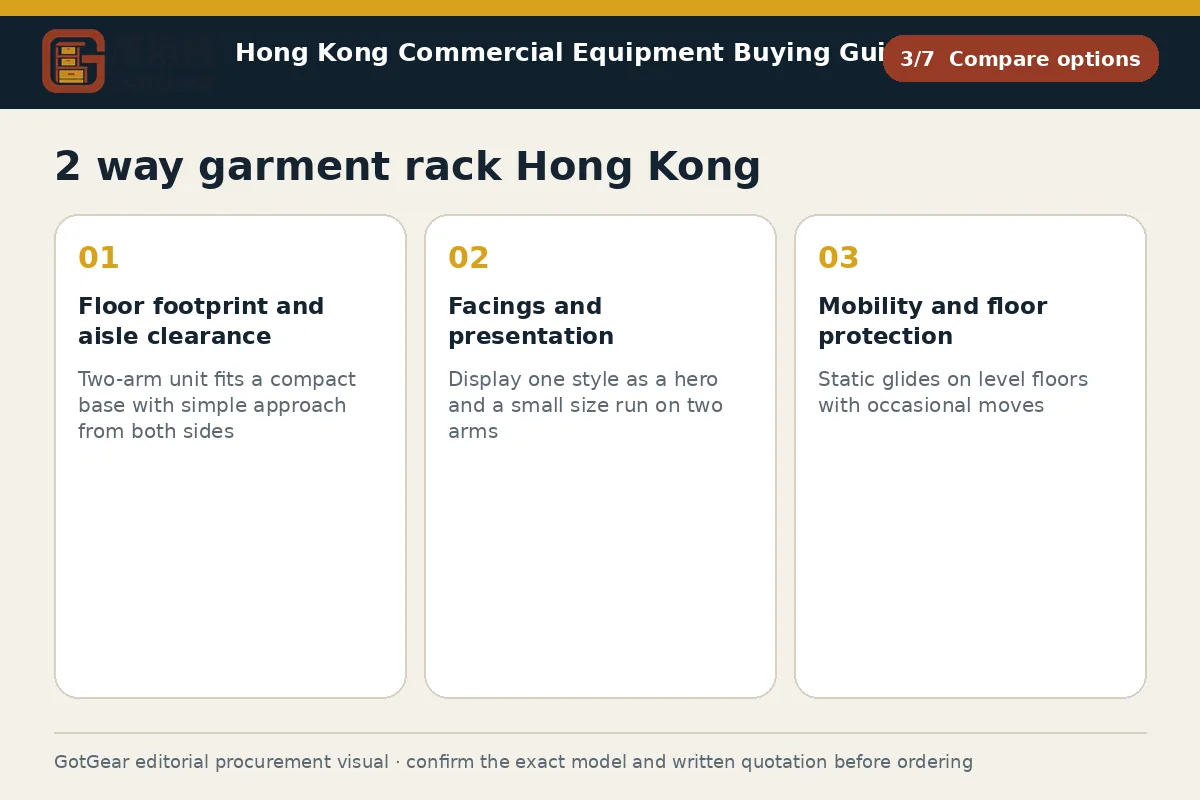
| Floor footprint and aisle clearance | Two‑arm unit fits a compact base with simple approach from both sides | Clustered four‑arm units placed mid‑floor without blocking key sightlines | Scaled plan showing base size, clearances and any venue spacing guidance |
| Facings and presentation | Display one style as a hero and a small size run on two arms | Show multiple colours/sizes or cross‑merch combinations on four arms | Garment list with hanger widths, item thickness and target facings per style |
| Mobility and floor protection | Static glides on level floors with occasional moves | Braked, non‑marking casters for frequent repositioning across thresholds | Floor type, route notes, lift dimensions and requested wheel diameter/tread |
| Arm configuration and adjustability | Two equal straight arms at matching heights | Mix of straight/waterfall arms with independent height/angle locks | Datasheet stating usable length, notch count, height range and lock method |
| Finish and environment | Standard chrome or powder coat in air‑conditioned sales floors | Corrosion‑resistant finish for humid back‑of‑house or sea‑breeze exposure | Material/finish specification and care guidance from the manufacturer |
This framework helps buyers create comparable written enquiries. Final model specifications, availability, delivery and commercial terms must be confirmed in a formal quotation.
Choose a 2 way garment rack Hong Kong for simpler browsing
Shoppers navigate faster when fixtures are legible at a glance. Two‑arm racks reduce visual noise and invite approach from either side, which helps with capsule drops, size‑limited lines and curated offers at store entrances. Align arm heights to neighbouring bays so the eye travels smoothly, and use slim stem signage rather than large toppers to preserve sightlines in smaller Hong Kong shops. For assisted sales, position one arm for the hero sample and the other for immediate size pickup.
To keep changeovers nimble, decide early between glides and casters. If staff will move displays daily, consider pairing two‑arm fixtures with a rolling garment rack Hong Kong for back‑of‑house staging, and specify brakes on at least two wheels for the sales‑floor unit. If storage space is constrained, evaluate whether a folding garment rack Hong Kong in the stockroom covers overflow while the two‑arm remains on the floor. Request bilingual assembly and care information, and confirm finish compatibility with your housekeeping routine. For umbrella planning across bays and mid‑floor, see how this choice sits alongside any retail garment rack Hong Kong already approved by your management office. Document the delivery path, lift size and any loading‑bay booking so the supplier can propose packaging and assembly steps that suit your building.
When a 4 way garment rack Hong Kong outperforms a 2 way garment rack Hong Kong
A four‑arm unit comes into its own when you need more facings within a single footprint, for example to present colourways or size breaks of one style, or to cross‑merchandise tops with coordinating bottoms. The extra arms build a denser, more impactful presentation that holds attention from multiple angles and can anchor a central zone. With independent height adjustment, you can stagger levels to create a stepped sightline while keeping the base area stable.
When assessing a 4 way garment rack Hong Kong against a two‑arm, ask for base weight, post gauge, and arm locking method so you can judge stability under asymmetric loads. Specify whether you require mixed arm types (two straight, two waterfall) and if stops or notches are included. For frequent moves on polished mall floors, request soft, non‑marking braked casters and ask suppliers to declare wheel diameter and tread material. Map spacing between units so aisle pinch points are avoided; as an example starting point to test in your layout, trial a wider gap between four‑arm fixtures than two‑arm, then confirm with the venue. Coordinate with the management office on any mid‑mall placement rules and loading‑bay windows, and ask for the manufacturer’s datasheet to file with your internal approvals. Formal quotations and the supplier’s written specifications take precedence.
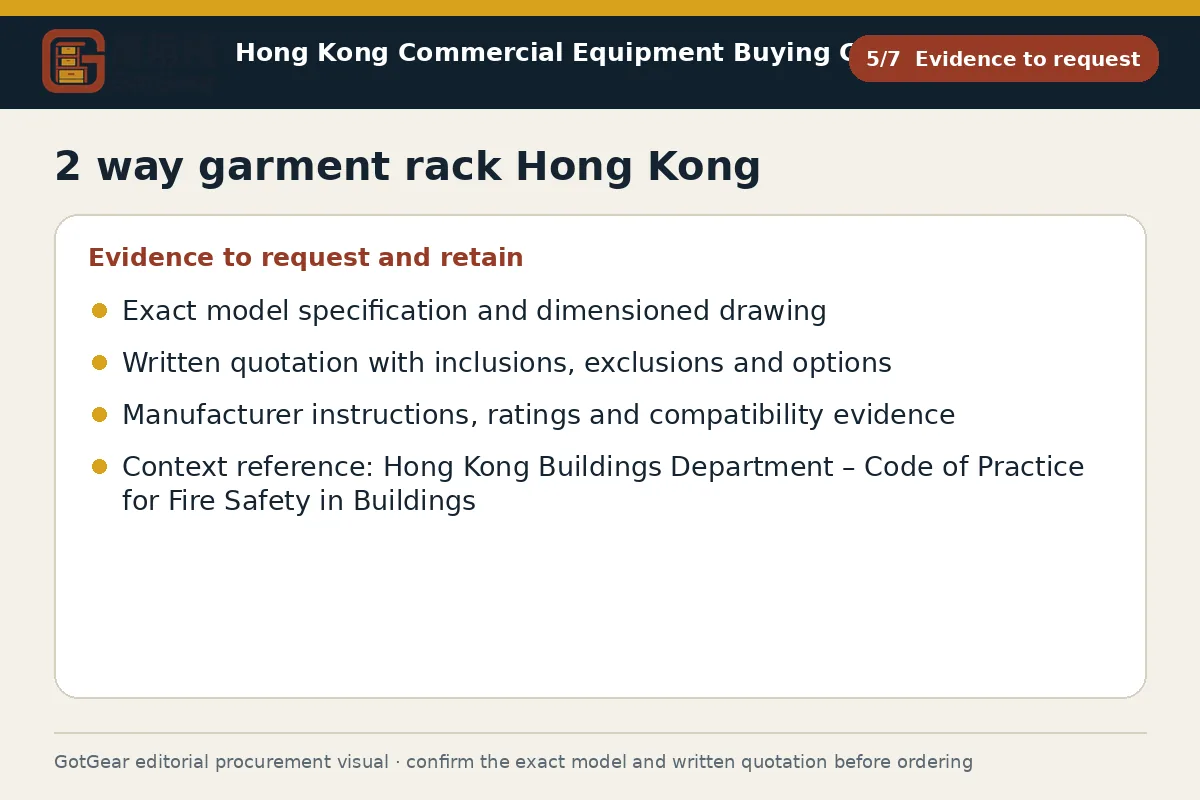
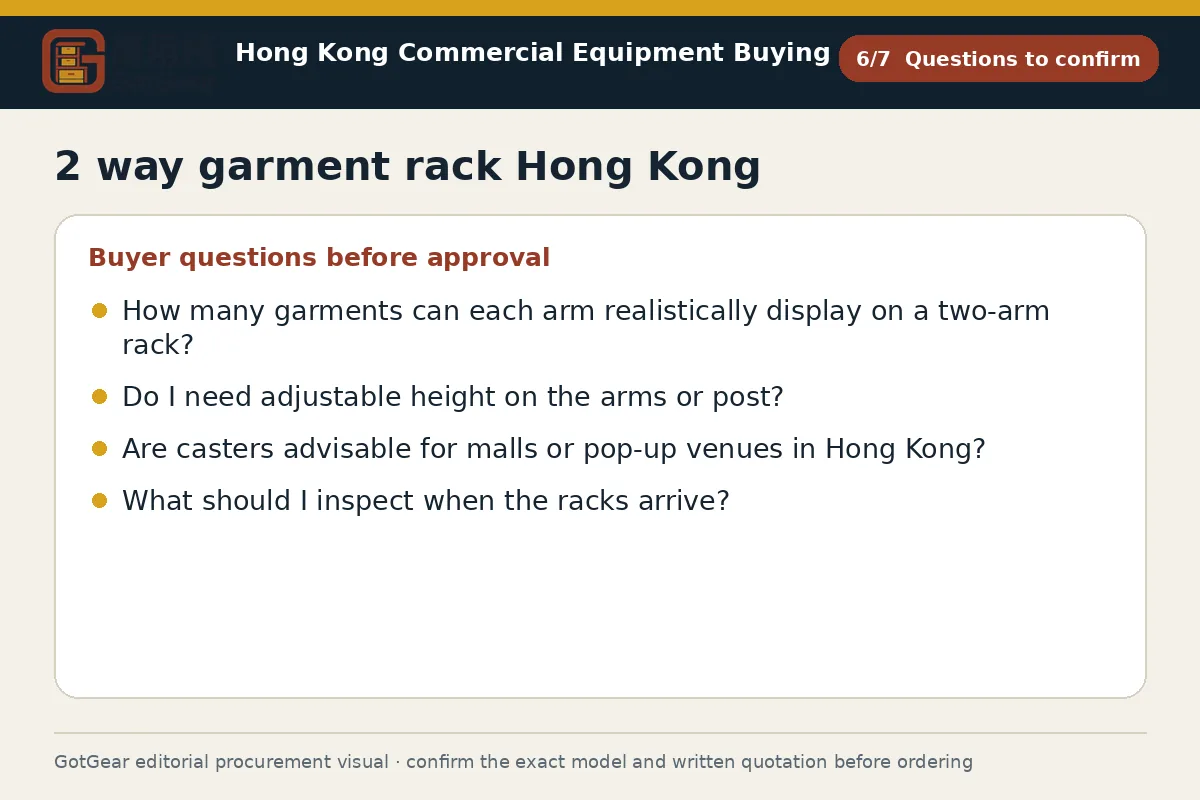
2 way garment rack Hong Kong decision checklist
Start by diagramming your intended fixture positions and measuring aisles, pillars, doors and lifts. Decide whether simpler approach and faster re‑merchandising outweigh extra facings; then shortlist two‑arm or four‑arm models accordingly. Specify arm style, usable length, notch count, height‑adjust range, base dimensions, finish, and whether casters with brakes are required. Request dimensioned drawings and a manufacturer datasheet. Compare written quotations line‑by‑line for included arms, stops, casters, finishes, delivery method and assembly. Plan delivery through your building’s approved route and confirm any loading‑bay booking. On receipt, inspect welds, coating uniformity, arm locks and casters before signing off. Where venues or insurers set restrictions on layouts, weights or signage, obtain their written confirmation. Use this guide to compare specifications and assemble a clear enquiry; the supplier’s formal quotation and model documentation prevail.
- Operating use, quantity and expected frequency
- Dimensions, capacity, material and accessory requirements
- Delivery address, floor, goods lift and loading window
- Required documents, acceptance checks and after-sales arrangements
Key points for 2 way garment rack Hong Kong, 4 way garment rack Hong Kong
Space in Hong Kong retail is often governed by building‑management rules as much as by square metres. Before ordering, confirm goods‑lift size, doorway width and any loading‑bay booking windows with your landlord or venue; many industrial buildings and malls require advance coordination. Humidity can accelerate surface tarnish in back‑of‑house areas, so validate finish suitability with the manufacturer and your housekeeping team. Pop‑up and public‑event venues may set their own fixture spacing and movement controls; obtain their written guidance. Keep bilingual (Chinese and English) assembly and care information on file so staff can reference it. These are practical operating notes, not legal advice; your site’s policies prevail.
Questions about 2 way garment rack Hong Kong
How many garments can each arm realistically display on a two‑arm rack?
Plan capacity by garment type and hanger width. As an example starting point to test on site, a 400–450 mm straight arm may hold 6–10 light tops, while structured coats may reduce that count. Waterfall arms depend on notch spacing and item bulk. Always confirm with the supplier’s data and a sample set from your range before finalising quantities.
Do I need adjustable height on the arms or post?
Adjustable arms or posts help align facings with nearby bays and improve sightlines across a small shop. They are also useful for accommodating long dresses versus short tops. If your venue has limits on overall fixture height or on clearance beneath sprinklers, confirm those constraints in writing with the management office before you select a model.
Are casters advisable for malls or pop‑up venues in Hong Kong?
Yes, provided you specify braked, non‑marking casters and confirm venue rules on moving fixtures during trading hours. Ask suppliers to declare wheel diameter and tread material, and test over thresholds on your route. Some buildings require loading‑bay bookings and goods‑lift use; coordinate schedules with management to avoid delays and to protect floors.
What should I inspect when the racks arrive?
Check welds and fasteners, ensure coating is even with no burrs at edges, and verify arm locks engage securely. Spin casters, test brakes and confirm all parts match the quotation (arms, stops, fixings, tools). Review bilingual assembly and care information. If anything is damaged in transit, photograph packaging and product and contact the supplier per your agreed process.
Continue with closely related procurement topics
These pages share equipment, operating or decision-stage signals with this guide.
Rolling garment rack Hong Kong
Compare a rolling garment rack Hong Kong with a folding garment rack Hong Kong by checking castors and brakes, rail height, loaded footprint, folded size, doorway clearance and handling. Find the full guide at GotGear.
Read the guide
Retail display plinth Hong Kong
GotGear compares retail display plinth Hong Kong and retail display pedestal Hong Kong, covering top area, height, product scale, viewing angle, and floor position for displays in Hong Kong stores.
Read the guide
Mobile podium Hong Kong
Choose a mobile podium Hong Kong by checking dimensions, doorway and lift access, castors and brakes and adjustment range. Compare a height adjustable lectern Hong Kong with GotGear to confirm fit and function.
Read the guide
Slatwall panels Hong Kong
Explore slatwall panels Hong Kong with GotGear. We compare panel formats, groove layouts, panel dimensions and accessory compatibility to help you plan a slatwall display system Hong Kong.
Read the guideRelated topic indexOpen more English procurement pages2 topics
Browse additional equipment families, applications and procurement questions relevant to a wider buying brief.