
Choose a tabletop sign holder Hong Kong by recording insert dimensions, viewing distance, available surface area and how often content changes. For a QR code sign holder Hong Kong, test the proposed code size and position under the lighting and approach angles expected at the site.
Size a tabletop sign holder Hong Kong for the printed message
Start by confirming the exact insert size and the viewing distance your team expects across tables, counters and reception desks. Allow space for bilingual headings and any QR, logo or allergen iconography so the live text remains legible. As an example starting point, some buyers trial A6 or A5 layouts for short counter notices, but the final format must be confirmed in the written brief and matched to the model specification and quotation. Decide portrait or landscape, and note if borders or bleed will be hidden by the frame.
For a tabletop sign holder Hong Kong, request the viewable area (not just nominal size), insert loading method (top, side or magnetic), compatible insert thickness range, material and finish (clear, matte anti‑glare, UV‑resistant), and cleaning guidance for common front‑of‑house chemicals. Ask for a drawing showing overall height and profile so servers can see over the sign. If considering an acrylic sign holder Hong Kong, confirm whether edges are flame‑polished, whether protective films are supplied, and whether the unit can accept laminated or synthetic paper. Always test a printed sample under site lighting before placing the final order and ensure the model code on the written quotation matches what you evaluated.
Check base footprint and viewing angle for a tabletop sign holder Hong Kong
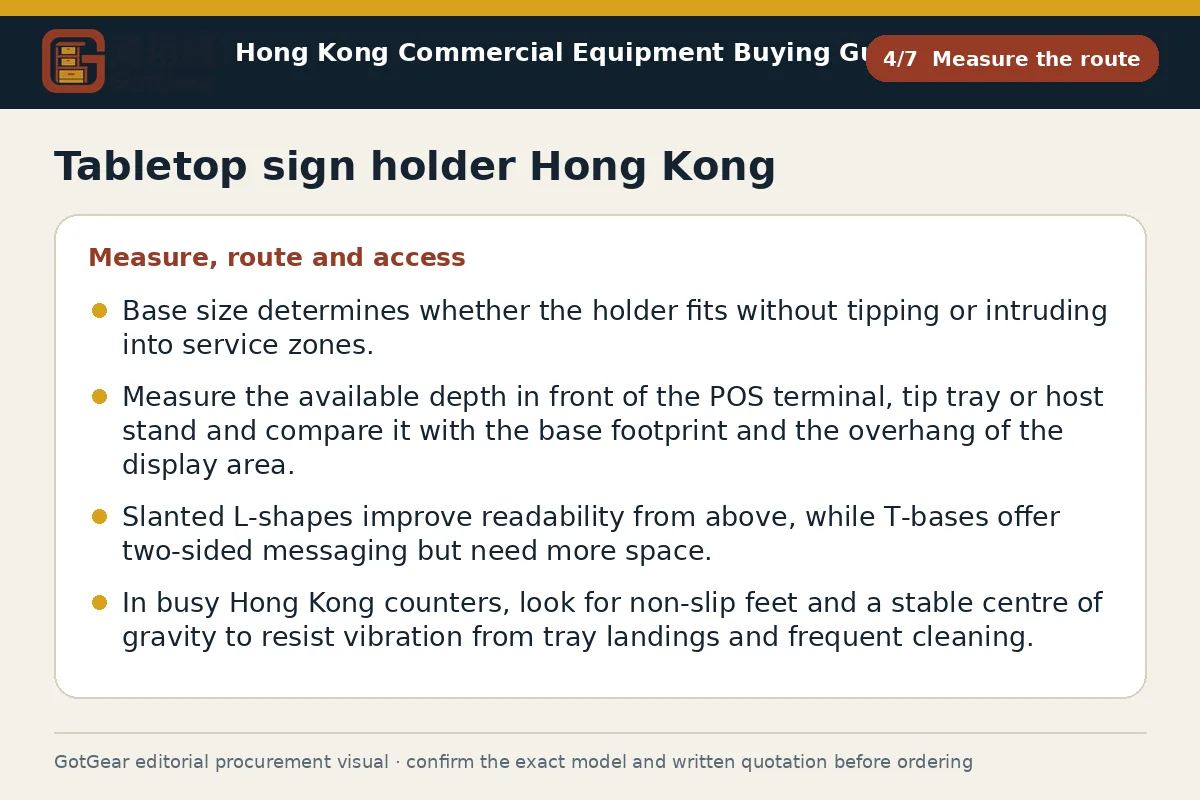
Base size determines whether the holder fits without tipping or intruding into service zones. Measure the available depth in front of the POS terminal, tip tray or host stand and compare it with the base footprint and the overhang of the display area. Slanted L‑shapes improve readability from above, while T‑bases offer two‑sided messaging but need more space. In busy Hong Kong counters, look for non‑slip feet and a stable centre of gravity to resist vibration from tray landings and frequent cleaning.
Ask suppliers to state base width and depth, overall mass, tilt angle or viewing angle (where applicable), and whether angle is fixed or adjustable. For quotes, request the same fields from each vendor so you can compare like‑for‑like. If evaluating a magnetic acrylic sign holder Hong Kong for metal cashier pods or back‑of‑house pass‑throughs, confirm magnet type and whether protective film prevents scratching. Seek a dimensional drawing or photo with a scale reference, and, on receipt, check for wobble, flush joints and intact pads. Note that any anti‑tip or adhesive options should be tested on your exact countertop material before large‑scale deployment.
What should buyers compare for tabletop sign holder Hong Kong?
| Criterion | Straightforward requirement | More complex requirement | Evidence to provide |
|---|---|---|---|
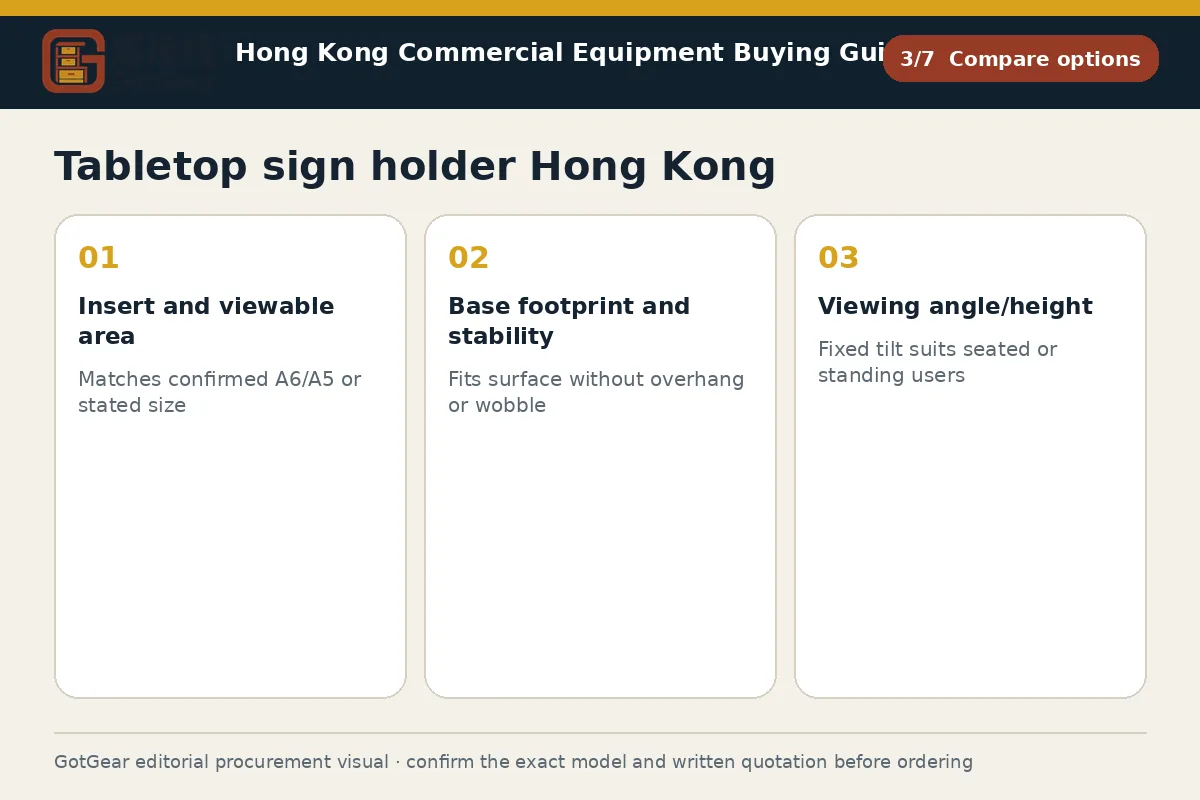
| Insert and viewable area | Matches confirmed A6/A5 or stated size | Exact viewable window specified with bleed/margins | Annotated photo with dimensions and bilingual artwork sample |
| Base footprint and stability | Fits surface without overhang or wobble | Anti‑slip pads and mass/anti‑tip suited to busy counters | Counter depth/width, traffic map, surface material notes |
| Viewing angle/height | Fixed tilt suits seated or standing users | Adjustable tilt or dual‑sided display for mixed heights | Typical viewing distance and user posture at location |
| Material and finish | Clear acrylic with standard cleaning | Matte/anti‑glare or PETG/polycarbonate for impact/chemicals | List of cleaning agents; any UV or chemical resistance statement |
| QR performance | Code scannable in standard lighting | Anti‑glare finish and quiet‑zone kept clear in site glare | Test results across phone models and lighting photos |
This framework helps buyers create comparable written enquiries. Final model specifications, availability, delivery and commercial terms must be confirmed in a formal quotation.
Position a tabletop sign holder Hong Kong without cluttering service space
Positioning affects both service speed and message effectiveness. Map where hands, trays, plates and payment terminals move during peak periods and mark a no‑obstruction zone. Keep the holder inside the table edge so sleeves do not catch it, and position it so staff can refresh inserts without crossing customer traffic. If content is extensive or needs elevated sightlines, consider whether a menu stand designed for Hong Kong entrances is more appropriate, while keeping smaller holders for tabletops.
When planning placement in malls, office towers or public atriums, coordinate with the management office on any branding or wayfinding rules and confirm whether temporary messaging requires prior approval. Record housekeeping routines so finishes withstand disinfectants and frequent wipe‑downs in humid conditions. If suspended or window messaging is required, consider a cable‑mounted sign holder to free up counter space and keep surfaces clear. For written enquiries, provide photos with measurements of the surface area, clearance to edges, and any nearby heat or moisture sources. For delivery to dense districts, add access notes such as goods‑lift dimensions, dock availability and loading windows so packaging sizes and delivery timing can be planned in advance.
Plan scanning with a QR code sign holder Hong Kong and tabletop sign holder Hong Kong
Scanning performance depends on contrast, quiet zone, angle and reflections. Test proposed artwork at the counter or table where it will be used, under your actual LEDs and any window glare. As an example starting point, some teams trial code panels that appear comfortably readable at arm’s length, then verify with several common phone models; final code size and distance must be validated on site and reflected in the model specification and formal quotation. Matte finishes often control glare better than high‑gloss in spotlighted bars.
For a QR code sign holder Hong Kong, verify that the insert path does not crease or distort the code and that the holder tilt lets guests scan without lifting the unit. Ask for anti‑glare or matte specifications where available, edge clarity for camera autofocus, and guidance on cleaning agents that will not cloud the surface. Request a sample or pilot batch to confirm scanning from seated and standing positions and to check that surrounding items do not obscure the quiet zone. On receipt, inspect for surface defects, clarity, evenness of tilt, and whether protective films and care instructions are included.
Tabletop sign holder Hong Kong decision checklist
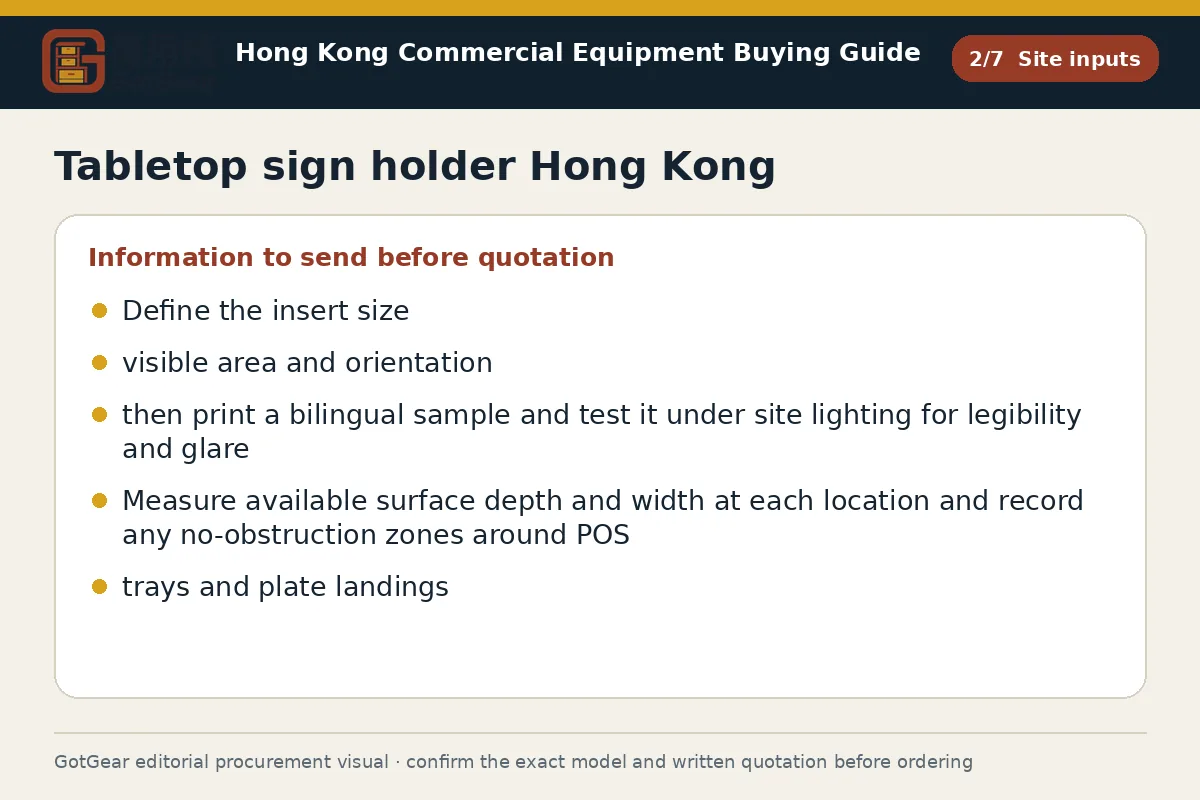
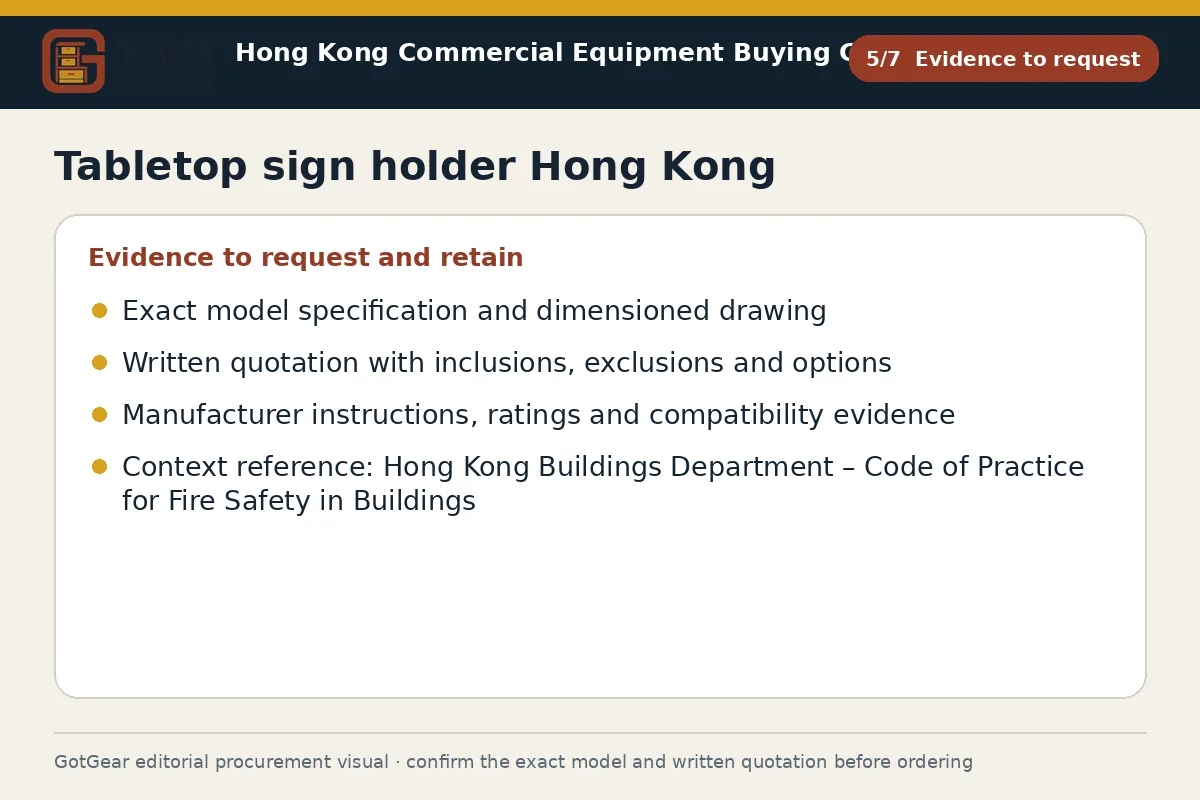
Define the insert size, visible area and orientation, then print a bilingual sample and test it under site lighting for legibility and glare. Measure available surface depth and width at each location and record any no‑obstruction zones around POS, trays and plate landings. Note content change frequency to choose top‑load, side‑load or magnetic closure. For quotations, request model code, material and finish, viewable area, compatible insert thickness, base footprint and mass, and fixed or adjustable tilt. Provide photos with measurements and any landlord or event‑control rules. Before approval, pilot a QR layout at real approach angles. On delivery, check clarity, edge finish, stability, protective films and count, and ask for cleaning and UV‑resistance statements where use or venue conditions warrant. The formal written quotation and model specification prevail.
- Operating use, quantity and expected frequency
- Dimensions, capacity, material and accessory requirements
- Delivery address, floor, goods lift and loading window
- Required documents, acceptance checks and after-sales arrangements
Key points for tabletop sign holder Hong Kong, QR code sign holder Hong Kong
Hong Kong counters and host stands are compact and brightly lit, so base footprint, glare control and clearances matter as much as insert size. Landlord or management‑office rules in malls and Grade‑A towers can affect placement and branding, and goods‑lift bookings or loading windows often shape delivery timing. Summer humidity and frequent wipe‑downs mean finishes should tolerate disinfectants without clouding. Bilingual messaging is common; allow space for both languages without forcing small fonts. This summary supports practical planning and is not legal advice; always confirm venue or authority requirements in writing.
Questions about tabletop sign holder Hong Kong
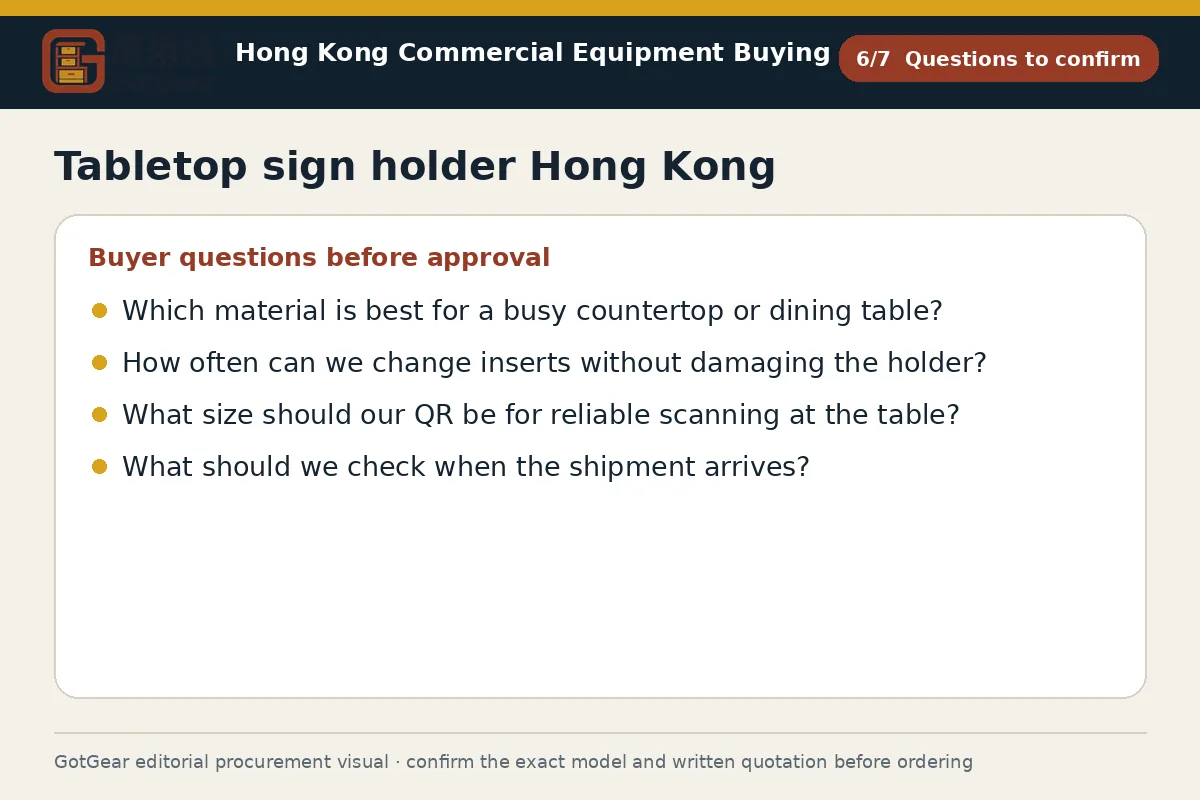
Which material is best for a busy countertop or dining table?
For most indoor front‑of‑house uses, clear acrylic provides good clarity and stiffness. Where impact risk or heat exposure is higher, consider PETG or polycarbonate, and use matte or anti‑glare where spotlighting is strong. Always confirm cleaning‑chemical compatibility and any UV‑resistance claims with the supplier in writing, matched to your site conditions and the model specification and written quotation.
How often can we change inserts without damaging the holder?
Choose a top‑ or side‑load unit for frequent changes, or a magnetic frame for speed and fewer creases. Specify the compatible insert thickness and whether laminated or synthetic paper is acceptable. Trial a sample with your real paper stock and workflow, and confirm the loading method and durability claims in the supplier’s documentation and the formal quotation before rollout.
What size should our QR be for reliable scanning at the table?
Test your artwork at the actual table height and typical user distance, adjusting code area and quiet zone until scanning is reliable from multiple phones. As an example starting point, teams often trial a comfortably readable code at arm’s length, but the final size must be validated on site and aligned with the selected holder, lighting and the written brief and quotation.
What should we check when the shipment arrives?
Verify model codes, quantities, viewable areas and orientation match the purchase documents. Inspect clarity, edge finishing, stability, pads, and the presence of protective films and care instructions; test one unit on the actual surface for wobble and glare. Report defects promptly per vendor terms, and retain packaging until the management office or venue approves the installation, where required.
Continue with closely related procurement topics
These pages share equipment, operating or decision-stage signals with this guide.
Acrylic sign holder Hong Kong
Choose the right acrylic sign holder Hong Kong with GotGear by considering insert size, orientation, viewing side, and how often you will change inserts. Compare options for magnetic acrylic sign holder Hong Kong.
Read the guide
Window sign holder Hong Kong
Use this checklist for a window sign holder Hong Kong to check insert size, whether it provides single or double sided viewing, ease of fixing and access, and glass position, reflections and viewing distance. It is from GotGear.
Read the guide
Shelf edge sign holder Hong Kong
GotGear checklist for shelf edge sign holder Hong Kong asks you to record ticket dimensions, shelf or rail profile and typical reading angle. It also asks how staff replace inserts and how the sign aligns with product facings.
Read the guide
Cable sign holder Hong Kong
Use this checklist when specifying a cable sign holder Hong Kong to compare sign size, suspension points, access for changes, ceiling-to-floor geometry and fixing locations. This checklist is from GotGear.
Read the guideRelated topic indexOpen more English procurement pages1 topics
Browse additional equipment families, applications and procurement questions relevant to a wider buying brief.