
For commercial equipment supplier Hong Kong research, check the legal entity, relevant experience, product documentation, quoted scope and commercial terms. Verify each claim against current documents and the requirements of the purchase.
Build a shortlist for commercial equipment supplier Hong Kong research
An evaluation of a commercial equipment supplier Hong Kong starts with a clear, written enquiry pack that defines what the equipment must do, for how long, and in what environment. State the intended function, duty profile, throughput or load, critical dimensions, footprint and minimum service clearances. Specify utilities (voltage, phase, current, plug type, water, drainage, ventilation), control/interface requirements, acceptable noise level at the operator position, and materials or hygiene finishes if food, education or healthcare are in scope. If the area is humid or coastal-exposed, ask for corrosion-resistance details. Example starting point: outline an indicative daily throughput range, to be confirmed by the chosen model’s datasheet and formal quotation.
Record site realities early. Measure doorways, corridors and goods-lift clear openings, cabin depth and turning spaces; note floor loading where relevant and confirm with the building manager. Capture loading-bay rules, booking windows and any need for escorts or work permits. State whether bilingual (Chinese/English) safety labels and manuals are required. Ask suppliers to respond to the same scope: delivery-to-room, positioning, installation, commissioning, operator training, packaging removal and any disposal. Request dimensioned drawings, a provisional method statement for access and lifting, and a list of included accessories and consumables. Use this guide to compare specifications and prepare a written enquiry so every candidate addresses the identical brief.
Commercial equipment supplier Hong Kong: Questions for Candidates
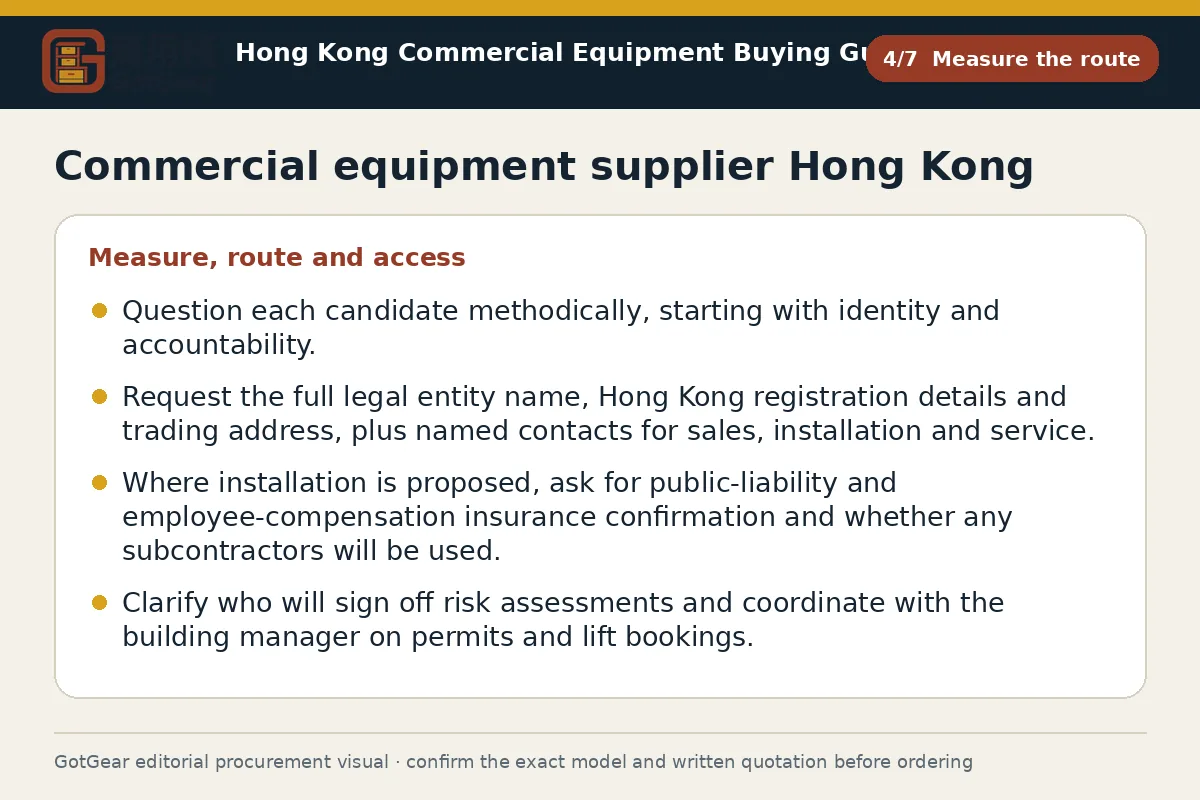
Question each candidate methodically, starting with identity and accountability. Request the full legal entity name, Hong Kong registration details and trading address, plus named contacts for sales, installation and service. Where installation is proposed, ask for public-liability and employee-compensation insurance confirmation and whether any subcontractors will be used. Clarify who will sign off risk assessments and coordinate with the building manager on permits and lift bookings.
Probe capability and authorisation. Seek written manufacturer authorisation for the specific product line, recent references for comparable Hong Kong sites (with the client’s permission), and the location of service technicians and spares. Ask how warranty claims are handled locally and what their target response looks like. Example starting point: state a preferred next-business-day response while acknowledging that the supplier’s written service terms will prevail. Confirm whether training is included and if bilingual instruction can be provided.
Validate product suitability against your environment. Discuss humidity, temperature, power quality, drainage and ventilation; ask for the model’s duty rating, cleaning method, consumables and expected wear parts. Request the exact utilities and fuse ratings, and any noise or heat output that might affect adjacent tenants. Where venues or insurers require documentation (e.g., hygiene statements or flame-spread for ancillary materials), ask how these will be evidenced for the offered model, if applicable.
What should buyers compare for commercial equipment supplier Hong Kong?
| Criterion | Straightforward requirement | More complex requirement | Evidence to provide |
|---|---|---|---|
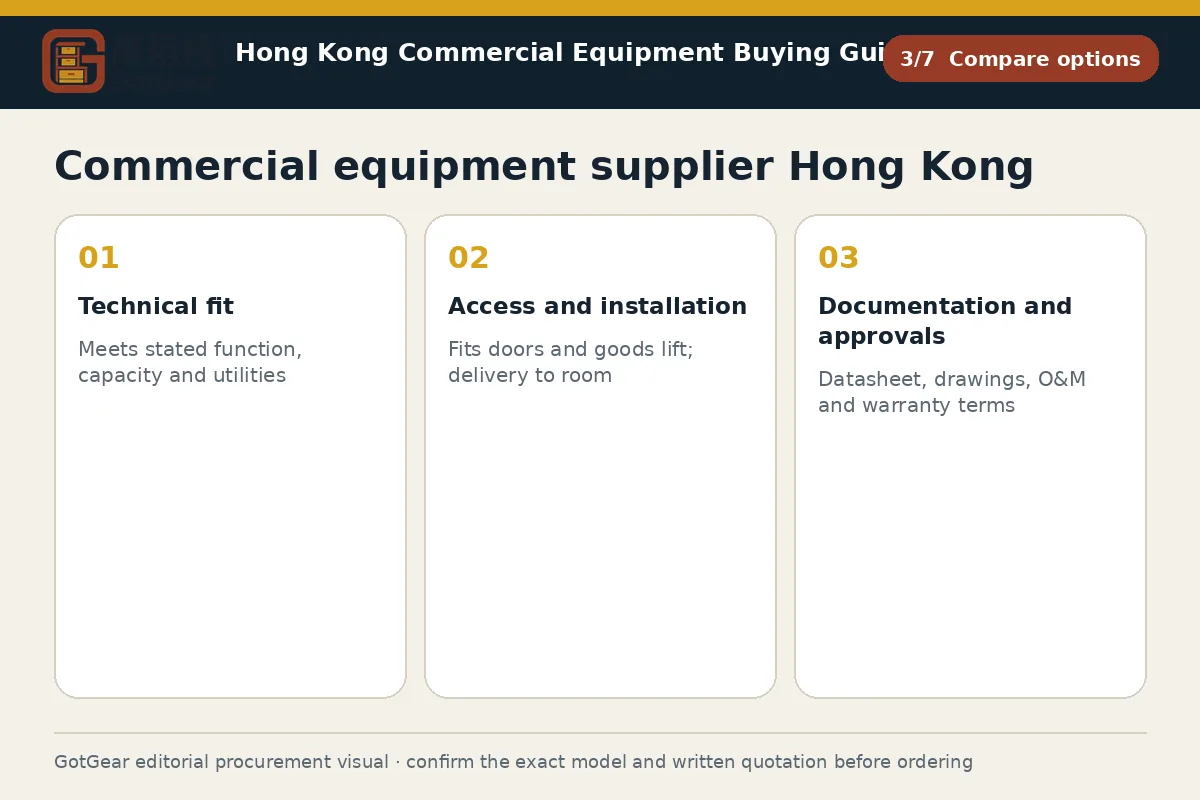
| Technical fit | Meets stated function, capacity and utilities | Handles humidity/heat, hygiene finish or corrosion resistance where relevant | Model number, datasheet, duty description, utilities schedule |
| Access and installation | Fits doors and goods lift; delivery to room | Method for tight turns/hoisting; protection to finishes and neighbours | Measured route, lift data, photos, provisional method statement |
| Documentation and approvals | Datasheet, drawings, O&M and warranty terms | Manufacturer authorisation; venue/insurer-requested statements if applicable | Document list, language needs, verification contact |
| Service and spares | Local contact and warranty support | Preventive-maintenance outline; critical spares and lead times | Service contact, sample schedule (example), spares list with lead times |
| Commercial and programme | Fixed fee with stated inclusions; delivery window | Milestones linked to acceptance; plan for building blackout/access limits | Signed quotation, exclusions, programme, booking confirmations |
This framework helps buyers create comparable written enquiries. Final model specifications, availability, delivery and commercial terms must be confirmed in a formal quotation.
Compare evidence: Commercial equipment supplier Hong Kong
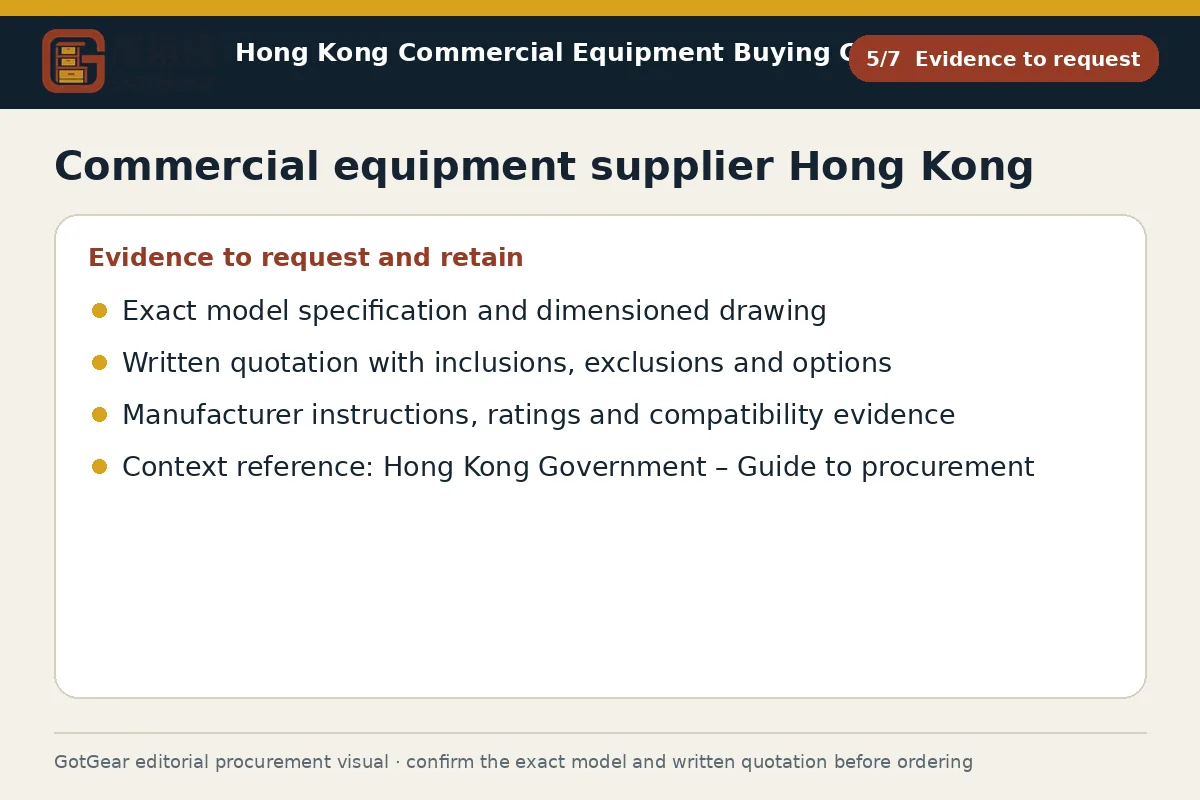
Compare candidates using the same evidence set. Line up model numbers and revisions, country of manufacture if relevant to your policy, inclusions/exclusions, and the delivery definition (kerbside, to floor, to position). Check who provides lifting gear, protection to finishes, commissioning, operator training, rubbish removal and any legacy-equipment disposal. Note any assumed by-others works such as power outlets, drainage traps or builders’ openings, and flag differences for clarification.
Read technical documents, not just brochures. Validate all quoted dimensions and service clearances against your measured route and final location plan. Confirm electrical and plumbing compatibility, and verify that required accessories and options are explicitly listed. If your site is humid or salt-air exposed, compare corrosion protection statements and materials. Where the venue or insurer expects certain declarations, confirm what is actually available for the offered model and in what language.
Scrutinise commercial terms. Check quotation validity, payment milestones tied to delivery, installation and acceptance, warranty period and service coverage. Note lead-time ranges only as planning guidance—example starting point: request an indicative weeks-from-order window—then confirm by formal quotation. Ensure programme dates align with building loading windows and blackout periods. Record any assumptions in writing, and treat the model specification and the final written quotation as the controlling documents.
Recording a decision made by a commercial equipment supplier Hong Kong
Create a decision record that shows how you reached your conclusion. List the shortlisted suppliers, weighted criteria, scores and the reasons each criterion was met or not, citing documents or site notes. Capture residual risks (e.g., tight lift cabin, shared power circuits, or access curfews) and allocate owners and deadlines. Log pre-installation actions: building-management approvals, lift and loading-bay bookings, method-statement sign-off, insurances received, and readiness of power, drainage and ventilation points.
Prepare a receipt and commissioning checklist before delivery. On arrival, confirm packaging condition, model and serial numbers against the purchase order, and that dimensions and accessories match the quotation. Check voltage, phase and plug type, safety guards or interlocks, and whether manuals and labels meet any bilingual requirement. Photograph placements and any damage. Example starting point: notify the supplier of discrepancies on the same day, then follow their written procedure. Complete test runs and operator training as agreed, obtain signed acceptance, and file all drawings, datasheets, training records and warranty confirmations in your shared repository for audit and future maintenance planning.
Commercial equipment supplier Hong Kong decision checklist
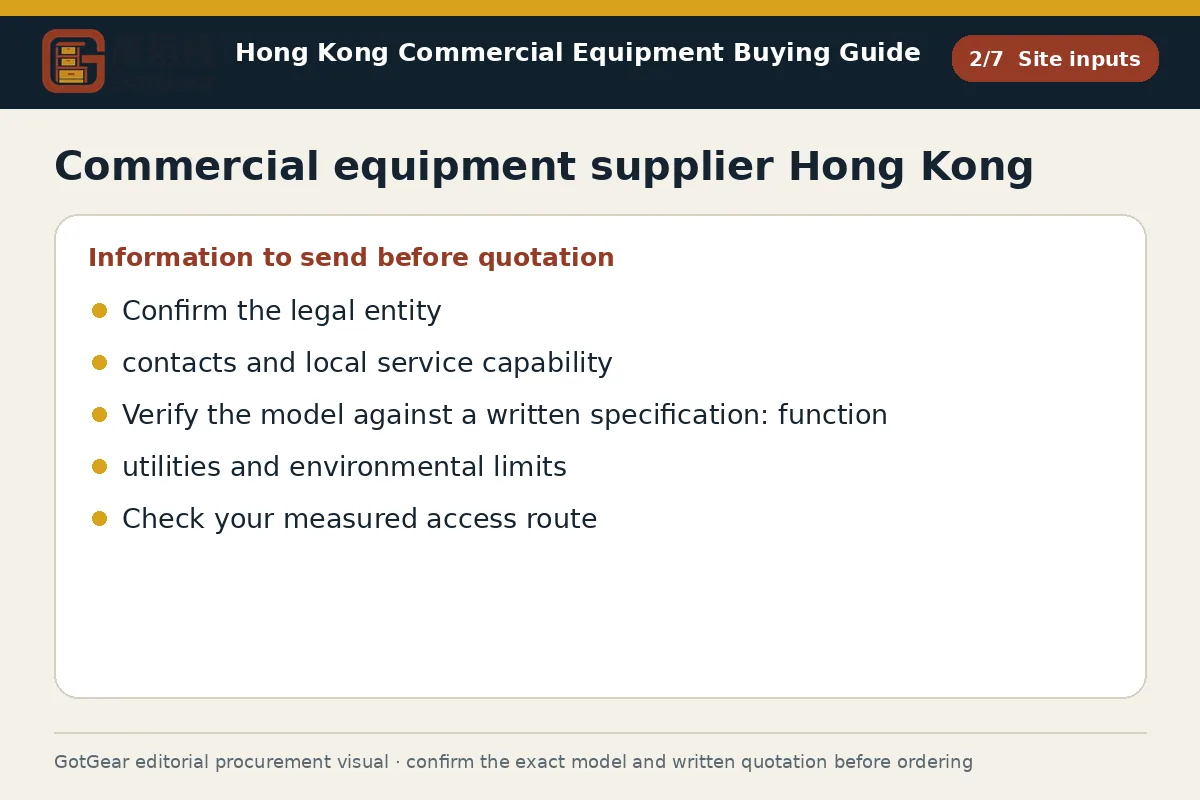
Confirm the legal entity, contacts and local service capability. Verify the model against a written specification: function, duty, dimensions, utilities and environmental limits. Check your measured access route, goods-lift data and any booking rules with the building manager. Ensure the quotation states inclusions, exclusions, delivery definition, installation, commissioning, training and rubbish removal. Obtain datasheets, dimensioned drawings, a provisional method statement, warranty terms and—where applicable—manufacturer authorisation or venue-requested statements. Align the programme to loading windows and site curfews. Tie payment milestones to documented acceptance. Record open risks and who is responsible. Prepare a receipt checklist and simple acceptance tests before placing the order.
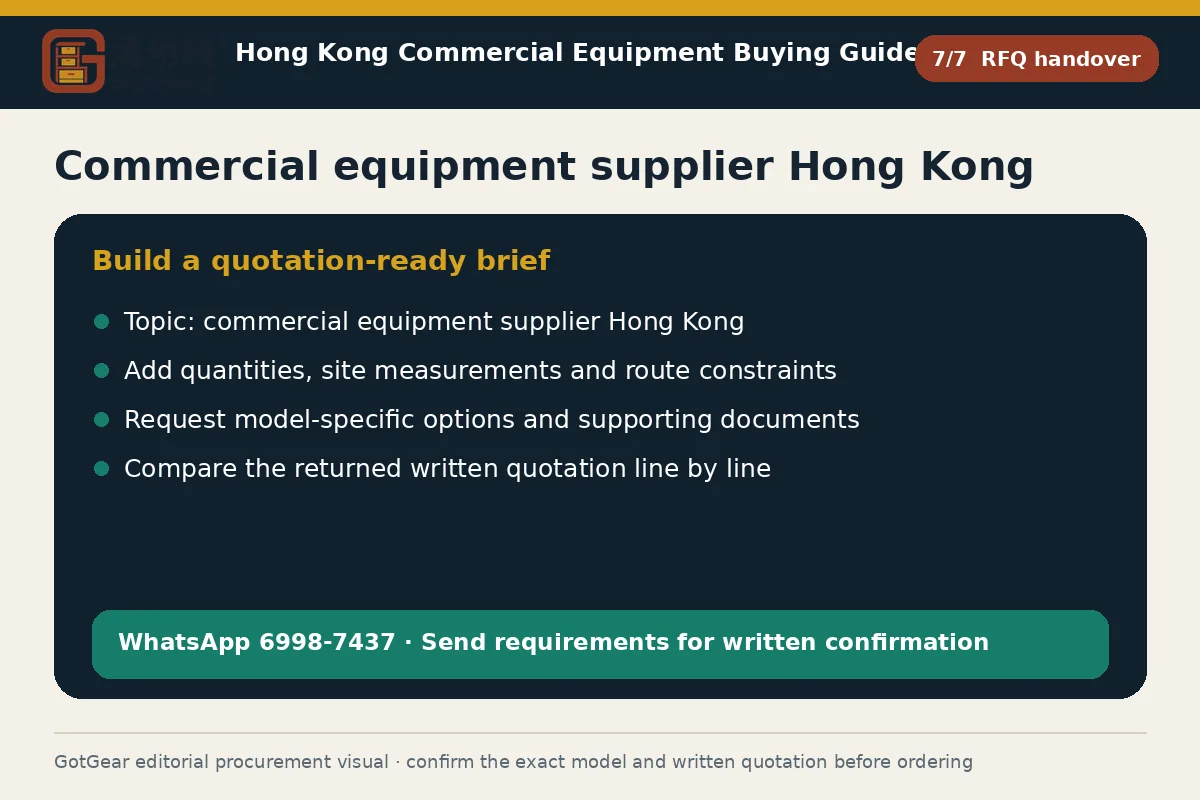
- Operating use, quantity and expected frequency
- Dimensions, capacity, material and accessory requirements
- Delivery address, floor, goods lift and loading window
- Required documents, acceptance checks and after-sales arrangements
Key points for commercial equipment supplier Hong Kong
Hong Kong deliveries often hinge on building-management office approvals, lift bookings and tight loading windows. Many industrial buildings have narrow goods-lift cabins and strict protection requirements for lobbies and corridors, so verified measurements and a method statement reduce risk. Humid conditions and salt air can influence material choices and maintenance regimes. Public venues may ask for bilingual safety information and additional documentation. Requirements vary by building and event operator; coordinate early with the responsible manager rather than relying on assumptions.
Questions about commercial equipment supplier Hong Kong
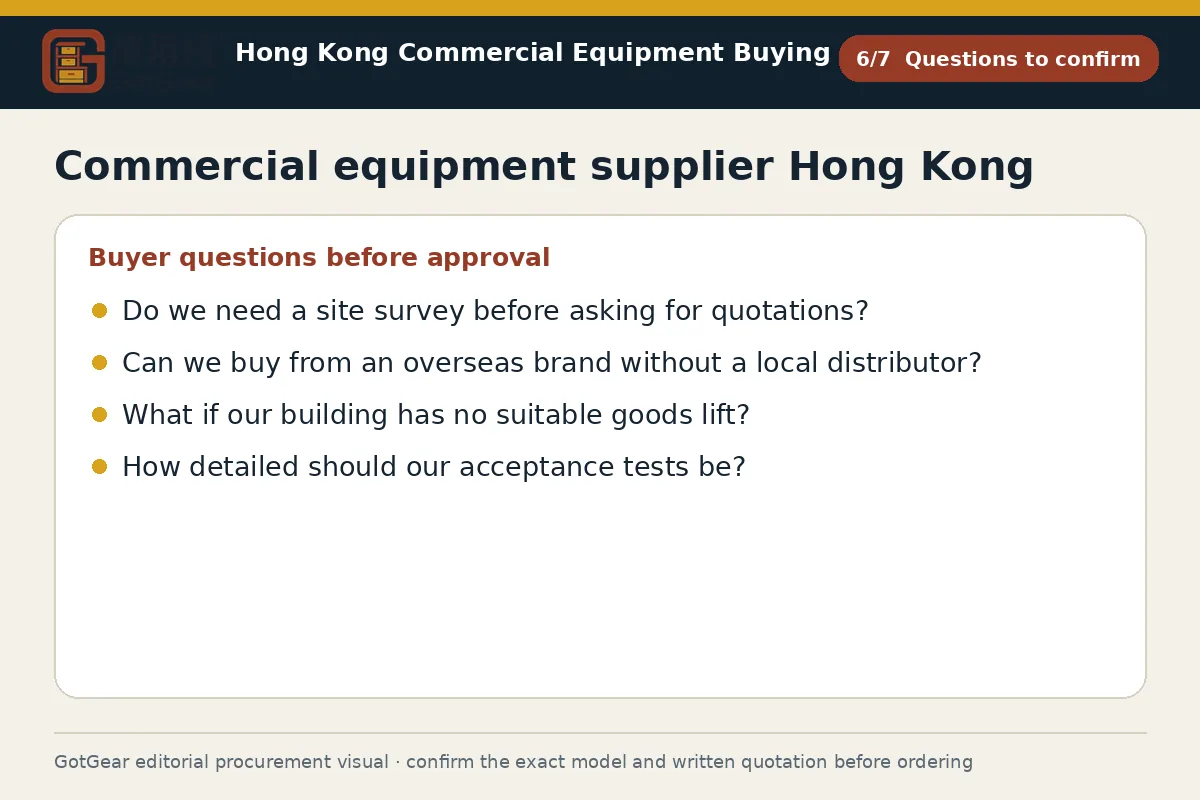
Do we need a site survey before asking for quotations?
Yes, arrange at least a measurement-based survey so candidates quote the same scope. Where access is straightforward, measurements and photos may suffice initially. If the route is complex or the building manager requires a method statement, request a supplier visit. Any measurement provided is an example starting point and must be confirmed in the written brief.
Can we buy from an overseas brand without a local distributor?
You can if installation, service and parts can be supported in Hong Kong and the building manager accepts the arrangement. Ask for local contact details, commissioning capability, warranty handling and lead-time clarity. Confirm voltage and plug compatibility, and whether bilingual documentation is available. Written commitments in the quotation should prevail over verbal assurances.
What if our building has no suitable goods lift?
Plan for sectional delivery, stair carries or external hoisting, subject to building rules and safe methods. Ask suppliers for a method statement that protects finishes and controls risk, and coordinate permits with the management office. Any hoisting gear, road-space booking or additional insurance is conditional and must be confirmed for your site and model.
How detailed should our acceptance tests be?
Keep them practical: identity check, basic functional run, safety interlocks, utilities connections and any performance points relevant to the model. Agree these with the supplier before delivery and tie sign‑off to training completion. Example starting point: a short test run under supervision; confirm the final scope in the quotation and commissioning documents.
Continue with closely related procurement topics
These pages share equipment, operating or decision-stage signals with this guide.
Bulk commercial equipment supplier Hong Kong
GotGear guide for bulk commercial equipment supplier Hong Kong helps multi-site buyers compare capacity evidence, product reference, quantity basis, substitution controls, batch identification, packaging and documentation.
Read the guide
Commercial equipment supplier credentials Hong Kong
GotGear explains how to verify commercial equipment supplier credentials Hong Kong. See the commercial equipment supplier company profile Hong Kong and equipment supplier registration Hong Kong.
Read the guide
Commercial equipment supplier quotation comparison Hong Kong
GotGear provides a commercial equipment supplier quotation comparison Hong Kong with a traceable table that aligns scope, identifies gaps and records cost, delivery basis and validity for client review.
Read the guide
Government equipment supplier Hong Kong
GotGear guide for procurement teams in Hong Kong shows how to verify a government equipment supplier Hong Kong by checking legal identity, issuing body, required documents and current status against procurement records.
Read the guideRelated topic indexOpen more English procurement pages1 topics
Browse additional equipment families, applications and procurement questions relevant to a wider buying brief.