
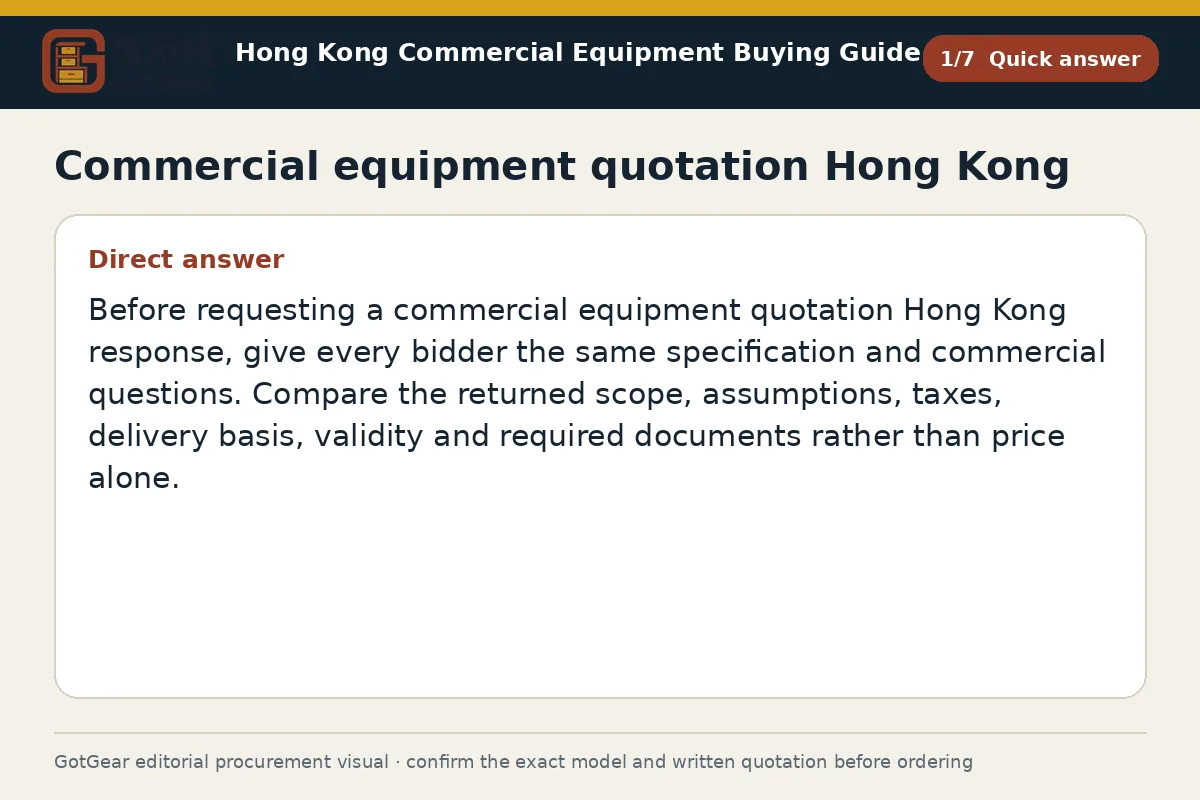
For commercial equipment supplier quotation comparison Hong Kong, the useful output is a traceable decision table, not simply the lowest stated amount. Compare the included scope, evaluated cost, validity, delivery basis, supporting evidence and unresolved risk.
Normalise scope for commercial equipment supplier quotation comparison Hong Kong
Begin by translating every supplier response into a single requirement-and-quantity schedule so you are comparing like for like. For a commercial equipment supplier quotation comparison Hong Kong, as part of the exercise, list each item with model number, rated capacity, electrical load, footprint, heat and noise output, materials of construction and any environment rating relevant to humid plant rooms or kitchens. Where a supplier offers an "equivalent", record it as an alternate line rather than merging it into the base scope. Note accessories, control options, installation method, commissioning, training and documentation as discrete rows.
Capture site realities that affect cost or feasibility: goods-lift and doorway clear openings, allowable floor loading, turning circles in corridors, and any stair runs. For example, as starting points only, you might note a measured lift car opening of 900 mm and a corridor turn that limits pallets to 1,200 mm; these must be confirmed in the written brief and drawings. State delivery windows, building management notification requirements, loading-bay rules, and whether bilingual labelling and manuals are required. Confirm utilities (power, water, waste, ventilation) with locations and distances. Keep optional lines—such as extended warranty or stainless upgrades—separate for evaluation. Use this guide to compare specifications and prepare a written enquiry; see also our guidance on commercial equipment quotation Hong Kong for aligning the request.
Exceptions in a commercial equipment supplier quotation comparison Hong Kong table
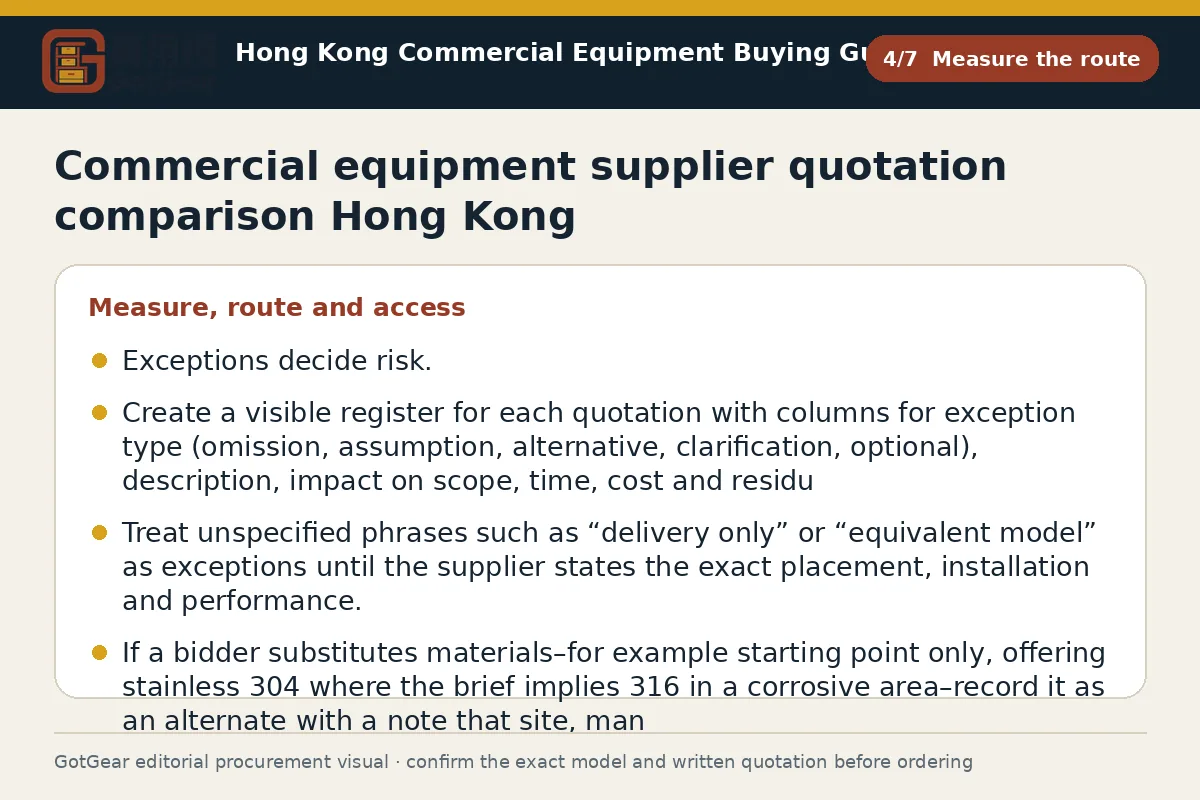
Exceptions decide risk. Create a visible register for each quotation with columns for exception type (omission, assumption, alternative, clarification, optional), description, impact on scope, time, cost and residual risk. Treat unspecified phrases such as “delivery only” or “equivalent model” as exceptions until the supplier states the exact placement, installation and performance. If a bidder substitutes materials—As a starting point, only, offering stainless 304 where the brief implies 316 in a corrosive area—record it as an alternate with a note that site, manufacturer or consultant confirmation is required before acceptance.
Ask suppliers to label exclusions (hoisting, out‑of‑hours work, skip disposal, protection, making good), list assumptions (power within 2 m as an example starting point), and provide method statements or sketches for any non‑standard installation. Keep optional items—spare parts kits, training beyond basic handover, enhanced filtration—outside the base total. Where bilingual clarifications are provided, capture both language versions to avoid mismatches. Do not resolve exceptions by guesswork; request written clarification or a priced add/deduct line. Exceptions that remain unresolved should be highlighted in the decision table with a recommendation to accept, negotiate, or reject based on documented risk tolerance.
What should buyers compare for commercial equipment supplier quotation comparison Hong Kong?
| Criterion | Straightforward requirement | More complex requirement | Evidence to provide |
|---|---|---|---|
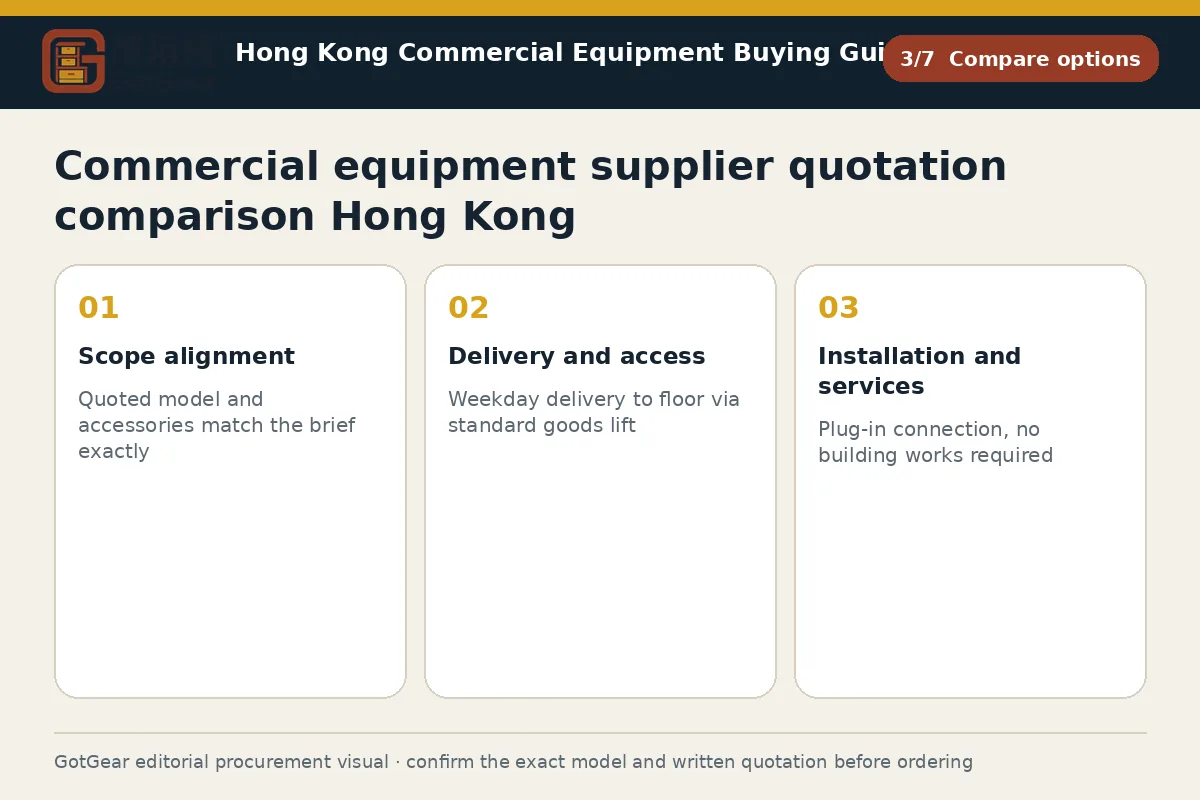
| Scope alignment | Quoted model and accessories match the brief exactly | Alternates allowed if equal/better performance and fit are proven | Model numbers, datasheets, marked deviations and option codes |
| Delivery and access | Weekday delivery to floor via standard goods lift | Out‑of‑hours, stair carries, narrow lifts or dock restrictions | Site photos, lift/door sizes, route sketch, building rules and booking windows |
| Installation and services | Plug‑in connection, no building works required | Hard‑wiring, drainage/ventilation runs or structural fixings | Service point locations, loads, drawings, licensed‑worker scope if required |
| Warranty and support | Stated warranty with on‑site response and parts coverage | Added service plan or extended warranty as options | Warranty statement, service coverage map, recommended spares list |
| Compliance and documentation | User manuals and labels provided, bilingual if needed | Venue/insurer documents where applicable (e.g., hygiene, safety) | Manufacturer declarations, test reports, approvals or sign‑offs as relevant |
This framework helps buyers create comparable written enquiries. Final model specifications, availability, delivery and commercial terms must be confirmed in a formal quotation.
Compare total evaluated cost in commercial equipment supplier quotation comparison Hong Kong
Cost alone is rarely decisive; compare total evaluated cost (TEC) across the normalised scope. Break each offer into equipment supply, delivery basis (kerbside, inside placement, to‑floor via lift or stairs), installation, commissioning, training, documentation and disposal of packaging or replaced units. Add allowances for site constraints such as out‑of‑hours working, building management escorts, or protective coverings where the venue requires them. If utilities require extension or modification, include priced hook‑ups (power, water, drainage, ventilation). Where your venue or insurer requires licensed electrical or gas work, ask the bidder to state the responsible party and include a costed scope.
Compare warranty terms (coverage, response time, on‑site labour, parts availability) and first‑year servicing. If a supplier proposes paid preventive maintenance, evaluate it as an option with a realistic utilisation assumption—an example starting point only might be two routine visits in the first year—subject to confirmation in the written quotation. Check quotation validity, delivery lead time, and whether the quotation is in HKD with clear payment milestones. Document performance trade‑offs (energy, heat rejection, noise) that drive running costs. Evidence should include datasheets, drawings where relevant, a delivery/installation plan, and a spare parts list with recommended stock for Hong Kong conditions.
Recommendation notes for commercial equipment supplier quotation comparison Hong Kong
Recommendation notes should explain why a supplier suits a particular site and risk profile rather than declaring a universal winner. Summarise compliance with the requirement schedule, TEC findings, delivery and installation feasibility, warranty support and any unresolved exceptions. For warehouses and industrial buildings, robust finishes and simple servicing may outweigh aesthetics. For schools and institutions, quieter operation and bilingual user materials can be decisive. In catering or humid back‑of‑house areas, corrosion resistance and condensate management deserve priority. For event use, rapid deployment, compact packaging and flexible delivery windows often matter most.
State conditions precedent clearly: building management approvals, confirmed lift sizes, power isolation points, and any authority or insurer documentation that the specific model or venue might require (for example, hygiene statements for food‑contact surfaces, or licensed‑worker sign‑off where fixed wiring is involved). Specify what to inspect on receipt — model and serial match, voltage and frequency, accessories, damage, and manuals in Chinese and English — before signing the delivery note. Reference your written commercial equipment quotation for Hong Kong as the source of truth, then raise a commercial equipment purchase order for Hong Kong that reflects the agreed inclusions, options and exceptions. Where relevant, verify commercial equipment supplier credentials for Hong Kong before award.
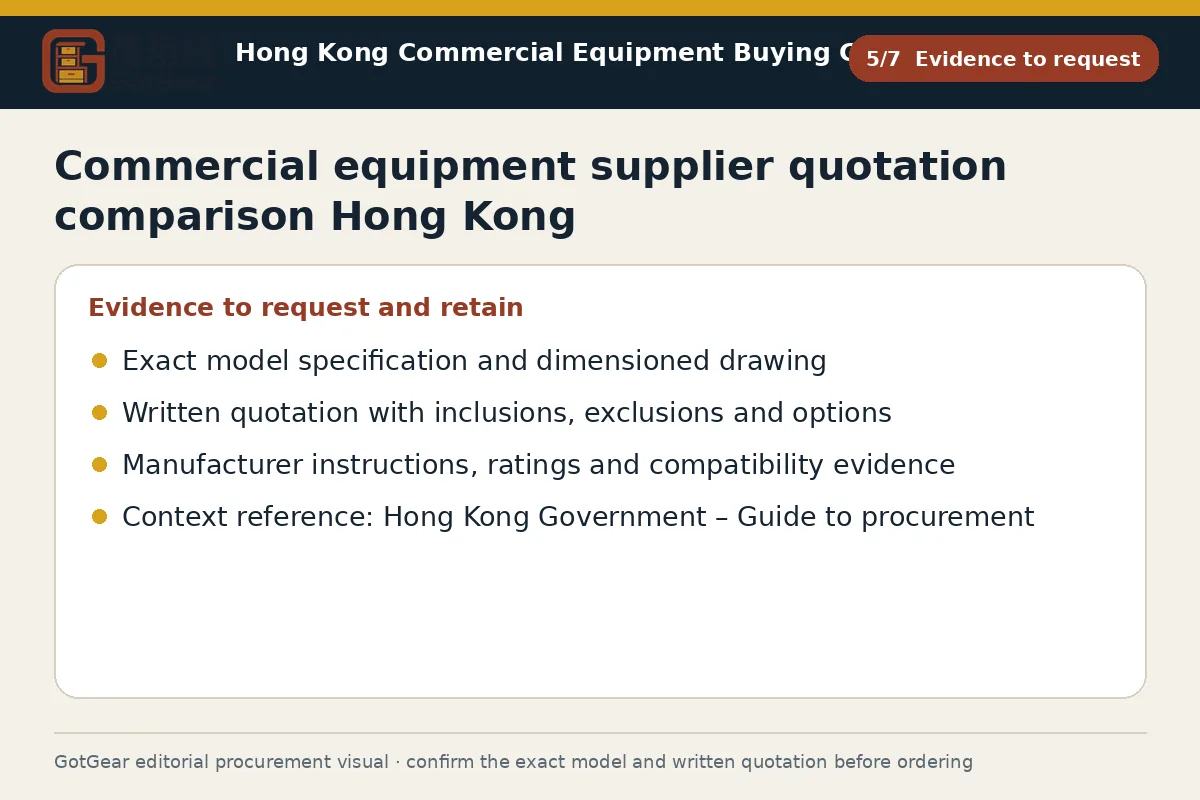
Commercial equipment supplier quotation comparison Hong Kong decision checklist
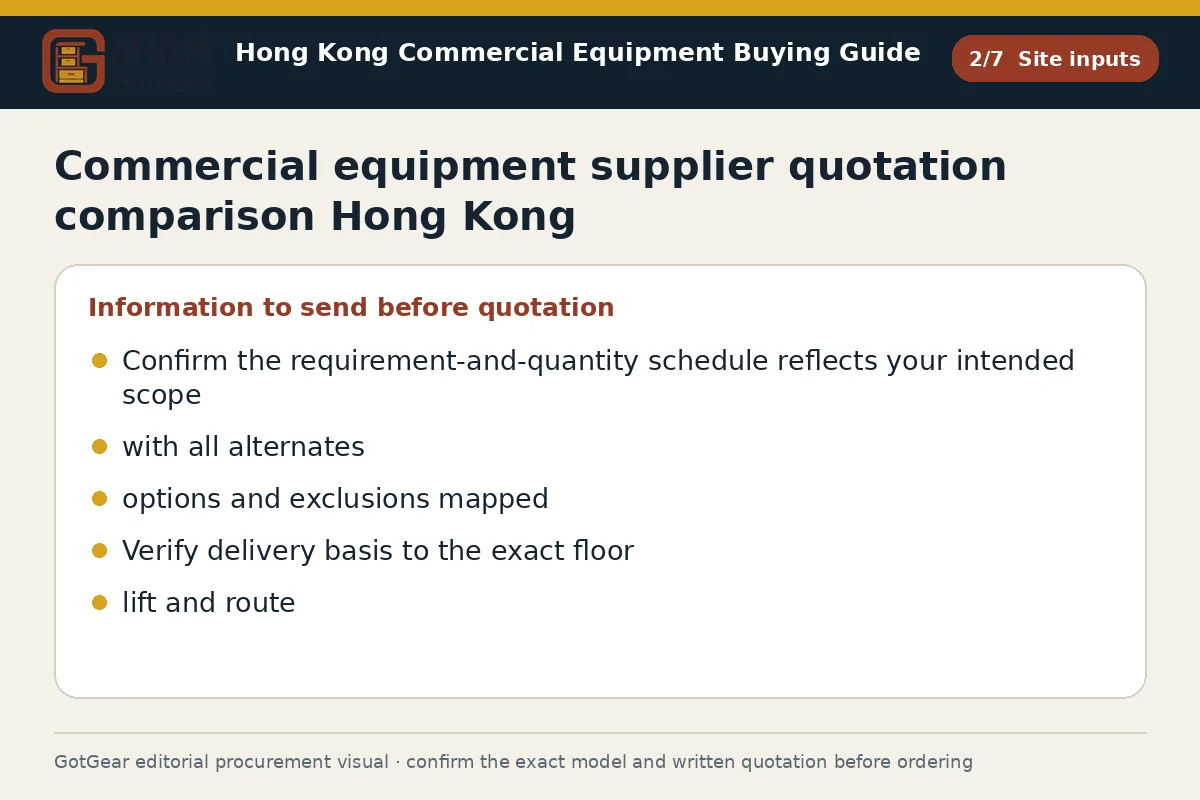
Confirm that the requirement and quantity schedule reflects your intended scope, with all alternates, options and exclusions clearly mapped. Verify the delivery basis down to the exact floor, lift and route, and check building‑management booking windows. Ensure utilities, loads and service points are measured, and that installation and commissioning responsibilities are explicit. Compare TEC, including installation, training, documentation, warranty and first‑year support. Record validity, lead time and any assumptions. Request datasheets and method statements where non‑standard works are proposed, and bilingual user materials if required. Document residual risks and propose mitigations. Before award, validate supplier authorisations where relevant and align the written commercial equipment quotation for Hong Kong with your purchase order terms.
- Operating use, quantity and expected frequency
- Dimensions, capacity, material and accessory requirements
- Delivery address, floor, goods lift and loading window
- Required documents, acceptance checks and after-sales arrangements
Key points for commercial equipment supplier quotation comparison Hong Kong
Hong Kong projects hinge on access and coordination. Many deliveries route through tight loading bays and goods lifts, with management offices enforcing booking windows and protective measures. Note measured lift and doorway clearances, turning spaces and any stair segments, then confirm the latest building rules in writing. Humid plant rooms, kitchens and waterfront venues may influence materials and maintenance intervals. Bilingual operating materials smooth handover for mixed teams. This page highlights comparison practice, not legal advice; model specifications, the formal written quotation, building‑manager instructions and any competent authority guidance prevail.
Questions about commercial equipment supplier quotation comparison Hong Kong
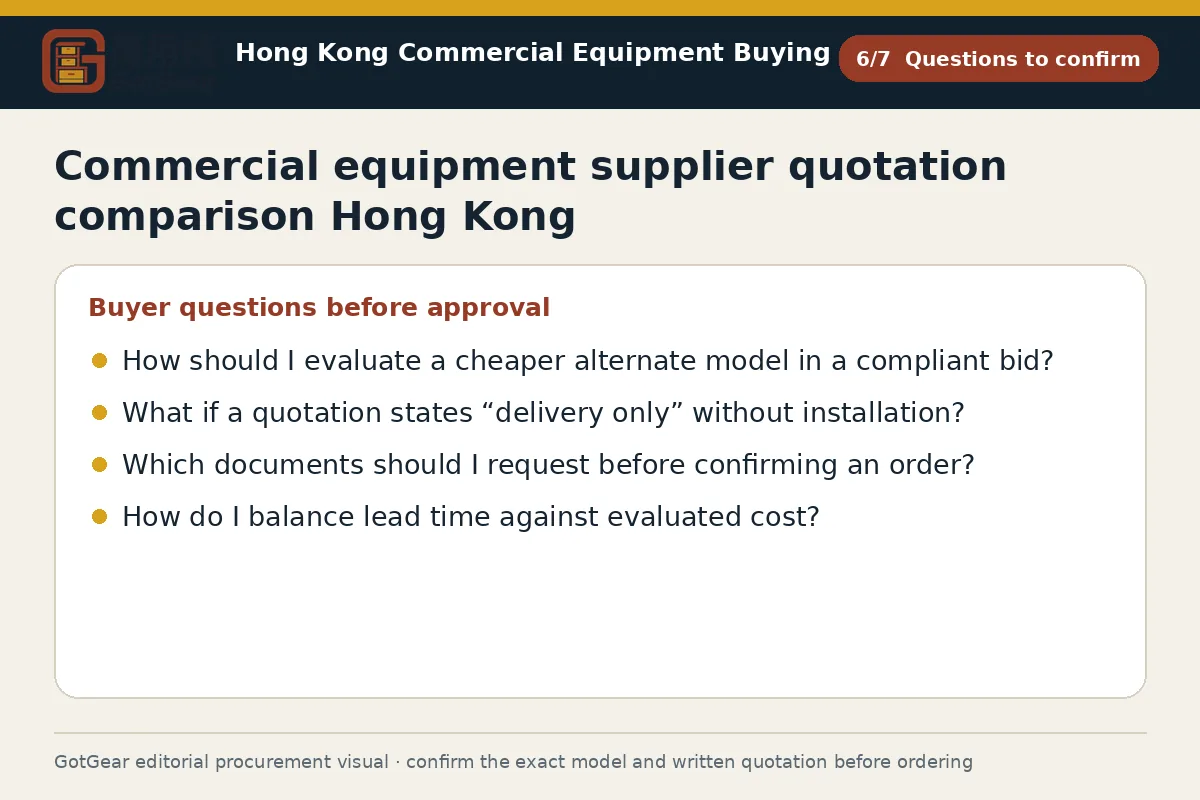
How should I evaluate a cheaper alternate model in a compliant bid?
Assess performance, footprint and services against the requirement schedule first, not cost. Request the manufacturer’s datasheet, installation clearances and any changes to utilities, then keep the alternate as a separately priced line. Acceptance may also depend on venue, insurer or consultant approval for the specific model. Record the risk and required confirmations in the decision table before recommendation.
What if a quotation states “delivery only” without installation?
Normalise the basis: add evaluated costs for inside placement, hoisting via goods lift or stairs, protection, waste disposal and commissioning as separate lines. Confirm building rules for loading windows and escorts. If the supplier will not install, identify who will, how services will be connected, and what documentation is needed. Keep all add/deduct items traceable to avoid hidden gaps.
Which documents should I request before confirming an order?
Ask for model datasheets, a delivery and installation plan, warranty terms, and bilingual user materials. Where the venue or insurer requires it, request licensed‑worker sign‑off for fixed wiring or gas, and hygiene or materials statements for food‑contact equipment. For non‑standard methods, seek a brief method statement or sketch. The formal written quotation and agreed exceptions should prevail over marketing material.
How do I balance lead time against evaluated cost?
If a fixed opening or event date is critical, prioritise a compliant offer with confirmed delivery and installation readiness, even if it is higher on a unit basis. Request a dated production and logistics plan and confirm building management bookings. Where time is flexible, a lower TEC may be preferable. Always align commitments in the written quotation and your purchase order before award.
Continue with closely related procurement topics
These pages share equipment, operating or decision-stage signals with this guide.
Commercial equipment quotation Hong Kong
GotGear offers a practical guide to commercial equipment quotation Hong Kong. Standardise scope and responses by issuing one commercial equipment RFQ Hong Kong for each request for quotation commercial equipment Hong Kong.
Read the guide
Commercial equipment supplier credentials Hong Kong
GotGear explains how to verify commercial equipment supplier credentials Hong Kong. See the commercial equipment supplier company profile Hong Kong and equipment supplier registration Hong Kong.
Read the guide
Government equipment supplier Hong Kong
GotGear guide for procurement teams in Hong Kong shows how to verify a government equipment supplier Hong Kong by checking legal identity, issuing body, required documents and current status against procurement records.
Read the guide
Commercial equipment supplier Hong Kong
GotGear outlines steps to vet a commercial equipment supplier Hong Kong by verifying the supplier's legal entity, experience, documentation, and that the quoted scope and terms match your equipment specification and intended use.
Read the guideRelated topic indexOpen more English procurement pages2 topics
Browse additional equipment families, applications and procurement questions relevant to a wider buying brief.