Before Ordering Corporate Mooncakes, Write Down the Approval Path
GotGear and YumYum (including its gifting, baking and florist branches) share an owner; this collection is not an independent recommendation. GotGear does not provide catering, gifting, cake, floral, tuition or rental services. External-service information is separate from GotGear’s equipment catalogue; confirm the actual scope with the relevant provider. Articles are general planning information, with no promises about supply, arrangements or outcomes. Concept photos are not records of real events, customers or classes.
The short answer
Before ordering corporate mooncakes, name the person who approves each decision and record what their approval covers. Separate product specifications, packaging artwork, recipient information and receiving arrangements, then send one version-controlled release to the supplier.
Before ordering corporate mooncakes, name the person who approves each decision and record what their approval covers. Separate product specifications, packaging artwork, recipient information and receiving arrangements, then send one version-controlled release to the supplier. A manager approving a box colour has not necessarily approved the filling, the label or the addresses attached to that box.
This is a same-owner planning journal: GotGear and YumYum share an owner. GotGear publishes the guidance; it does not provide food, floral, gift, class or rental services. The supplier information discussed here is an enquiry resource, not an independent recommendation or confirmation that a particular arrangement is available.
Start with the recipient groups, not the box design
Write down what each gift is for before asking anyone to choose a ribbon. Staff collection from a Kwun Tong office, individual client gifts handed over after a Central meeting and boxes sent to colleagues' homes are different tasks. They may share an appearance, but they need different packing records and receiving plans. Keep those distinctions visible from the first brief.
For example, a hypothetical Hong Kong company might want one coordinated outer design for its Mid-Autumn programme while sending different contents to different groups. An office-sharing box should not automatically become the default individual gift. Ask who will open it, whether it will be passed on and whether the recipient actually wants an edible gift. Give people a discreet way to decline without asking them to explain personal circumstances.
YumYum's Corporate Mooncake page discusses staff and client gifting with coordinated packaging enquiries. Use it to frame your own request: describe the recipient groups, intended handover and elements requiring branding. Ask for written confirmation of the feasible scope rather than treating the page as a commitment to reach every recipient or accommodate every design.
Choose one internal coordinator to maintain the brief. Department contacts can check their own recipients, but should not independently instruct the supplier to change the assortment or artwork. The coordinator's job is to reconcile those requests and put unresolved decisions back to the correct approver, not to guess what a silent colleague intended.

Give each approval a specific owner and meaning
Make an approval record with a decision, an owner and the evidence they need to review. Marketing may approve logo placement and greeting copy. The organiser responsible for the order approves quantities and the accepted product specification. Department contacts check recipient details. A person at each destination confirms that the site can receive and store the chosen products. These are suggested roles; a smaller business can assign several to one person.
Avoid a single message saying that everything looks fine. Record whether approval covers artwork only, a physical sample, an ingredient specification or the final destination allocation. State any conditions in the same record. If the sample uses a temporary insert, for example, an approval of its overall appearance should not silently become approval of an unseen production insert.
Keep an enquiry separate from permission to proceed
A request for ideas should be labelled as an enquiry. Ask the supplier what can be confirmed, what requires a sample and what information remains missing. Discuss the sequence of review and the point at which changes stop being possible. Do not promise an internal approval date until the relevant people have agreed to it, and do not infer a production slot from an automated acknowledgement.
Name a final release owner
Give one person authority to send the consolidated instruction after all relevant approvals are present. Their release should identify the accepted product sheet, artwork file, packaging sample and allocation record. If one item remains conditional, the order is not ready for an unconditional instruction. A supplier's written acceptance of the same versions is the useful closing step; a collection of scattered internal replies is not enough.

Distinguish a branded sleeve from a manufacturing change
Describe what is actually changing. Adding a greeting card to an existing box is not the same request as altering a tray, changing a moulded surface or developing a different filling. A logo on the outside does not by itself mean a new mooncake formulation is needed. Separating these choices makes the enquiry more precise and keeps artwork approval from standing in for product approval.
The Custom Mooncake Manufacturing resource discusses product and packaging development enquiries. If that is the route under consideration, provide a written specification of the proposed changes and ask who would manufacture and pack the product. Request current supporting documentation for any assurance your organisation needs; do not assume factory ownership, certification scope or production capacity from a page heading.
For a manufacturing enquiry, identify the product style, intended assortment, piece count and requested appearance. Ask which details are already established and which would need development. Record the source of ingredient and handling information, who will issue the final label and what would trigger a new sample. The organiser should not fill an information gap with a guessed shelf life or a decorative product description.
If the brief involves existing products supplied in batches, YumYum's Mooncake Wholesale page is a disclosed supplier-information resource for that separate enquiry. Specify whether you need grouped packs or individual gift presentation, and ask how assortments and allocations would be recorded. The anchor describes the external resource; it is not a GotGear equipment offer or evidence of a particular purchasing benefit.
Put substitution rules in writing before approving the specification. A change from one filling to another can affect the ingredient information, recipient allocation and greeting-card wording. Require the supplier to report the proposed change for review rather than treating an apparently similar product as automatically interchangeable.
Approve the packaging as a physical object
A flat design proof can show spelling and layout, but it cannot demonstrate how a lid closes or whether an insert supports the contents. Ask what kind of sample will be available and which parts represent the intended finished packaging. Compare the closed box, opened box and carrying arrangement. Keep reference photographs with the record, clearly described as samples rather than images of an accepted final batch.
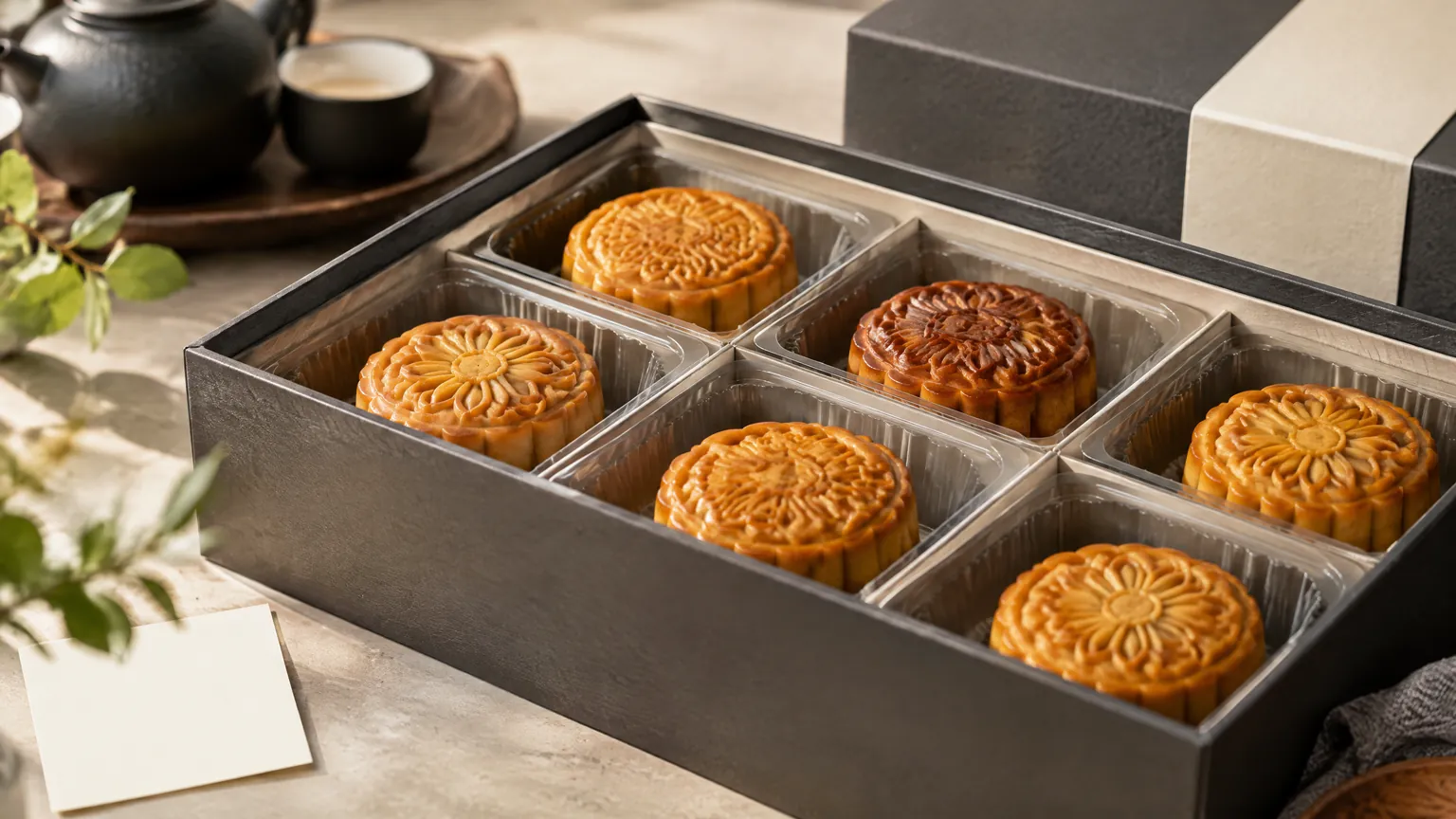
The Mooncake Gift Box page presents assortment and compartment ideas relevant to this review. Treat those images as presentation references, then confirm the actual contents, dimensions, inserts and outer packaging for your enquiry. A box that looks suitable on a screen still needs a practical check against the intended handover and the product information that must remain available.
Try the complete configuration, including any card or sleeve. Does the recipient need to remove the sleeve to read storage instructions? Does the greeting card press against the contents? Can the box remain supported during the short journey from reception to the collection point? If the pack will be taken home, consider how it sits inside the proposed bag rather than approving the bag in isolation.
Settle logo ownership and the correct artwork internally. For a bilingual corporate greeting, have someone authorised to approve both language versions check names, tone and punctuation. A decorative greeting is separate from the food label, so an approved greeting does not establish that the label is accurate or complete. Save the approved artwork itself, not only a screenshot with an ambiguous filename.
Keep food information inside the approval record
Hong Kong's Centre for Food Safety explains that general prepackaged-food labelling requirements, subject to exemptions, cover the food name, ingredient list and specified allergens, date marking, relevant storage or use instructions, manufacturer or packer details and quantity information. Ask the supplier how those requirements apply to the proposed pack and request the label proof; this checklist does not certify compliance. 1
The CFS also explains that labels are generally permitted in English, Chinese or both. Where both are used, the food name and ingredient list must appear in both languages. That matters when a corporate design team adds English copy to an existing presentation: ask the supplier to review the complete labelling arrangement rather than assuming that a translated greeting settles the food-information question. 1
Do not approve the assortment solely by flavour name. Ask for the current ingredient information and any cross-contact information relevant to recipient enquiries. A preference for plant-based ingredients is different from a request concerning an allergy. Do not turn a flavour description, a sample tasting or the absence of a particular ingredient in an informal message into an allergen-exclusion guarantee.
Keep the label proof tied to the specific product version. A sample box may use illustrative date information, so ask how the final batch's dates will be applied and checked. If the formula, assortment or packer changes, ask which parts of the specification and label need review again. Keep unverified health or certification language out of the corporate greeting.

Let recipient information follow a separate, controlled route
The recipient list should not circulate with the design proof. Hong Kong privacy principles require personal-data collection to be related to a lawful purpose and adequate but not excessive. They also address collection notices, accuracy, retention, permitted use and security. These principles support limiting a gifting list to the details needed for the agreed task rather than exporting a whole employee or client database. 2
For staff collection at an office, decide whether a department allocation and an internal collection record can do the job. For individually addressed handovers, confirm the intended name, address and necessary contact details through an appropriate process. When collecting directly from recipients, explain the purpose and relevant classes of recipients of the data. Ask the organisation's privacy lead to review the process where needed. 2
Separate the artwork approval file from the address file. The designer needs the greeting and logo, not a colleague's home address. Share the dispatch information only with people who need it, using an access-controlled method appropriate to the organisation. Establish a retention and deletion arrangement for working copies and discuss the supplier's handling of information instead of assuming that an attachment disappears after dispatch. 2
Treat a move of office or a corrected surname as a tracked revision. Update the master allocation record, identify the affected card or dispatch label and ask the supplier which physical items have been changed. A revised spreadsheet alone does not prove that an already printed label has been replaced. Require confirmation of the accepted revision before relying on it.

Do not release the order before each site can receive it
A receiving plan is part of product selection, not something to add after approval. A meeting room awaiting an evening event and a staffed reception desk accepting morning deliveries have different practical needs. Ask each Hong Kong destination about access, receiving responsibility and storage before selecting products that depend on particular handling conditions. No provider's general coverage statement resolves those local questions.
CFS mooncake guidance advises checking packaging and expiry dates, following package storage instructions and maintaining the appropriate cold conditions for snowy and ice-cream mooncakes. It also recommends an icebox when carrying those types outdoors. Do not transfer one product's handling instructions to another merely because both are called mooncakes. 3
For an office distributing boxes that colleagues will take home, consider the whole handover. The office may have suitable storage while an employee has a long journey and errands afterwards. Share the supplier's product-specific instructions in a form the recipient can read. If suitable handling cannot be established, reconsider the selection or collection arrangement rather than assuming a decorative box provides temperature control.
At receipt, have the designated person compare the delivered allocation with the accepted record and check packaging, dates and supplied instructions. Record discrepancies and contact the supplier before distributing an uncertain item. Do not improvise a shelf life or describe an unclear product as suitable merely because the printed greeting is correct.
Use a short final-release checklist
The final review should be brief because the detailed work has already been done. Check the accepted versions together, not by searching through a chat history while cartons are on their way.
- Confirm the product specification and label proof refer to the same assortment.
- Record artwork approval and the packaging sample's accepted scope.
- Reconcile group quantities with the controlled recipient allocation.
- Obtain each site's receiving and storage confirmation.
- Identify the release owner and obtain the supplier's acceptance of the listed versions.
If a late request arrives, decide which approval it affects before sending it onwards. Changing a greeting may need a new artwork check; changing a filling needs a product and label review; moving a destination needs an allocation and receiving review. Keep the unaffected approvals, reopen the affected ones and issue a clearly identified replacement instruction. That is more useful than either restarting everything or pretending that nothing changed.

Common questions
Does adding our logo mean we need a new mooncake formulation?
No. Specify whether the request changes only a card or sleeve, the physical packaging, or the product itself. Ask the supplier to confirm the route and the samples needed for that exact scope.
Can marketing approve the complete order after checking the artwork?
Only if it has been assigned authority for every relevant decision and has reviewed the necessary evidence. Artwork approval alone does not cover ingredients, labelling, recipient data or receiving arrangements.
What should change if a recipient's address changes after sample approval?
Revise the controlled allocation record, check receiving conditions at the new destination and identify affected dispatch labels or cards. Ask the supplier to confirm the accepted revision and any physical changes; an unchanged product sample may remain approved.
What if a provider page mentions certification or production capacity?
Treat it as a claim to verify. Request current supporting documents relevant to the actual manufacturer and proposed product, plus written confirmation of the order scope. Do not infer a production commitment from general page copy.
Sources & what they support
Each reference supports only the stated scope. Citations are not independent endorsements of YumYum or its branches and do not confirm a provider’s current arrangements or any individual outcome.
- Centre for Food Safety: Food Labelling FAQ (opens in a new tab)
General prepackaged-food label requirements subject to exemptions, including ingredients and specified allergens, dates, special storage or use instructions and language requirements. Does not establish compliance of a specific supplier or product.
- Community Legal Information Centre: Personal Data and the Six Data Protection Principles (opens in a new tab)
Hong Kong principles covering lawful purpose, adequate but not excessive collection, collection notices, accuracy, retention, permitted use and security of personal data. Supports recipient-list controls, not a declaration that a particular workflow is legally compliant.
- Hong Kong Government: CFS Mooncake Surveillance Announcement and Handling Advice (opens in a new tab)
Mooncake packaging and expiry checks, following package storage instructions, cold handling for snowy and ice-cream products and icebox use outdoors. The surveillance results are not used to endorse YumYum.