A receding-hairline appearance brief: compare coverage without diagnosing loss
GotGear and DT HUB share an owner. This collection is not an independent recommendation. GotGear does not supply DT HUB salon, wig, Academy or healthcare services. Three online service sections do not represent three physical stores; the shared public studio is in Kwun Tong. Medical articles are informational only, with no diagnosis, clinical endorsement or outcome promises, and do not replace medical advice.
The short answer
Start by describing the appearance you want, not guessing why your hairline has changed. A useful brief identifies which area you want covered, whether you prefer an exposed hairline or a fringe, and how much fitting and care you can manage. Compare those needs with the actual piece and attachment method. Coverage is optional and cosmetic; it does not diagnose hair loss or promise regrowth. Seek qualified medical advice if changes concern you or come with scalp symptoms.

A useful hairline brief might say: ‘I want less temple exposure when my hair moves, but I do not want a completely different forehead shape.’ That gives a fitting conversation something concrete to work with. ‘Fix my hair loss’ does not: it mixes an appearance preference with a medical question that a wig fitting cannot answer.
You can choose coverage, change your styling, leave your hairline visible or take more time. None of those choices needs to be justified by looking younger or more confident. The practical aim is to find an appearance you like without accepting discomfort, maintenance or promises that do not suit you.
Describe the visible area, not its cause
Write down what you notice in ordinary language: more skin showing at the temples, a wider part near the front, or a fringe that separates when you turn your head. These descriptions help locate an appearance concern. They do not establish a diagnosis. The NHS explains that hair loss has different causes and advises seeing a GP if you are worried; it also recommends understanding the cause before considering a commercial hair clinic.1
For an appearance discussion, separate the area you want covered from the outline you want to keep. You might want to soften one corner while preserving your existing centre hairline. Alternatively, you might prefer a fringe without changing the visible outline at all. A lower, straighter front is not automatically the right choice simply because it covers more skin.
The DT HUB page on receding hairline cover is a starting point for discussing cosmetic coverage options. Use it to frame questions about the front edge, blending and attachment, not as evidence that a piece treats the underlying reason for a changing hairline. Confirm the specific option being proposed rather than relying on a general promise of an invisible result.
If you use reference photographs, explain what you like about each one. A soft fringe, modest density or visible forehead is a clearer request than asking to reproduce another person's entire look. A photograph cannot tell you whether the same construction will feel comfortable on your head.
Compare where each option actually covers
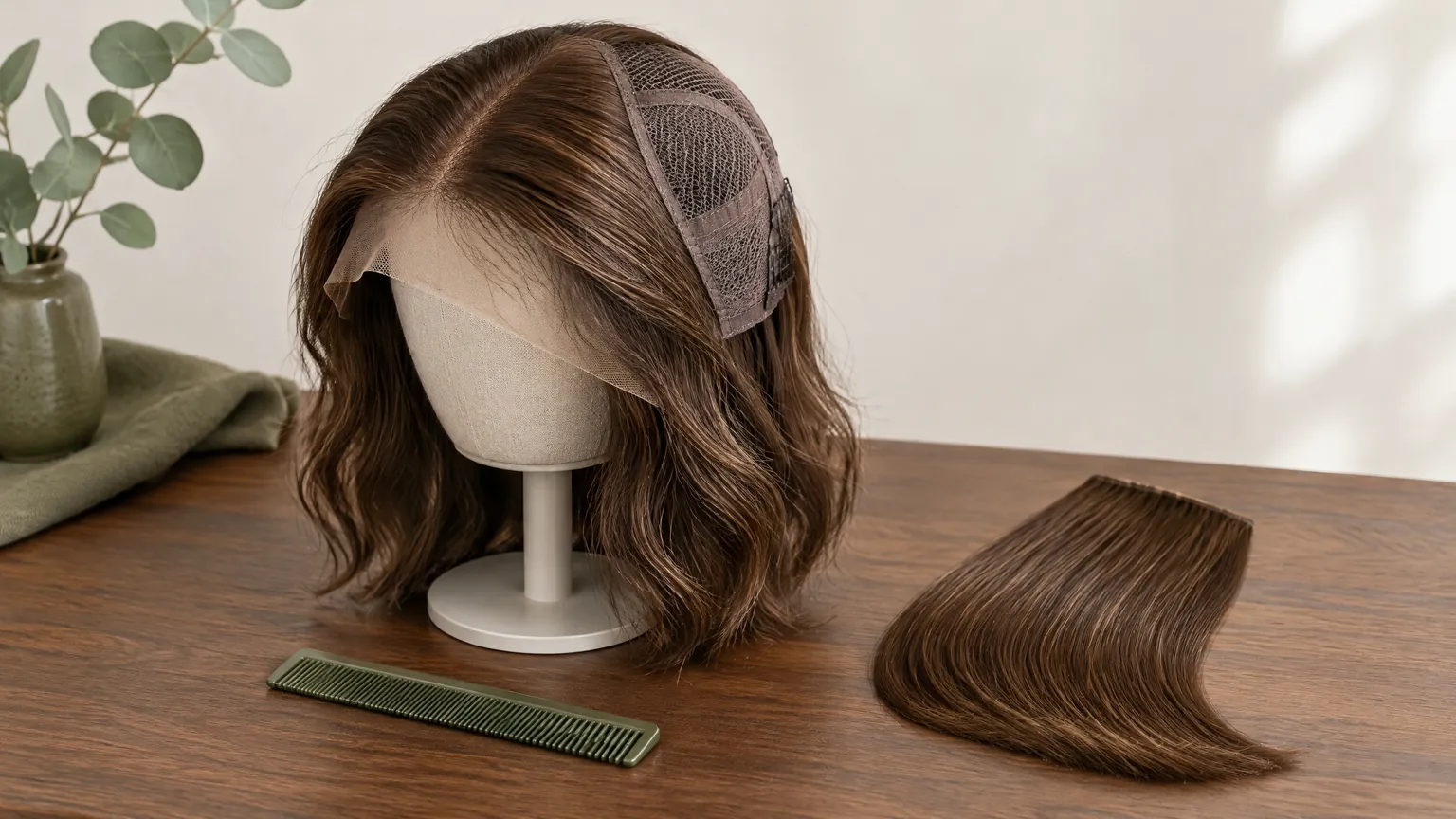
Start with the coverage map before choosing fibre, colour or length. A piece can look attractive on a stand yet leave the area you care about uncovered. Ask to see where its base begins and ends, where added hair falls, and which parts of your own hair remain visible. Product names alone do not answer those questions.
| Appearance option | Question it can help explore | Main check before deciding |
|---|---|---|
| Styling your existing hair | Would a different part or relaxed fringe give enough coverage? | Does the style work without pulling tightly or constant adjustment? |
| Partial topper or piece | Can added hair blend over a defined area? | Does the base reach that area, and what supports the attachment? |
| Front-focused hairpiece | Can the front outline or temple exposure be changed? | How does its edge look with your preferred hair direction? |
| Full wig | Would replacing the overall hairstyle be preferable to blending? | How does the cap fit, and can you manage its care and removal? |
This is a comparison of appearance tasks, not a ranking of treatments. More coverage also means a different amount of existing hair is concealed, so assess what you would be giving up as well as what you would gain.
A topper needs the right coverage map
A topper usually adds hair over part of the head rather than replacing the whole hairstyle. DT HUB's hair topper hong kong information describes partial pieces intended to blend with existing hair. If your priority is the temples, ask whether the proposed base and hair direction actually address them. A crown-focused piece should not be assumed to create a new exposed front edge.
Blending also involves more than colour. Compare texture, density and the way the added hair sits beside your own. Ask where clips or other attachments would sit and whether those positions are suitable for your hair and scalp. If the design depends on hair that is sparse or uncomfortable to pull, pause rather than compensating with tighter attachment.
An exposed front edge needs its own check
Decide whether you want to brush hair backwards, wear a side part or keep the front covered by a fringe. Each puts the edge in a different position. Examine the proposed piece in your preferred style, not only in the arrangement used to present it.
Look from the front and both sides under ordinary lighting. Turn your head gently and see whether the shape still feels like yours. Avoid demanding a perfect close-up photograph as the only standard; a design should also meet your comfort and everyday-use needs. Equally, do not let a flattering hairstyle distract from an edge or attachment you dislike.
Make the comparison fit a Hong Kong working day
Write down how you would use the piece on a normal day. A person who moves between outdoor errands and an air-conditioned office has different practical questions from someone who wants coverage only for occasional video calls. Include glasses, a usual hat and any work requirements that affect the front or sides.
For a broader view of product categories, the DT HUB wig hong kong overview can help you prepare a shortlist. Treat the categories as choices to investigate, not proof that every construction is suitable for every activity. Confirm current fitting arrangements and the particular product's care instructions directly.
Material is one consideration, but not the whole comfort decision. The NHS notes that synthetic wigs are generally easier to look after than real-hair wigs and can feel hot or itchy.1 That is general guidance, not a prediction about a particular piece. Ask to compare the actual cap or base, fibre and attachment rather than assuming a material label settles the question.
Consider the time you can realistically spend on care. If you want to remove a piece after work, ask for a demonstration of the relevant removal process and how it should be stored. If a proposal involves longer wear, ask who handles removal, what maintenance is required and what to do if discomfort develops. Do not assume permission to sleep, swim or exercise in it from a general promotional statement.
Keep comfort separate from the feeling of security
A piece that feels very tight is not necessarily better fitted. The American Academy of Dermatology explains that repeated pulling can cause traction alopecia, a form of hair loss, and that a painful hairstyle is too tight. It identifies scalp stinging, crusts and broken hairs around the forehead among signs worth taking seriously.2
That guidance does not tell you why your own hairline has changed. It does give a sensible boundary for an appearance trial: do not accept pain or pulling as the price of coverage. Existing hair beneath a covering should not be pulled tightly simply to make the covering sit neatly. The AAD advises keeping hair loose beneath coverings and reducing stressful styling.2
Ask the fitter to explain where the design grips, presses or attaches. With a removable option, request a demonstration of removal without tugging at your own hair. With any proposed tape or adhesive, ask for product-specific suitability and removal guidance. Avoid improvising with household products or accepting claims that an attachment is appropriate for every scalp.
A brief try-on cannot establish long-term comfort or exclude a later skin reaction. Record pressure, warmth or irritation while comparing options, and ask what follow-up is available if fit becomes uncomfortable. Persistent irritation, pain, inflammation or sudden marked hair loss should be assessed by qualified medical personnel, not managed by repeatedly covering the area.
Bring a brief that leaves room to say no
A fitting conversation should clarify a choice rather than create an obligation. Decide which features are essential and which are negotiable before discussing a specific piece. ‘No pulling at the temples’ might be essential; matching the exact length of a reference image might be negotiable. This helps prevent an attractive sample from overriding your everyday needs.
The page labelled free wig consultation describes DT HUB's consultation and trial service. Check the current terms, what the appointment includes and whether measurements, alterations, an order or later support involve separate charges. The word ‘free’ should not be treated as a guarantee that every subsequent step is included or that an appointment is available when you want it.
Before arranging a fitting, use this preparation checklist:
- Describe the area you want covered and the hairline shape you want to retain.
- State whether your preferred style exposes the front edge or uses a fringe.
- Note your normal wearing occasions and the care tasks you can manage.
- List any scalp discomfort or attachment concerns you need to discuss.
- Ask how fitting, removal, alterations and follow-up are handled.
- Request written confirmation of the proposed product, service scope and order terms before committing.
Keep a short note for each option: coverage, comfort, appearance, care and unanswered questions. You do not need to give each one a score. A design with one unresolved essential concern can remain unsuitable even if everything else looks appealing.
GotGear and DT HUB are under common ownership. The linked pages describe DT HUB's own services; they are not an independent recommendation or medical endorsement.
A hypothetical comparison: temple coverage for office days
Consider a hypothetical office administrator who wears glasses, prefers a side-swept fringe and wants less temple exposure during conversations. They do not want an unusually dense front or a daily routine built around styling tools. Their appearance brief specifies a familiar forehead shape, a manageable fringe and an attachment that does not interfere with their glasses.
They could first compare a relaxed styling change with a partial piece. During a proposed fitting, they would check whether the fringe covers both areas they identified and whether the added hair blends at the sides. A topper that improves volume near the part but leaves the temple concern unchanged would not meet this particular brief, however attractive its crown looks.
They might also compare a full wig to understand the alternative of not blending with their own hair. That does not make the wig the automatic choice. They would still need to consider cap comfort, the overall change in appearance and the care routine. If neither option meets the essential requirements, taking the brief away is a reasonable outcome.
This example describes a decision process, not a customer result. It does not assume stock, a same-day fitting or suitability for someone with the same visible hairline. A different person who wants a brushed-back style would need to examine the exposed edge more closely and might reach a different conclusion.
Let support follow the wearer's preference
If you accompany someone to a fitting, ask whether they want practical help, an opinion or simply company. Comments such as ‘you look younger now’ can introduce a goal they never chose. More useful feedback refers to their brief: whether the fringe moves as they wanted or the density resembles their usual style.
The wearer should decide how much personal information to share and whether they want photographs taken. A support person can help remember questions and record answers without taking over the conversation. If the person prefers to keep their hairline visible, that choice deserves the same respect as choosing coverage.
Hair changes can affect wellbeing. The NHS recognises that hair loss can be upsetting and advises telling a GP when it is affecting you.1 Emotional support does not depend on purchasing a product, and a cosmetic choice should not be presented as the only way to feel comfortable socially.
Keep the medical question on a separate track
A fitter can discuss the appearance, dimensions and practical use of a piece. Those tasks are different from identifying the cause of hair loss. A familiar-looking pattern or a photograph is not enough for this article to diagnose a condition. If changes are persistent, sudden or worrying, or the scalp is painful, itchy or inflamed, seek qualified medical assessment.
The NHS states that no hair-loss treatment is completely effective.1 Neither that guidance nor the AAD's advice on avoiding traction provides evidence that a particular wig, topper or commercial service causes regrowth. Coverage changes what is visible while worn; it does not establish that follicles have recovered or that future changes will stop.
You can investigate appearance options while keeping medical advice separate, but do not let a fitting substitute for assessment of symptoms. The best brief ends with a practical question: does this option provide the coverage I want, with a fit and routine I can accept? It need not promise a different hairline underneath.
Common questions
Will a crown topper cover my temples?
Not necessarily. The answer depends on the base size, its position and the direction of the added hair. Ask to see the proposed piece in your preferred hairstyle, including side views. A piece that adds crown volume may not address temple exposure or create an exposed front hairline.
What if the piece looks right but feels tight?
Do not treat pain or pulling as proof of secure attachment. Ask for the fit to be reviewed and for an appropriate removal demonstration. Repeated tension can damage hair. Persistent discomfort, scalp inflammation or worrying hair changes belong with qualified medical personnel rather than being hidden by tighter coverage.
Must I choose coverage while arranging medical advice?
No. Coverage is an optional appearance choice, not a requirement for investigating hair changes. You can keep your hairline visible, try a relaxed styling change or postpone a purchase. Medical assessment addresses possible causes and symptoms; a fitting addresses the look, fit and practical use of a particular piece.
Sources & what they support
The scope below identifies what each reference supports. Citations do not imply independent endorsement of DT HUB or any provider, and do not establish treatment benefits or guaranteed results.
- NHS: Hair loss (opens in a new tab)
Hair loss has different causes; people worried about it should seek GP advice, including before considering a commercial hair clinic. Supports general wig-care and comfort considerations, emotional impact and the limit that no treatment is completely effective. Does not establish any DT HUB product's performance or Hong Kong healthcare entitlement.
- American Academy of Dermatology: Hairstyles that pull can lead to hair loss (opens in a new tab)
Repeated tension can cause traction alopecia; painful tight styling, scalp stinging, crusts and hairline breakage merit attention. Supports loose styling beneath coverings and dermatological assessment, not diagnosis of an individual or a claim that cosmetic coverage regrows hair.