
For an aluminium work platform with a safety lock in Hong Kong, inspect the locking action, feet, floor condition and complete set-up before each task. Follow the manufacturer’s instructions and verify site controls and applicable Hong Kong requirements; neither a lock nor rubber feet alone establishes safe use.
How the locking sequence works on Aluminium work platform with safety lock Hong Kong
An Aluminium work platform with safety lock Hong Kong relies on a defined sequence: legs fully deployed to their stops, spreaders or braces seated, and the platform or frame lock positively engaged. Ask the supplier to describe this sequence in writing and provide diagrams or a short operation note in English and Chinese. Request the lock type (auto-latch, cam, pawl or pin), indicator method (visual window, tagged flag, tactile detent), and what constitutes a successful engagement. As an example starting point only, the lock should resist manual back-drive without noticeable play (e.g., under 2 mm); confirm acceptable tolerance with the manufacturer and your competent adviser.
When comparing quotations, include fields for lock materials, corrosion protection, re-engagement method, and whether the mechanism is guarded against accidental release when carried through narrow corridors or goods lifts. Ask for maintenance and inspection intervals as guidance, plus the availability of replacement lock components. On receipt, cycle the lock repeatedly in a clean area, check for a consistent click, confirm the indicator is unambiguous from normal working positions, and verify that folded components do not foul doorways or lift car finishes. If anything binds, deforms or misaligns, quarantine the unit and request the manufacturer’s inspection advice in writing before use.
Floor and foot inspection for Aluminium work platform with safety lock Hong Kong
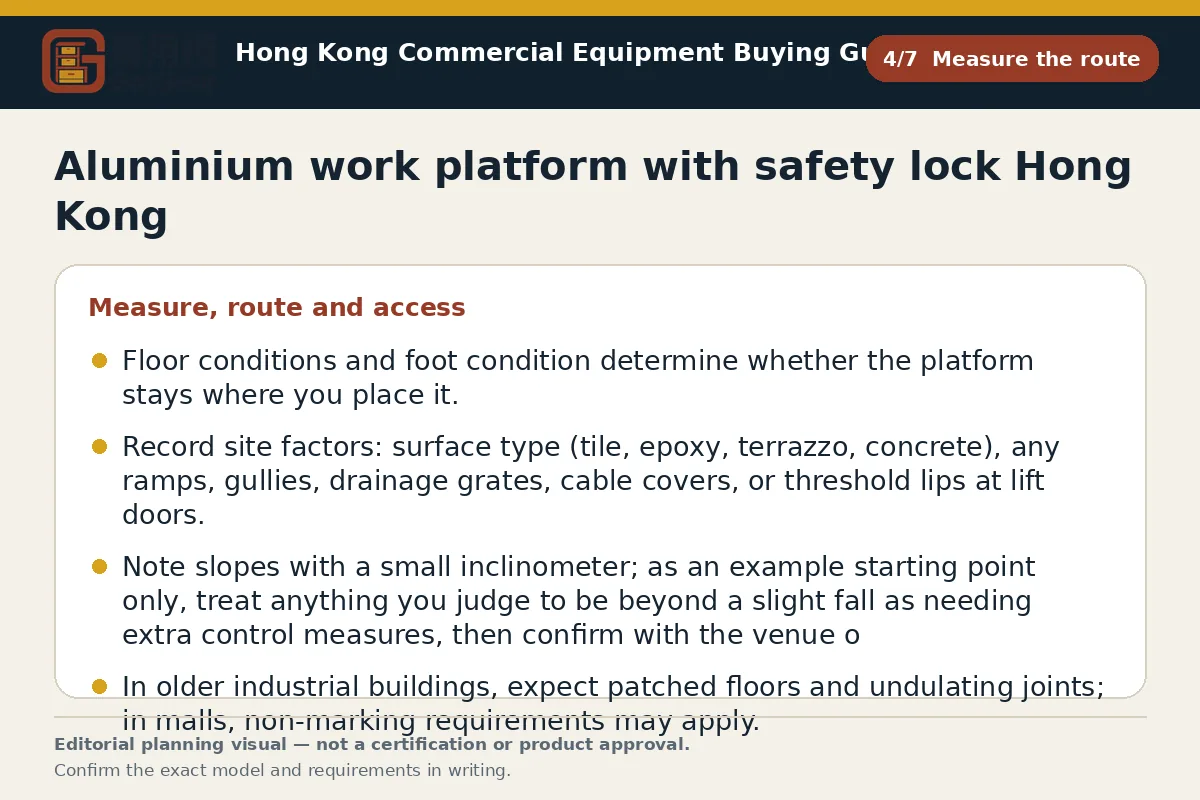
Floor conditions and foot condition determine whether the platform stays where you place it. Record site factors: surface type (tile, epoxy, terrazzo, concrete), any ramps, gullies, drainage grates, cable covers, or threshold lips at lift doors. Note slopes with a small inclinometer; as an example starting point only, treat anything you judge to be beyond a slight fall as needing extra control measures, then confirm with the venue or building manager. In older industrial buildings, expect patched floors and undulating joints; in malls, non-marking requirements may apply.
Inspect feet before every set-up. Check that pads sit flat with full contact, fasteners are snug, and rubber shows no splits, glazing, swelling or contamination from cleaning chemicals. Ask the supplier for any available friction or compatibility data for their compound on wet concrete or smooth tiles, and whether pads are non-marking. Request part numbers and replacement instructions in bilingual format, and compare quotations on the lead time and availability of spare feet sets. On receipt, verify all feet match the quoted specification, seat squarely, and can be replaced using basic hand tools without disturbing primary structural fixings.
What should buyers compare for Aluminium work platform with safety lock Hong Kong?
| Criterion | Straightforward requirement | More complex requirement | Evidence to provide |
|---|---|---|---|
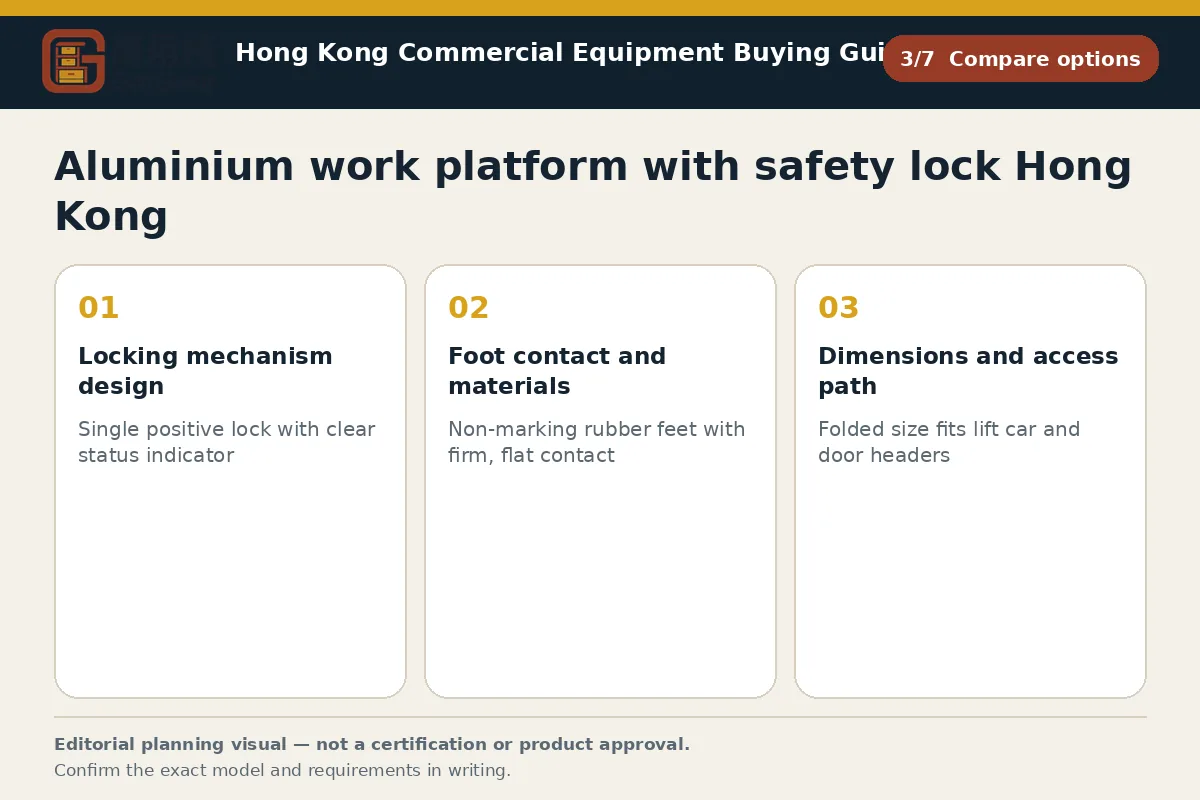
| Locking mechanism design | Single positive lock with clear status indicator | Dual-action lock with secondary visual/tactile indicator and captive release | Lock type, drawings, materials, indicator description and reset method |
| Foot contact and materials | Non-marking rubber feet with firm, flat contact | Articulated non-slip feet with replaceable pads and wear indicator | Pad area, compound description, articulation detail, spare part numbers |
| Dimensions and access path | Folded size fits lift car and door headers | Route survey covers turns, thresholds and corridors to the job site | Measured lift car size, route photos, folded dimensions, total weight |
| Site surface condition | Use only on clean, dry, level hard floors | Controls for slopes, drains, soft finishes or temporary coverings | Surface description, risk note, venue/building acceptance confirmation |
| Documentation and upkeep | English/Chinese user instructions supplied | Inspection checklist, maintenance guidance and parts list for fleet control | Sample manuals, bilingual O&M, serial number format and spares list |
This framework helps buyers create comparable written enquiries. Final model specifications, availability, delivery and commercial terms must be confirmed in a formal quotation.
Different checks for Aluminium work platform with safety lock Hong Kong and Aluminium work platform with non-slip rubber feet Hong Kong
Checks differ because locks manage geometry while feet manage contact. For a safety-locking platform, focus on engagement certainty, redundancy against accidental release, and the clarity of any indicator viewed from the operator’s stance. For a model described as Aluminium work platform with non-slip rubber feet Hong Kong, concentrate on compound grip on your actual floors, non-marking behaviour in public spaces, and whether the feet articulate to stay flat on mild irregularities. Neither feature compensates for unsuitable floors, overreach, or loads outside the quoted rating.
When seeking quotations, separate lock and foot requirements so nothing is assumed. Specify lock type, indicator style, reset method with gloves, and the availability of replacement lock kits. For feet, request pad area, articulation or swivel detail, confirm replaceability, and ask for the manufacturer’s statement on chemical and humidity resistance suitable for Hong Kong. Include folded and open dimensions for tight goods-lift cars and narrow fire doors, total weight for manual handling routes, and any building-manager rules on non-marking feet. If your tasks include uneven service corridors, consider whether adjustable legs or platform levelling accessories are offered, and ask for written compatibility and part numbers.
Instructions to verify before using Aluminium work platform with safety lock Hong Kong
Before each job, walk the route from store to work area and confirm access bookings with the management office if you need a loading window or goods-lift escort. At the task site, clear obstructions, isolate wet-cleaning, and assess the floor. As an example starting point only, if you detect more than a gentle slope or soft finishes, plan controls such as moving the task, using protective sheeting approved by the venue, or changing equipment—then confirm with your supervisor. Place the platform, ensure all feet bear evenly, deploy to the intended height, and operate the lock fully.
Verify the lock by sight and touch, then load the platform lightly and check for any creeping or rocking. Inspect feet for debris and damage; wipe clean if contaminated. Confirm any exclusion zone, signage and supervision per your organisation’s procedures. Ensure instructions are present in bilingual format and the serial number is legible for your asset log. If the lock sticks, the indicator is ambiguous, or feet are worn, tag the unit out of service and seek the manufacturer’s written guidance. Do not continue until your competent person closes the issue and the model specification and formal quotation remain applicable.
Aluminium work platform with safety lock Hong Kong decision checklist
Confirm your floor types, slopes, thresholds and any non-marking policies, then select a platform with feet compatible with those surfaces. Request a written description of the locking sequence, indicator design and replacement parts availability, plus bilingual instructions. Provide measured folded and open dimensions constraints—lift car space, doorway widths and turning space—to each respondent and ask them to state compliance. Compare quotations on lock type, foot design, spare feet kits and materials suited to humid conditions. On receipt, verify serial numbers, lock action and foot seating; cycle the lock several times. Keep a brief note of access bookings, site controls and your internal approval before first use, and escalate any uncertainty to a competent person.
- Operating use, quantity and expected frequency
- Dimensions, capacity, material and accessory requirements
- Delivery address, floor, goods lift and loading window
- Required documents, acceptance checks and after-sales arrangements
Key points for Aluminium work platform with safety lock Hong Kong, Aluminium work platform with non-slip rubber feet Hong Kong
Hong Kong sites often require careful access planning: older industrial buildings and schools may have narrow lift cars, low door headers and tight turns that restrict folded height and width. Management offices commonly control loading-bay time slots and goods-lift escorts, so confirm bookings before delivery or movement. High humidity can accelerate corrosion and rubber degradation; ask about materials and maintenance suited to local conditions. Many public venues require non-marking feet. Treat these as site controls rather than legal advice and confirm requirements with the venue, building manager, insurer or competent adviser for your exact model.
Questions about Aluminium work platform with safety lock Hong Kong
How can I tell if the platform’s lock is truly engaged?
Check the model’s visual or tactile indicator, then try to move the frame in the unlocking direction with light hand force; there should be no unintended release. Finally, load the platform lightly and confirm no creeping occurs. Always follow the exact instructions from the manufacturer and your site procedures for the specific model.
Do I need special feet for smooth tiles or polished epoxy floors?
Yes, choose feet the manufacturer states are compatible with those surfaces and are non-marking if required by the venue. Request any available friction or compatibility data and trial on a small area if permitted. Smooth, wet or chemically treated floors vary, so confirm suitability with your building manager and supplier.
What specification details should appear in a written quotation?
Ask suppliers to state model designation, lock type and indicator, foot design and replaceability, folded/open dimensions and weight, and materials appropriate to humid conditions. Include spare feet part numbers, language of instructions and delivery to your building constraints. The supplier’s quotation format and the agreed model specification prevail for your purchase.
How often should I replace feet or service the lock?
Replace feet when worn, split, hardened, contaminated or not seating flat; inspect before every use. Service intervals depend on the model, usage and your organisation’s policy. As an example starting point only, plan more frequent checks in heavy daily use. Confirm with the manufacturer, venue controls and your competent person.
Continue with closely related procurement topics
These pages share equipment, operating or decision-stage signals with this guide.
Aluminium step platform with safety protective bar Hong Kong
Aluminium step platform with safety protective bar Hong Kong: GotGear assesses task access and geometry. Aluminium step platform with fall protection net Hong Kong: Compare manufacturer details and risks.
Read the guide
Aluminium step platform with platform lock Hong Kong
Aluminium step platform with platform lock Hong Kong and Aluminium step platform with wide non-slip steps Hong Kong should be inspected for lock operation, tread dimensions, surface grip and floor footing, according to GotGear.
Read the guide
Aluminium work platform with adjustable legs Hong Kong
Before selecting or using an Aluminium work platform with adjustable legs Hong Kong, check the ground surface, adjustment range and footprint. Compare Work platform with adjustable stabilisers Hong Kong at GotGear.
Read the guide
Aluminium work platform with bridge board Hong Kong
For Aluminium work platform with bridge board Hong Kong, assess span, access and edge conditions, and confirm supports and connections. Use GotGear to confirm details for any Aluminium work platform guardrail option Hong Kong.
Read the guideRelated topic indexOpen more English procurement pages1 topics
Browse additional equipment families, applications and procurement questions relevant to a wider buying brief.