
A Working platform risk assessment Hong Kong should identify who will use the equipment, where and how it will be set up, the work and loads involved, foreseeable environmental hazards, and the controls required. Verify manufacturer instructions, product evidence, site-specific duties and applicable Hong Kong requirements before selection and use.
Define task, location and users in a Working platform risk assessment Hong Kong
Start by writing a single brief that captures the task, location and users. A working platform risk assessment for Hong Kong should define the work at height in plain language: what must be reached, how long the task lasts, which tools and materials are handled, and what constitutes a successful outcome. Convert that into measurable requirements: target working height (platform height plus guardrail reach), horizontal reach, and platform area required for users’ feet, tools and any parts. Note whether one or more users will be on the platform at the same time, and describe any supervision arrangements for inexperienced staff.
Record the exact place of use. For industrial buildings and shopping malls, walk the access route and note loading dock rules, management office booking windows and whether the goods lift and corridors can accept the packed platform sections. In schools, hospitals and venues, record safeguarding measures, quiet hours and public-separation arrangements. Confirm whether bilingual operating information is required by your institution. Finally, capture the users’ profile: typical footwear, gloves, training level and any physical constraints. This becomes your work-platform procurement specification for Hong Kong and should travel with the enquiry pack so every bidder responds to the same site-specific brief.
Product evidence needed for a Working platform risk assessment Hong Kong
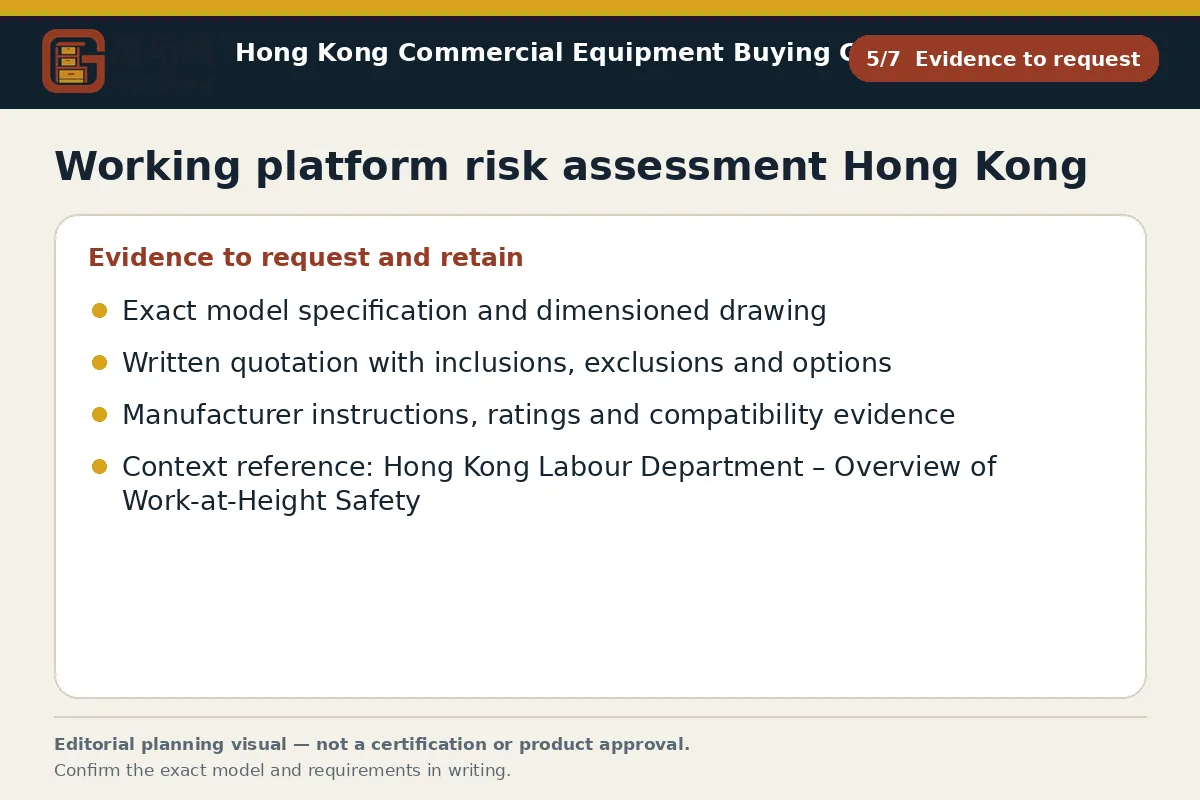
Request product evidence that lets you verify suitability before you compare options. Ask for the manufacturer’s safety instructions and parts list, the marked safe working load shown on the product, and a clear statement of any exclusions (for example, no use on slopes or in rain) relevant to your site. If multiple people will stand on the deck, ensure the supplier confirms how the safe working load is distributed and the intended number of concurrent users. This ties directly to your Mobile working platform safe working load Hong Kong — see the decision point.
Guardrail and access details matter. Obtain drawings or datasheets showing guardrail height, mid-rail/toe-board presence, and gate type, so you can check them against your internal policy and any applicable venue rules. Keep a record alongside your Working platform guardrail requirements Hong Kong — in your review notes. Request anti-slip tread information and the test method used, especially for wet or dusty floors.
For durability and control, ask for statements on corrosion resistance, wheel and brake type, stabilisers/outriggers, and fold-down or modular dimensions. Insist that operating instructions and decals be available in English, and, where needed by your users, Chinese. Where a slope or uneven surface is possible, seek a stability explanation or warning from the manufacturer rather than assuming suitability.
What should buyers compare for Working platform risk assessment Hong Kong?
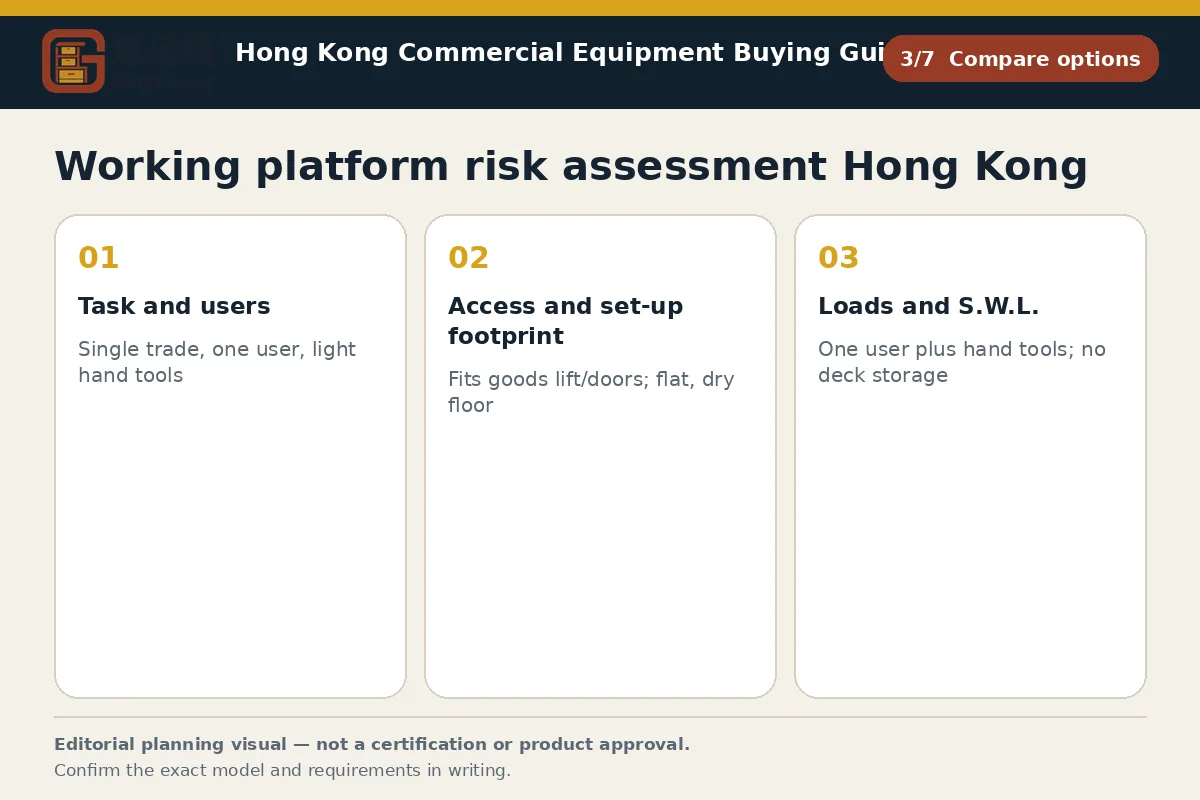
| Criterion | Straightforward requirement | More complex requirement | Evidence to provide |
|---|---|---|---|
| Task and users | Single trade, one user, light hand tools | Multi-trade, multiple users, variable tasks and durations | Describe work, heights, durations, number of users, tools/materials handled |
| Access and set-up footprint | Fits goods lift/doors; flat, dry floor | Tight lifts/doors, stair-only, mezzanine, obstructions or slopes | Smallest route width/height, lift car size/capacity, route photos and plan |
| Loads and S.W.L. | One user plus hand tools; no deck storage | Two users and materials; dynamic handling or storage on deck | Required safe working load, load distribution, user count and examples |
| Environment and stability | Indoor, low wind, dry, level | Outdoor/semi-exposed, humidity, wind, gradients or uneven ground | Floor type/gradient, wind exposure, corrosion expectations, ground bearing notes |
| Controls, training and documentation | OEM manual and markings in English | Bilingual instructions/decals, site method statement and supervision plan | Sample manual/markings, training plan, evidence of model configuration quoted |
This framework helps buyers create comparable written enquiries. Final model specifications, availability, delivery and commercial terms must be confirmed in a formal quotation.
Resolve access, load and environment in a Working platform risk assessment Hong Kong
Resolve the practicalities of getting the platform to the work and keeping it stable. Measure doorways, corridors and lift cabins along the entire delivery route; note the smallest clear width and height, and any turns that restrict long components. Get the goods-lift rated capacity and booking rules from the building manager, and record if there is stair-only access to mezzanines or rooftops. Confirm the set-up footprint available at the work area, including overhead obstructions such as ducting or signage, and whether floor protection is needed in finished spaces.
Define the load and environment. State the heaviest tool or part carried to the platform and whether loads are static, handled, or placed on rails or shelves. Describe the floor condition (dry concrete, tiles, carpet, gratings) and any gradient. If gradients or ramps exist, determine whether a platform designed for uneven ground is required and document this under your Mobile working platform on slopes Hong Kong considerations. For outdoor or semi-exposed sites, capture wind exposure, rain risk and humidity. In Hong Kong’s humid climate, ask suppliers to explain material choices and finishes for corrosion resistance. Where noise or dust controls apply—common in offices, schools and retail—note timing restrictions and any requirement for clean-down after work.
Turn a Working platform risk assessment Hong Kong into RFQ questions
Turn the assessment into RFQ questions so quotations are directly comparable. Open with a one-page summary of task, location and users, then list measurable requirements: platform height range, minimum deck size, maximum folded section length to pass your tightest doorway, and the required safe working load and number of concurrent users. Ask suppliers to state the model quoted, configuration, stabilisation method, wheel/tyre type, and whether instructions and safety labels are supplied in English and Chinese. Require confirmation that the quoted model fits your measured route and set-up footprint without modification and that any slope or outdoor limits are declared.
Structure evaluation by asking for product datasheets, drawings with guardrail dimensions, marking photos, maintenance guidance, spares availability and warranty terms. Request lead-time estimates and delivery method, acknowledging that building management booking windows will control the actual slot. On receipt, inspect serial numbers, deck, guardrails, gates, castors, brakes, outriggers and all markings against the quotation and manual; check count of modules and fasteners; verify bilingual information if specified. Any numbers in your enquiry (for example, sample platform height or gradient) are an example starting point and must be confirmed in the final, model-specific quotation and approved by your competent person and venue management.
Working platform risk assessment Hong Kong decision checklist
Before you issue an RFQ, ensure the brief documents the task, working height and reach, user count, set-up footprint and route constraints, plus the heaviest handled items. Require suppliers to confirm safe working load, user capacity and guardrail details, and to provide instructions and markings in the languages your team needs. Compare quotations like-for-like using the same model configuration, stability method, wheel type and corrosion protection. Plan delivery against building booking windows. On receipt, check serial numbers, markings, guards, brakes and outriggers against the quotation and manual, and log any discrepancies for the supplier to resolve before first use.
- Operating use, quantity and expected frequency
- Dimensions, capacity, material and accessory requirements
- Delivery address, floor, goods lift and loading window
- Required documents, acceptance checks and after-sales arrangements
Key points for Working platform risk assessment Hong Kong
Hong Kong sites often combine tight goods-lift dimensions, shared loading bays and strict management-office booking windows. Build these local constraints into your enquiry so suppliers confirm whether their packed modules and delivery method will pass through actual doors, corridors and lifts. Humidity and salt exposure can accelerate corrosion at coastal or semi-exposed locations, so ask for finishes suitable for your environment. Many institutions expect bilingual instructions and decals. Where a venue or building manager sets additional rules on working hours, public segregation or storage, include them in the brief without treating this page as legal advice.
Questions about Working platform risk assessment Hong Kong
What measurements should I capture before requesting quotations?
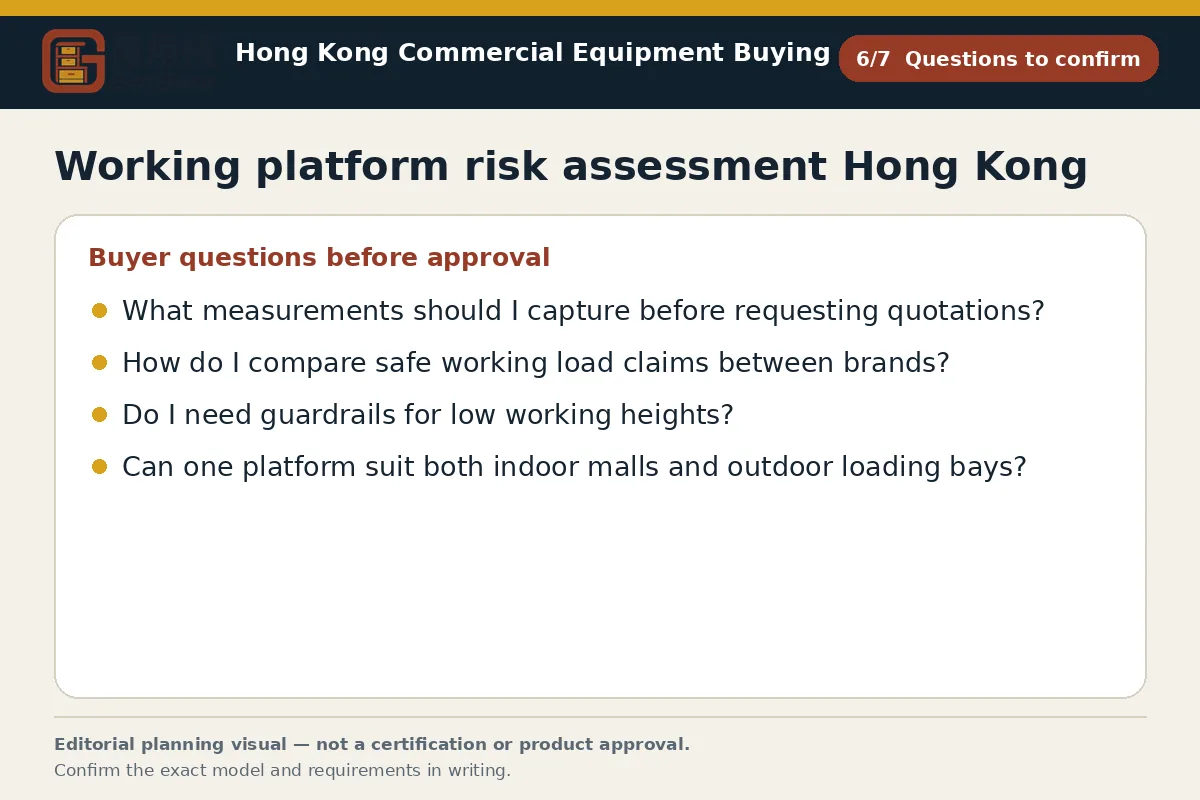
Measure the target platform height, minimum deck area, and the tightest door, corridor and lift dimensions on the access route, plus the set-up footprint at the work area. Note gradients, floor type and overhead obstructions. These are example starting points and must be verified by your responsible person and confirmed by the quoting supplier against the proposed model.
How do I compare safe working load claims between brands?
Ask each supplier to confirm the stated safe working load, number of concurrent users and how the load is distributed across the deck. Request the marking location and any exclusions (such as no materials storage). Use the same load case in every enquiry. Treat figures as model-specific and accept only what the formal, written quotation and manufacturer’s instructions confirm.
Do I need guardrails for low working heights?
If a fall could cause injury in your setting, choose a platform with integrated guardrails and a self‑closing gate rather than relying on ad‑hoc controls. The exact requirement depends on the model, task, venue rules and insurer expectations. Compare datasheets against your internal policy and any applicable Working platform guardrail requirements Hong Kong, and the guidance you follow.
Can one platform suit both indoor malls and outdoor loading bays?
It can, if the model’s wheels, stabilisation, finishes and wind/rain limits fit both environments. Ask suppliers to state outdoor limitations, corrosion protection and deck slip resistance for wet use. Many buyers specify separate treads or wheels for polished floors. Final suitability must be confirmed in the written quotation and approved by your competent person and venue manager.
Continue with closely related procurement topics
These pages share equipment, operating or decision-stage signals with this guide.
Aluminium work platform original accessories Hong Kong
Check Aluminium work platform original accessories Hong Kong for compatibility and correct fit. Follow Working platform manufacturer instructions Hong Kong and plan Working platform storage and maintenance Hong Kong with GotGear.
Read the guide
Working platform guardrail requirements Hong Kong
GotGear explains Working platform guardrail requirements Hong Kong, covering exposed edges and falling-object risk. It outlines Working platform toe board requirements Hong Kong and Working platform access handrail Hong Kong.
Read the guide
Work platform procurement specification Hong Kong
Create a clear Work platform procurement specification Hong Kong that defines the task, site, dimensions, load basis and configuration. Use GotGear's Work platform quotation checklist Hong Kong to compare supplier responses.
Read the guide
Fiberglass work platform with guardrail Hong Kong
GotGear assesses Working platform electrical hazards Hong Kong and advises whether a Fiberglass work platform with guardrail Hong Kong or a Non-conductive work platform Hong Kong best suits the task and site controls.
Read the guideRelated topic indexOpen more English procurement pages2 topics
Browse additional equipment families, applications and procurement questions relevant to a wider buying brief.