
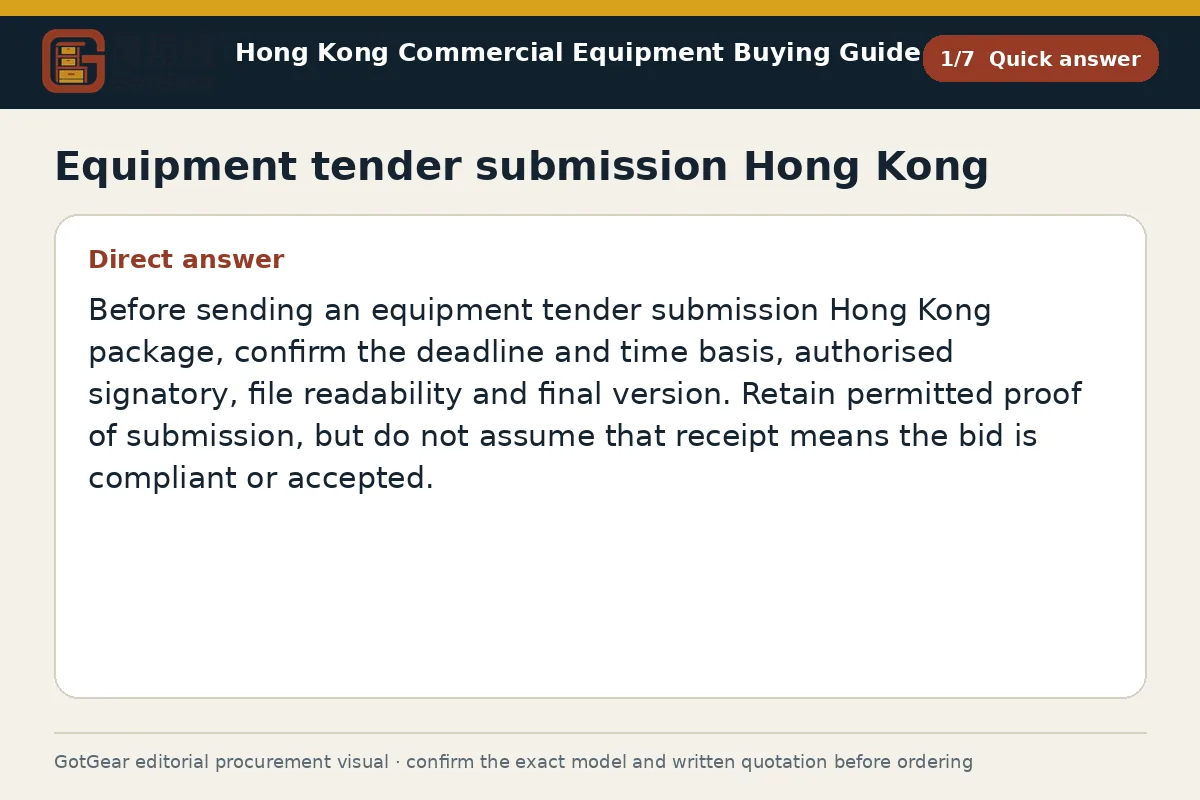
Before sending an equipment tender submission Hong Kong, confirm the deadline and time basis, the authorised signatory, file readability and that you are sending the final version. Retain permitted proof of submission, but do not assume that receipt means the bid is compliant or accepted.
Read the instructions before an equipment tender submission Hong Kong
Start by mapping the full enquiry pack: invitation letter, scope, specification, drawings, response schedules, tender form, declarations, and the evaluation method. Note which criteria are pass/fail, which are scored, and where evidence is required. Identify the accepted submission channel and file formats, labelling conventions, and any separation between technical documents and commercial documents. For an equipment tender submission Hong Kong bid teams manage, confirm the working time basis stated, how addenda are issued, and the final clarification cut‑off.
Read the delivery, installation and service requirements as if you were scheduling day one. Record site constraints that will be material to acceptance: goods‑lift and doorway clearances, floor loading, access through industrial buildings, loading‑bay windows and building‑management procedures, and any bilingual documentation expectations. If samples, demonstrations or site visits are required, capture the who/where/how and permissible dates. Where public‑event use is contemplated, note the requirement pathway for crowd, hygiene, electrical or fire controls as applicable to the venue, not as a universal rule. Confirm whether alternatives or variants are allowed and how they must be priced and distinguished from the compliant bid. Establish a secure, version‑controlled workspace and name a single document controller so that clarifications and addenda flow to one master set without duplicated edits.
Completeness check for an equipment tender submission Hong Kong
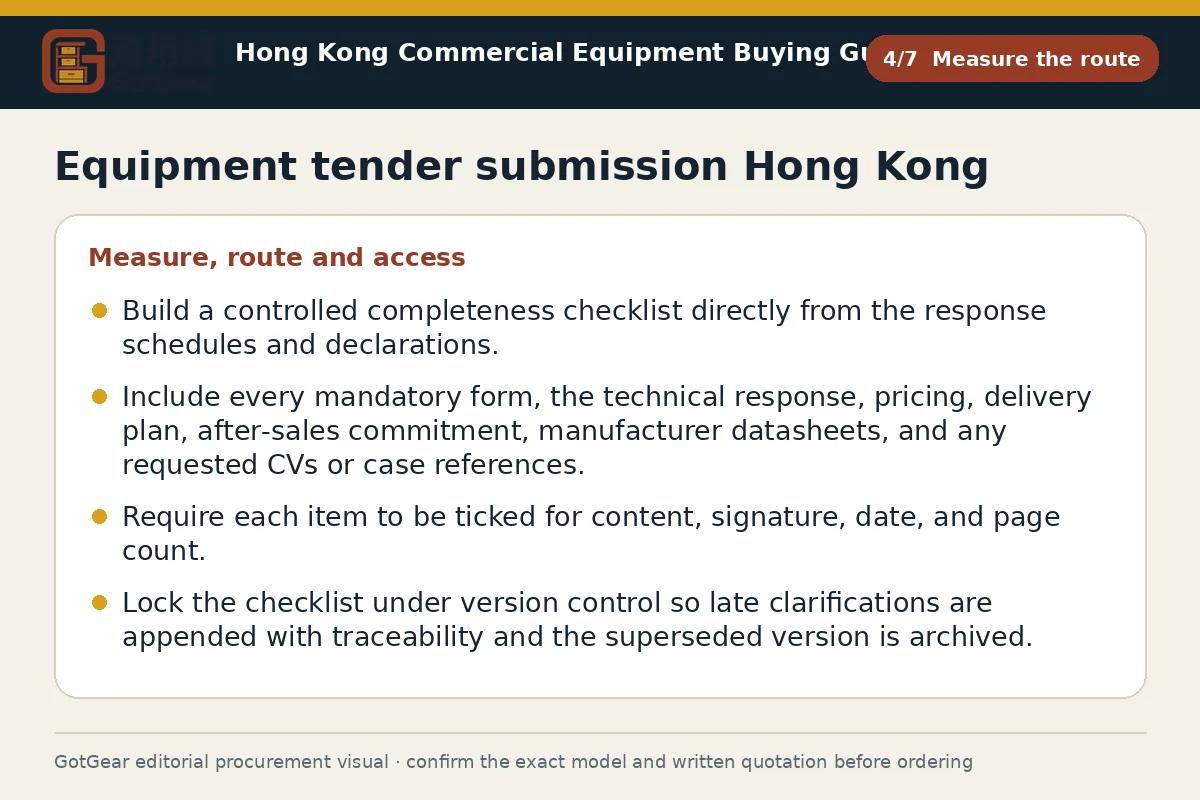
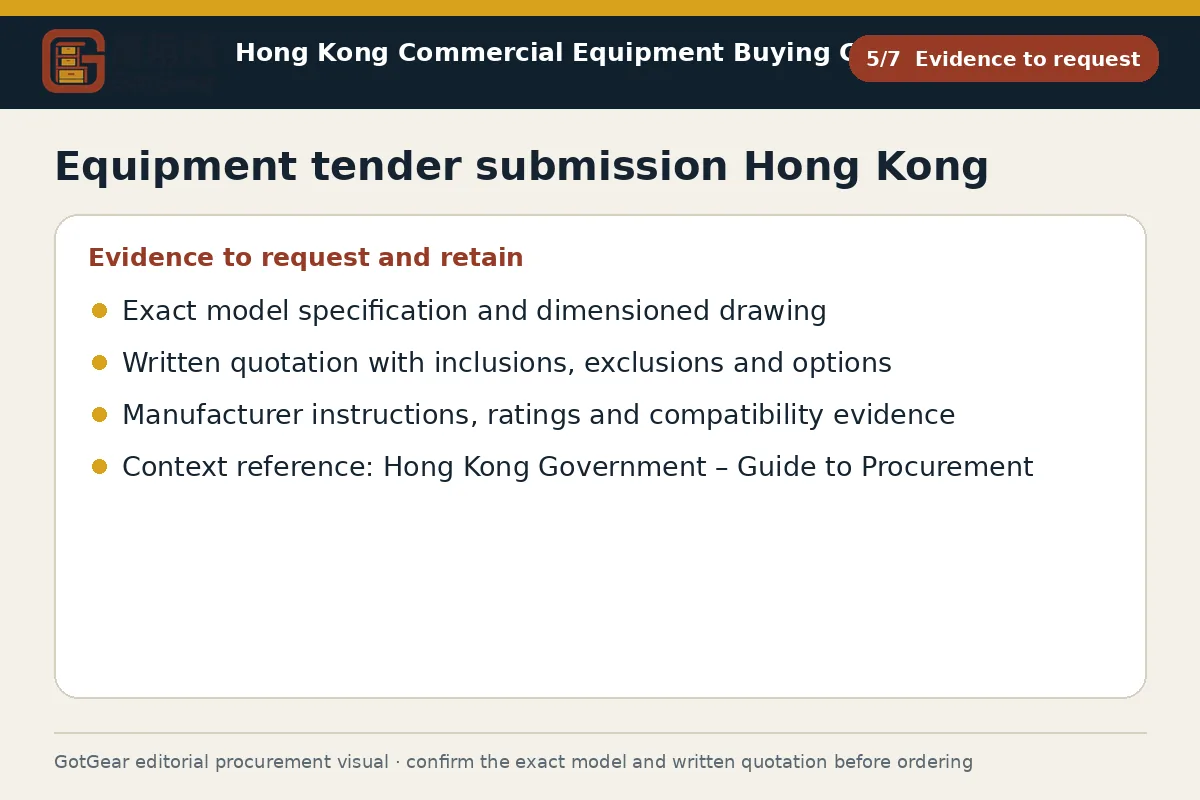
Create a controlled completeness checklist directly from the response schedules and declarations. Include every mandatory form, the technical response, delivery plan, after-sales commitment, manufacturer datasheets, and any requested CVs or case references. Require each item to be ticked for content, signature, date, and page count. Place the checklist under version control so that late clarifications are appended with traceability and the superseded version is archived.
Use a compliance matrix for each material specification line. State the offered model and confirm conformity; where there is a deviation, flag it and provide a reason only if variants are permitted. Ensure bilingual file coverage if specified. Check that scans are legible and searchable, that links open without passwords unless requested, and that filenames follow the instructed convention. If the enquiry includes a quotation comparison step on the buyer’s side, mirror the fields so your submission is easy to score: brand and model, capacity or rating, materials and finishes, ingress protection or hygiene properties where relevant, energy usage, noise, space claim, consumables, and warranty terms. If samples are to be submitted, verify labelling, quantities, and safe packaging per the pack; if any number is quoted in your internal plan, treat it as an example starting point and confirm it in writing with the responsible party.
What should buyers compare for equipment tender submission Hong Kong?
| Criterion | Straightforward requirement | More complex requirement | Evidence to provide |
|---|---|---|---|
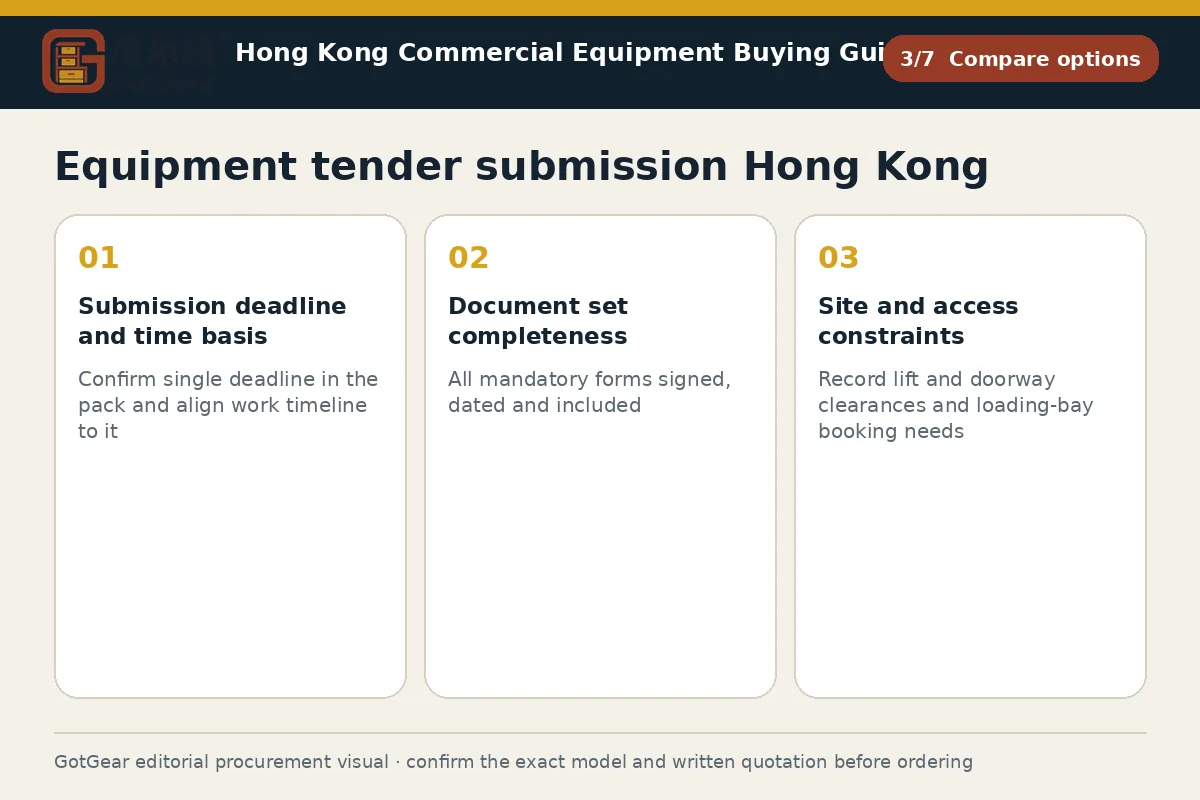
| Submission deadline and time basis | Confirm single deadline in the pack and align work timeline to it | Different channels (portal, email, hard copy) each with distinct cut-offs | Screenshot or clause reference showing time basis and channel rules |
| Document set completeness | All mandatory forms signed, dated and included | Technical separation, variants and samples handled per instruction | Controlled checklist with filenames, page counts, and signatory evidence |
| Site and access constraints | Record lift and doorway clearances and loading-bay booking needs | Route plan with protection, supervision and out-of-hours arrangements | Measured notes, photos and building-management email confirmation |
| Technical compliance | Offered model meets core specification lines | Declared deviations justified only if variants are permitted | Compliance matrix plus manufacturer datasheets and statements |
| Dispatch proof | Portal confirmation or email header saved to tender file | Courier/tender-box receipt and allowed photo records of sealed pack | Time-stamped reference, tracking number and acknowledgement copy |
This framework helps buyers create comparable written enquiries. Final model specifications, availability, delivery and commercial terms must be confirmed in a formal quotation.
Assemble and authorise an equipment tender submission Hong Kong
Sequence the internal approvals so that finance, legal, technical and operations sign off before the authorised signatory executes the Tender Form. Confirm the authorisation basis (board resolution, delegated authority, or contract‑signing list) and the required markings such as company chop, wet signature or approved e‑signature. Where different bid components must be sealed separately, prepare distinct, clearly labelled inner packages and a correctly addressed outer. For electronic submissions, structure folders as instructed and apply any password‑exchange process exactly as stated.
Assemble the delivery and installation plan with Hong Kong realities in mind: book building‑management time slots where needed, state the goods‑lift and doorway route, and outline handling of humidity or outdoor exposure if applicable. Where the model triggers particular authority or venue documentation (for example, as a starting point: a fire‑retardancy statement for fabrics, an electrical safety declaration, or food‑contact hygiene evidence), request current manufacturer literature and confirm acceptance with the procurer. Include spare‑parts and maintenance information if the enquiry requests lifecycle support. If the process requires demonstration units or mock‑ups, pack them for industrial‑building access and document the return or disposal arrangement. In parallel, agree the post‑award receipt checks you will accept: count and condition on arrival, serial‑number capture, conformance against the submitted schedules, and escalation steps. Model specifications and the formal written quotation prevail.
Proof of dispatch for an equipment tender submission Hong Kong
Match your dispatch method to the instruction. For e‑portals, upload early, validate each file, and capture the on‑screen submission reference and timestamp. For email submissions, send from an approved account, request permitted read/arrival confirmations, and save the outbound message with headers. For physical tenders, prepare the packaging and labels as specified, factor in building‑management counter sign‑off where applicable, and retain the courier waybill or tender‑box receipt.
File all evidence in the tender record: the final signed forms, the validated file set, and the proof of dispatch with the relevant time basis as stated in the pack. Keep screenshots or PDFs of the portal confirmation and any checksum or hash if generated. Where photographs are allowed, record the sealed envelope and address panel before handover. Store contact logs with the appointed clarification contact and any addenda acknowledgements. Do not treat a delivery or upload receipt as acceptance or compliance; it is simply the trace that your package was sent. Retain material in line with institutional policy and applicable data‑handling rules for Hong Kong, and avoid including personal data unless explicitly required by the enquiry.
Equipment tender submission Hong Kong decision checklist
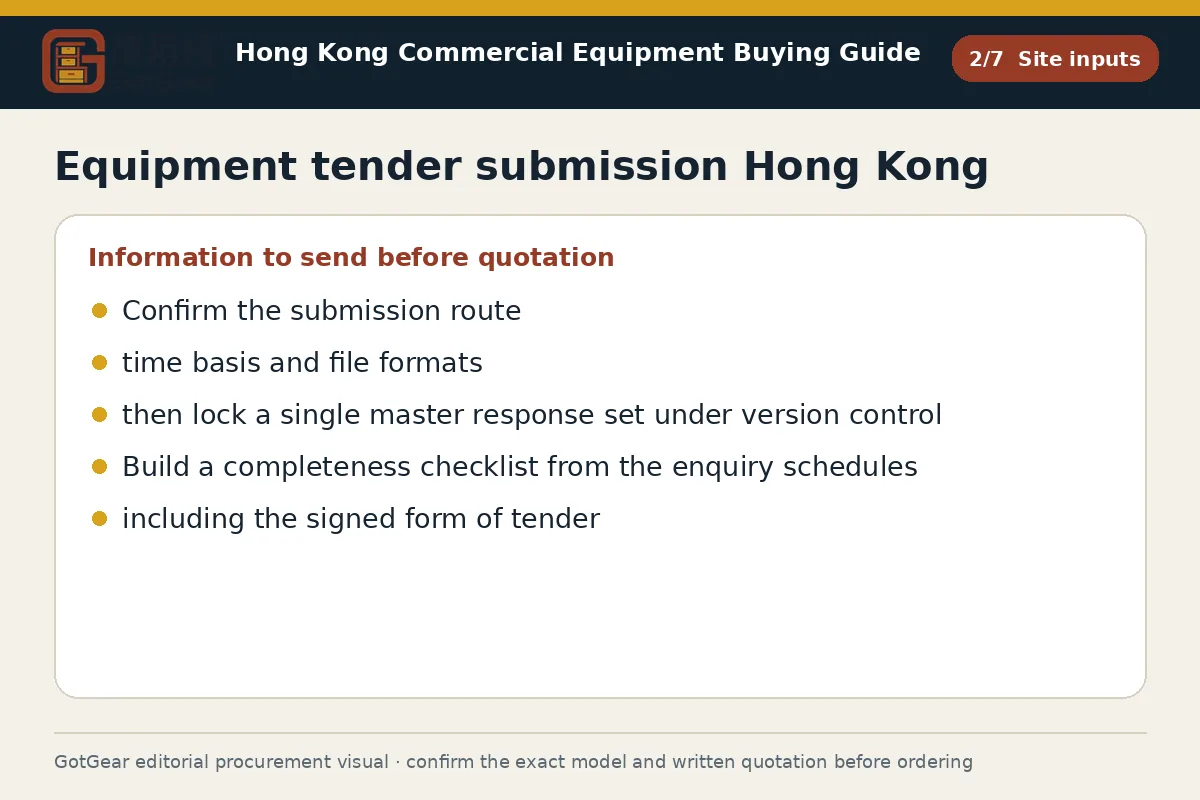
Confirm the submission route, time basis and file formats, then lock a single master response set under version control. Build a completeness checklist from the enquiry schedules, including the signed form of tender, declarations, technical response, delivery and after‑sales plans. Verify the authorised signatory and any required chop or e‑signature method. Test file readability and naming, and ensure bilingual content where requested. Prepare technical and commercial packages separately if instructed, and label any permitted variants clearly. Record site constraints, photographs and building‑management confirmations that support your delivery plan. For dispatch, obtain an allowed receipt (portal confirmation, email header record or stamped counterfoil) and file it with the final version. None of these proofs replace compliance or acceptance; the model specification and formal written quotation prevail.
- Operating use, quantity and expected frequency
- Dimensions, capacity, material and accessory requirements
- Delivery address, floor, goods lift and loading window
- Required documents, acceptance checks and after-sales arrangements
Key points for equipment tender submission Hong Kong
Tender control in Hong Kong is shaped by practical site and administration factors. Many industrial and commercial buildings require advance booking for loading‑bay access and goods‑lift use, and deliveries may need management‑office coordination. Submission timing is frequently assessed against Hong Kong time, and bilingual documentation may be requested by public bodies or institutions. Humid conditions influence packaging for samples and any sensitive equipment. E‑tendering portals are common, but some procurements still require sealed hard copies. Treat any compliance, certification or licensing needs as venue‑ and model‑specific and confirm them with the procurer or a competent adviser; this guidance is procedural, not legal advice.
Questions about equipment tender submission Hong Kong
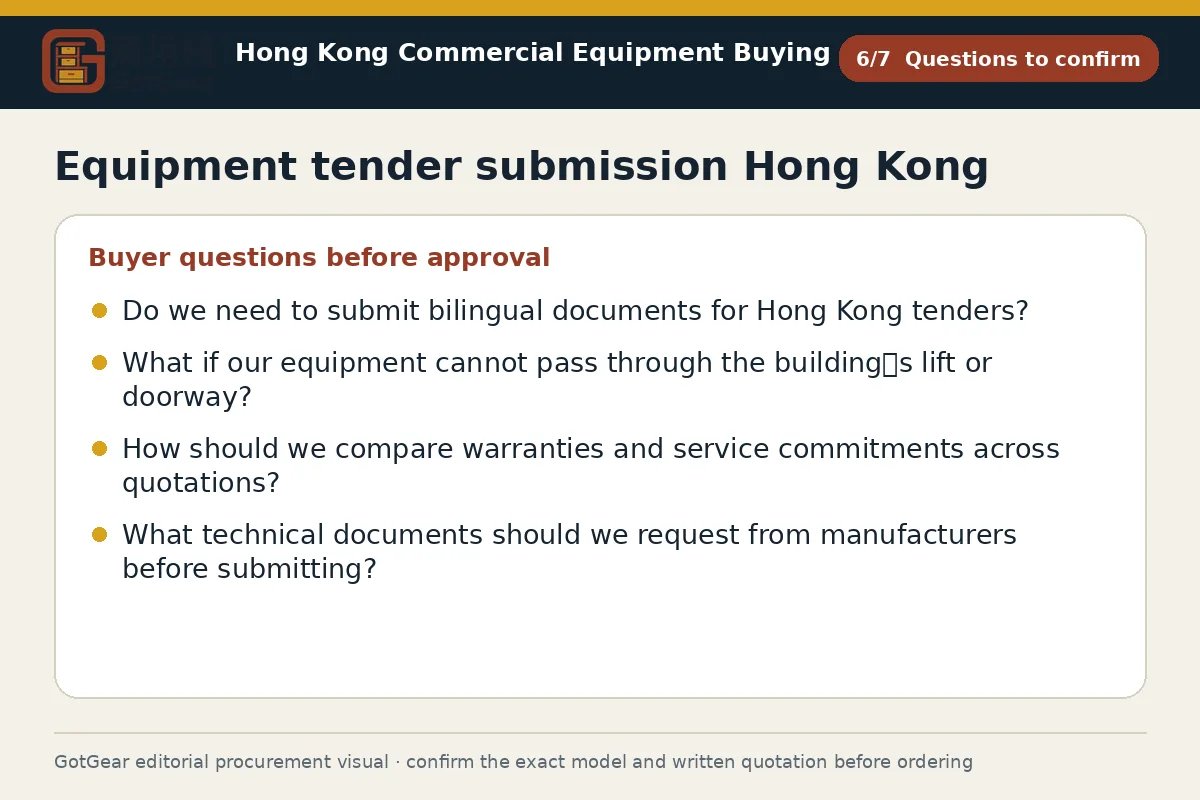
Do we need to submit bilingual documents for Hong Kong tenders?
Only if the instructions require them. Some public and institutional buyers ask for English and Chinese responses or key pages in bilingual form. Where bilingual content is requested, state which language prevails for interpretation. If nothing is specified, keep technical data consistent and avoid mixing languages on the same form unless it aids clarity. Confirm expectations during the clarification window.
What should we do if our equipment cannot fit in the building’s lift or through the doorway?
Disclose the constraint in your method statement and propose a compliant handling plan, such as sectional delivery or on‑site assembly, if allowed. Seek written confirmation from the procurer and the building manager before submission. If special equipment or out‑of‑hours access is envisaged, describe supervision, safety and protection measures. Treat any dimensions you use as an example starting point until verified on site.
How should we compare warranties and service commitments across quotations?
Create a like‑for‑like matrix: warranty term, response times, parts and labour inclusion, exclusions, preventive maintenance, and availability of consumables. Translate marketing language into measurable commitments. Weigh these alongside lifecycle costs specified by the enquiry. If details are unclear, ask the supplier for written confirmation and attach manufacturer statements where needed. Formal quotations and model specifications take precedence over summaries.
What technical documents should we request from manufacturers before submitting?
Ask for current datasheets, installation and operating manuals, and any test reports or declarations specifically referenced by the enquiry or venue. Examples include ingress protection ratings, hygiene or food‑contact statements, material fire performance, or electrical safety documentation. Requirements are model‑ and site‑dependent in Hong Kong; seek confirmation from the procurer or a competent adviser. File only the versions you actually submit, under document control.
Continue with closely related procurement topics
These pages share equipment, operating or decision-stage signals with this guide.
Commercial equipment tender Hong Kong
GotGear explains the distinction between mandatory and scored criteria in a commercial equipment tender Hong Kong. Use an equipment tender specification Hong Kong to set measurable outputs, bidder instructions and governance.
Read the guide
Equipment tender evaluation Hong Kong
GotGear offers a procurement checklist for committees in equipment tender evaluation Hong Kong, to verify mandatory requirements, technical evidence, evaluated cost, delivery assumptions, scoring, moderation and assessor records.
Read the guide
Commercial equipment procurement Hong Kong
Use GotGear's checklist for commercial equipment procurement Hong Kong to confirm need, budget, specification and acceptance. Use it to create commercial equipment procurement documentation Hong Kong that teams can audit.
Read the guide
Commercial equipment quotation Hong Kong
GotGear offers a practical guide to commercial equipment quotation Hong Kong. Standardise scope and responses by issuing one commercial equipment RFQ Hong Kong for each request for quotation commercial equipment Hong Kong.
Read the guideRelated topic indexOpen more English procurement pages3 topics
Browse additional equipment families, applications and procurement questions relevant to a wider buying brief.