
Choose exhibition furniture Hong Kong by linking every item to a visitor task and dwell time. Confirm dimensions against the stand plan, preserve access routes and include handling, cleaning and storage requirements in the event schedule.
Allocate stand footprint to exhibition furniture Hong Kong
Start with the scaled stand plan and mark every visitor interaction area before selecting any exhibition furniture Hong Kong. Note aisle edges, pillars, fire equipment, height limits, and floorbox locations supplied by the organiser. Map primary and secondary routes and preserve turning space at corners. As an example starting point, reserve a clear walking path comparable to typical show aisles, then confirm the exact width with the organiser; the written venue plan and the supplier’s model specifications prevail.
Record hard constraints early: goods‑lift car size, door clear openings, corridor pinch points, and any ban on pallet jacks in carpeted halls. For each furniture item, request full dimensions (overall footprint and height), base size, chair push‑back allowance, and stacking footprint if relevant. Ask for stability details for pose‑height tables and stools, surface finish descriptions, and floor protection type. Compare quotations on the same bill of quantities and annotated plan references so you are judging like‑for‑like. For shared concourse areas, agree boundaries with the venue in writing and highlight access to washrooms, emergency egress and neighbouring stands. Confirm who is permitted to move items during open hours and whether overnight repositioning is allowed by the management office.
Coordinate power and storage with exhibition furniture Hong Kong
Power routing and storage discipline prevent cable clutter and overnight losses. Identify every device requiring electricity—AV screens, demo rigs, laptops, lighting, charging points—and place them on the plan. Note plug type and estimated load per device from manufacturer data; as an example starting point, BS 1363 (13 A) outlets are common in Hong Kong, but confirm the venue distribution and any on‑stand boards. Ask suppliers for cable exit options (underside grommets, rear pass‑throughs), recommended trunking, and stability with cable weight. If placing furniture over temporary ramps or raised floors, confirm levelling feet range in writing.
For storage, specify lockable cupboards within counters, under‑table boxes for literature, and labelled crates for spare chairs. Request lock type, key quantity, and hinge durability details, plus ventilation slots or fans where devices or batteries are enclosed. Humid conditions and daily cleaning mean finishes should resist fingerprints and disinfectants; ask for material datasheets and cleaning compatibility statements. Where the venue or insurer requires flame‑retardant evidence for upholstered items or cable management products, obtain the manufacturer’s declaration or test report accepted by the organiser. The written venue rules and the chosen model’s documentation prevail.
What should buyers compare for exhibition furniture Hong Kong?
| Criterion | Straightforward requirement | More complex requirement | Evidence to provide |
|---|---|---|---|
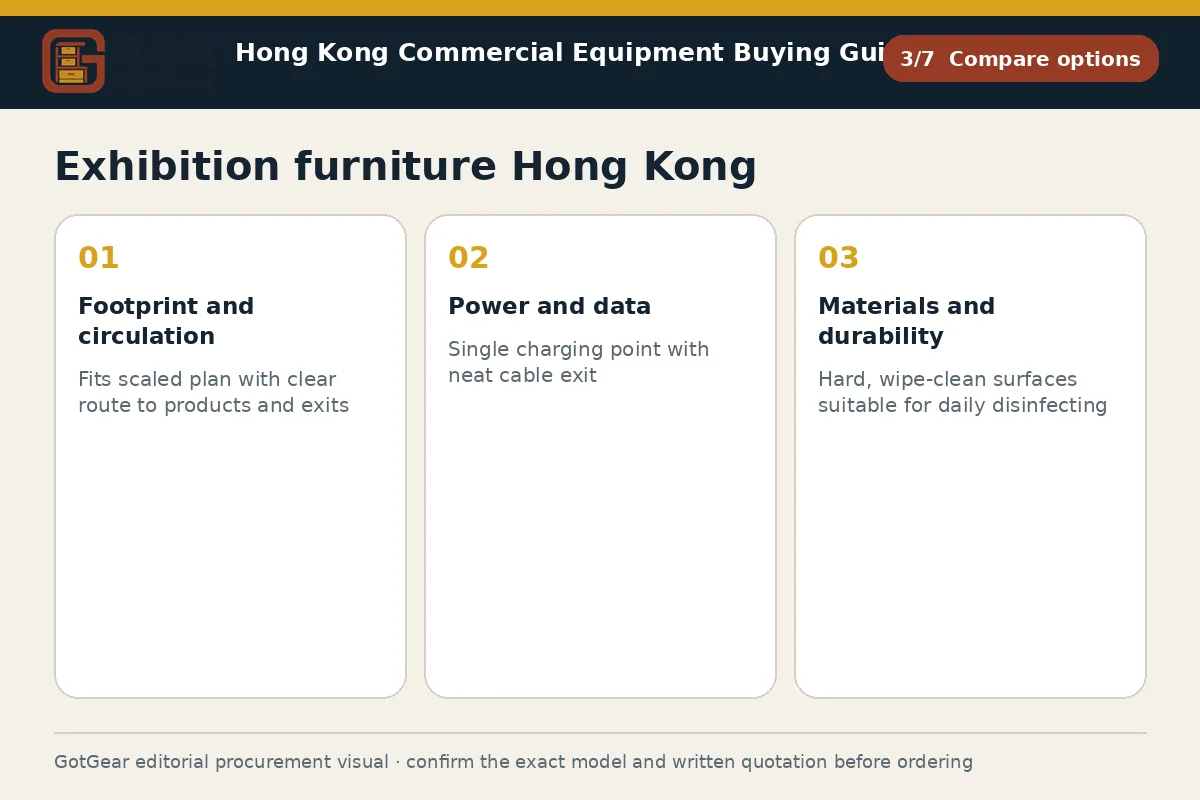
| Footprint and circulation | Fits scaled plan with clear route to products and exits | Shared concourse with dynamic flows and pinch points | Annotated drawing with dimensions, turning areas and aisle setbacks |
| Power and data | Single charging point with neat cable exit | Multiple AV, lighting and charging with defined routing and isolation | Device list with rated loads, plug type, outlet map and trunking detail |
| Materials and durability | Hard, wipe-clean surfaces suitable for daily disinfecting | Upholstery and illuminated elements with humidity exposure | Material datasheets, cleaning compatibility and finish codes |
| Transport and access | Items fit lifts and door clear openings in one piece | Staged deliveries, tight corridors and restricted loading windows | Packaged dimensions/weights, route photos and booked time slots |
| Storage and turnover | Stackable chairs and labelled crates for overnight | Lockable, ventilated cupboards for electronics and literature | Stack height, lock type/key count and ventilation notes |
This framework helps buyers create comparable written enquiries. Final model specifications, availability, delivery and commercial terms must be confirmed in a formal quotation.
Match exhibition furniture Hong Kong to meetings, displays and waiting
Match furniture families to the task and dwell time before you set any aesthetic theme. For swift conversations, small pose‑height points reduce linger time; a cocktail table Hong Kong, recognised by operators for stand‑up use, can stabilise traffic without blocking views. For product showcases, choose counters and plinths with concealed storage and cable pass‑throughs, and ask the manufacturer for load ratings and anti‑tip information. For longer meetings, specify tables that permit notepad space and discreet power access, with chairs that stack or trolley efficiently after close.
Where visitors may wait, opt for benches, modular sofas or perching stools that maximise seats per metre without narrowing escape routes. If using temporary event seating Hong Kong, which buyers frequently standardise on, request frame construction details, glide type for carpet or vinyl, and the quoted stack height per model. For fabric finishes, ask for abrasion, colourfastness and cleaning guidance; for hard surfaces, request slip‑resistance data for footrests and bases. For shared areas, have bilingual signage ready for “reserved” or “for meetings” to avoid misuse. Above all, confirm that every shortlisted model has dimensions, finish codes and suitability notes that match the plan, and that the formal quotation reflects those exact selections.
Prepare a stand-by-stand schedule for exhibition furniture Hong Kong
Create a stand‑by‑stand schedule that ties each item to a plan grid, a delivery slot and a responsible person. List the bill of quantities, annotated locations, and any power or data tie‑ins for each furniture piece. Record access‑route checks (lift size, door swings, gradients) and the packaged dimensions for every bulky item so logistics can validate movement without unboxing. Include who inspects and signs off the condition on arrival, and the cleaning routine before doors open and after show close.
To align event furniture procurement in Hong Kong with venue operations practice, add bilingual labels to cartons and on‑stand tags so contractors, security and client teams read the same codes. Ask contacts at your venue’s furniture supplier in Hong Kong to confirm loading‑dock procedures, move‑in passes and whether overnight storage rooms are allocated. Compare written quotations for delivery to location (not just kerbside), placement, protection materials, on‑site contact phone numbers, and out‑of‑hours surcharges. On receipt, inspect for wobble, finish defects, loose fasteners, missing glides and key sets; document variances with photos. The schedule should also state end‑of‑day stacking, cable isolation and key return procedures agreed with the organiser.
Exhibition furniture Hong Kong decision checklist
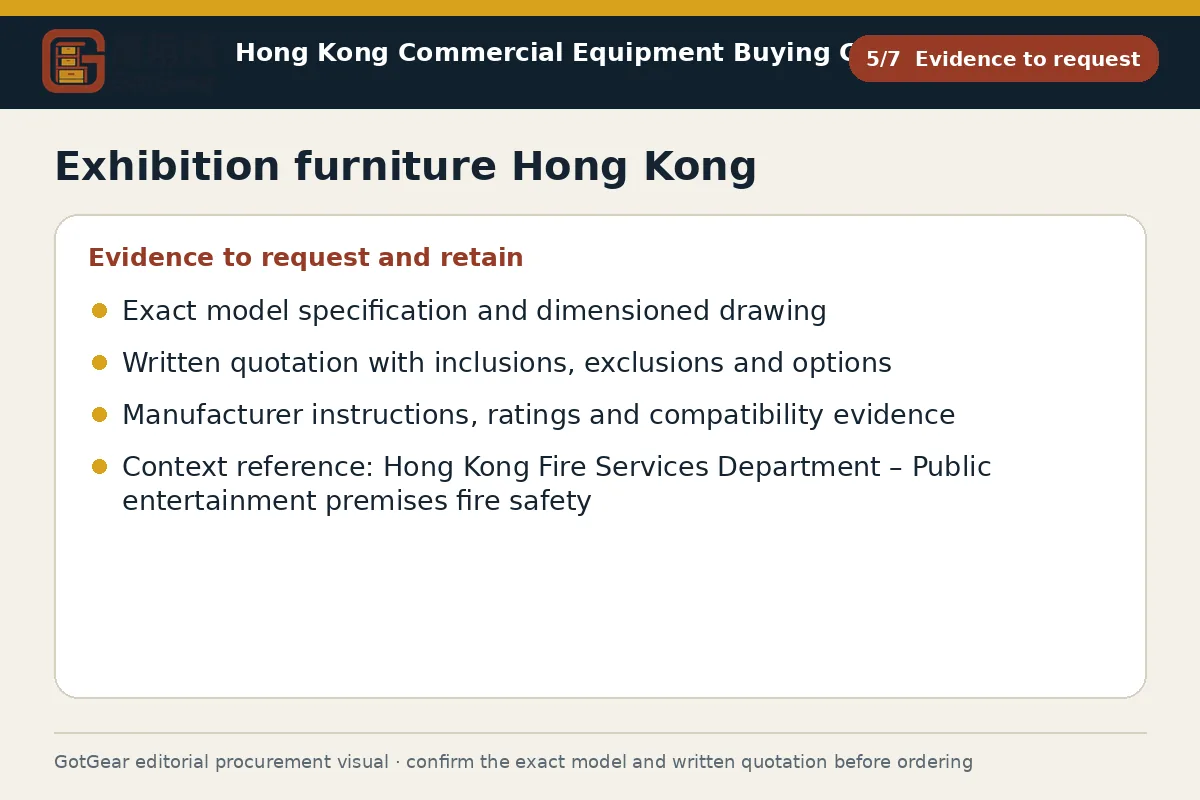
Confirm the scaled stand plan, aisle boundaries and floorbox positions; then allocate zones for quick chats, seated meetings, displays and waiting, preserving agreed clear routes. Record access constraints—service‑lift car size, door clear openings, ramps—and verify packaged dimensions against them. List every powered device with plug type and estimated load, and ask for cable pass‑throughs and trunking. Request materials and cleaning compatibility statements, plus flame‑retardant evidence where the venue requires it. Compare written quotations line‑by‑line for model codes, dimensions, finishes, delivery‑to‑location, placement, protection, on‑site contact and surcharges. Build a bilingual schedule covering delivery slots, sign‑off checks, key control, overnight storage, stacking and end‑of‑day cable isolation. The written quotation and the venue’s published rules prevail.
- Operating use, quantity and expected frequency
- Dimensions, capacity, material and accessory requirements
- Delivery address, floor, goods lift and loading window
- Required documents, acceptance checks and after-sales arrangements
Key points for exhibition furniture Hong Kong
Hong Kong venues typically operate booked loading windows and service‑lift access rather than drive‑to‑stand delivery. Build your plan around management‑office approvals, move‑in passes and goods‑lift dimensions, then confirm all timings in writing. Many sites sit in mixed‑use towers with tight corridors and low turning radii, so packaged dimensions matter. Humidity and intense cleaning regimes argue for corrosion‑resistant, wipe‑clean finishes. Power usually uses BS 1363 plug types, but check site diagrams for outlet locations and ratings. This is practical guidance only; specific venue rules, the supplier’s model specifications and any insurer or authority directions prevail.
Questions about exhibition furniture Hong Kong
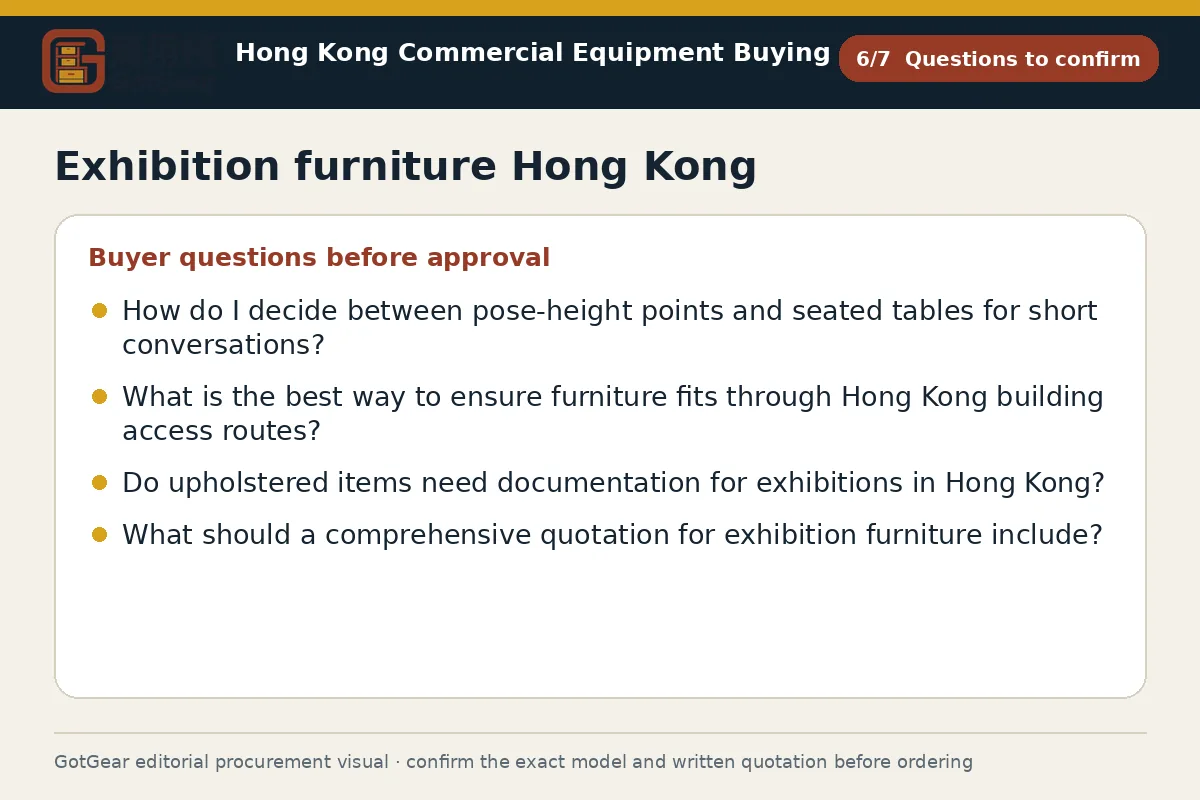
How do I decide between pose-height points and seated tables for short conversations?
Use dwell time: pose-height points speed turnover and keep sightlines clear; seated tables encourage longer discussions and note-taking. Map each zone’s purpose to visitor flow on your plan before buying. As an example starting point, place pose-height points at edges and seated tables deeper in the stand, then confirm exact counts with the sales team and the organiser’s space rules.
What is the best way to ensure furniture fits through Hong Kong building access routes?
Request packaged dimensions, weights and handling notes from the supplier, then compare them with measured lift cars, door clear openings and corridor turns. Photograph tricky pinch points and add them to the enquiry. If access demands split deliveries or stair carries, put the sequence and labour assumptions in the written quotation. The agreed model specifications and venue approvals should prevail.
Do upholstered items need documentation for exhibitions in Hong Kong?
Check the venue’s published requirements and insurer conditions first; some ask for flame-retardant declarations or test reports for fabrics and foams. If required, obtain the manufacturer’s documentation naming the model and finish. Also confirm cleaning-agent compatibility and colourfastness statements. Avoid assuming overseas certificates are accepted; the organiser must state what evidence they will recognise for the specific event.
What should a comprehensive quotation for exhibition furniture include?
Look for model codes, dimensions, finishes, load or stability notes, cleaning guidance, delivery-to-location (not just kerbside), placement, protection, on-site contact, and removal arrangements. Add access-route assumptions, delivery windows, and any out-of-hours surcharges. If power or storage features are integrated, list cable pass-throughs, plug types and lock details. The final written quotation and supplier datasheets define the scope.
Continue with closely related procurement topics
These pages share equipment, operating or decision-stage signals with this guide.
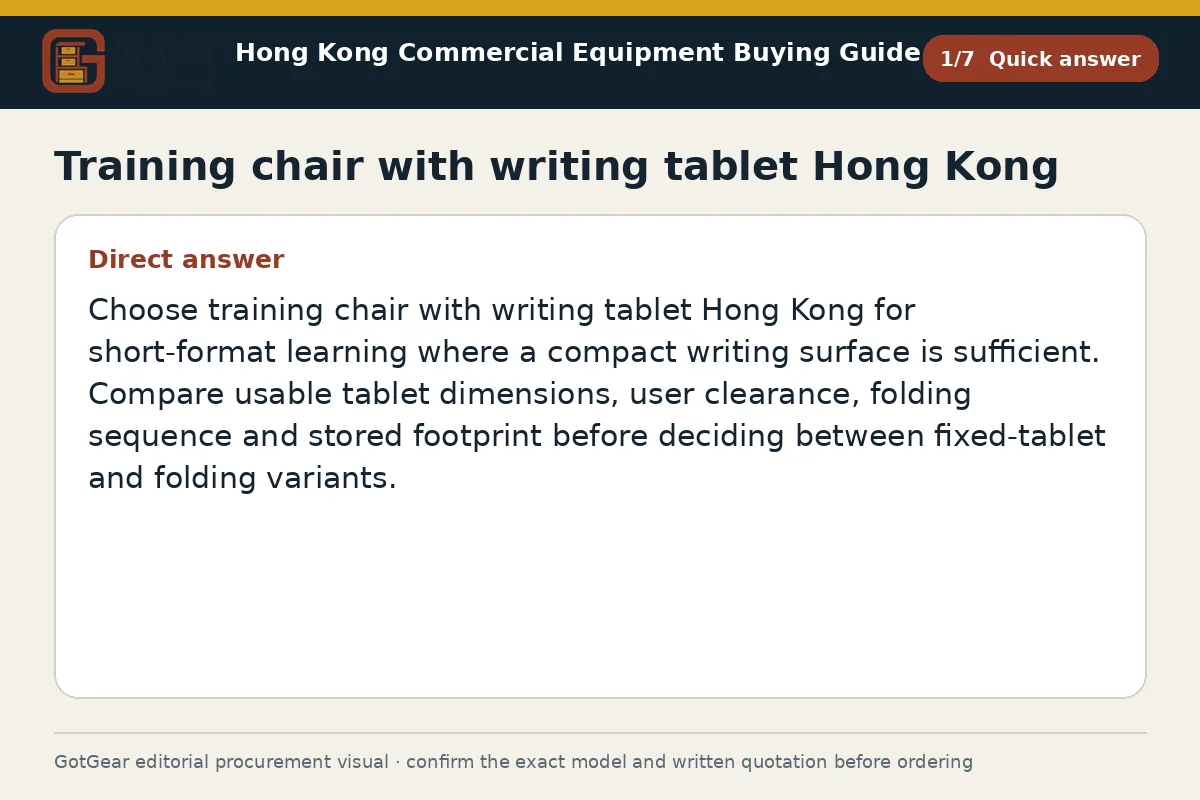
Training chair with writing tablet Hong Kong
GotGear compares training chair with writing tablet Hong Kong, folding training chair with writing board Hong Kong and folding training chair with armrest Hong Kong, covering tablet size, access and stored footprint.
Read the guide
Flip top training table Hong Kong
GotGear guides buyers on comparing a flip top training table Hong Kong by folded footprint, movement routes and joining options. It also covers nesting training table Hong Kong and modular training table Hong Kong designs.
Read the guide
Training room furniture Hong Kong
Training room furniture Hong Kong helps you plan layouts for capacity, sightlines and writing space. Assess a training room table and chair set Hong Kong for circulation, reset labour and comfort with GotGear.
Read the guide
Trapezoid training table Hong Kong
Compare trapezoid training table Hong Kong and semi circular training table Hong Kong to choose a layout for your training space. Consider cluster formation, seating edges, join details, leg positions and storage with GotGear.
Read the guideRelated topic indexOpen more English procurement pages2 topics
Browse additional equipment families, applications and procurement questions relevant to a wider buying brief.