
Choose trapezoid training table Hong Kong when angled units form the group patterns you use most often. A semi-circular alternative may suit curved ends or presentation arrangements, but buyers should compare complete configurations, storage and the number of units required.
Where trapezoid training table Hong Kong creates useful clusters
Clusters, chevrons and short arcs are where trapezoid tops earn their keep. Three or four units can close up to form a compact group with everyone facing inwards, while six can build a near-hexagon for peer work without forcing laptops onto corner gaps. In presentation-led sessions, offset rows of trapezoids create a chevron that improves sightlines and aisle flow compared with straight rectangles. Specifiers shortlist trapezoid training tables in Hong Kong when frequent regrouping is expected between breakout and plenary modes.
Plan the groups you actually run: pairs facing pairs, triads, or rings around a facilitator. For each, measure the working edge each person needs for a laptop, notes and elbow room, and draw this to scale. Check the distance between opposing seats within a cluster, the angle of view to a screen, and the space left for the trainer to step in. Locate floor boxes: a central join line is poor for cable grommets. If this purchase is part of a wider training room furniture programme in Hong Kong, confirm that finishes, heights and underframes coordinate across suppliers before issuing the enquiry.
Test joins and usable edge space on trapezoid training table Hong Kong
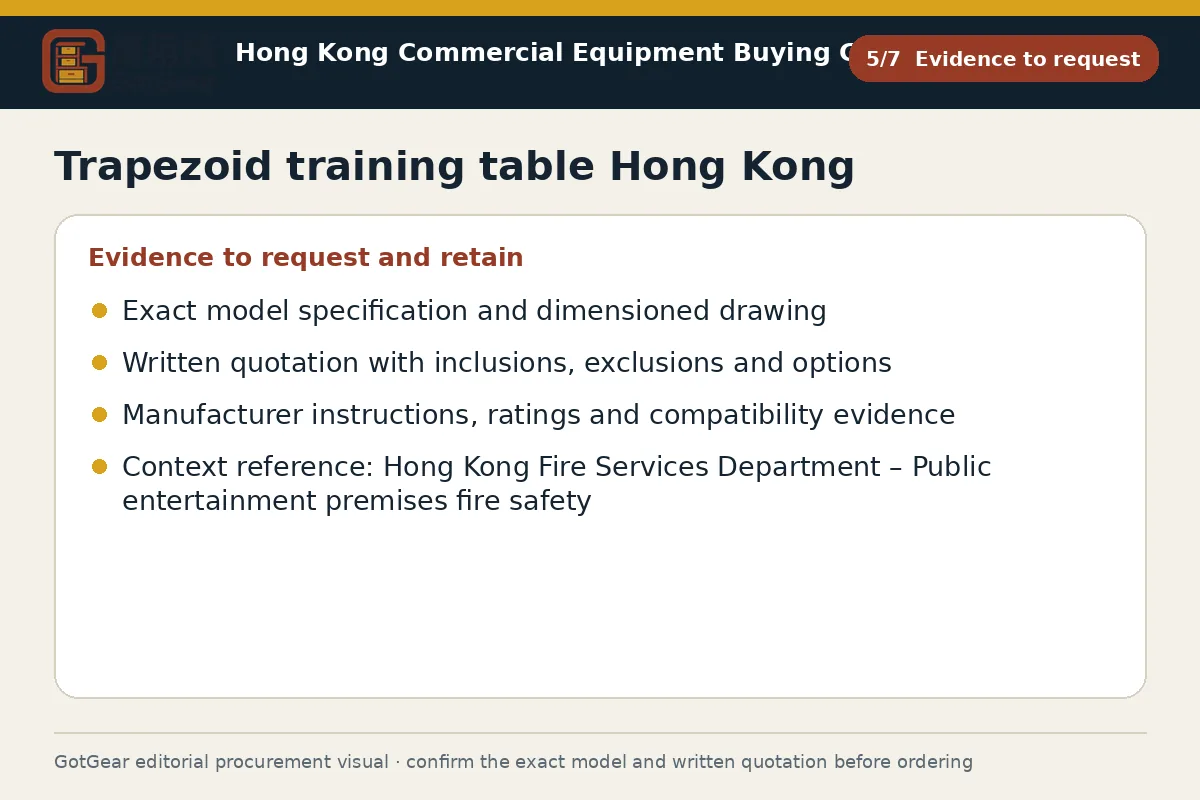
Before committing, mock up joints and edges at full scale. Tape outlines on the floor, then place two real tops together if possible. Confirm how tight the seams are, how much straight edge remains usable at each joint, and whether corner radii create “dead zones” for devices. Ask for underframe drawings showing leg positions relative to the joining edges and specify a target leg setback from each inside corner (As a starting point, 100 mm, to be confirmed in the quotation and drawings).
Request details of the linking method—clips, brackets or magnets—and whether they are captive to the frame. Note any modesty panels or stretcher bars that could collide with knees in clusters. In humid Hong Kong conditions, ask the manufacturer to state edge-banding material and adhesive type, and provide cleaning and care guidance in bilingual format. On receipt, inspect for chip-free edges, flatness across multi-table joins and complete hardware packs. If flexibility is critical, confirm compatibility with modular training table Hong Kong ranges so mixed shapes can still connect safely and at the same nominal height.
What should buyers compare for trapezoid training table Hong Kong?
| Criterion | Straightforward requirement | More complex requirement | Evidence to provide |
|---|---|---|---|
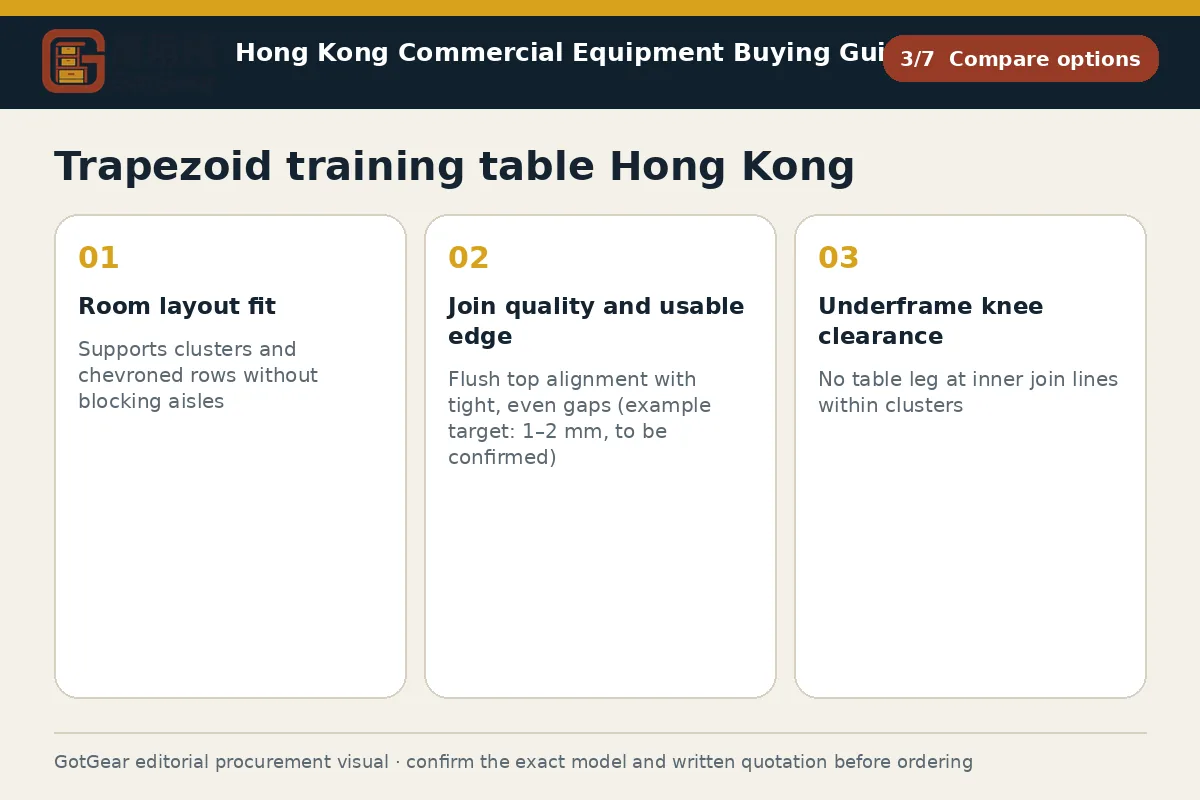
| Room layout fit | Supports clusters and chevroned rows without blocking aisles | Delivers clusters plus presenter arc/U-shape within site obstructions | Scale plan with measured clearances and counted seat edges (to be confirmed) |
| Join quality and usable edge | Flush top alignment with tight, even gaps (example target: 1–2 mm, to be confirmed) | Consistent alignment across 6+ joins with levelling feet and linking hardware | Manufacturer drawings, join hardware spec, sample photos from a mock-up |
| Underframe knee clearance | No table leg at inner join lines within clusters | Cantilever/rail frames clearing knees around arcs and D-ends | Underframe drawing showing leg offsets from joins and seat positions |
| Storage and handling | Tables nest or trolley-move through goods lift and corridors | Stated pack density, stacked height and handling method for facilities team | Packed dimensions, weight per unit, trolley footprint and lift constraints |
| Power and cable routing | Grommets set away from join lines and user elbows | Shared cable trays and floor-box alignment across chosen layouts | Port locations on drawings, cable plan and any clip-on chain details |
This framework helps buyers create comparable written enquiries. Final model specifications, availability, delivery and commercial terms must be confirmed in a formal quotation.
Trapezoid training table Hong Kong: Comparison with semi-circular training table Hong Kong
Angled shapes excel in clusters and chevrons, while semicircles are well suited to arcs and teaching ends. A semi-circular training table in Hong Kong can create a clear focal edge for a tutor, panel or camera, enabling horseshoe and U-shaped layouts that maintain sightlines. It also makes presenter access to the open end simpler and helps to guide participants’ attention forward. Where you need a D-end to terminate rows or to form a curved head table, semicircles are an efficient and intuitive option.
Consider storage and movement. Semicircles may not nest as densely as trapezoids, and their radius can challenge tight goods lifts unless a flip-top frame is specified. If you run blended delivery, a front station using a flip-top whiteboard table in Hong Kong can pair well with either shape, supporting impromptu annotation without changing seating. For AV, arcs often place users at more consistent distances from cameras and speakers, while trapezoids may spread participants laterally. Confirm how the chosen solution integrates with your wider training room furniture in Hong Kong, including finishes, power access and tidy cable routing.
Count complete layouts before ordering trapezoid training table Hong Kong
Count complete room layouts before you order. Start with a measured plan noting door swings, columns, projector throw, screen width, floor boxes and any wall-mounted services. Sketch your priority configurations—clusters, chevrons, U-shapes—then calculate how many tables each needs, including a small reserve for breakage and spares. As a starting point only, you might allow 600 mm of straight edge per seated user and 900 mm for main circulation aisles; confirm all dimensions in the written brief agreed with your venue and supplier.
Model the parked state as well: where will tables stand when the floor is cleared? Obtain folded or nested footprints, weight per table, and packed sizes to verify goods-lift and corridor clearances. If you use a training chair with writing tablet Hong Kong, check that tablet swing and leg frames do not clash with inside joins. When comparing written quotations, align inclusions—tops, frames, linking devices, castors, grommets, cable trays, trolleys—and request drawings showing leg positions and join lines. Coordinate delivery slots with the management office and ask for bilingual assembly and care information.
Trapezoid training table Hong Kong decision checklist
Start with a scale plan of the room, including door swings, fixed furniture and power/data points. Draw your priority teaching modes and count how many tables each configuration requires, plus a small buffer. Test joins and leg clearance with sample tops or full-size templates. Confirm underframe drawings, linking methods, and the finish/height match with other items in scope. Check storage state, trolley fit and whether packaged sizes clear your goods lift and corridors. Request bilingual drawings, care guidance and a statement on edge-banding and substrate suitable for humid conditions. Compare like-for-like quotations: tops, frames, castors, connectors, grommets, trays and any delivery constraints stated. Inspect on arrival for straight joins, intact edges and complete hardware.
- Operating use, quantity and expected frequency
- Dimensions, capacity, material and accessory requirements
- Delivery address, floor, goods lift and loading window
- Required documents, acceptance checks and after-sales arrangements
Key points for trapezoid training table Hong Kong, semi circular training table Hong Kong
Hong Kong buildings often constrain movement more than floor plans suggest. Confirm table footprint, frame height and packaged sizes against goods-lift car dimensions, lift-door width and lobby turning space, then schedule deliveries within the building’s approved loading window. Industrial blocks may require pre-registration with the management office and the use of designated service routes. Humidity can affect edge-banding and substrates; request the manufacturer’s care guidance. Where institutional approvals apply, ask for bilingual specifications and drawings so all stakeholders can sign off the same information. This isn’t legal advice—local venue rules and your written brief prevail.
Questions about trapezoid training table Hong Kong
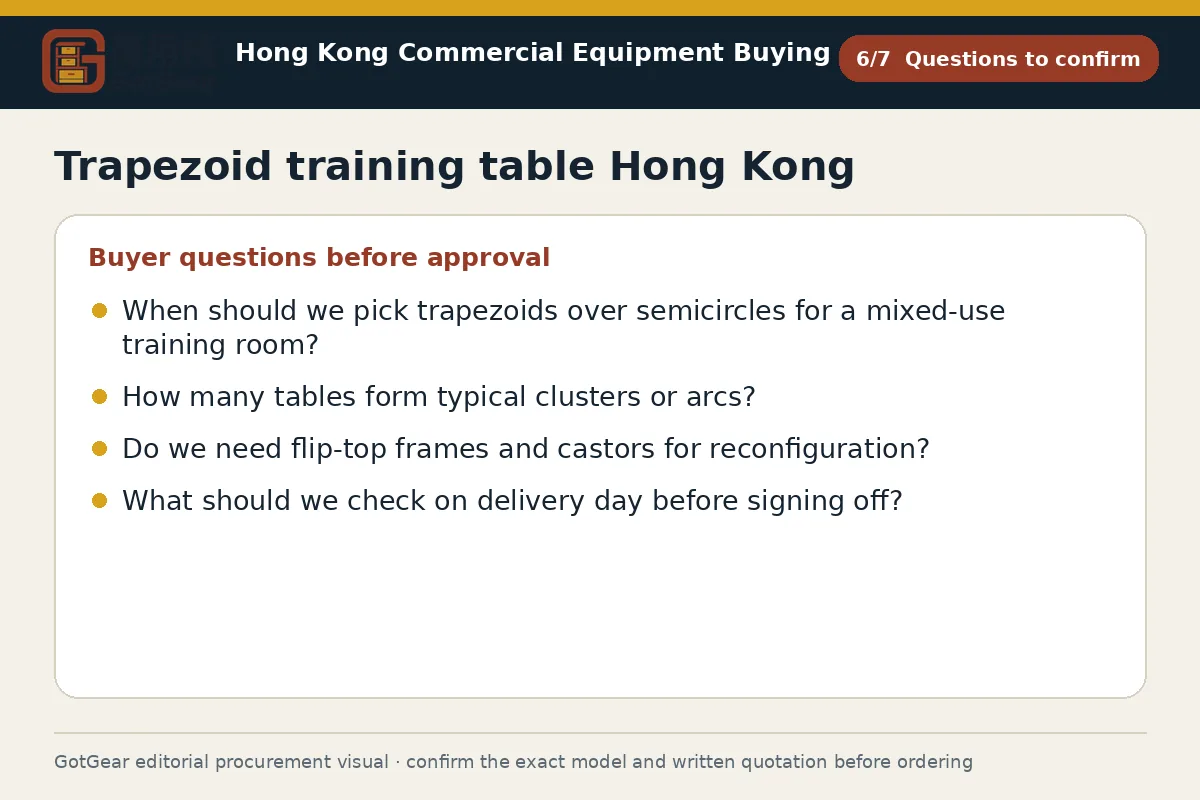
When should we pick trapezoids over semicircles for a mixed-use training room?
Choose trapezoids when you frequently pivot between small-group collaboration and quick re-formation into chevroned plenary rows. Pick semicircles when arcs, U-shapes and a clear teaching end dominate. If both modes are routine, consider a split set—trapezoids for clusters with a few semicircular units for the presenter end—and confirm compatible heights, links and finishes in the quotation.
How many tables form typical clusters or arcs?
As an example starting point, three to six trapezoids can create compact clusters, while two semicircles can anchor a D-end or complete a tighter arc. Treat these as planning markers only. Room size, seat width, device footprint and aisle standards vary; request supplier drawings that show exact seat counts and clearances, and confirm the final layout in your signed brief.
Do we need flip-top frames and castors for reconfiguration?
Flip-tops and castors speed resets and reduce manual handling, especially where goods lifts and corridors are tight. If storage depth is limited, flip-tops can nest more densely. However, castors add height and may reduce rigidity on thick carpet. Ask for braking specification, nested footprint and total weight per table, and confirm compatibility with your handling trolleys and lift schedule.
What should we check on delivery day before signing off?
Check tops for chips, scratches and edge-banding adhesion, and confirm frames are square with stable levelling feet. Dry-fit two or more tables to verify join alignment and that linking hardware and grommet covers are present. Match finishes and heights against the quotation and drawings. If institutional approvals apply, ensure bilingual instructions and care guidance are included before removing packaging.
Continue with closely related procurement topics
These pages share equipment, operating or decision-stage signals with this guide.
Flip top training table Hong Kong
GotGear guides buyers on comparing a flip top training table Hong Kong by folded footprint, movement routes and joining options. It also covers nesting training table Hong Kong and modular training table Hong Kong designs.
Read the guide
Training table with modesty panel Hong Kong
GotGear’s checklist for a training table with modesty panel Hong Kong covers panel coverage, knee clearance, cable routing, folding, nesting mobility and sightlines.
Read the guide
Cocktail table Hong Kong
GotGear explains how a cocktail table Hong Kong performs in terms of top diameter, height, floor footprint, stability, circulation and storage. It also outlines how it differs from a bar height table Hong Kong.
Read the guide
Training room furniture Hong Kong
Training room furniture Hong Kong helps you plan layouts for capacity, sightlines and writing space. Assess a training room table and chair set Hong Kong for circulation, reset labour and comfort with GotGear.
Read the guideRelated topic indexOpen more English procurement pages3 topics
Browse additional equipment families, applications and procurement questions relevant to a wider buying brief.