
For a gridwall panel base Hong Kong, confirm panel dimensions, connection details, overall footprint and the planned merchandise distribution. Compare gridwall panel legs Hong Kong on the same information, and follow the relevant manufacturer instructions for assembly and loading.
Match a gridwall panel base Hong Kong to the intended panel
Start with the intended panel. Confirm the wire pitch, wire diameter, frame thickness, and the panel’s overall width and height so the base’s fixing geometry truly matches. Check the published gridwall panel dimensions Hong Kong to verify any bracket slots, hole centres or clamp capture points. When shortlisting a gridwall panel base Hong Kong, document whether the unit will be single-sided or double-sided, and whether shelves, hooks or baskets are planned on one or both faces.
Translate that use case into requirements for footprint, rigidity and finish. Ask suppliers for a data sheet showing: compatible panel family and gauge; recommended maximum panel height and width; base footprint (depth and width); fixing method; finish (chrome, zinc, powder coat) and care guidance in humid conditions; and the recommended maximum distributed merchandising load per face. Note any accessories (levelling feet, anti-slip pads, castors, crossbars) included or optional. Record site constraints early: aisle width, nearest goods-lift and doorway clear openings, and whether the base must pass through the lift standing or flat-packed. In written quotations, request confirmation that all fasteners and tools required for assembly are included, and that the manufacturer’s assembly instructions accompany the shipment in bilingual format if your team requires it.
Check stance and connection details on a gridwall panel base Hong Kong
Stability is a function of stance and connection. Review the base’s depth and width relative to the installed panel height and the intended loading pattern. As an example starting point only, some buyers test a base depth in the region of 25–35% of panel height, then adjust once the supplier confirms the centre of gravity for their model and merchandise plan. For heavier shelving or high-traffic aisles, shortlisting H-bases or braced frames may improve torsional resistance, whereas lighter T-bases may suit single-face hook displays in calmer zones.
Connection details determine how reliably force transfers from panel to base. Specify whether the base captures panel wires, bolts through the frame, or uses clamp collars, and ask for drawings with dimensions of hole positions, clamp spacing, and any required panel overhang above the base. Request details of hardware grade and finish, plus any recommended torque settings. For venues that restrict tools on the floor, ask about tool-less or captive fasteners. Upon receipt, check weld integrity, squareness, thread quality on levellers, and that fixings match the packing list. For public-facing use, consider asking the manufacturer for written load guidance and a statement of intended use to file with your venue or insurer if they require it.
What should buyers compare for gridwall panel base Hong Kong?
| Criterion | Straightforward requirement | More complex requirement | Evidence to provide |
|---|---|---|---|
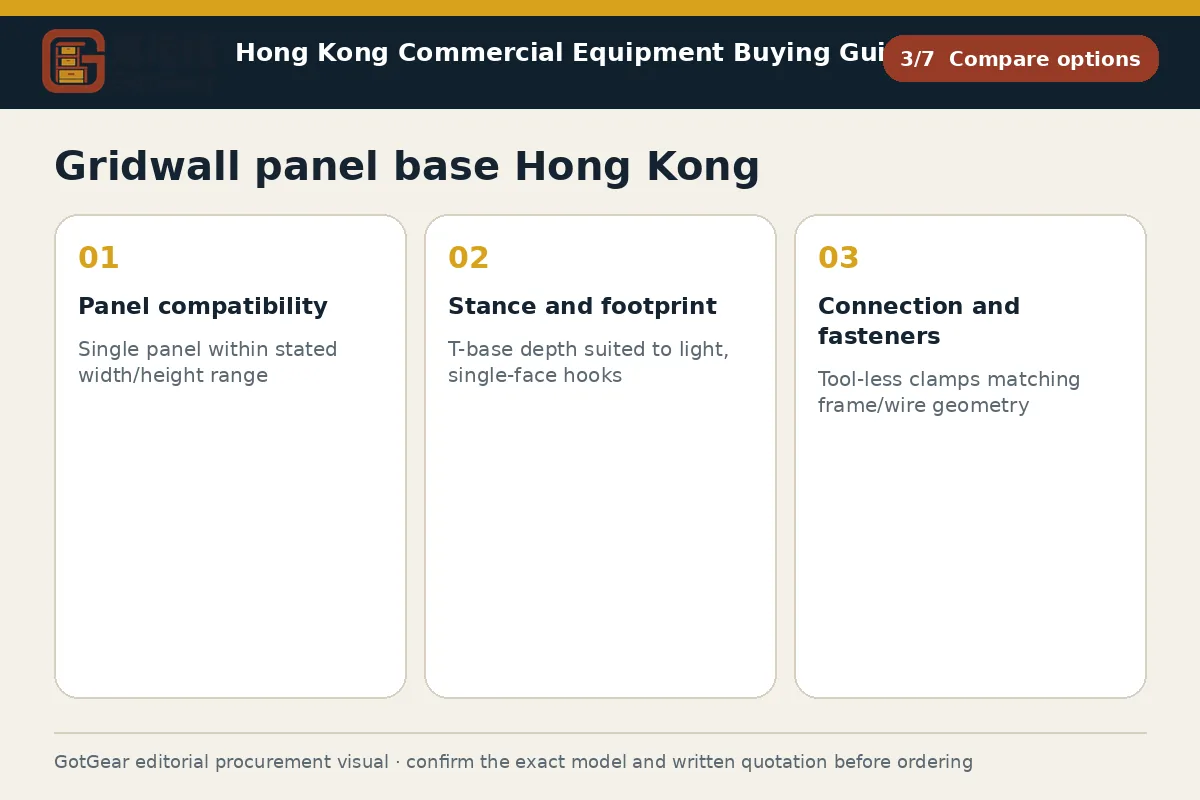
| Panel compatibility | Single panel within stated width/height range | Oversize or double-sided layout with accessories | Panel width/height, wire gauge and pitch; intended accessories list |
| Stance and footprint | T-base depth suited to light, single-face hooks | H-base or braced frame for heavier shelving | Scale floor plan, panel height, example load distribution |
| Connection and fasteners | Tool-less clamps matching frame/wire geometry | Bolted brackets with anti-tamper or torque spec | Connection drawings, wire/frame dimensions, hardware finish |
| Floor contact and movement | Levelling feet with non-marking pads on smooth floors | Braked castors or approved anchoring if venue permits | Floor type, slope notes, venue restrictions or approvals |
| Documentation | Assembly sheet and basic load guidance | Venue- or insurer-requested method statement or plan | Requested document list; organiser/building instructions |
This framework helps buyers create comparable written enquiries. Final model specifications, availability, delivery and commercial terms must be confirmed in a formal quotation.
Plan floor contact and position for a gridwall panel base Hong Kong
The floor and the circulation plan are as important as the hardware. Identify surface type (polished tile, vinyl, timber, low-pile carpet, concrete) and any slope or drainage falls. Ask for levelling feet with non-marking pads, and confirm whether the feet can accept protective cups where floors are easily marked. For wet-side entries or loading bays, request information on anti-slip pad material and corrosion resistance of any exposed steel. If castors are required for overnight reconfiguration, confirm braking type and wheel material with the building manager before ordering.
Positioning should follow your merchandise and customer flow. If you plan a gridwall panel shelf Hong Kong on one face, allow extra turning space and verify total depth including shelf bracket projection. A gridwall sign holder Hong Kong mounted at the top may demand additional clearance for sightlines and sprinkler throw, subject to your venue’s rules. Map approach direction, queue management and fire egress lines on a scale floor plan before finalising footprint. For buildings with tight goods-lifts, record both assembled and flat-packed dimensions and coordinate delivery slots with the management office. In humid back-of-house spaces, ask the supplier to confirm coating specification and maintenance guidance, then capture these in your operating notes.
Gridwall panel base Hong Kong: Compare with gridwall panel legs Hong Kong
Two separate feet offer a light, mobile solution, while a full base frame usually delivers greater rigidity. When comparing gridwall panel legs used in Hong Kong with a framed base, consider how each option resists racking, twisting and tipping when the panel is loaded asymmetrically. Legs can reduce packed volume for exhibition logistics and simplify transport through narrow lift cars, but they may require crossbars or stabilisers for heavier planograms or for use in public venues.
A framed base typically provides a defined footprint and can incorporate bracing, levellers or castors more neatly, supporting double-sided merchandising with fewer add-ons. For multi-panel runs, check whether legs or bases can be ganged together or share stabilisers. In written quotations, ask suppliers to state the maximum recommended panel height for each option, the accessories permitted, and any restrictions on shelves or baskets. If your brief leans towards tower-style messaging rather than wire-grid flexibility, evaluate whether a slatwall display tower in Hong Kong would meet the objective with fewer components. Whichever route you choose, request assembly drawings, fastener counts and finish samples to ensure a like-for-like comparison.
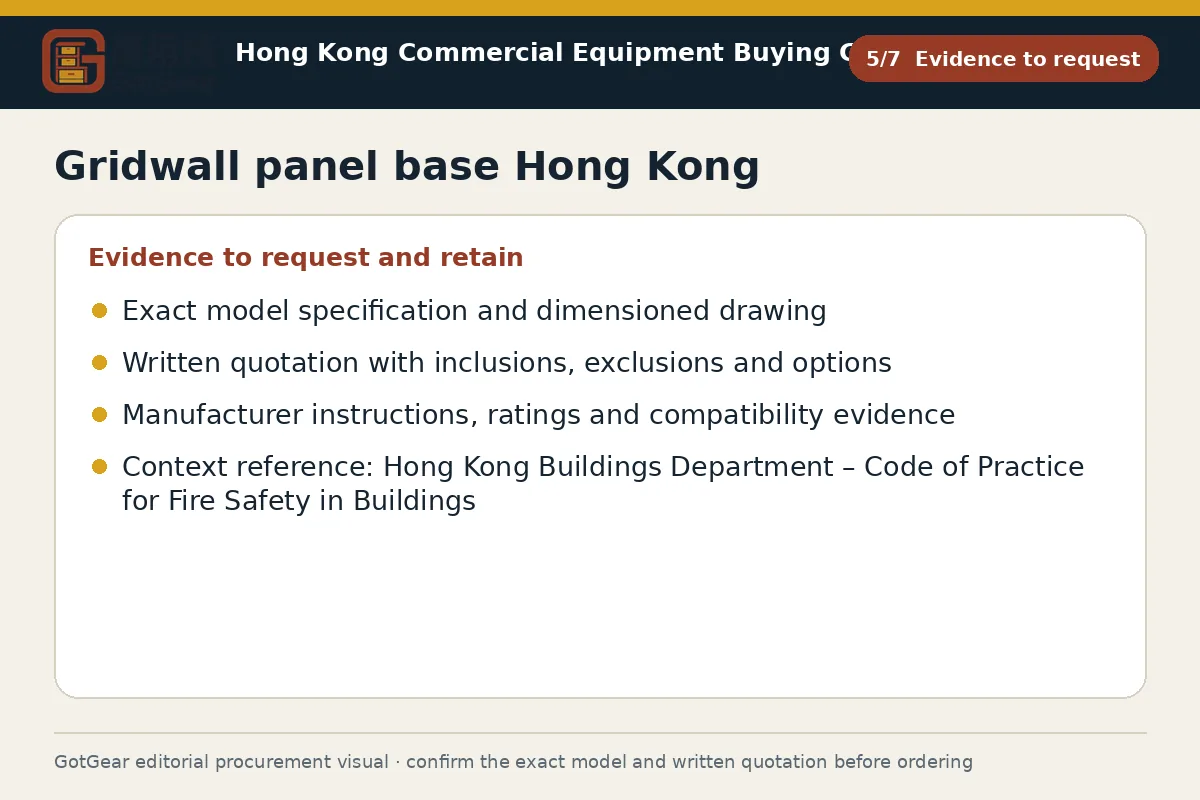
Gridwall panel base Hong Kong decision checklist
Define the panel size, wire gauge and pitch, then state if the display will be single- or double-sided with shelves, hooks or baskets. Mark aisle widths, door and goods-lift clear openings, floor type and any slope. Ask suppliers to confirm compatible panels, base footprint, fixing method, finish, included hardware, and example load guidance for your plan. Compare written quotations on model code, dimensions, stance depth, levellers or castors, accessory allowance and instructions format. Book delivery with the management office and confirm any restrictions on tools, castors or protective floor coverings. On receipt, inspect welds, squareness, coating, levelling feet and the fastener count against the packing list. Where a venue, institution or insurer requests it, ask the manufacturer for assembly and loading documentation in writing.
- Operating use, quantity and expected frequency
- Dimensions, capacity, material and accessory requirements
- Delivery address, floor, goods lift and loading window
- Required documents, acceptance checks and after-sales arrangements
Key points for gridwall panel base Hong Kong, gridwall panel legs Hong Kong
Hong Kong buildings often require delivery bookings via the management office, with specified loading-bay windows and goods-lift access that can be tight. Confirm the largest item size that can pass through lift cars and fire doors, and whether castors are permitted on mall floors. Humidity can accelerate corrosion in back-of-house areas, so coating choice and care instructions matter. For public events, organisers may ask for basic load guidance and a method statement before build-up; obtain these from the manufacturer where required. Ensure assembly instructions are available in the languages your team needs. This summary is operational, not legal advice; venue and supplier documents prevail.
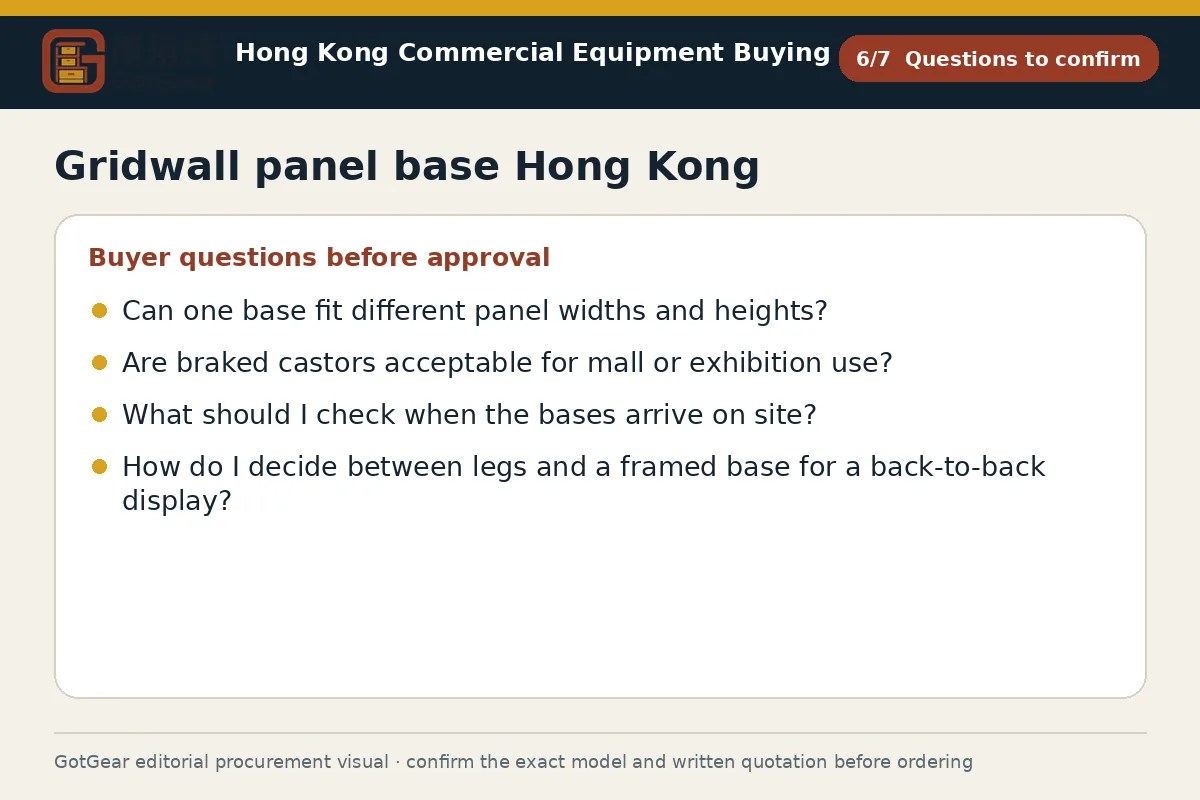
Questions about gridwall panel base Hong Kong
Can one base fit different panel widths and heights?
Often, yes, within the manufacturer’s stated compatibility range. Many bases accept common panel widths if the fixing geometry and wire gauge match. However, stability changes with height and load plan, so ask the supplier for the recommended maximum panel height and any bracing needed for your intended merchandise. Written model specifications and the formal quotation should prevail.
Are braked castors acceptable for mall or exhibition use?
They are frequently acceptable if they lock positively and the venue allows wheeled fixtures on that floor finish. Always confirm with the building manager or organiser beforehand, noting any requirements for wheel material, protective mats or overnight immobilisation. Where requested, obtain manufacturer guidance on load and centre-of-gravity before committing to castors.
What should I check when the bases arrive on site?
Verify quantities against the packing list, then inspect weld continuity, squareness, coating quality and thread action on levelling feet or castors. Check that fixings and tools match the assembly sheet and that instructions are readable by your team. If public-facing, file the supplier’s written load guidance with any method statement the venue or insurer has requested for your event or store.
How do I decide between legs and a framed base for a back-to-back display?
Choose the option that controls tip and twist under your actual merchandise load. Framed bases often stabilise two-sided layouts with fewer extra parts; legs may need crossbars or stabilisers. Request each supplier’s recommended maximum panel height, permitted accessories and any back-to-back notes, then compare drawings, footprints and included hardware in writing before ordering.
Continue with closely related procurement topics
These pages share equipment, operating or decision-stage signals with this guide.
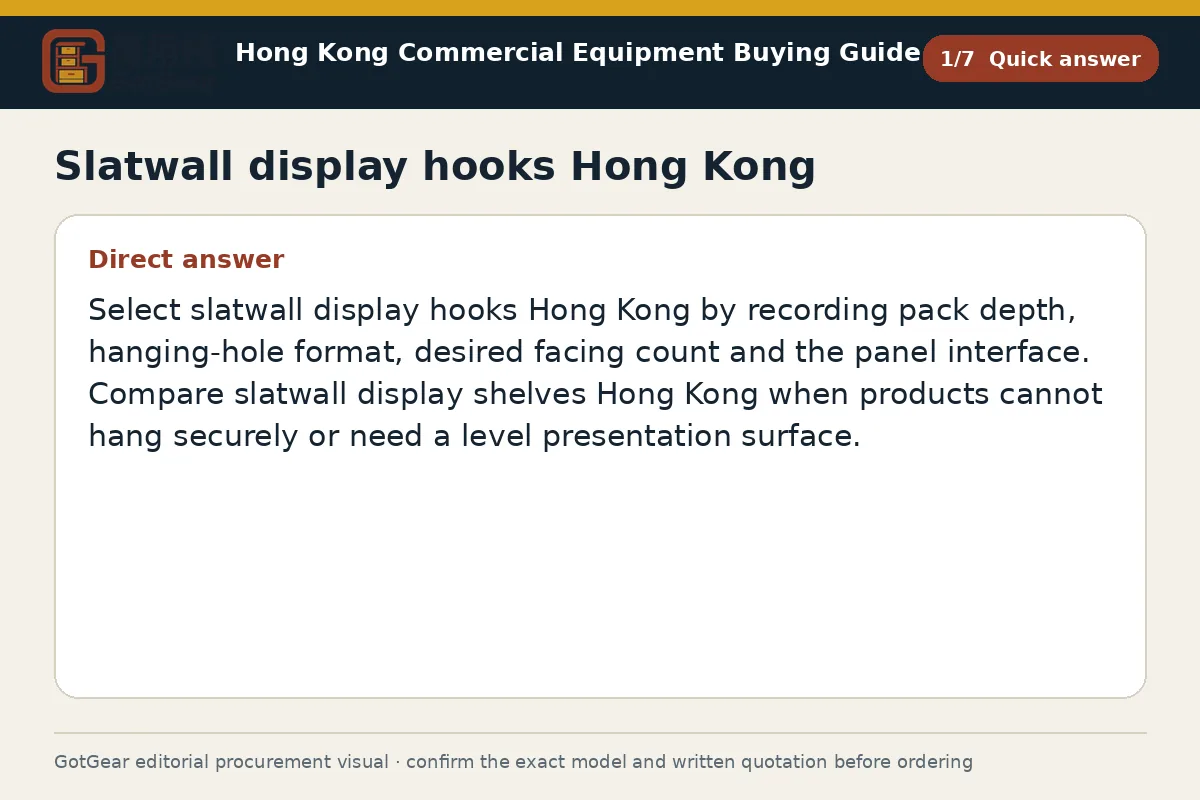
Slatwall display hooks Hong Kong
When selecting slatwall display hooks Hong Kong, check pack depth, hanging-hole format, facing count and panel fit for proper mounting. Compare slatwall display shelves Hong Kong for support and installation with GotGear.
Read the guide
Gridwall panel shelf Hong Kong
GotGear checklist for a gridwall panel shelf Hong Kong explains the panel grid, attachment interface and shelf dimensions and depth. It also covers viewing height and pick access for folded or boxed stock.
Read the guide
Retail garment rack Hong Kong
At GotGear, assess garment type, longest drop, target volume and floor area to choose a retail garment rack Hong Kong that suits your store. Compare fixed and mobile retail clothes rail Hong Kong to decide on layout.
Read the guide
Acrylic sign holder Hong Kong
Choose the right acrylic sign holder Hong Kong with GotGear by considering insert size, orientation, viewing side, and how often you will change inserts. Compare options for magnetic acrylic sign holder Hong Kong.
Read the guideRelated topic indexOpen more English procurement pages1 topics
Browse additional equipment families, applications and procurement questions relevant to a wider buying brief.