
Assess a slatwall display tower Hong Kong by mapping the full footprint, viewing sides, aisle space and accessory mix. Compare a slatwall spinner display Hong Kong for rotating access and a slatwall gondola Hong Kong for longer, multi-sided merchandising runs.
Fit a slatwall display tower Hong Kong into a compact sales floor
If your floor space is compact, plan the fixture before you plan the product. A slatwall display tower Hong Kong works best when its base, turning circle, and customer circulation are mapped on the actual floor. As an example starting point, sketch a circular or square footprint of 500–700 mm plus an outer ring that represents intended aisle clearance, then confirm both figures against the venue brief and the model specification in the written quotation. Add queue lines, door swings and POS approaches to the diagram so staff sightlines are protected.
Decide early whether the tower will be static on levelling feet or mobile on braked castors. Mobile units ease overnight cleaning and replenishment but increase the need for floor flatness checks and an on-site stability test. In Hong Kong buildings, book the management office for goods-lift and loading-bay slots, and confirm the packed dimensions and mass fit the lift car. Where humidity is high, ask the supplier to state panel material, finish and edging in writing, and whether aluminium inserts are used. If the tower will echo wall fixtures, note finish and slot pitch so it coordinates with slatwall panels Hong Kong and merchandising accessories you already operate.
Measure footprint and reach around a slatwall display tower Hong Kong
Convert design intent into measurements that a supplier can quote and that an installer can follow. Mark a taped footprint, then measure: base width/depth (or diameter), maximum overhang from accessories, turning allowance if the head rotates, and the nearest hard obstruction. As an example starting point, allow a continuous browsing lane of 900–1,100 mm around the unit, and a top slot height that typical shoppers can reach comfortably; confirm both with your venue policy, risk assessment and the model data in the supplier’s written quotation.
Request key fields in every quotation: overall height, base dimensions, panel thickness and core (e.g., MDF type), slot pitch and whether aluminium inserts are fitted, rated load per accessory and per face, rotation mechanism and brake, levelling range, finish, anti-corrosion treatment, knock-down packaging dimensions, net and gross weights, and assembly hardware list. Ask for exploded assembly drawings and bilingual instructions on request. On receipt, inspect for flat, chip-free grooves, secure edging, square bases, intact fasteners and unscratched finishes. If the unit will sit under sprinklers or cameras, provide recorded heights to the supplier and ask whether the proposed model’s top cap and signage keep within your site’s clearances.
What should buyers compare for slatwall display tower Hong Kong?
| Criterion | Straightforward requirement | More complex requirement | Evidence to provide |
|---|---|---|---|
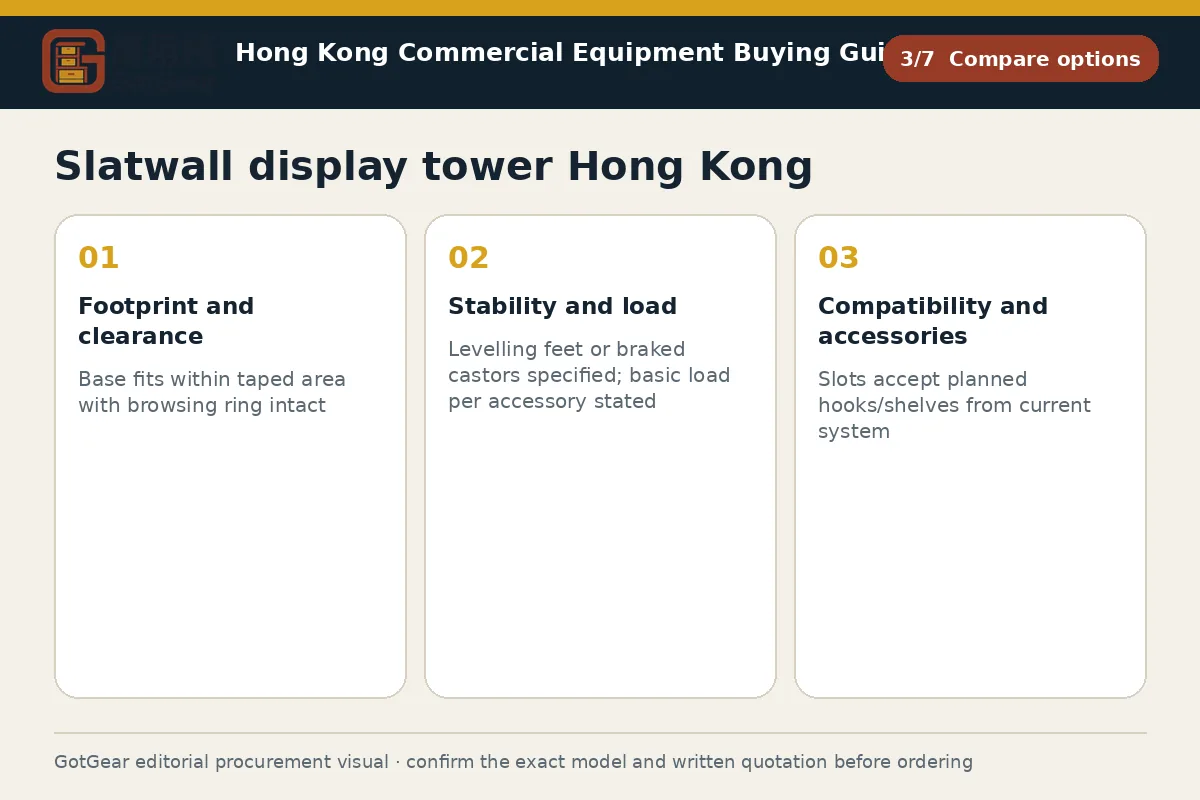
| Footprint and clearance | Base fits within taped area with browsing ring intact | Rotation and accessory overhangs preserved at pinch points and queue lines | Measured base width/depth or diameter; target aisle width; obstruction map |
| Stability and load | Levelling feet or braked castors specified; basic load per accessory stated | Stability with full planogram, signage and customer interaction considered | Written load ratings; base mass; levelling range; any stability notes |
| Compatibility and accessories | Slots accept planned hooks/shelves from current system | Mixed brands and specialised holders validated before order | Slot pitch (mm); panel thickness; insert type; sample-fit confirmation |
| Transport and assembly | Knock-down pack fits lift and corridors; bilingual instructions available | Complex routes, restricted windows and limited staging space accommodated | Packed dimensions; gross weight; route photos; booking confirmations |
| Finish and environment | Finish matches store set; cleaning method agreed | Humidity, corrosion and colourfastness addressed for site conditions | Material/finish statement; edge/band type; care guidance from supplier |
This framework helps buyers create comparable written enquiries. Final model specifications, availability, delivery and commercial terms must be confirmed in a formal quotation.
Compare access around a slatwall display tower Hong Kong
Access is not only about width; it is about approach, pause, selection and exit. Towers invite 360-degree browsing, so keep corners and queue rails from pinching the circulation ring. If customers will use baskets or trolleys, walk the route with those items during planning. Where an island display must signal a category, consider pairing the tower with a retail display plinth Hong Kong for vertical hierarchy without blocking sightlines. For impulse ranges by the till, ensure the unit does not push the payment queue into escape routes; ask the venue if any event-day or mall restrictions apply to free-standing fixtures.
Think about housekeeping access too. If staff replenish during trading, specify swivel clearance and a safe place to park a case trolley without blocking the browse ring. For seasonal promotions, plot temporary neighbours such as a retail dump bin Hong Kong so product facings are not shadowed. In tight stores, mirrored or light-coloured finishes can reduce visual mass, but check cleaning regimes and fingerprint tolerance with operations. Finally, if you plan label rails, header cards or lighting, ensure cable routing and ticket holders do not snag customers as they move around the unit.
Weigh a slatwall spinner display Hong Kong and slatwall gondola Hong Kong against a slatwall display tower Hong Kong
When you compare a slatwall spinner display in Hong Kong with a static tower, start by assessing interaction. Spinners minimise walking by rotating the merchandise to the shopper, which suits small, high‑SKU items on hooks or small shelves. They can feel playful but need reliable bearings, a positive brake and a stable base; ask the supplier to state bearing type and tip‑resistance measures in the quotation. Static towers feel more deliberate and are steadier for heavier accessories or framed signage; specify levelling and base mass, and request any available stability test summary if your venue or insurer asks for it.
For longer runs or to define zones, a slatwall gondola in Hong Kong offers multi‑sided merchandising in linear form, often with better planogram discipline and shared endcaps. Confirm aisle spacing at both faces and the ends, and ask for precise overall lengths including end panels and feet. If you operate both systems, a gridwall panel base in Hong Kong can supplement capacity for wire‑intensive ranges, but check hook compatibility and finishes. Across all three families, compare accessory ecosystems, spares availability, packing dimensions for your lift, and whether the supplier can provide bilingual assembly instructions; the model specification and the final written quotation prevail.
Slatwall display tower Hong Kong decision checklist
Begin by mapping the base footprint, browse ring and queuing paths on the floor, then verify that drawing against the building plan and goods-lift capacity. Capture measurements in millimetres and record ceiling, sprinkler and camera heights if signage or headers are planned. Request written specifications for overall height, base size, panel core and slot inserts, accessory load ratings, rotation and brake (if any), levelling range, finish and packaging dimensions. Ask whether bilingual assembly instructions are supplied. Compare quotations line by line for the same accessory counts and finishes, and ensure the final drawing matches what is priced. Before delivery, book the loading bay and lift, confirm cartons fit, and brief staff on safe handling. On receipt, inspect panel flatness, groove quality, edging, base squareness, brake action, fastener counts and surface condition. Where required by the venue or insurer, request manufacturer statements on stability or material composition; the model specification and written quotation prevail.
- Operating use, quantity and expected frequency
- Dimensions, capacity, material and accessory requirements
- Delivery address, floor, goods lift and loading window
- Required documents, acceptance checks and after-sales arrangements
Key points for slatwall display tower Hong Kong, slatwall spinner display Hong Kong, slatwall gondola Hong Kong
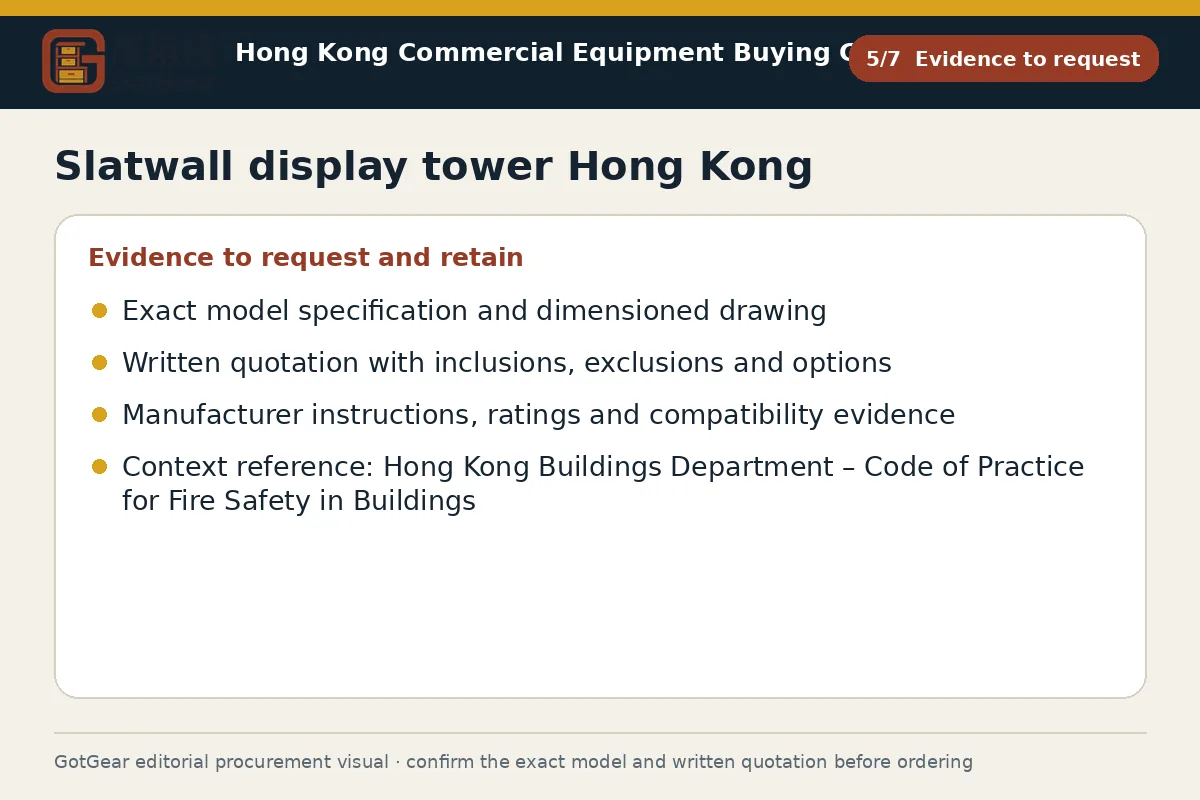
Hong Kong buyers should plan around tight lifts, doorways and reserved loading windows managed by building offices. Confirm packed dimensions, longest panel length and unit weight against the actual goods-lift car and turning space in corridors. Summer humidity and coastal air can age laminates and unprotected steel; ask for stated finishes and any corrosion-resistant inserts where appropriate. In malls or public venues, free-standing fixtures may face positional rules during events; request any site constraints in writing. Finally, bilingual assembly guidance and clear labelling simplify handover to mixed-language operations and maintenance teams.
Questions about slatwall display tower Hong Kong
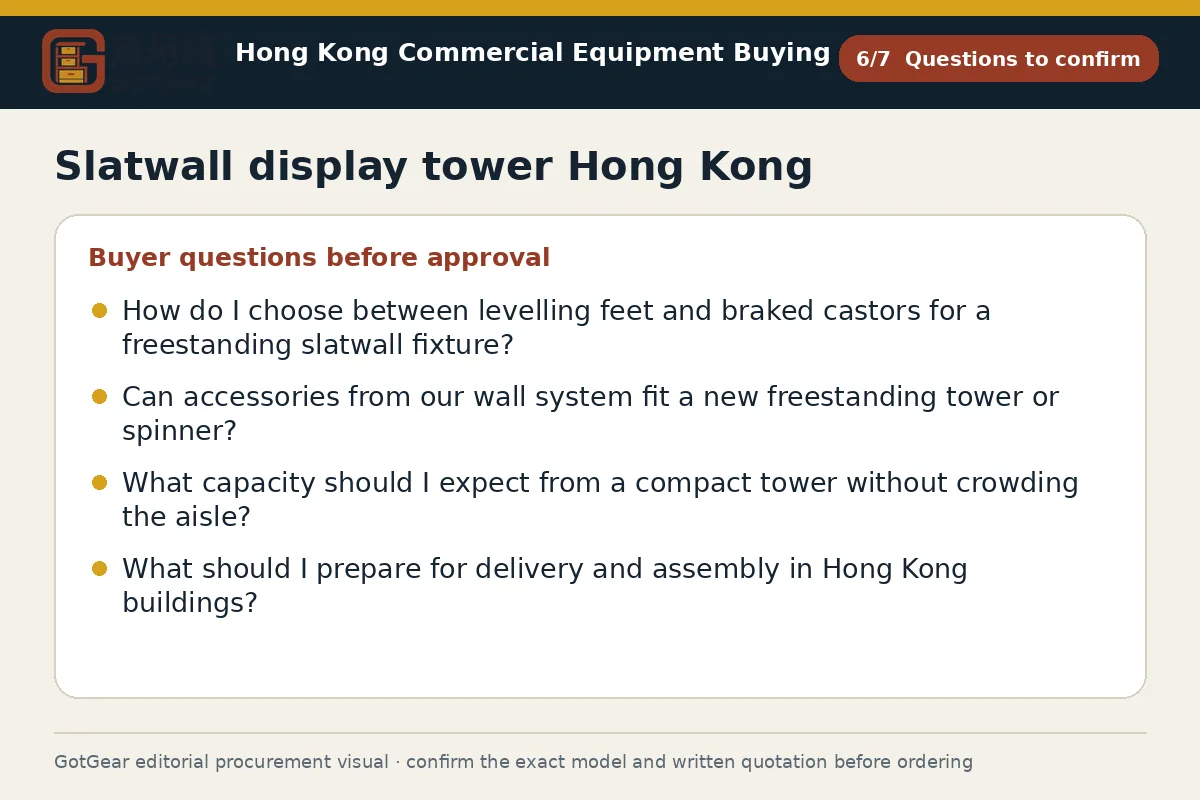
How do I choose between levelling feet and braked castors for a freestanding slatwall fixture?
Use levelling feet for maximum stability on uneven tiles, and braked castors if you must move the unit for cleaning or seasonal layouts. Castors increase convenience but add height and require flat floors and effective brakes. Confirm floor conditions on site and ask the supplier to state levelling range or castor type and lock strength in the written quotation.
Can accessories from our wall system fit a new freestanding tower or spinner?
Often yes, if slot pitch, panel thickness and any aluminium inserts match your current hardware. Treat this as a trial requirement: provide the supplier with accessory samples or exact specifications and request written confirmation of compatibility. As an example starting point, many systems use a regular slot pitch, but verify yours in millimetres before ordering to avoid misfits.
What capacity should I expect from a compact tower without crowding the aisle?
Plan capacity by face and accessory, then test it on a taped footprint. As an example starting point, you might plan 4–6 hooks per face for small items, adding shelves for boxed goods, but confirm loads per accessory and per panel with the supplier. If traffic is heavy, reduce protrusion lengths and keep a continuous browsing lane around the unit.
What should I prepare for delivery and assembly in Hong Kong buildings?
Book the management office for loading-bay and goods-lift access, and confirm the largest carton and longest panel fit through doors and into the lift car. Provide staff or a contractor for safe handling, and set an assembly area clear of customers. If your venue requires insurance documents or method statements, request them in advance; the schedule in the quotation prevails.
Continue with closely related procurement topics
These pages share equipment, operating or decision-stage signals with this guide.
Retail display plinth Hong Kong
GotGear compares retail display plinth Hong Kong and retail display pedestal Hong Kong, covering top area, height, product scale, viewing angle, and floor position for displays in Hong Kong stores.
Read the guide
Acrylic display risers Hong Kong
Choose acrylic display risers Hong Kong by footprint, tier height and counter depth to improve viewing, access and cleaning. Compare countertop display risers Hong Kong at GotGear.
Read the guide
Slatwall panels Hong Kong
Explore slatwall panels Hong Kong with GotGear. We compare panel formats, groove layouts, panel dimensions and accessory compatibility to help you plan a slatwall display system Hong Kong.
Read the guide
Slatwall waterfall arms Hong Kong
GotGear offers a practical checklist for Hong Kong shops that compares visibility, capacity and projection of slatwall waterfall arms Hong Kong and slatwall faceout arms Hong Kong. It helps retailers plan displays and layout.
Read the guideRelated topic indexOpen more English procurement pages2 topics
Browse additional equipment families, applications and procurement questions relevant to a wider buying brief.