Colour, makeup and scalp courses: choose a skill boundary to practise
GotGear and DT HUB share an owner. This collection is not an independent recommendation. GotGear does not supply DT HUB salon, wig, Academy or healthcare services. Three online service sections do not represent three physical stores; the shared public studio is in Kwun Tong. Medical articles are informational only, with no diagnosis, clinical endorsement or outcome promises, and do not replace medical advice.
The short answer
Choose a beauty course by the task you want to practise safely, not by the breadth of its title. Makeup needs hygienic product handling; colour needs chemical safety and hair-history checks; styling needs control of heat and tension. Scalp care should remain cosmetic, with clear referral rules for symptoms. Ask who supervises practice, what assessment covers and what any certificate actually means before committing to a course.
Start with one task you want to perform
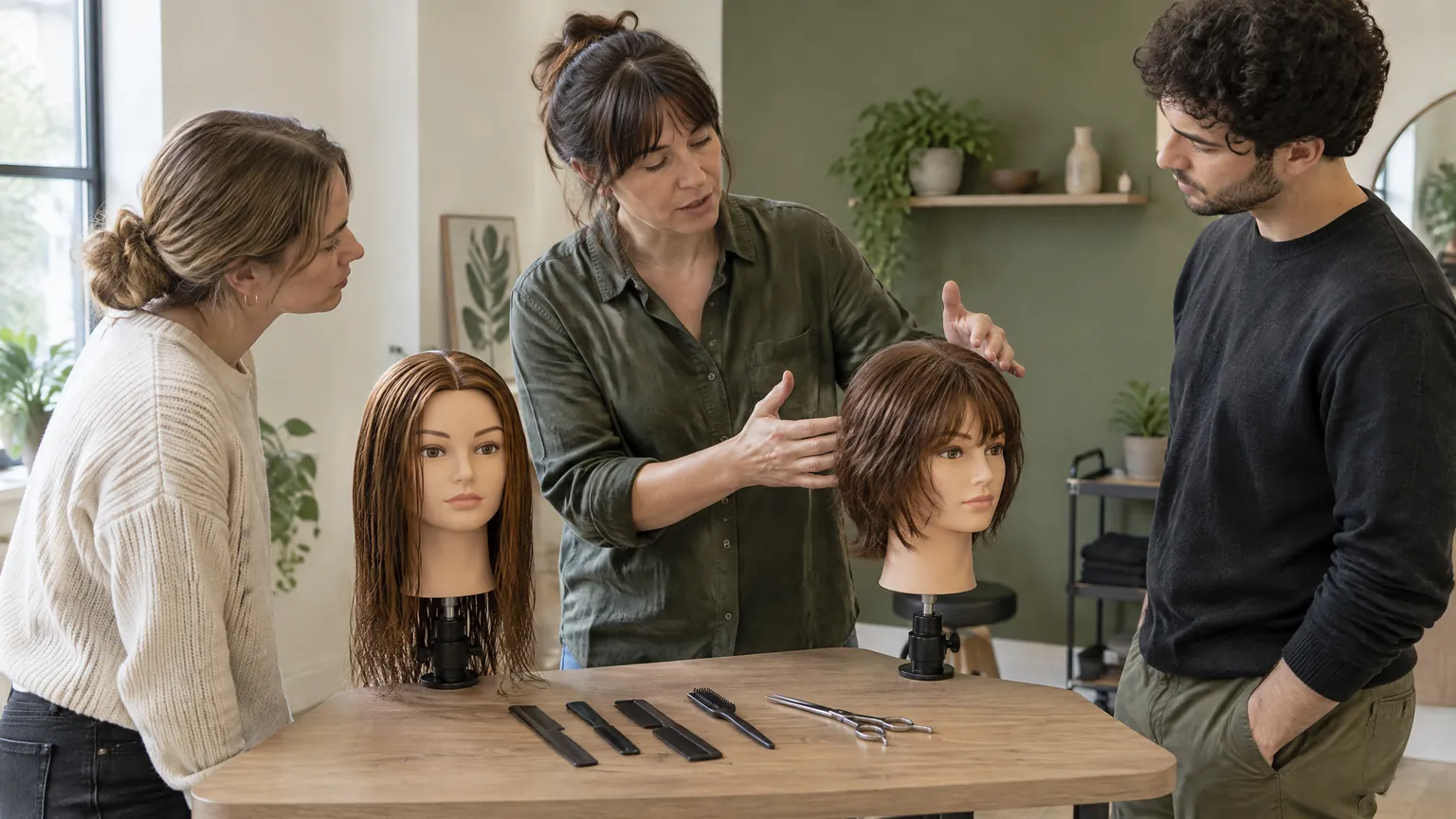
A course becomes easier to compare when you can describe its intended use in one sentence. ‘I want to create a comfortable pinned style’ is more useful than ‘I want to learn everything about hair’. ‘I want to apply everyday eye makeup hygienically’ gives a clearer starting point than ‘I want to become a beauty professional’. The narrower statement lets you ask what will be demonstrated, what you will practise and which mistakes the tutor will correct.
That does not mean restricting your interests forever. It means separating an initial skill from later responsibilities. A learner may eventually combine makeup and styling, while a salon assistant may progress from sectioning hair to supervised colour work. Neither progression should be assumed from a course name. Understanding where a lesson stops is part of choosing it well.
For a small salon, the same distinction prevents a training purchase from becoming an unsupported promise to clients. Decide which existing task needs improvement before introducing a new service category. If staff struggle to keep a station organised, a broad course title will not automatically fix that operational problem. Ask whether the practical teaching addresses preparation and clean-up as well as the finished appearance.
GotGear and DT HUB are under common ownership. The course links here provide access to provider information, not an independent endorsement. Academy information concerns DT HUB x Canvas Academy, with course enquiries handled by Canvas Academy. GotGear is not the course booking desk or a provider of hair and scalp services.
Compare what you will practise and where you must stop
The following comparison is a way to evaluate a syllabus, not a claim about what any particular provider currently includes. Ask the course contact to confirm the activities, supervision and assessment in writing. A strong answer describes an observable task rather than relying on labels such as ‘advanced’ or ‘specialist’.
| Learning area | A specific practice task to ask about | Feedback worth requesting | Boundary to clarify |
|---|---|---|---|
| Makeup | Preparing a hygienic station and applying an everyday look | Product handling, placement and safe work near the eyes | When irritation or an inflamed eye area means practice should not proceed |
| Hair colour | Recording hair history and preparing supervised application | Sectioning, label compliance and avoiding unintended overlap | When chemical work should be deferred rather than forced to match a reference image |
| Hair styling | Creating and removing a comfortable pinned style | Heat control, placement and tension | When discomfort requires loosening or stopping the style |
| Scalp care | Conducting a cosmetic consultation and describing observations neutrally | Consent, gentle handling and referral communication | No medical diagnosis, prescription or hair-regrowth promise |
Use the table to choose your first learning objective. A course may cover several areas, but breadth is not evidence that a beginner will receive enough supervised repetition in each. You need to know how practice time is divided, not simply how many topics appear on the page.
Makeup: judge the handling routine, not only the finished look
A makeup lesson should help you understand the route from a clean workstation to a finished application. Ask how products are kept from becoming contaminated during practice on another person. The US Food and Drug Administration advises against sharing eye cosmetics, calls for clean instruments near the eyes and recommends single-use applicators when sampling eye cosmetics. It also advises washing hands before application.1
That guidance is useful for evaluating classroom habits; it is not a substitute for the provider explaining its full hygiene procedure. Ask what is supplied for individual use, how used tools are separated from clean ones and who checks the station between models. Watching a tutor blend a colour beautifully does not answer those questions. Nor does a clean-looking brush establish that the entire handling routine is appropriate.
Use the makeup course hong kong information page to frame a specific enquiry: will your intended level of practice include feedback on product hygiene, work around the eyes and application on another person? Confirm the teaching format with the Academy contact rather than treating the existence of a webpage as confirmation of a place or class date.
Ask to rehearse a decision not to apply
For eye makeup, safety includes recognising when not to continue. FDA guidance says to avoid eye cosmetics when there is an eye infection or inflammation around the eye, and to stop a product that causes irritation. Persistent irritation should be assessed by a doctor.1 A learner should therefore be able to explain a postponement politely without attempting to identify the underlying condition.
For personal-use learning, practising on yourself may suit your aim. For work on other people, consultation and hygienic handling become additional responsibilities. Ask whether these are taught and assessed, and whether changing the model changes the assessment. A photograph of a completed look cannot show how the learner responded when an applicator became contaminated or a model reported discomfort.
Colour: learn why an attractive reference may be unsuitable
Colour training involves a different kind of judgement. The reference photograph shows an intended appearance, but not the model's previous chemical services, prior reactions or present scalp condition. A course comparison should therefore include consultation and preparation, not just shade selection. Ask how the tutor teaches learners to record previous colouring, bleaching, perming or straightening without guessing from appearance.
The FDA notes that some hair dyes can cause allergic reactions and that sensitivity can develop after previous uneventful use. It recommends following product instructions and performing the instructed skin test before every use. Crucially, it also says a reaction can still occur when no reaction was seen in the preliminary test.2 A negative result must not be presented as an all-clear guarantee.
When reviewing the hair colour course hong kong page, distinguish the listed subject area from your eventual permission to work independently. Ask which chemical activities are demonstrated, which you may practise under supervision and how the tutor decides that a model is unsuitable. Do not assume that a combined colour-and-perm title means both processes are appropriate for the same person or session.
Keep product instructions inside the learning process
The FDA's safety checklist includes wearing gloves, observing the specified processing time and not dyeing or relaxing an irritated or damaged scalp.2 These are useful topics to ask about, but a general article cannot provide a formula or timing for an individual application. The relevant product instructions and supervised assessment must guide the actual exercise.
If a learner can produce a pleasing shade but cannot explain the recorded hair history, the exercise is incomplete as preparation for client work. Ask whether assessment includes decisions to defer a process. Previously processed lengths, fragile hair and an uncertain history call for judgement, not a promise that stronger chemicals or a longer application will achieve any requested result. Bleaching, perming and straightening are not suitable for every hair condition.
Styling: practise comfort as well as shape
Styling may appear simpler because it need not change hair chemically. Yet heat, repeated handling and pulling still matter. The American Academy of Dermatology recommends the lowest heat setting, limiting contact time with heated tools and avoiding tightly pulled styles. Its guidance also explains that damaging habits can lead to breakage and, with continued damage, thinning or bald spots.3
Make comfort an observable part of the exercise. Ask the model whether a pin presses into the scalp, whether a section feels pulled and whether the style remains comfortable when the head turns. A tutor should be able to explain how these observations affect the next step. A tidy shape is not a reason to dismiss discomfort.
For someone whose goal is a repeatable everyday or occasion style, the hair styling course hong kong page provides a starting point for discussing the exact technique they want to learn. Ask whether practice includes preparation, secure but comfortable placement and removal, and whether it is conducted on a mannequin, a person or both. None of those arrangements should be inferred from the course title.
Removal deserves attention because it is part of the client's experience. A learner who finishes a pinned style should also know how to explain its safe removal without tugging through tangled sections. When reviewing practice photographs, note which skills the images cannot demonstrate: temperature choices, the model's comfort and the care taken when dismantling the style.
Scalp care: observation is not a diagnosis
Scalp training needs the clearest boundary of the four areas. A cosmetic consultation can record what a person reports and what is visibly observed. It should not turn those observations into a disease label. ‘The person reports itching after using a product’ is a record; ‘this is a particular inflammatory condition’ is a medical conclusion. A learner should practise the difference in ordinary language.
NHS inform explains that hair loss has different causes and advises contacting a GP about abnormal, unexpected or sudden loss. Assessment can involve questions and examination, and sometimes blood tests or referral to dermatology.4 A magnified scalp image does not supply that whole assessment. Knowing how to operate a viewing device is not the same as knowing why hair is being lost.
Treat the descriptions on the scalp care course hong kong page as provider information to question, not medical evidence. Ask how teaching separates cosmetic care from diagnosis, how referral decisions are practised and what any completion certificate signifies. A scalp care course or a ‘specialist’ label does not itself confer a medical licence or authority to prescribe treatment.
Cosmetic activities should remain within the learner's training and competence. They must not be advertised as treating disease or restoring follicles merely because a course covers scalp anatomy. The evidence needed to diagnose a condition or establish a treatment's effectiveness is different from evidence that a person attended lessons. The course name supplies neither.
Persistent irritation, pain, inflammation or sudden noticeable hair loss should prompt assessment by a qualified healthcare professional rather than a student-led cosmetic plan. The useful skill is a respectful referral conversation: explain that the concern needs medical assessment and avoid promising what a cosmetic service will change. Do not offer a disease explanation simply to make the consultation sound more authoritative.
Before enrolling, get answers you can use
Send the course contact a short description of your present experience and intended task. ‘I have no experience working on models and want supervised practice in a comfortable pinned style’ gives them something concrete to answer. ‘Which course is best?’ can produce a general recommendation without resolving whether the course fits your needs.
Use this checklist before committing:
- State whether you want personal-use skills or preparation for work on other people.
- Ask what prior experience is required and which practical activities you will actually perform.
- Confirm the language of instruction, rather than inferring it from an English information page.
- Ask who supervises each practical activity and how corrective feedback is provided.
- Confirm whether models, individual-use products and relevant tools are supplied or need arranging.
- Request an explanation of assessment, attendance requirements and the meaning of any certificate.
- Clarify the current enrolment terms, cancellation arrangements and course enquiry channel.
These are questions, not statements that every provider offers each arrangement. If a reply describes a certificate, ask who issues it and what was assessed. Do not equate attendance with demonstrated competence, or either with a regulated qualification. A course also cannot guarantee employment or a particular business result.
Because Academy enquiries are handled by Canvas Academy, confirm the current course contact through the Academy information rather than sending training questions to GotGear's equipment enquiries. Do not assume salon service booking and course administration follow the same route. Confirm dates and arrangements directly; public descriptions do not establish availability.
A hypothetical salon chooses a smaller learning objective
Consider a hypothetical two-person salon where an assistant helps with finishing but has never performed colour application or scalp consultations. The owner wants the assistant to contribute more, and considers enrolling them in several subject areas at once. The immediate operational problem, however, is that pinned finishes require frequent correction and removal instructions are inconsistent.
In this hypothetical situation, a narrow styling objective is easier to evaluate: prepare a section, place pins without uncomfortable pulling, check the model's comfort and explain removal. The owner could ask a provider whether supervised practice covers those steps. This does not prove that styling is the right first course for every assistant; it follows from the particular task described.
Colour remains a separate responsibility. A satisfactory pinned finish would say nothing about the assistant's ability to interpret product warnings or record chemical history. Likewise, an interest in scalp care would not qualify them to explain a client's sudden shedding. The owner should not add those duties merely because the assistant becomes more confident in another area.
After training, the salon could review the specific task with supervision appropriate to the assistant's role. It could note where correction is still needed and agree which activities remain outside that role. Those records would guide further learning without claiming that a course produced client improvements or commercial results. This is a hypothetical planning example, not a report of a visit or a tested outcome.
Make your practice record describe decisions
A useful practice record contains more than a finished photograph. Record the task, the preparation, the feedback received and what you would change next time. For makeup, that might be a handling mistake caught before application. For styling, it might be a pin position changed after the model reported pressure. For colour, it might be a supervised decision not to proceed because the history was unclear.
For scalp learning, keep observations factual and avoid labelling a disease. Record that a concern was referred for medical assessment rather than suggesting that a viewing device confirmed a cause. If a person participates in practice, agree separately whether any photographs may be taken or used. Participation should not be treated as automatic permission for public promotional images.
The best course fit is the one that supports your next defined task, gives you meaningful feedback and makes its limits clear. More subjects can be added later. At each stage, ask whether you can explain not only how to proceed, but when to pause, seek supervision or direct someone to qualified healthcare.

Common questions
Should I combine makeup and hair styling in my first course enquiry?
You can ask about both, but define a separate task for each. Check how practice time is divided and whether each task receives supervised feedback. If your immediate need is a comfortable pinned style, adding makeup should not obscure the preparation, placement and removal skills you need to practise first.
Does a scalp care certificate allow me to diagnose hair loss?
A course completion certificate does not itself confer a medical licence or authority to diagnose disease. Ask what the document certifies and how cosmetic observation is distinguished from medical assessment. Unexpected hair loss, persistent irritation or pain should be directed to a qualified healthcare professional, not interpreted through a student consultation.
What should I tell the Academy contact before asking about enrolment?
Describe your experience, your intended practical task and whether you plan to work on yourself or other people. Then ask about supervision, assessment, teaching language and model arrangements. Academy enquiries are handled by Canvas Academy; confirm the current contact and terms rather than assuming salon bookings and training administration are interchangeable.
Sources & what they support
The scope below identifies what each reference supports. Citations do not imply independent endorsement of DT HUB or any provider, and do not establish treatment benefits or guaranteed results.
- FDA: Eye Cosmetic Safety (opens in a new tab)
Supports hand and instrument hygiene, avoiding shared eye cosmetics, single-use applicators for sampling, and avoiding application during eye infection or inflammation; persistent irritation needs medical assessment.
- FDA: Hair Dyes (opens in a new tab)
Supports label compliance, gloves, specified processing times, avoiding dye or relaxer on an irritated or damaged scalp, repeated skin testing, and the limit that a negative preliminary test cannot exclude a later reaction.
- American Academy of Dermatology: 10 Hair Care Habits That Can Damage Your Hair (opens in a new tab)
Supports reducing heat exposure and contact time, avoiding tightly pulled hairstyles, and recognising that damaging habits can contribute to breakage and hair loss; does not endorse a course provider.
- NHS inform: Alopecia and Hair Loss (opens in a new tab)
Supports the different causes of hair loss, medical consultation for abnormal, unexpected or sudden loss, and assessment that may include history, examination, blood tests or dermatology referral; does not establish efficacy of cosmetic scalp training or services.