
A DT HUB wig shortlist: compare fibre, construction and the enquiry scope
GotGear and DT HUB share an owner. This collection is not an independent recommendation. GotGear does not supply DT HUB salon, wig, Academy or healthcare services. Three online service sections do not represent three physical stores; the shared public studio is in Kwun Tong. Medical articles are informational only, with no diagnosis, clinical endorsement or outcome promises, and do not replace medical advice.
The short answer
Build a wig shortlist around three separate decisions: the fibre you can maintain, the cap that feels comfortable, and the work included in the proposed service. A human-hair description does not explain the cap, while a lace label does not confirm fit or attachment. Compare each candidate against your normal routine, then ask DT HUB to confirm the specific product and enquiry terms. This is a selection guide, not an independent ranking of Hong Kong wig shops.

Start with a wearing brief, not a shop ranking
A useful wig shortlist is small enough to compare properly and detailed enough to reveal differences. Instead of collecting attractive photographs, write down when you expect to wear the wig, how you usually style your hair, and which part of the routine you want to keep simple. An office day with little time for restyling poses different questions from occasional wear for a particular outfit. Neither automatically calls for a particular fibre or cap.
GotGear and DT HUB share ownership. This article explains how to assess options and prepare an enquiry; it is not an independent shop review or a report of a fitting. DT HUB's wig hong kong overview is a starting point for understanding its published wig categories. Treat those categories as items to discuss, rather than confirmation that a particular style, sample or appointment is currently available.
Keep appearance and practical requirements together. Describe your preferred length, parting and overall volume, but also say whether you wear glasses, need to put the wig on without assistance, or have little space for drying and storage. A photograph can convey the cut you like. It cannot show whether a cap presses behind your ears or whether you can manage its care routine at home.
Separate fibre from construction
Fibre means what the visible hair is made from. Construction means how that hair is attached to the cap or base. These are different specifications. Dana-Farber Cancer Institute describes synthetic, human-hair and blended fibres, and distinguishes machine-made from hand-tied construction. It also notes that some ready-made wigs can be altered towards a near-custom fit. A ready-made label therefore does not, by itself, rule out adjustment.2
Macmillan Cancer Support explains that synthetic wigs often retain a set style after appropriate washing, whereas human-hair wigs may require more regular cleaning and styling support. Blends need their own care instructions because the synthetic component can respond differently to heat.1 These are general care considerations, not a guarantee about any DT HUB product.
Use the comparison below to identify questions, rather than to award a winner. The fibre observations draw on those two sources; the checks are practical questions to put to the supplier.1
| Fibre description | Relevant everyday consideration | What to establish for the actual wig |
|---|---|---|
| Synthetic | A set style may reduce the work needed after washing. | Confirm the care method and whether any heat styling is permitted. |
| Human hair | Cleaning and restyling may need more time or professional help. | Ask which styling changes are suitable for this processed hair and cap. |
| Human-hair and synthetic blend | One care routine must suit both components. | Obtain blend-specific washing, drying and styling instructions. |
| Fibre not clearly specified | A photograph cannot establish composition. | Request the material description before comparing care requirements. |
Human hair is a specification, not an automatic upgrade
DT HUB's human hair wig hong kong page introduces that product category. For a meaningful enquiry, move beyond the category name: ask about the selected piece's fibre composition, previous processing, cap construction and care instructions. Do not interpret human hair as permission to bleach, colour or apply unrestricted heat. A desired styling change needs confirmation for the individual wig, not an assumption based on its material alone.
Think about how much flexibility you will actually use. If you normally keep one cut and parting, extensive restyling possibilities may offer little practical benefit. Conversely, if changing the style matters to you, ask how that change would be carried out and who would do it. The useful distinction is between flexibility you will use and maintenance you can realistically sustain.
Inspect the cap where it meets your head
The cap deserves as much attention as the hair. Dana-Farber advises that the foundation should not feel uncomfortably hot or heavy and explains that wigs vary in ventilation. It also recognises that some caps may irritate a sensitive scalp.2 This makes a construction label an incomplete answer to the comfort question. You still need to consider the exact base, edges, seams and fit.
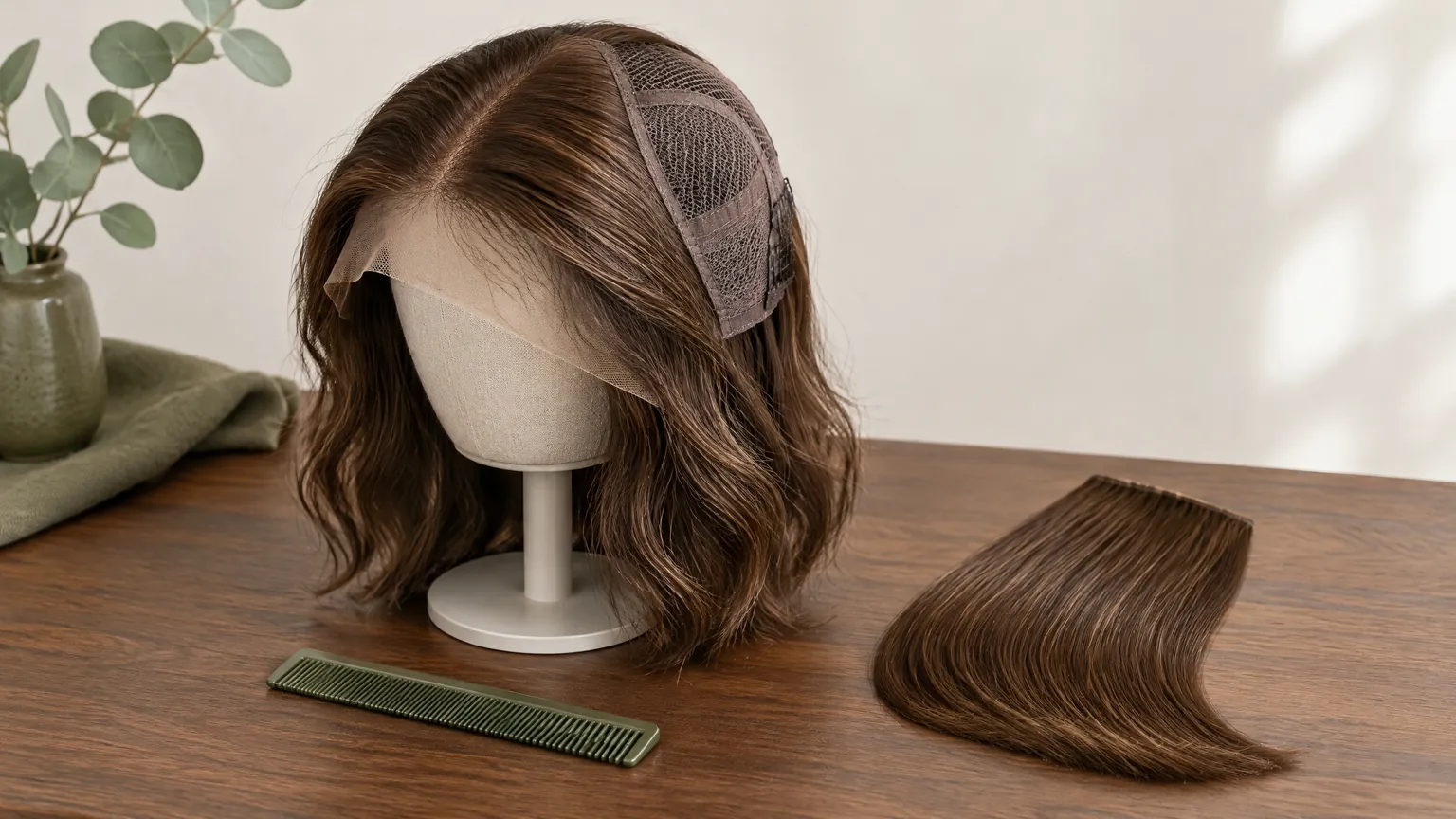
Ask to see where the cap is adjustable and where its structure is fixed. Establish whether any lace or hand-tied section covers only part of the base or extends further. If your usual look exposes the front hairline, that area deserves close inspection. If you wear a consistent parting, check that parting rather than assuming that the widest possible styling range is necessary.
DT HUB describes its full lace wig category as using lace across the cap. That description makes it a relevant candidate when discussing different parting positions, but it does not establish that every tied-back style will work on every piece. Ask for the selected cap's layout, permitted styling and attachment requirements to be explained. Full lace is a construction description, not proof of superior comfort or secure wear during every activity.
Compare the same hairstyle on different bases
Where suitable comparisons can be arranged, keep the visible style as similar as possible while comparing caps. A long, dense sample and a short, lighter-looking sample introduce several differences at once. They can make it difficult to tell whether you prefer the base itself or simply the haircut. Record which specifications differ, so you do not attribute the whole impression to construction.
Bring your usual glasses and consider the clothes you normally wear. Ask whether the cap edge interferes with the arms of the glasses or whether hair catches around a collar. These checks will not predict every wearing situation, but they make the discussion more specific than asking whether a wig is generally comfortable. Avoid approving an option while a clear pressure point remains unexplained.
Treat fitting and attachment as separate questions
A cap can fit well without using every available attachment aid. Both Macmillan and Dana-Farber explain that a well-fitting wig may stay in place without additional aids, while some wearers want extra reassurance.1 Ask first how the selected cap fits and adjusts. Only then discuss whether another attachment method is needed for your circumstances.
Make your expectations concrete. If daily removal matters, say so. If you have existing hair, ask how any proposed clip would interact with it. If an adhesive is proposed, ask what product is involved, how removal works and what care it requires. Do not accept a general statement about security as proof that the same arrangement will suit commuting, exercise and swimming.
Macmillan notes that a cotton liner can help with cap irritation but can also make a wig move more, so its effect on fit needs checking.1 Adding a liner is therefore not a guaranteed comfort solution. Ask about the whole arrangement together: cap, liner if used, adjustment and attachment. If you are receiving cancer treatment or have a very sensitive scalp, discuss adhesive suitability with your care team before use.
The sources here offer wig-selection guidance, including advice written for people affected by cancer. They do not show that a wig treats hair loss or that a particular commercial product is medically suitable. Persistent irritation, pain, inflammation or sudden marked hair loss should be assessed by a qualified healthcare professional, rather than addressed solely through a different cap or fastening.
Define what customisation would change
Customisation should answer a specific problem. It might concern the measurements, a colour match, density, the hairline or the final cut. Those are not interchangeable tasks. Before considering a custom order, identify which aspect of an otherwise suitable option is wrong. If the fit is acceptable but the fringe is too long, ask what adjustment would address that issue before assuming that an entirely new build is required.
DT HUB's custom wig hong kong service page describes measurement and design work. Use it to frame an enquiry about what would be made or altered for you, which specifications you would approve, and how the final fitting would be handled. Confirm the scope and timing directly; a general service description is not confirmation of a completion date for your order.
Record approvals before irreversible changes
Ask how the chosen colour, length, density and cap will be recorded. If a sample is being used as a reference, identify what should match and what should differ. A request for a less dense fringe is more useful than simply asking for a natural look. Where photographs are proposed, ask why they are needed and how they will be used before agreeing.
Separate design approval from acceptance of the finished item. Establish what happens if the final fit differs from the agreed specification and which alterations are possible after cutting or other changes. Ask about adjustment and return terms before authorising work. These questions do not imply that a particular policy exists; they prevent an undefined customisation promise from becoming the basis of your decision.
Compare the service scope before any commitment
Two enquiries can describe similar-looking wigs while covering different work. One may concern the item alone; another may also discuss measurement, fitting, cutting or care instruction. For the comparison to be useful, ask for each proposed task to be identified. Then distinguish work included at handover from support that would need a separate arrangement later.
The wig price hong kong guide can be used as a service-scope checking resource. The important follow-up is what the description covers for your chosen piece: fibre, base, length, density, alterations, fitting and subsequent care. This article does not quote monetary amounts. Request an itemised explanation rather than assuming that every task mentioned on a general information page is included.
Establish practical terms alongside the specification. Ask when the chosen option could be assessed, whether further fittings would be needed and how any necessary follow-up would be arranged. Confirm what happens if you cannot manage the proposed care routine. Maintenance advice is more useful when it matches the way you will actually wear, clean and store the item.
For visit planning, the wig shop hong kong information page is the relevant location reference. Verify the current appointment arrangements and whether the options you want to discuss can be considered at that visit before travelling. An English-language page does not itself confirm English-language reception, walk-in access or immediate supply.
A hypothetical shortlist for a busy office routine
Consider a hypothetical wearer who wants a shoulder-length style for office days, wears glasses and has little time to restyle hair before leaving home. They normally keep a side parting and prefer to remove the wig each evening. This is an illustrative decision, not a customer account or a report of DT HUB stock.
Their first candidate might be a synthetic option with a set style, subject to confirmation of its care requirements and fit. A second might be a human-hair option in a similar cut, allowing them to compare the maintenance involved without being distracted by a completely different hairstyle. A third candidate could explore a different cap construction, but only if the initial comparison reveals an unresolved fit or parting issue.
The deciding questions are straightforward. Can the wearer put it on and remove it as instructed? Does the cap work with their glasses? Can they maintain the side parting without styling tools that the fibre does not permit? Where will the wig dry? A broader range of styling possibilities would not solve a care routine that is impractical for this person.
Leave the enquiry with a usable comparison
A guide labelled best wig shop hong kong should be read as a prompt for checking selection criteria, not as an independent award. For this shortlist, a useful outcome is a clearly described candidate that fits your routine, with unresolved questions made visible. There is no need to turn product labels or brand descriptions into a ranking.
Before accepting an option, use this checklist to turn the conversation into a record you can compare:
- Record the exact candidate, fibre composition and cap construction.
- Note your preferred cut, parting and volume, including any agreed changes.
- Confirm fit adjustment, daily removal and any attachment requirements.
- Obtain care instructions for the actual fibre and base, including heat restrictions.
- Distinguish included fitting or alteration work from separately arranged aftercare.
- Clarify approval stages, adjustment terms and return conditions before changes are made.
- Confirm appointment arrangements and order timing directly, rather than inferring them from a category page.
The strongest shortlist is not the one with the most elaborate specifications. It is the one where you understand why each candidate remains, what its care demands would mean at home and what still needs confirmation. If a comfortable fit, suitable appearance or manageable care routine remains unresolved, keep that issue open rather than treating the enquiry itself as a reason to commit.
Common questions
Can a ready-made wig remain on the shortlist if I want a personalised fit?
Yes. Ready-made describes how an item is supplied, not whether any adjustment is possible. Ask which parts of the actual cap can be altered and whether the visible style can be adjusted separately. Compare that work with the specific problem a custom build would address, rather than assuming custom is always necessary.
Does choosing full lace settle the question of daily comfort?
No. The construction label does not tell you how the individual cap feels at its edges or how its fit changes with a liner. Check the selected piece with your usual glasses and discuss adjustment and removal. A sensitive scalp requires particular care, and persistent discomfort should not simply be accepted.
What should I request when an enquiry covers both a wig and customisation?
Request a clear description of the item and the work proposed. Separate fibre and cap specifications from measurement, cutting, fitting and later care. Ask how you approve changes and what adjustment or return terms apply. Confirm timing directly; an online description is not an order-specific commitment.
Sources & what they support
The scope below identifies what each reference supports. Citations do not imply independent endorsement of DT HUB or any provider, and do not establish treatment benefits or guaranteed results.
- Macmillan Cancer Support: Wigs for cancer treatment (opens in a new tab)
General synthetic, human-hair and blend care differences; fitted-wig attachment considerations; cotton liner comfort and possible movement; care-team advice for adhesive use during cancer treatment. Does not establish DT HUB product performance, availability or Hong Kong financial entitlements.
- Dana-Farber Cancer Institute: How to Choose a Wig (opens in a new tab)
Distinction between fibre and machine-made or hand-tied construction; possible alteration of some ready-made wigs; foundation comfort, ventilation, scalp sensitivity and the role of fit in attachment. Does not endorse DT HUB or prove suitability of an individual commercial product.