
Toppers, lace fronts and glueless labels: inspect different parts of the product
GotGear and DT HUB share an owner. This collection is not an independent recommendation. GotGear does not supply DT HUB salon, wig, Academy or healthcare services. Three online service sections do not represent three physical stores; the shared public studio is in Kwun Tong. Medical articles are informational only, with no diagnosis, clinical endorsement or outcome promises, and do not replace medical advice.
The short answer
A topper describes partial coverage, lace front describes the front hairline construction, and glueless describes an intended way of securing a piece. Synthetic describes the fibre. These labels answer different questions and can overlap on one product. Start with the area you want to cover, then inspect the base, attachment points and care instructions. None of the labels alone establishes all-day comfort, movement security or suitability for heated styling tools.
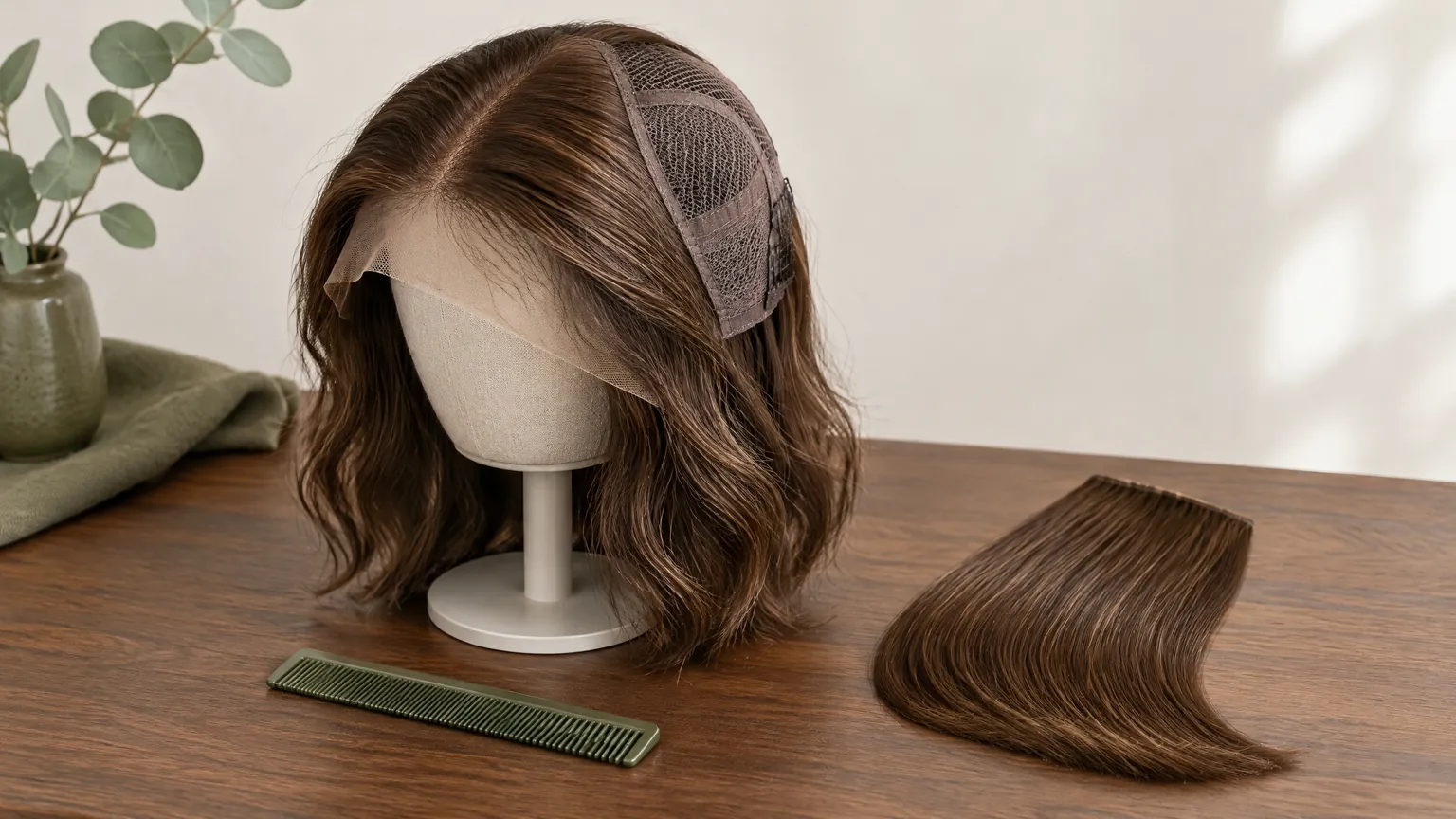
Read the labels as separate product details
Choosing between a topper, a lace-front wig and a glueless design can sound like choosing between three competing technologies. It is more useful to ask what part of the product each term actually describes. A piece may combine several of these features, while another product with a similar name may have a different base, fastening arrangement or fibre. The photograph of a finished hairstyle rarely supplies all the information needed to compare them.
Start with four questions: how much of your head should the piece cover, which part of the hairline will be visible, how will it stay in position, and how will you care for the hair? Keeping those questions separate prevents a convincing front-hairline photograph from standing in for evidence about the entire cap. It also prevents an adhesive-free label from being mistaken for a claim about softness or ventilation.
GotGear and DT HUB are under common ownership. The DT HUB product links in this guide are information routes, not independent recommendations. Product-specific construction and any fitting arrangements need confirmation with the provider; the comparisons here do not establish stock, appointment availability or a particular item's performance.
| Label or feature | What it primarily describes | What to inspect next | What it does not establish by itself |
|---|---|---|---|
| Topper | Partial coverage over an area of existing hair | Base footprint, blending and attachment positions | Whether surrounding hair can comfortably support the piece |
| Full wig | Broader head coverage | Cap shape, size, ear tabs and hair underneath | That the cap fits every wearer |
| Lace front | Lace construction at the front hairline | Lace extent, edge finish and visible hairline | Full-cap construction or fastening method |
| Glueless | Intended wear without glue | Actual straps, bands, clips or other fasteners supplied | No pressure, no pulling or universal movement security |
| Synthetic | Manufactured hair fibre | Written washing and heat instructions for that fibre | Automatic heat-tool compatibility |
Decide the coverage before the hairstyle
A topper is generally intended to add coverage or volume over a limited area, with the wearer's own hair remaining part of the finished style. That makes the underside as important as the colour photograph. Ask to see the base dimensions and where its edges would sit relative to the area you want covered. A piece that looks generous from above may still position an attachment somewhere uncomfortable or leave an edge difficult to blend.
DT HUB's hair topper hong kong page provides a category starting point, but the useful next question is about the proposed piece's footprint and fastening positions. Ask how these relate to your existing hair rather than assuming that the word topper means a small, light or easily concealed base. Those qualities need checking on the actual item.
Blending is more than finding a similar shade. Compare the direction of the parting, the wave or curl pattern, and the transition in length between the piece and your own hair. Look at the join from the side and back, not just straight ahead. If you usually move hair away from your face, check whether that exposes an edge or changes where the piece is supported.
A full wig reduces the need to blend a partial piece into surrounding hair, but brings a different fitting task: arranging the hair underneath and matching the cap to the head. Cancer Research UK notes that a wig fitted while someone still has hair may need a different size after hair loss, or an adjustable design. This illustrates why head circumference alone does not capture every change in fit.1
When considering the women's wig hong kong category, separate the style you like from the cap you would actually wear. Request details about the proposed cap size, underside and adjustment method. A gendered product category is not a construction specification, and a model's hairstyle cannot show how the same cap will sit over your own hair.
Check the hair underneath as part of the fit
Use your usual, gentle hair arrangement when assessing a cap, rather than an unusually tight style created only to make the fitting look neat. The American Academy of Dermatology advises keeping hair loose beneath coverings and explains that repeated pulling, as well as rubbing from coverings, can contribute to traction-related hair loss.2 The practical aim is to avoid solving a bulky fit by putting your own hair under excessive tension.
For a clipped partial piece, ask where the clips would engage and whether the attachment can be demonstrated without tugging. Cancer Hair Care describes clips as one way of gripping a wig or hairpiece onto existing hair.3 That does not establish that a particular area of sparse or fragile hair is an appropriate anchor. If the proposed attachment hurts or pulls, it needs reassessment rather than a tighter fastening.
Inspect the front without guessing the whole cap
A lace front places a lace section at the front hairline, with hair attached to that section. The term draws attention to the transition between forehead and hair, especially when the style exposes the front. It does not tell you how far the lace extends, how the crown is built, or what materials and seams sit against the rest of the head. Those are separate questions.
For the lace front wig hong kong category, ask to see both the front edge and the underside of the proposed product. Confirm whether the pictured lace is already finished or requires preparation, and who would be responsible for any trimming. Do not infer that every lace-front item permits the same parting position or can be worn in the same swept-back style.
Inspect the hairline in the hairstyle you intend to wear. A fringe can cover a front edge that would be visible with the hair brushed away from the face. Look in ordinary lighting as well as a close mirror, and consider whether glasses sit comfortably beside the ear tabs. These checks are about the combination of product and wearer, not about achieving a supposedly invisible result for everyone.
Avoid making an irreversible alteration merely to complete a trial. Before lace is cut or a style is changed, ask how that affects any agreed exchange or adjustment options. Get those terms in writing if they influence your choice. A product demonstration and a finished personal fitting are different stages, and the boundary should be clear before scissors or other modifications are involved.
Translate glueless into an attachment description
Glueless should prompt a question about the intended fastening arrangement, not an assumption that the piece simply rests on the head. Cancer Hair Care explains that wigs and hairpieces may use adjustable straps, clips, tape or glue.3 A design intended for adhesive-free wear still depends on its actual components, cap fit and the way those components interact with the wearer.
The glueless wig page is a place to clarify the product category; ask the provider to identify every fastening component on the proposed item. Establish whether it uses an internal band, adjustable straps, clips or another arrangement, and which elements are supplied. The label does not establish that all those mechanisms are present or suitable for your scalp and hair.
Comfort and stability must be assessed separately. A cap can feel pleasant while sitting still yet shift when you look down. An attachment can resist movement while creating pressure behind the ears. Neither observation should be ignored. Try ordinary movements within the provider's permitted fitting conditions: turn your head, look down and gently change position. This is a practical fit check, not proof of security during wind, exercise or an entire working day.
Do not use tightness to disguise a mismatch
If the cap needs repeated tightening to remain in place, ask whether its size or shape is suitable before adding more tension. Check whether an accessory changes pressure at the forehead, temples or nape. More fastening is not automatically better, and an additional liner or grip may change the fit that was initially assessed without it.
Pain, stinging and crusting are among the warning signs highlighted by the American Academy of Dermatology in its guidance on hairstyles and products that can cause hair loss.2 Do not regard these as a normal price of secure wear. Stop the irritating arrangement and seek advice; persistent scalp irritation, pain or sudden marked hair loss should be assessed by a qualified healthcare professional. This guide cannot identify the cause or prescribe treatment.
Separate fibre care from feeling hot
Synthetic tells you about the hair fibre, not the cap's warmth or the strength of its fastening. Cancer Research UK distinguishes synthetic, human-hair and mixed-fibre wigs. It notes that many synthetic styles come ready to wear, but warns that direct heat from dryers and styling tools can melt fibres or cause frizz. Some manufactured fibres allow heat use, so the manufacturer's instructions matter.1
For the synthetic wig hong kong category, request the exact fibre description and written care instructions for the item being discussed. If it is described as heat-friendly, ask which tools and settings the instructions permit. Without clear product-specific permission, do not experiment with a heated tool on the assumption that a general synthetic label includes heat resistance.
Human hair is not a licence for unrestricted heating, bleaching or recolouring either. Cancer Research UK notes that some human-hair wigs need professional styling and that the fitter should explain whether home washing is appropriate.1 Confirm what the particular product's care instructions allow, including any limits affecting its base and attachments. A possible styling technique is not a guarantee that a specific piece can tolerate it.
Feeling warm while wearing a piece is a different issue from heat-tool compatibility. Cancer Hair Care notes that a wig can make the head feel hotter, while Cancer Research UK describes varied experiences of wearing one: some people become accustomed to it, while others prefer not to wear it.3 Neither source supports declaring an entire label universally cool or comfortable.
For everyday life in Hong Kong, discuss your own pattern of wear: outdoor walking, air-conditioned workplaces, frequent removal, or a hairstyle that sits against the neck. Ask to handle the base and inspect its layers. If you plan to add a liner, assess that combination rather than the bare cap alone. A short indoor fitting cannot establish how comfortable it will feel through every part of your routine.
A hypothetical office-day comparison
Consider a hypothetical wearer who wants coverage around the parting, wears glasses and normally takes the piece off at home. This is an illustration, not a customer account or a tested result. The first question is whether a partial base covers the intended area and can attach without pulling on surrounding hair. If it cannot, a broader-coverage option deserves consideration even if the preferred hairstyle photograph shows a topper.
Suppose the same wearer usually keeps a fringe. A lace front may matter less to the visible style than cap fit, blending and pressure near the glasses. If they later want to sweep the fringe back, they should inspect the exposed front in that position rather than assume that the original fitting answered the new styling question. The priority changes with how the product will actually be worn.
Finally, imagine that the wearer wants little morning styling. A ready-styled synthetic piece could be worth comparing, but only with its maintenance instructions understood. Adhesive-free removal might fit their routine, yet a band or clip could still prove uncomfortable. The useful decision is therefore about a particular combination of coverage, fastening and care, not a winning label.
Take a focused checklist to the enquiry
Before discussing individual pieces, write down the coverage area, usual hairstyle and activities that affect fit. Mention scalp sensitivity or discomfort without trying to diagnose it. Ask whether the provider can address each point below for the product under discussion, rather than assuming that every fitting or adjustment is included.
- Ask for the base dimensions or cap size, and a clear view of the underside.
- Identify the lace area separately from the construction of the crown and back.
- Confirm every fastening component and where it would contact scalp or hair.
- Assess fit with your usual gentle hair arrangement and any glasses or liner.
- Check the front, sides and back in the intended hairstyle.
- Obtain the exact fibre description and written washing, drying and heat instructions.
- Clarify responsibility for trimming or adjustments before the piece is altered.
- Confirm applicable exchange conditions and what follow-up help, if any, is included.
Ask for a demonstration of putting the piece on and taking it off if that is part of the proposed service. The removal routine matters as much as the finished appearance: you need to understand which parts release first and how to avoid pulling your own hair. Keep the care instructions with the product so that a later change of hairstyle does not turn into guesswork.
A useful comparison ends with specific answers: the area covered, the construction you have seen, the fastening you have assessed and the care limits you understand. If a provider cannot explain a detail that matters to your routine, leave that question open. Choosing a wig or topper does not require accepting a universal comfort or security promise; it requires knowing what the particular piece asks of its wearer.

Common questions
Can the same wig be both lace-front and glueless?
Yes, the terms describe different features and can overlap. Lace front concerns construction at the front hairline; glueless concerns intended attachment without glue. Confirm the actual fastening components and the rest of the cap construction. Neither label alone establishes whether the product fits you comfortably.
Is a topper always the lighter or more comfortable choice?
No universal comparison follows from partial coverage. Inspect the base, its attachment points and how it blends into your existing hair. A smaller piece can still tug or create local pressure. Comfort depends on the particular product and wearer, and pain should not be accepted as normal fitting discomfort.
Does heat-friendly synthetic mean the wig will feel cooler outdoors?
No. Heat-friendly describes permitted styling heat for a particular fibre, subject to its instructions. It is not a promise about scalp temperature. Feeling warm involves the whole wearing arrangement, including the base, hair underneath and any liner. Ask for separate information about fibre care and cap construction.
Sources & what they support
The scope below identifies what each reference supports. Citations do not imply independent endorsement of DT HUB or any provider, and do not establish treatment benefits or guaranteed results.
- Cancer Research UK: Wigs, hats and scarves (opens in a new tab)
Supports synthetic, human-hair and mixed-fibre distinctions; warnings about direct heat on synthetic fibres and manufacturer-specific exceptions; fit changes when underlying hair changes; product care instructions and varied personal comfort experiences. UK funding, prices, lifespan estimates and clinical treatment claims are not applied to Hong Kong products.
- American Academy of Dermatology: Hairstyles that pull can lead to hair loss (opens in a new tab)
Supports the risks of repeated pulling and rubbing, loose hair beneath coverings, warning signs including pain, stinging and crusting, and seeking qualified assessment for hair loss. It does not evaluate any named wig or prove that a particular attachment causes a reader's symptoms.
- Cancer Hair Care: Wigs commonly asked Q&A (opens in a new tab)
Supports the existence of straps, clips, tape and glue as different attachment arrangements, the role of clips in attaching pieces to existing hair, and the possibility of increased warmth while wearing a wig. Personal testimonials, prices, security guarantees and hair-regrowth statements are not adopted.