
East Kowloon salon searches: verify the address behind the area page
GotGear and DT HUB share an owner. This collection is not an independent recommendation. GotGear does not supply DT HUB salon, wig, Academy or healthcare services. Three online service sections do not represent three physical stores; the shared public studio is in Kwun Tong. Medical articles are informational only, with no diagnosis, clinical endorsement or outcome promises, and do not replace medical advice.
The short answer
An area page is not proof that a salon has a branch in that district. DT HUB’s public address is in Kwun Tong, so readers coming from Ngau Tau Kok, Kowloon Bay or Lam Tin should confirm that destination before planning a visit. Check the street number, building, floor and room against a written booking confirmation, then use official MTR maps for the journey. Treat service claims and appointment availability as separate questions.

A salon page named after your neighbourhood can be useful without describing a shop in that neighbourhood. It may explain how people from the area can reach a salon elsewhere. The practical mistake is to read the district heading, assume a local branch, and organise the rest of the day around that assumption. Before choosing a route or discussing a hairstyle, find the actual appointment address.
For DT HUB, the public homepage lists Room 03, 21/F, 50 Hoi Yuen Road, Kwun Tong, Kowloon, Hong Kong. That is the known Kwun Tong location: Room 03, 21/F, at 50 Hoi Yuen Road. The homepage describes surrounding districts as service areas, rather than establishing a separate shop in each one. 3 GotGear and DT HUB have common ownership; this guide is not an independent salon ranking or a report of a customer visit.
Read the district name as a starting point, not an address
An area label answers a broad question about relevance. A full address answers the narrower question that matters when leaving home: where will this appointment take place? Keep those questions separate. A salon can describe services for residents of Kowloon Bay while receiving them in Kwun Tong. Equally, a district page might remain online after operational details change, so its heading should not replace direct confirmation.
The DT HUB hair salon ngau tau kok page is framed around travelling from that area to its Kwun Tong salon. Use it to understand the proposed destination, not as evidence of a Ngau Tau Kok branch. Before relying on the suggested walk, check where you will actually start and ask for the current building entrance instructions.
Read beyond the first paragraph. Look at the contact section and booking footer, then compare them with the address supplied in your appointment message. If the street number, floor or room differs, ask which version applies before setting off. Agreement across several pages is useful, but a repeated statement still comes from the same business and is not independent verification of its service quality.
Confirm the building, floor and room together
A street address without the upstairs destination is incomplete for this visit. Keep the entire address in one saved note rather than splitting the building name into one screenshot and the room into another. The public Chinese address is a useful cross-check if an English building label differs between pages or mapping results. Do not assume two differently named map pins identify the same entrance simply because both mention Hoi Yuen Road.
The distinction matters here because some DT HUB area-page copy uses “Liberte Centre”, while its booking footer uses “Lee Bo Times Centre”. Rather than choosing a translation by guesswork, ask the salon to confirm the building name and entrance against the Chinese address, street number, floor and room. The consistently published homepage address supplies a starting point, not a reason to ignore conflicting wording elsewhere. 3
The following comparison separates information that helps you browse from information needed to arrive. It also shows why neither a transport map nor a gallery can settle every question.
| Information you find | What it helps establish | What still needs checking |
|---|---|---|
| District heading on an area page | Which neighbourhood the page discusses | Whether the appointment is actually in that district |
| Full address in the contact section | The business’s published destination | Whether it applies to your booked visit |
| Station location map | Nearby streets, major buildings and exit orientation | The salon’s current entrance and upstairs access |
| Appointment message | What the business has confirmed for you | Missing details such as room, finish estimate or cancellation terms |
| Portfolio or styling illustration | A look you may want to discuss | Whether it represents client work and suits your own hair |
For the visit itself, save the address in both the form used by the salon and the language you can readily recognise. If you need help from building staff, showing the full Chinese address may be clearer than repeating an uncertain English translation. Keep the confirmation accessible without having to reopen several web pages at the entrance.
Plan the station journey and the final approach separately
MTR’s official map resource provides distinct location maps and station layouts for Kowloon Bay, Ngau Tau Kok, Kwun Tong and Lam Tin on the Kwun Tong Line. It explains that location maps show major buildings and their nearest station exits. These are useful for orientation, but they do not confirm a salon branch or promise a door-to-door arrival time. 1
The hair salon kowloon bay information page points readers towards Kwun Tong. Its district name should therefore remain your starting-area reference, not become the destination entered into a journey planner. Check the rail route on MTR’s own map rather than carrying over a commercial page’s stop count or travel estimate.
Choose the exit for your actual needs
First identify the destination station and the street-side approach. Then look at the station layout if stairs, a lift or an unfamiliar concourse could affect your journey. A convenient exit for someone travelling lightly may not be the practical option for a person accompanying a relative or carrying luggage. If step-free access is essential, ask about the complete route, including the building entrance and lift, rather than assuming that a high-floor address proves accessibility.
Treat the final approach as its own task. You need to find the correct entrance, reach the appropriate floor and locate Room 03. Ask the business which entrance to use and whether any arrival instructions apply. Do not infer a guaranteed lift arrangement, visitor access policy or reception setup from a floor number alone. Those details belong in the current visit confirmation.
Leave room for the parts a route estimate omits
Start your plan from your actual office or home, not from the railway platform unless that is genuinely where you will begin. Include getting to the station, navigating the exit, finding the building and reaching the room. Rain, road crossings and unfamiliar entrances can change the practical journey even when the rail section is straightforward. No fixed buffer works for everybody; choose one that reflects your familiarity with the area and any onward commitment.
If you have a strict finish deadline, communicate it before accepting an appointment. A journey estimate is not a service-duration estimate, and neither proves that a slot is available. Ask what happens if the consultation indicates that the requested work cannot fit the time allowed. It is better to adjust the plan before starting than to rely on a rushed return journey.
Compare service fit before accepting a “best” label
A district superlative does not supply the evidence needed for a personal decision. DT HUB’s best hair salon kowloon bay page is the business’s own description, not an independent ranking adopted by GotGear. Use it to identify claims and service categories you want to clarify. The meaningful comparison is whether a salon can explain the proposed work, its limits and the practical requirements for your visit.
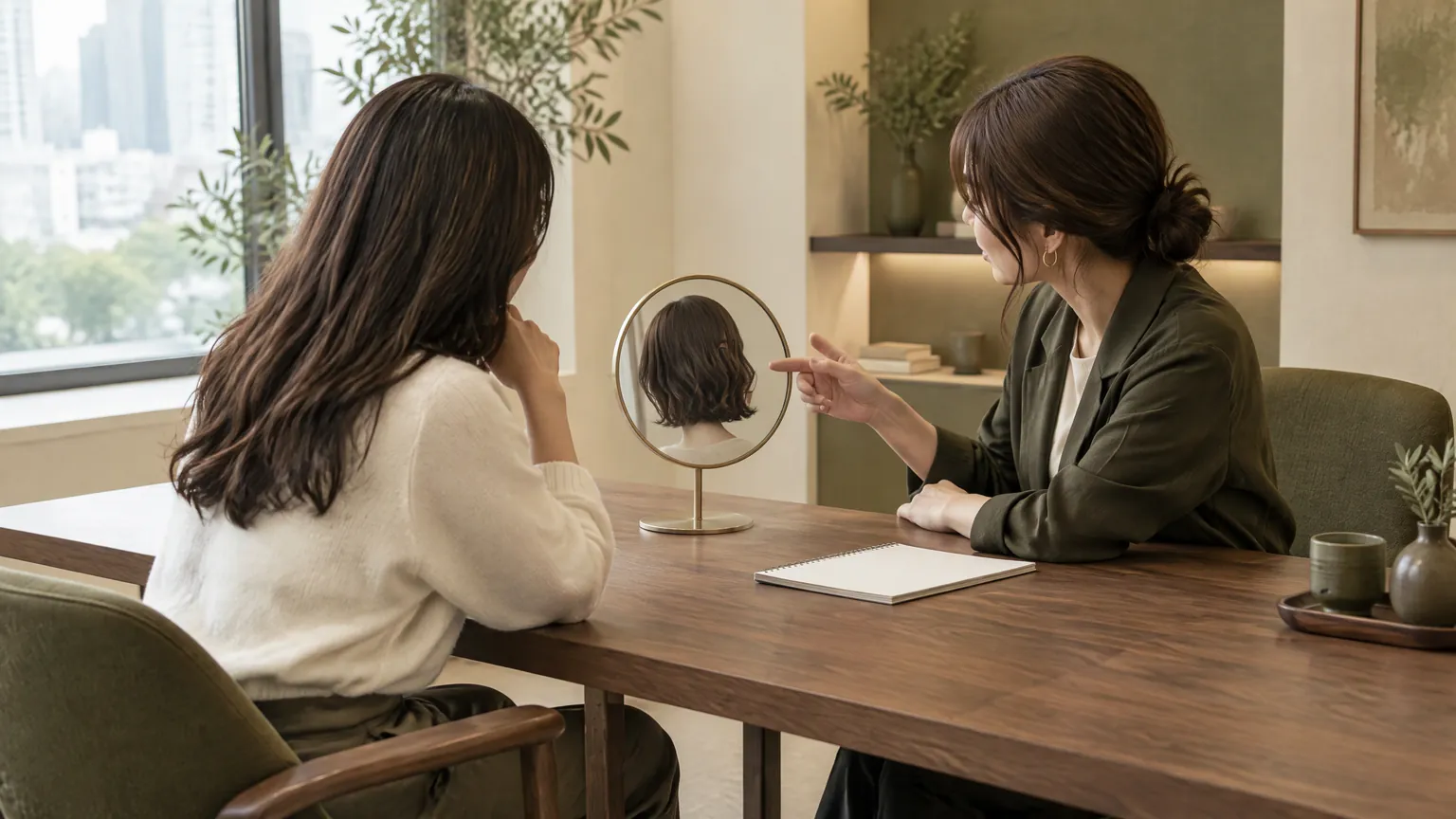
For a haircut, describe the length you want to retain and how you normally wear it. Someone who ties their hair back at work needs a different discussion from someone happy to style short layers every morning. Explain how much time you spend drying your hair, whether you use heated tools and what you dislike about the current shape. These details make a consultation more useful than an instruction to copy a photograph exactly.
For colour or a perm, provide a clear history of previous chemical work and what you hope to change. Ask which parts of the reference image are realistic for your current length and condition, and what maintenance would follow. This is a question about a proposed cosmetic service, not a promise that every technique suits every head of hair. Do not treat a broader menu as automatic evidence that a more complicated service is necessary.
Pictures also need context. An image labelled as a styling illustration can help communicate a preference, but it should not be read as proof of a real customer outcome. Ask what the image represents and describe the feature you like: the outline, colour placement or amount of curl. That is more precise than expecting the whole look to transfer unchanged to different hair.
Send one enquiry that connects the route to the service
The hair salon lam tin page also describes visiting DT HUB in Kwun Tong. If you are travelling from Lam Tin, make that starting point clear while confirming the same full destination. An enquiry that includes both your arrival constraints and requested work lets you resolve practical gaps before treating the visit as booked.
There is no need for a long personal account. State the service you want to discuss, your preferred date, your starting area and any hard departure deadline. Add relevant hair history and ask for the address to be repeated in the reply. If you need communication in a particular language or help with access, request confirmation explicitly rather than assuming the area page guarantees it for your appointment.
Use this checklist before leaving:
- Confirm the date, arrival time and requested service in writing; do not treat an unanswered enquiry as a reservation.
- Match the destination to 50 Hoi Yuen Road, the confirmed building, 21/F and Room 03; clarify any difference.
- Check the destination station and exit using official MTR resources, then save the building entrance instructions.
- Ask what the service includes and how changes will be agreed before any extra work starts.
- Clarify any deposit, cancellation or rescheduling terms without assuming a particular policy applies.
- Save the confirmation and keep the business’s contact details available for an arrival problem.
This is a preparation checklist, not a claim about DT HUB’s current booking conditions. Published information can help you frame an enquiry, but only the business can confirm whether the requested slot and arrangements are available. GotGear supplies this guide; it is not the salon booking desk, and hair-service enquiries should not be sent to an equipment-sales contact.
A hypothetical after-work visit shows why the checks matter
Consider a hypothetical reader who works in Kowloon Bay and wants a trim before meeting a friend elsewhere. They find a Kowloon Bay area page and initially assume the salon is close to their office. On reading the address, they realise the visit is in Kwun Tong. Their plan now needs to account for travel from the office, the upstairs destination and the onward journey, rather than just the haircut.
They also want to keep enough length for a ponytail and do not normally blow-dry their hair. Instead of adding colour because a gallery catches their eye, they send a trim enquiry that explains those preferences and their departure deadline. They ask for the current entrance instructions and whether the visit can reasonably fit their schedule. This scenario does not describe a real client, a confirmed slot or a salon result.
If the reply leaves the finish estimate uncertain, the reader can choose another day or reconsider the scope. If the building name remains unclear, they can ask again before travelling. The benefit is not a guaranteed quicker appointment; it is avoiding a decision based on a district label and a hairstyle photograph while essential details remain unresolved.
Keep a record if the destination or agreement changes
A useful confirmation should let you reconstruct what was agreed without relying on memory. Save the business name, contact details, appointment particulars and any agreed service scope. If a later message changes the location or requested work, retain that exchange too. Keeping the original and revised messages together makes it easier to identify what still needs clarification.
The Hong Kong Consumer Council asks complainants to provide trader details, transaction particulars and supporting documents such as contracts, receipts and correspondence. Its guidance also explains that tracing and reaching the trader matters to complaint follow-up. 2 These requirements are a practical reason to retain an address and booking record even for an ordinary salon visit, not an allegation that a dispute will occur.
If something goes wrong, first set out the issue clearly to the business: what was confirmed, what happened and what response you are seeking. For an address problem, specify the conflicting destination information rather than simply saying the page was confusing. The Consumer Council handles complaints through conciliation and does not have investigation or adjudication powers, so its involvement should not be described as a guaranteed refund or binding decision. 2
Before setting off, the decision should be concrete: a known destination, a confirmed appointment and a service discussion that fits your needs. An East Kowloon area page can be the beginning of that process. It should not be the last piece of information you check.
Common questions
Does a Kowloon Bay or Lam Tin area page prove there is a branch there?
No. A page can discuss serving people from a district while directing them to another location. DT HUB’s known public address is in Kwun Tong. Check the contact section and ask the business to repeat the full address in your appointment confirmation before deciding where to travel.
What should I do if the English building name differs between pages?
Do not choose a map pin by guesswork. Ask the salon to confirm the building and entrance against the full Chinese address, 50 Hoi Yuen Road, 21/F and Room 03. Save that reply with your appointment details so you can recognise the destination and show it to building staff if needed.
Can I rely on an area page’s journey estimate for an after-work booking?
Use official MTR resources to check the rail route and station exit, then allow for travel from your actual starting point and reaching the upstairs room. Confirm the appointment and explain any departure deadline separately. A short journey estimate does not establish service duration or guarantee that a suitable slot is available.
Sources & what they support
The scope below identifies what each reference supports. Citations do not imply independent endorsement of DT HUB or any provider, and do not establish treatment benefits or guaranteed results.
- MTR: System Map, Station Location Maps and Layouts (opens in a new tab)
MTR provides separate location maps and station layouts for Kwun Tong, Ngau Tau Kok, Kowloon Bay and Lam Tin. Location maps show major buildings and nearest exits; they do not establish a salon branch or guarantee door-to-door travel time.
- Consumer Council: Complaints & Services (opens in a new tab)
Complaint preparation includes trader identity and contacts, transaction particulars and supporting documents such as contracts, receipts and correspondence. The Council handles complaints through conciliation and has no investigation or adjudication powers.
- DT HUB: Public Salon Address and Service Information (opens in a new tab)
The homepage lists Room 03, 21/F, 50 Hoi Yuen Road, Kwun Tong, Kowloon, Hong Kong and presents surrounding districts as service areas. This supports the known Kwun Tong address, not separate branches, independent quality endorsement, specific opening hours or confirmed booking availability.