
A Tseung Kwan O salon shortlist: compare enquiries without assuming a branch
GotGear and DT HUB share an owner. This collection is not an independent recommendation. GotGear does not supply DT HUB salon, wig, Academy or healthcare services. Three online service sections do not represent three physical stores; the shared public studio is in Kwun Tong. Medical articles are informational only, with no diagnosis, clinical endorsement or outcome promises, and do not replace medical advice.
The short answer
For a useful Tseung Kwan O salon shortlist, separate where you start your journey from where the appointment actually takes place. Ask each provider the same questions about your hair, the proposed service and the full address, then check the route independently. An area page is an enquiry resource, not proof of a branch in that neighbourhood. Choose on confirmed suitability and practical access rather than a location keyword or an unsupported claim to be the best.

An area name is not an appointment address
A salon shortlist should help you decide where to enquire and what to ask, not leave you outside the wrong building. A page mentioning Tseung Kwan O may describe travel from the district to a salon elsewhere. Before treating it as a nearby option, find the actual address and separate the starting neighbourhood from the service destination. This matters particularly when you have fitted a visit around work, school collection or another appointment.
DT HUB's hair salon tseung kwan o page is an area enquiry resource for a Kwun Tong destination. Its published address is Room 03, 21/F, Lee Bo Times Centre, 50 Hoi Yuen Road, Kwun Tong, Kowloon. Ask the provider to confirm that this is where your proposed appointment would take place. The neighbourhood wording does not establish a Tseung Kwan O branch, and the address alone does not confirm a booking.
GotGear and DT HUB are under common ownership. The linked pages are provider information, not independent recommendations or evidence that one salon outperforms another. This guide offers a way to evaluate replies from any salon you are considering, including options you find yourself. It does not rank businesses or assume that a more distant salon has greater skill than a local one.
Define the haircut or colour problem before comparing providers
Start with what you want to change and what must stay the same. For a haircut, useful details include the length you want to retain, whether you tie your hair back and how you normally dry it. Saying that you want a manageable cut is less informative than explaining that you air-dry on working days and need the front sections to stay out of your face without daily heat styling.
Colour enquiries need a different set of details. Describe the current colour, previous bleaching or colouring that you remember, and any sections that feel fragile. If you do not know what was previously used, say so rather than guessing. A photograph may help explain the appearance you want, but it cannot settle every question about suitability or how the work should be carried out. Leave room for an in-person assessment before committing to the process.
Put your everyday routine beside the reference image
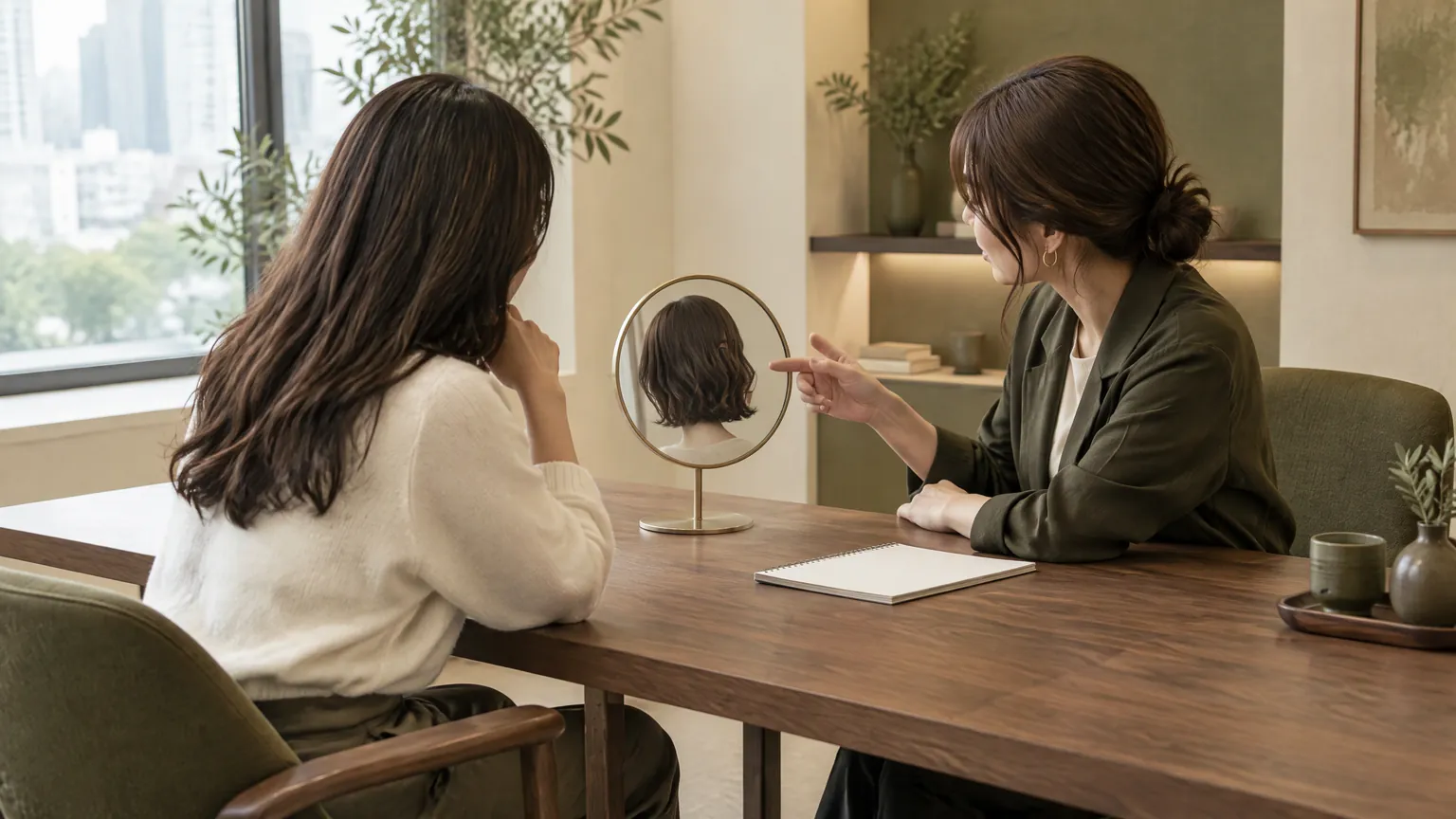
A styled photograph can show the shape, tone or finish you like. It does not show how much effort you will need at home. Explain whether you use a dryer, can work with a brush, or prefer to leave your natural texture largely alone. Ask which part of the reference is achievable through the cut and which part depends on styling. This makes the consultation more specific without turning an inspiration image into a promised result.
For someone who regularly swims, exercises or wears their hair tied back, maintenance questions belong in the first enquiry. Ask how the proposed style would fit your routine and what upkeep the provider expects. If you cannot reasonably follow that routine, reconsider the plan before choosing a salon purely because its appointment slot looks convenient. A service that needs frequent return visits also has a different travel burden from an occasional trim.
Compare replies using the same questions
Send a short, consistent brief to the salons on your own shortlist. Include your main goal, relevant hair history and any hard scheduling limit. Keep the initial request focused: you are seeking a clear outline, not asking someone to promise a finished result from a message. A helpful reply should distinguish what can be discussed remotely from what needs assessment when you arrive.
DT HUB's best hair salon tseung kwan o page can be used to identify topics for a comparison enquiry. Treat the wording as a prompt to ask about service scope and suitability, not as an award or verified ranking. If a page describes a provider as better than neighbourhood alternatives, seek concrete information about your own proposed appointment rather than accepting that comparison as independent evidence.
The table below compares enquiry needs, not salon quality. Use the row closest to your situation to identify missing information in a reply. An answer that suits a simple trim may still be incomplete for a substantial colour change.
| Your main need | Information to send | What a useful reply should clarify | What remains unconfirmed |
|---|---|---|---|
| Keep a familiar haircut manageable | Current length, tie-back needs and usual drying routine | Proposed scope, consultation arrangements and finishing expectations | Whether the final shape suits you until discussed in person |
| Change an existing colour | Known colour history, desired tone and areas of fragility | Need for assessment, possible limits and whether the plan may require separate visits | A precise result based only on a reference image |
| Explore a perm or straightening service | Previous chemical work and the texture you want to change | Suitability checks and what happens if the proposed process is unsuitable | That the service is appropriate for every hair condition |
| Fit a visit around a firm departure time | Your arrival options and latest departure | Whether the proposed scope can be planned within that constraint | A guaranteed completion time |
| Visit with access requirements | Steps or walking you cannot manage and any assistance needed | Building entrance, lift access and relevant appointment arrangements | A fully accessible route from the station to the chair |
Read replies for substance rather than speed. A quick acknowledgement is not the same as a complete answer, while a cautious response is not necessarily a weakness. If a provider says it must see your hair before agreeing to a process, ask whether you should book a consultation rather than the full service. Do not assume the consultation has particular terms unless those terms are confirmed.
Agree the service scope before the work starts
The Hong Kong Consumer Council's 2014 guidance on hair salons advises consumers to clarify less prominent conditions, including hair-length or designated-hairdresser surcharges, and retain a receipt listing the services provided. These are useful precautions, but the historical report is not evidence of current complaint levels or the conduct of any salon in this shortlist.2
For your enquiry, distinguish the work you requested from anything suggested later. If you ask for a haircut, clarify whether washing and finishing are part of the proposed appointment. If colour is being discussed, ask whether cutting is a separate decision. When an additional care service is suggested, ask what it involves and whether it is optional. Agree changes before work begins rather than treating an unfamiliar term as something you must accept.
Keep the written reply and request an itemised receipt after the visit. If the in-person assessment changes the proposed work, ask for an updated explanation before proceeding. You can pause when you do not understand the revised plan. Clear records help you compare what was discussed with what was delivered without relying entirely on memory.
The Consumer Council also advises asking about product contents when uncertain and seeking medical advice if an allergic reaction occurs.2 Tell the provider about any previous reaction relevant to the service. Do not treat a reassuring product description as proof that a reaction cannot happen. Persistent scalp irritation, pain or sudden marked hair loss belongs with a qualified healthcare professional, not a decision based on salon marketing.
Check the actual journey, not a promotional travel estimate
Once the destination is confirmed, plan from where you will really begin. Home may not be your starting point if the appointment follows work. Include getting to the departure station, changing trains where required, leaving the destination station and finding the building entrance. A station-to-station description does not account for your entire visit or your return journey.
For a visit starting in Yau Tong, DT HUB's hair salon yau tong page provides an enquiry entry point, but its area label should not replace an address check. Ask where you would be received and use that destination for route planning. Keep the appointment confirmation and the travel plan as separate records: knowing how to get somewhere does not mean the provider has agreed to see you.
MTR publishes a system map together with station location maps and station layouts. Its official resources include Tseung Kwan O, Tiu Keng Leng, Yau Tong and Kwun Tong, and explain that location maps show major buildings and their nearest station exits.1 Use these resources to verify the railway connection and inspect the destination station rather than copying an unverified stop count or train direction from a commercial page.
Check the last part of the route separately
Finding the correct exit is only part of arrival. Confirm the building name, street number, floor and room, and ask the salon about any entrance instructions. If different descriptions of the building appear online, request the wording you should look for at the entrance. Do not rely on a photograph or a general neighbourhood pin when the appointment is inside an upper-floor unit.
For someone with limited mobility, a station map does not establish that the whole journey is step-free. Ask about the path from the street, the building entrance and the route to the salon. If you are travelling with a companion or carrying equipment, discuss those needs beforehand. Leave practical allowance for finding the entrance and getting upstairs instead of building the appointment around the most optimistic journey estimate.
Decide whether combining services actually helps
It can be tempting to add services because you are already making the journey. However, travelling once is not automatically the better choice. A longer appointment may clash with your departure time, and the proposed combination may not suit your hair. Ask whether the work should be separated and what the alternative visit plan would involve. Convenience should not decide whether chemical services are appropriate.
If Tiu Keng Leng is your starting point, use DT HUB's hair salon tiu keng leng page to frame a location-specific enquiry while confirming the Kwun Tong address directly. Explain whether you are travelling from home or passing through after another commitment. Ask about the proposed appointment rather than assuming a short trip, a local branch or an available slot from the page title.
Think about maintenance travel as well as the first visit. If you want to keep a particular colour or shape, ask how future appointments would be discussed. You do not need to accept a fixed return schedule at the first enquiry. Instead, consider whether repeat journeys would fit your working week and whether you understand the home-care expectations before making a larger change.
A hypothetical shortlist with a real scheduling constraint
Consider this hypothetical situation: a Tseung Kwan O resident wants to reshape shoulder-length hair and discuss a lighter colour, but must leave in time for an evening family commitment. Their ends were bleached previously, and they usually air-dry. They are comparing a provider with a confirmed nearby address against an appointment enquiry for a Kwun Tong salon. Neither has been visited or assessed for this example.
The resident sends both providers the same brief, stating the previous bleaching and the latest departure. A useful answer would explain whether the haircut and colour discussion can be accommodated and which decisions need an in-person assessment. A statement that both services are offered is not enough to establish that both should happen during this visit. The resident also needs the exact destination before judging convenience.
If the colour plan remains uncertain, the resident could ask about arranging an assessment first or limiting the proposed appointment to a haircut, subject to the provider's confirmation. The point is not that the nearby salon wins or that travelling farther is worthwhile. It is that the shortlist becomes useful only when the service decision and the travel decision are both based on confirmed information.
Before you leave: an appointment confirmation checklist
An enquiry can end with several details still unresolved. Before travelling, review the latest response rather than assuming that an earlier discussion secured the appointment. This is especially important if you changed the service, requested a different stylist or moved the visit to another day.
- Confirm the appointment date and time directly with the provider.
- Save the full street address, building name, floor and room.
- Check what is booked and what is only being discussed.
- State any hard departure time and ask whether the scope needs changing.
- Clarify service inclusions, possible additions and cancellation or rescheduling terms.
- Verify the railway route and destination exit using official information.
- Ask about entrance or access arrangements that matter to you.
- Reconfirm relevant hair history or previous reactions before work begins.
Keep provider enquiries with the provider rather than sending salon appointment requests to GotGear's equipment channels. A shortlist is ready for a decision when you can explain why each option fits your hair needs, where you would go and what is still subject to assessment. You do not need a universal winner; you need an appointment whose scope and location you understand.
Common questions
Does a Tseung Kwan O area page prove that the salon has a branch there?
No. It may describe a salon serving people who travel from Tseung Kwan O to another district. Check the full appointment address with the provider, including the building, floor and room. DT HUB's area information identifies a Kwun Tong destination; the neighbourhood label should not be treated as a separate branch listing.
How should I compare a nearby salon with a Kwun Tong enquiry?
Give both providers the same description of your hair, desired change and scheduling limits. Compare how clearly they explain the proposed scope, assessment requirements and service conditions. Then plan each journey from its confirmed address. Neither proximity nor a more extensive service menu establishes which option is suitable for your particular appointment.
What if an area page's journey description does not match the official map?
Use official transport information to check the route and ask the provider to confirm the destination and entrance instructions. Do not rely on the commercial page's stop count or promised travel time. Allow for leaving the station and reaching the actual unit, and reconfirm your appointment if the revised journey affects your arrival.
Sources & what they support
The scope below identifies what each reference supports. Citations do not imply independent endorsement of DT HUB or any provider, and do not establish treatment benefits or guaranteed results.
- MTR: System Map and Station Location Maps and Layouts (opens in a new tab)
Official system-map, station-location-map and station-layout resources for checking railway connections and exits, including Tseung Kwan O, Tiu Keng Leng, Yau Tong and Kwun Tong; does not guarantee door-to-door travel times or building accessibility.
- Consumer Council: Consumers' Woes against Hair Salons Many and Varied (opens in a new tab)
Historical 2014 consumer guidance to clarify service conditions and possible additional charges, ask about product contents, seek medical advice for allergic reactions and retain itemised receipts; not evidence of current complaint rates or any named salon's conduct.