
Travelling from the New Territories: prepare a wig-fitting brief, not assumptions
GotGear and DT HUB share an owner. This collection is not an independent recommendation. GotGear does not supply DT HUB salon, wig, Academy or healthcare services. Three online service sections do not represent three physical stores; the shared public studio is in Kwun Tong. Medical articles are informational only, with no diagnosis, clinical endorsement or outcome promises, and do not replace medical advice.
The short answer
Before travelling for a wig fitting, confirm the actual appointment address and send a short brief about your current hair, preferred appearance and daily routine. A page named after Tseung Kwan O or Yuen Long does not, by itself, establish a branch there. Decide what you need to learn during the visit, rather than assuming you must choose or collect a wig that day. Bring useful reference photographs and everyday accessories, and ask which later stages could require another journey.

Confirm the venue before planning the journey
A district name in a page title is not a substitute for a street address. A business may explain how it serves residents of an area while conducting appointments elsewhere. For someone travelling from the New Territories, that distinction affects the entire visit: the route, the time away from work and whether a companion can attend. Start with the building, floor and room, then confirm the appointment itself.
DT HUB's tseung kwan o wig shop information identifies a studio in Kwun Tong serving the district. Treat it as an information page for residents, not evidence that you can walk into a Tseung Kwan O branch. Before setting off, ask where your particular fitting will take place and obtain the full address in writing.
The yuen long wig shop page likewise identifies DT HUB as based in Kwun Tong. Do not turn a district label or a general statement about serving an area into a confirmed local appointment. Any proposed arrangement away from the published studio needs its own confirmed venue, date and service scope before it becomes your travel plan.
The published studio address is Room 03, 21/F, Lee Bo Times Centre, 50 Hoi Yuen Road, Kwun Tong, Kowloon. Check that this is the address for your booking rather than relying on an old saved message. Ask about building access if stairs, standing or finding an upper-floor unit could be difficult. GotGear and DT HUB share ownership; the linked pages here are business information resources, not an independent rating of the provider.
Write a brief based on an ordinary day
A useful fitting brief explains what the wig must accommodate. Saying that you want it to look natural gives little guidance on length, density or the situations in which you will wear it. Describe your usual hairstyle and whether you want to preserve it or make a deliberate change. Identify one main priority, such as keeping hair away from your face at work, rather than asking every feature to be equally important.
Record your current hair coverage without trying to diagnose it. Explain where you have existing hair, how you normally arrange it and whether its amount has recently changed. This matters because a fitting performed over one hair arrangement may feel different over another. Macmillan Cancer Support notes, in its medically reviewed guidance for treatment-related hair loss, that a wig fitted before hair falls out can initially feel tight and may need adjustment as coverage changes.1
Next, describe your routine in practical terms. Do you wear spectacles throughout the day? Does your work involve leaning forward, looking down or turning your head repeatedly? Do you want to remove the wig each evening? How much time can you realistically devote to washing and styling? These answers are more useful than choosing a material solely because its description sounds premium.
Use photographs to explain, not promise
Choose a small selection of photographs showing the shape and colour you actually want. Include a front view and a side view where possible. Explain the relevant detail in each: a fringe that clears your glasses, a flatter crown or a particular parting. A single heavily styled image can hide the very features that need discussion, including the hairline and the amount of hair around the ears.
Your own older photograph may help communicate your usual appearance, but it is not a promise that another piece will reproduce it exactly. Lighting, hair texture and head shape affect what an image shows. Separate the elements you want to match from those you are willing to change. If you are uncomfortable sharing photographs beforehand, ask whether you can show them on your phone during the visit instead.
Compare the care routine as well as the appearance
Material choice deserves attention, but it should not take over the whole fitting. Macmillan describes synthetic wigs as generally light and easy to look after, while human-hair wigs may need regular cleaning and styling by a professional. It also warns that blended wigs can need special care because their synthetic fibres may be affected by heated tools.1 These are general considerations, not specifications for every product or proof of what a particular studio has available.
The most useful comparison is between what you would need to do at home and what you would need help with. Someone who likes changing a hairstyle may accept more maintenance. Someone who wants a consistent shape before an early commute may prefer a simpler routine. Neither preference establishes that one material is universally better. Ask for the instructions for the actual piece being considered, including restrictions on heat and products.
| Question to settle | Why it matters after travelling home | What to ask during the fitting |
|---|---|---|
| Daily preparation | A routine that seems manageable in a studio may be difficult before work. | Can I practise putting it on and arranging it myself? |
| Washing and drying | Care may temporarily leave the piece unavailable to wear. | What are the instructions for this specific material and construction? |
| Attachment and removal | The method must suit your current hair and your ability to handle it. | Which steps can I do at home, and which require assistance? |
| Later adjustment | A change in fit may mean another journey. | What needs an in-person check, and how is a follow-up arranged? |
| Change of style | Cutting or changing colour may not be reversible. | Which alterations are suitable for this particular piece? |
If a standard option does not address the fit or coverage you need, DT HUB's custom wig hong kong service description is a starting point for discussing measurements and design. Ask which features would actually be customised, how they would be recorded and when you would approve them. Do not assume that custom production means an exact photographic match, unrestricted colour changes or a guaranteed completion date.
A sample can establish a direction without settling every detail of a later order. Ask whether its colour, density and construction represent the proposed finished piece or are only illustrative. If an alteration is suggested, confirm whether you can see the effect before it becomes permanent. This is especially useful for a fringe or length adjustment, where a decision made quickly cannot necessarily be undone.
Give the fitting a clear purpose
DT HUB's wig fitting hong kong consultation page can help you frame questions about trying on, measuring and discussing care. Confirm what your appointment will include before travelling. A consultation, a measurement visit and a fitting of a completed piece are different tasks; the presence of a service description does not establish that all three will happen in one appointment.
For a first visit, a reasonable aim is to understand fit, appearance and maintenance well enough to decide your next step. It need not end with an order. Ask whether you can bring a companion and whether the fitting arrangements suit your privacy needs. Confirm the language you need for the discussion rather than assuming an English-language webpage guarantees English-speaking reception or consultation.
Check everyday comfort before agreeing to changes
Bring the glasses you normally wear and, if relevant, a familiar item of headwear to discuss. Once the fitter has positioned a sample, notice contact around the ears, forehead and nape. Turn your head and look down gently while seated. Explain any pressure or shifting instead of trying to solve it yourself by tightening the piece. The purpose is to observe ordinary movement, not to conduct a strenuous security test.
Ask to practise the steps you would be expected to manage alone. Being comfortable while someone else puts on a wig is different from being able to position it at home. Note how you would recognise the correct position and whom to contact if it does not feel right. Do not accept pain as a necessary sign that the fit is secure.
Attachment deserves a separate conversation if your scalp is sensitive. Macmillan advises people whose skin is affected by cancer treatment to check with their doctor or nurse about suitable wig tape and its removal. It also notes that a cotton liner can reduce irritation from the lining but may make a wig move more.1 That is a reason to assess the complete arrangement, not to assume an accessory solves every comfort problem. Persistent irritation, pain or sudden marked hair loss should be assessed by a qualified healthcare professional rather than treated as a styling issue.
Plan the route only after the booking is confirmed
Use the actual origin of your journey, not simply the name of your home district. Someone starting near a railway station has a different first stage from someone needing a feeder journey. MTR's official Train Trip Planner offers route searches using MTR stations, Light Rail stops and other locations.2 Use its current route suggestion rather than relying on a remembered journey or an unverified fixed travel time.
Station-to-station planning does not finish the job. MTR also publishes station location maps and layouts, including those for Kwun Tong, Tseung Kwan O and Yuen Long.3 Check the relevant destination map, then confirm the building entrance and upper-floor access separately with the business. A convenient station exit does not itself establish an accessible route all the way to a fitting room.
Allow a personal buffer for finding the venue and settling in. This is a planning choice, not a promised journey duration. Tell the business beforehand if you have a firm departure time, and ask whether the proposed appointment task fits within it. Avoid compressing a measurement or attachment discussion because you have scheduled another commitment immediately afterwards.
The return journey matters too. If you are collecting a piece, ask how it should be carried and stored when you arrive home. If you are only comparing options, keep your notes together so the trip produces a usable decision record. Confirm how to notify the business if transport disruption or illness prevents attendance; do not assume a cancellation or rescheduling rule from another service.
A hypothetical Yuen Long visit with two competing priorities
Consider a hypothetical office worker living in Yuen Long who wears glasses and wants a familiar shoulder-length style. They are comfortable travelling for an initial fitting but cannot make frequent weekday return visits. Their first brief should say this explicitly. The immediate goal is not to find the longest-lasting option in the abstract; it is to understand whether the proposed fit and care routine match their circumstances.
Before travelling, they ask for the appointment address, whether suitable comparison samples can be shown and what the session will cover. They bring a photograph of their usual hairstyle and their everyday glasses. During the fitting, they focus on the area around the ears, the fringe and whether they can position the piece themselves. These checks address their actual working day rather than an imagined special occasion.
If one option needs regular professional styling, they ask where that would happen and whether it entails another trip. If a custom order is discussed, they ask which stages require attendance and whether the design remains open to discussion after measurements. They can leave with unanswered questions documented and decide later. Nothing in this example assumes stock, a local branch, immediate collection or a particular result.
Leave with a record of what is agreed and what is pending
Before ending the visit, separate observations from commitments. A sample felt comfortable during a brief trial; that is an observation. A specified design has been approved for production; that is a different decision. Ask for the proposed material, coverage, colour direction and alteration scope to be recorded clearly. If something has not been confirmed, keep it marked as pending rather than filling the gap with an assumption.
Use this final checklist before travelling and again before committing to an order:
- Confirm the complete venue, appointment date and task in writing.
- State your usual hair arrangement, preferred style and main comfort concern.
- Bring reference photographs and everyday glasses; confirm whether a companion may attend.
- Ask what you can practise yourself and request care instructions for the specific piece.
- Clarify which design changes need approval and which alterations cannot be reversed.
- Identify any further visits, their purpose and how they would be scheduled.
- Keep the written scope and unresolved questions together with your fitting notes.
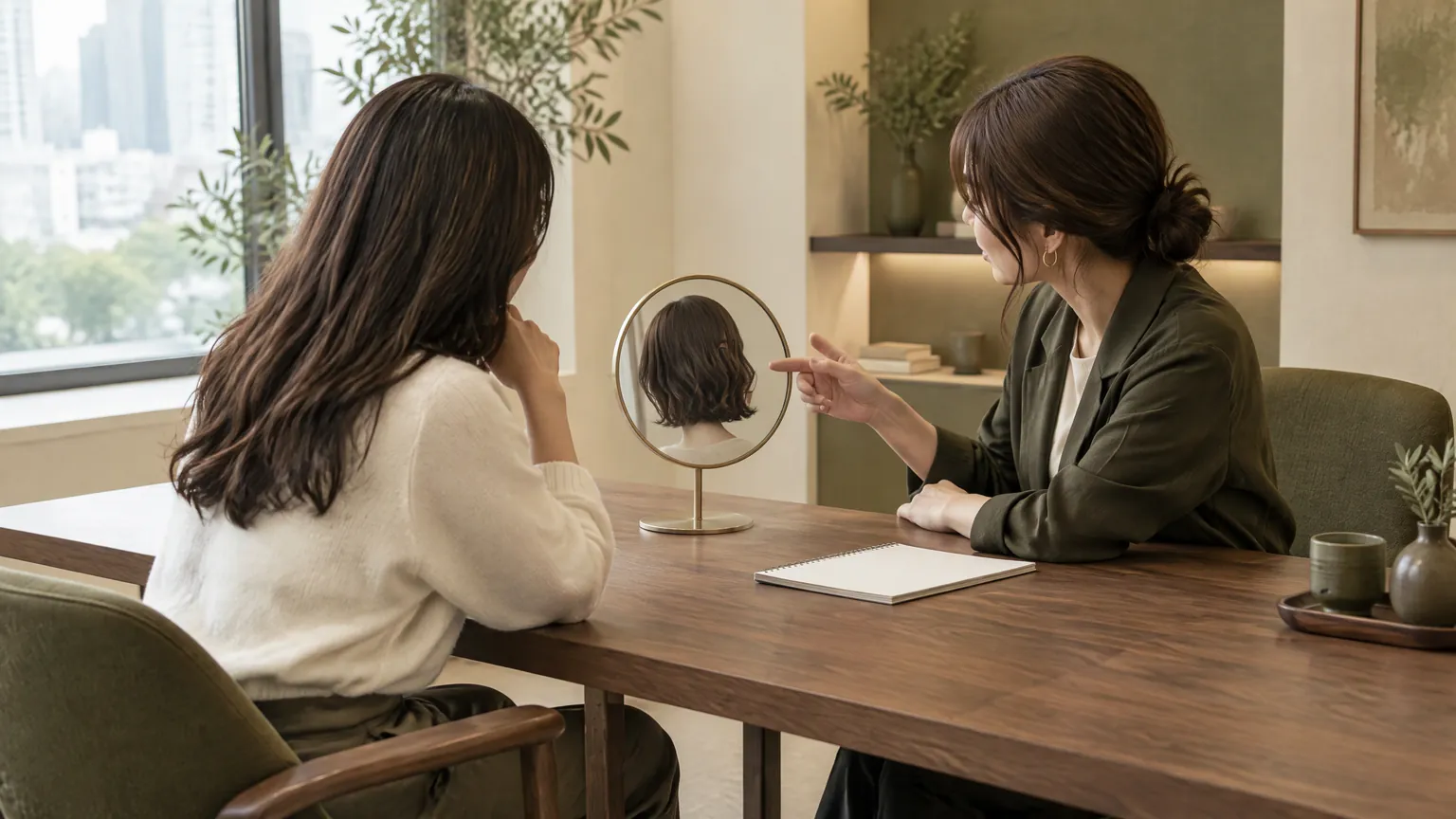
Finally, ask how follow-up questions should be raised once you are back in the New Territories. Do not assume that a photograph can resolve a fit problem remotely, or that every adjustment is included. Macmillan emphasises following the care instructions supplied with a wig and avoiding exposure to flames or unsuitable heat.1 Make sure you understand those instructions before experimenting at home. A useful visit leaves you with a workable routine and clear next steps, not just a hairstyle you liked in the mirror.
Common questions
Does a Tseung Kwan O or Yuen Long page confirm a branch in that district?
No. A district page can describe service coverage while appointments take place elsewhere. The pages discussed here identify a Kwun Tong studio. Obtain the complete address for your specific appointment and confirm any proposed alternative venue before planning the journey.
What should I send before travelling for a first fitting?
Send a short description of your current hair coverage, usual hairstyle, main comfort concern and daily routine. Mention glasses, headwear and any difficulty making return visits. Use a few reference photographs if you are comfortable sharing them, and ask what the booked session will actually include.
Can I avoid another journey by choosing a custom wig at the first visit?
Do not assume so. Measurement, design approval, fitting and later adjustments may be separate stages. Ask which stages require attendance and when they can be confirmed. A custom-service description does not guarantee a single-visit process, a completion date or collection on your first trip.
Sources & what they support
The scope below identifies what each reference supports. Citations do not imply independent endorsement of DT HUB or any provider, and do not establish treatment benefits or guaranteed results.
- Macmillan Cancer Support: Wigs for cancer treatment (opens in a new tab)
Medically reviewed practical guidance on synthetic, human-hair and blended wigs; changes in fit with treatment-related hair loss; liners, tape precautions and product-specific care. UK funding rules, prices, lifespans and service timelines are not applied to Hong Kong.
- MTR: Train Trip Planner and route suggestion (opens in a new tab)
Official route-planning interface supports searches from and to MTR stations, Light Rail stops and other locations. No specific route, fare or journey-duration guarantee is asserted.
- MTR: System map, station location maps and layouts (opens in a new tab)
Official system map and station location-map and layout resources, including Kwun Tong, Tseung Kwan O and Yuen Long. Does not establish building access or a step-free route to the studio.