Extensions and a blow-dry routine: ask about attachment and maintenance
This column offers salon and styling information and links to Vit So, a hair website under the same ownership. Hair services are provided by Vit So, not GotGear.
The short answer
Choose extensions by looking at how they attach, how your own hair can support them and how you will wash and dry them afterwards. Fine hair does not call for one universal method, and a convincing photograph cannot establish comfort or suitability. Before an event, confirm the attachment plan, home-care instructions, review arrangements and removal process. A shorter or simpler result may be a more workable choice than extra length that makes everyday care difficult.
Start with the routine, not the finished photograph
Before choosing extensions, describe an ordinary morning. How often do you wash your hair? Do you leave home with it partly damp? Do you tie it up for a shift, exercise after work or rely on a quick brush and little else? These details belong in the consultation because the finished style has to work between appointments, not just while you are sitting in the chair.
Separate your aim into length, fullness and styling flexibility. Someone who wants a fuller outline around the shoulders may not need the same plan as someone seeking much longer hair. Bring a photograph to explain the shape, but also say what you do not want: a heavier feel, an attachment near a sensitive area, or a routine that requires more drying time than you can reliably allow.
The service information for hair extensions is a starting point for asking about an individual consultation. Confirm which options can actually be considered for your hair, rather than treating a general service page as evidence that every method, shade or appointment arrangement is available. GotGear and Vit So are under common ownership; these links provide access to the associated business, not an independent salon endorsement.
Fine strands and low density need different questions
Fine hair describes the thickness of individual strands. Density concerns how much hair grows across an area. You may have fine strands with relatively full coverage, or less coverage with strands that are not especially fine. Explain which issue you notice rather than asking simply for something suitable for thin hair. The stylist needs to assess the actual attachment areas and your existing hair, not just the label you use.
A consultation should consider your usual parting, the hair around your temples and the way you wear your hair up. Ask where attachments would sit and what happens when you change your parting or turn your head. No sensible discussion should promise that attachments will be invisible in every hairstyle, under every light or throughout every stage of wear. Agree on the everyday styles that matter to you.
If your search began with hair extensions for fine hair, use the associated guide to prepare questions about placement and maintenance, not to decide your own suitability. Ask what would make the stylist advise against installation, reduce the proposed length or suggest styling your existing hair instead. An explanation of limits is more useful than an assurance that one technique suits everybody.
Mention bleaching, colouring, straightening and previous extensions, including any uncomfortable experience. Repeated pulling can cause traction alopecia, a form of hair loss, and the British Association of Dermatologists identifies extensions and tight hairstyles among the practices associated with it. Its leaflet also warns that long-term repetitive pulling can permanently damage hair follicles. This is a reason to discuss tension carefully, not a diagnosis of your own hair condition.1
Compare attachment plans by the work they create
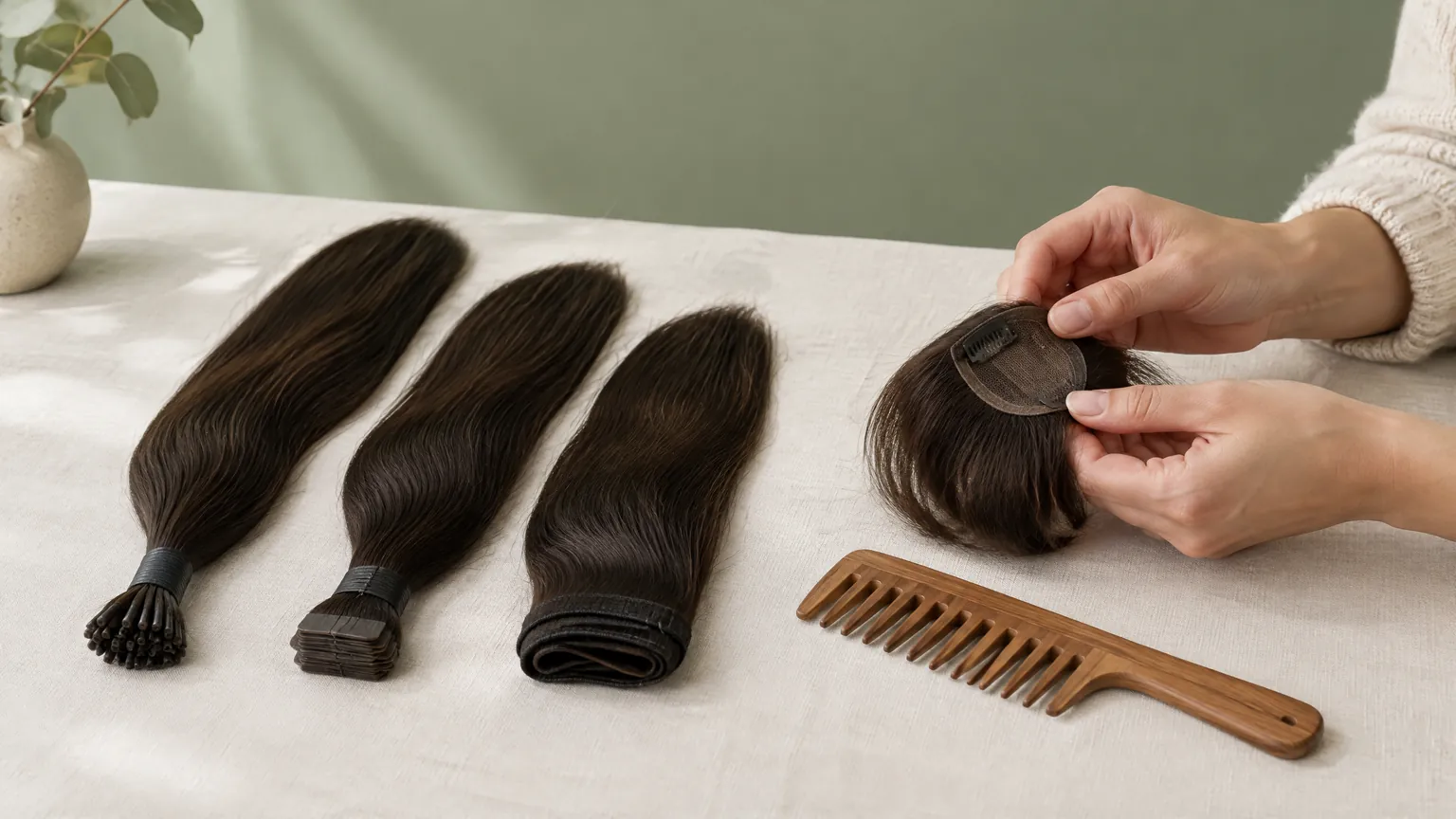
Method names are only a starting point. Ask the person assessing your hair to explain the proposed attachment, how it is supported and how it will eventually be removed. The comparison below sets out consultation questions for broad types of extension systems. It does not establish that any particular option is offered by the linked salon or suitable for your hair.
| Broad option to discuss | What to clarify about attachment | What to clarify about daily care | Question before committing |
|---|---|---|---|
| Removable clip-in pieces | Where clips would sit and whether your hair can support the proposed pieces | How to take them out without pulling, and how the pieces are cleaned separately | Can the desired look work with fewer pieces or less length? |
| Tape-based systems | Placement, the proposed attachment areas and what removal involves | Which products and washing movements are compatible with the specific system | What should I do if an edge lifts or a section feels uncomfortable? |
| Individually bonded or ring-attached sections | How sections are distributed and how your own hair is assessed | How to separate and detangle around the attachments without catching them | What review or adjustment arrangements are proposed for this installation? |
Do not choose solely because a method is described as lightweight. Ask what the proposed amount and length mean for your own hair and scalp. A smaller-looking attachment does not, on its own, answer questions about tension, removal or how comfortably you can sleep and style your hair. Likewise, being removable does not make a piece harmless if you pull it out or repeatedly secure it tightly in the same place.1
There is also a practical difference between buying a look and agreeing to its upkeep. You may be comfortable with an occasional removable piece but not with installed attachments that need planned follow-up. Alternatively, removing and positioning pieces yourself may be the task you most want to avoid. Explain these preferences before discussing the final appearance.
Make the first wash an agreed procedure
A general washing routine cannot replace instructions for the specific attachments and extension material. Before leaving, ask for a clear explanation of when to wash, which products to use, where to apply them and how to dry the attachment areas. If an instruction sounds vague, ask for a demonstration rather than trying to infer the technique from a short social-media clip.
Clean the scalp without turning the lengths into a knot
The American Academy of Dermatology advises washing according to how dirty or oily the hair becomes, applying shampoo to the scalp and using conditioner after washing. For fine or straight hair, it advises applying conditioner to the ends. It also recommends gentle handling rather than roughly rubbing hair with a towel.2 These are useful general principles, but attachment-specific product restrictions still need confirmation.
Ask how to reach the scalp between the proposed attachments and whether there are areas where conditioner or other products should be avoided. Do not assume that every extension system accepts the same oil, mask or leave-in product. Bring the names or photographs of products you already own so the advice can be concrete. You should leave knowing what is compatible, not simply being told to use something gentle.
Describe the way you usually wash. If you turn your head upside down over a basin, ask whether that movement is workable with the proposed installation. If you normally scrub and twist the lengths together, ask to be shown a gentler alternative. The aim is a routine you can repeat accurately at home, including on a tired evening.
Dry with less heat and without tugging at the roots
The AAD recommends limiting blow-drying and other heated tools, using low or medium heat settings and a heat-protective product. It also notes that wet hair is delicate and advises gentle detangling, beginning at the ends; for straight hair, it suggests allowing some drying before combing.2 With extensions, ask which comb or brush and which handling technique are appropriate around the attachments.
Confirm how the attachment areas should be dried, rather than assuming that natural-hair advice about partial air-drying answers the whole question. The required care depends on the installed system. Ask where heat should not be directed, how to handle the roots without pulling, and whether the extension material can be heat-styled at all. Do not apply a curling iron directly to an attachment because the visible lengths tolerate heat.
If you are considering a salon wash and blow dry, explain beforehand that extensions are installed and identify the system if you know it. Confirm whether that appointment can accommodate the relevant washing, detangling and drying requirements. A booking description alone does not establish that attachment inspection, adjustment or removal is included.
Rehearse the event style before the event
For a dinner, presentation or celebration, decide how you want the hair to sit with the clothes and accessories you will wear. A high neckline, a hair accessory or a planned updo may change which attachment areas need particular attention. Ask whether your preferred style works with the proposed placement. A photograph with the hair down cannot answer what happens when it is pinned back.
Avoid making the event day the first occasion on which you discover how to wash, dry or put up the new style. Ask what preparation sequence is realistic: consultation, any agreed installation, learning the home routine and checking the intended finish. The actual timing needs to be confirmed with the salon; there is no universal lead time or guaranteed appointment slot.
Hypothetical example: a reader with fine, straight hair wants more fullness for an evening function and normally washes after a late gym session. They have little time for drying before bed and must tie their hair back at work. Rather than requesting maximum length, they could ask whether a modest fullness-focused plan is practical, how their work hairstyle affects placement and what the post-exercise washing routine would involve.
If that discussion reveals an aftercare routine they cannot maintain, styling their existing hair may be the more manageable event choice. If extensions are still considered, a trial of the agreed everyday hairstyle and a clear drying demonstration would address actual concerns. This example is a decision-making scenario, not a report of a customer result or proof that a particular attachment is safe.
Leave with a checklist you can actually use
A useful aftercare note should answer what you will do at home and what you must refer back to the salon. Keep it alongside your appointment details so another person helping with your hair does not have to guess. The checklist below can guide the conversation; the answers should come from the assessment and the system actually used.
- Record the attachment method and extension material, with any product or heat restrictions.
- Confirm the first-wash instructions and a routine that fits your scalp, exercise and work habits.
- Practise the agreed detangling movement and learn where the brush or comb must not catch.
- Ask how to prepare the hair for sleeping, and how to secure it for work or exercise without a tight pull.
- Agree on review arrangements and find out whom to contact about lifting, slipping, matting or discomfort.
- Confirm who will remove the attachments and whether removal requires a separate appointment.
Do not accept a maintenance interval copied from someone else's installation as your own plan. Ask what the proposed review is intended to check and what changes should prompt an earlier call. If you travel regularly, say so before committing. An arrangement that depends on returning while you are away may be impractical even when you like the initial style.
Also clarify the scope of later appointments. Washing and styling, checking attachments, moving sections and removing the installation are different tasks. Ask which are included in the proposed arrangement and which need separate confirmation. Keep the explanation in writing where possible, so both sides understand what you have agreed to.
Treat discomfort as a reason to stop and ask
Pain is not evidence that extensions are securely fitted. The British Association of Dermatologists notes that traction-related problems may involve soreness, itching or increased flaking, although these symptoms alone cannot establish a diagnosis.1 Tell the stylist immediately if an attachment pulls or hurts during fitting. If it becomes uncomfortable afterwards, contact the salon rather than waiting for the next routine visit.
Do not try to solve discomfort by hiding an area beneath a tighter ponytail, and do not cut, dissolve or pull out installed attachments yourself. Ask for the appropriate professional response for the particular system. Seek assessment from a qualified healthcare professional for persistent irritation, pain or sudden marked hair loss. Salon maintenance is cosmetic care; it is not a substitute for diagnosing a scalp condition.
The absence of pain also does not establish that any installation is suitable indefinitely. Keep to the agreed reviews and report changes around the attachment areas. If someone notices a change, describe what you can see or feel without guessing at the cause. Clear observations help the salon address maintenance issues and help a healthcare professional assess symptoms where needed.
Know what would make you choose less
A worthwhile consultation should make a smaller plan possible. That may mean less length, a different finished shape or no extensions for now. Ask what compromises would preserve your main aim while reducing the work you dislike. For example, if fullness matters more than length, make that priority explicit instead of allowing the reference photograph to dictate the entire plan.
Make the final decision against three ordinary tests: can you carry out the washing and drying instructions, can you wear the hairstyles your day requires, and do you understand how the attachments will be checked and removed? If one answer remains uncertain, resolve it before proceeding. Extensions should not depend on a routine you already know you will skip, and an event deadline is not a reason to overlook discomfort or unclear aftercare.

Common questions
Does fine hair automatically rule out extensions?
Fine strands alone do not settle suitability. The consultation should assess your actual hair, attachment areas, processing history and daily routine. Ask whether less length or fewer pieces could meet your aim, and what findings would make the stylist advise against installation. No method should be assumed suitable for everyone.
Can I keep using my usual shampoo and conditioner?
Ask about the specific attachment system before assuming your products are compatible. Bring their names or photographs to the consultation, and confirm where each product should be applied. General advice about scalp cleansing and conditioning the ends does not resolve every restriction associated with adhesives, bonds or the extension material.
What should I tell a salon before booking a blow-dry with extensions?
State that extensions are installed, identify the attachment method if known and explain any washing or heat restrictions you were given. Confirm that the appointment can accommodate those requirements. Ask separately about checking, adjusting or removing attachments; these tasks should not be assumed to form part of an ordinary washing and styling booking.
Should I wait for the next maintenance visit if an attachment hurts?
No. Contact the salon promptly rather than accepting pain as normal or attempting to remove the attachment yourself. Persistent irritation, pain or sudden marked hair loss warrants assessment by a qualified healthcare professional. An appointment to maintain extensions cannot diagnose or treat an underlying scalp condition.
Sources & what they support
The scope below identifies the information supported by each reference; a citation is not an endorsement of a salon or a guarantee of results.
- British Association of Dermatologists: Traction alopecia (opens in a new tab)
Repeated pulling, including that associated with extensions and tight hairstyles, can cause traction alopecia; prolonged traction can damage follicles permanently; possible symptoms include soreness, itching and flaking. Used for cosmetic safety cautions, not diagnosis or treatment recommendations.
- American Academy of Dermatology: Tips for healthy hair (opens in a new tab)
General hair-care advice on washing according to oiliness or dirt, shampooing the scalp, conditioning fine or straight hair at the ends, gentle towel handling and detangling, and limiting heat with low or medium settings and a heat-protective product. Not presented as instructions for a particular extension attachment.