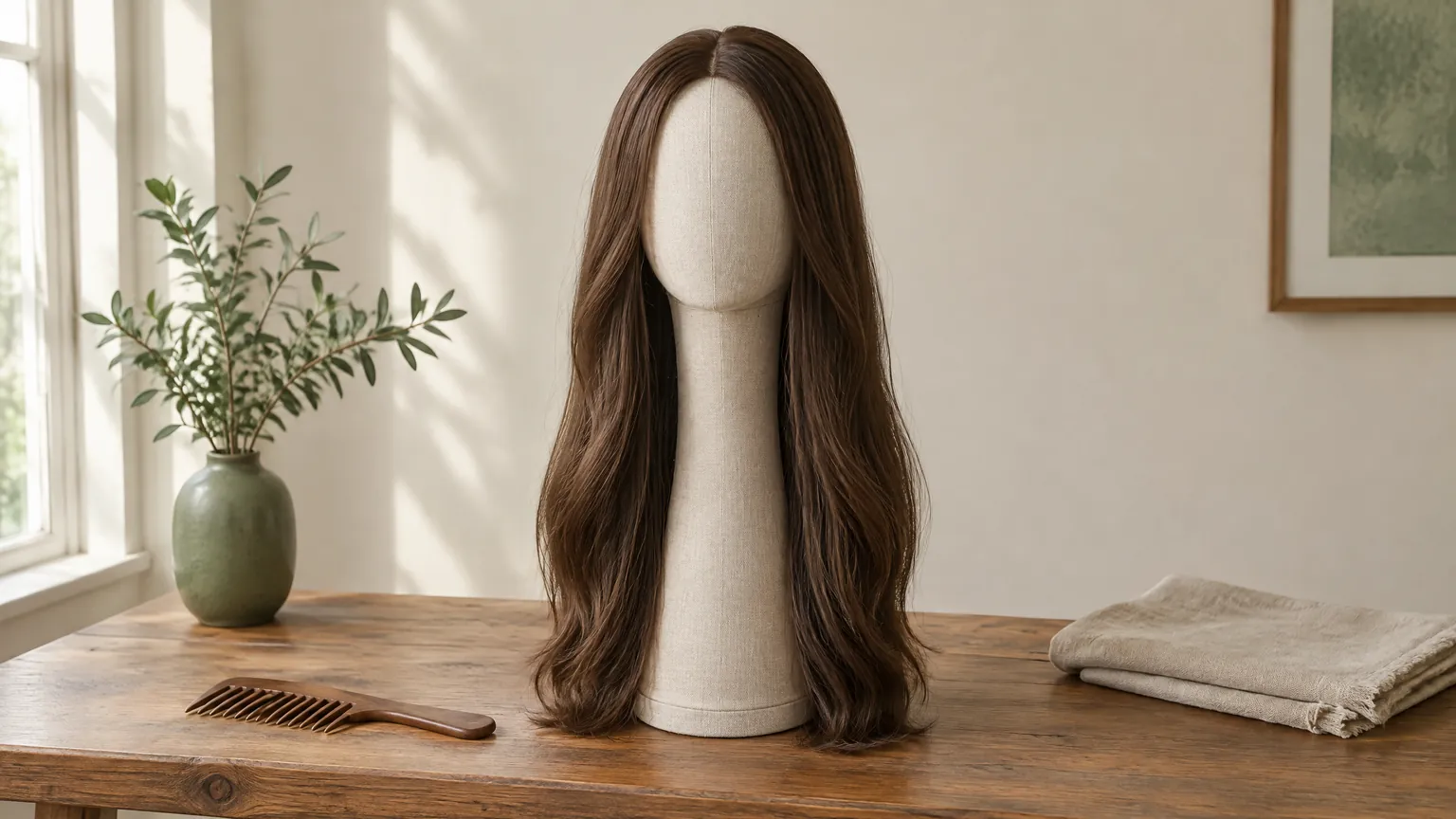
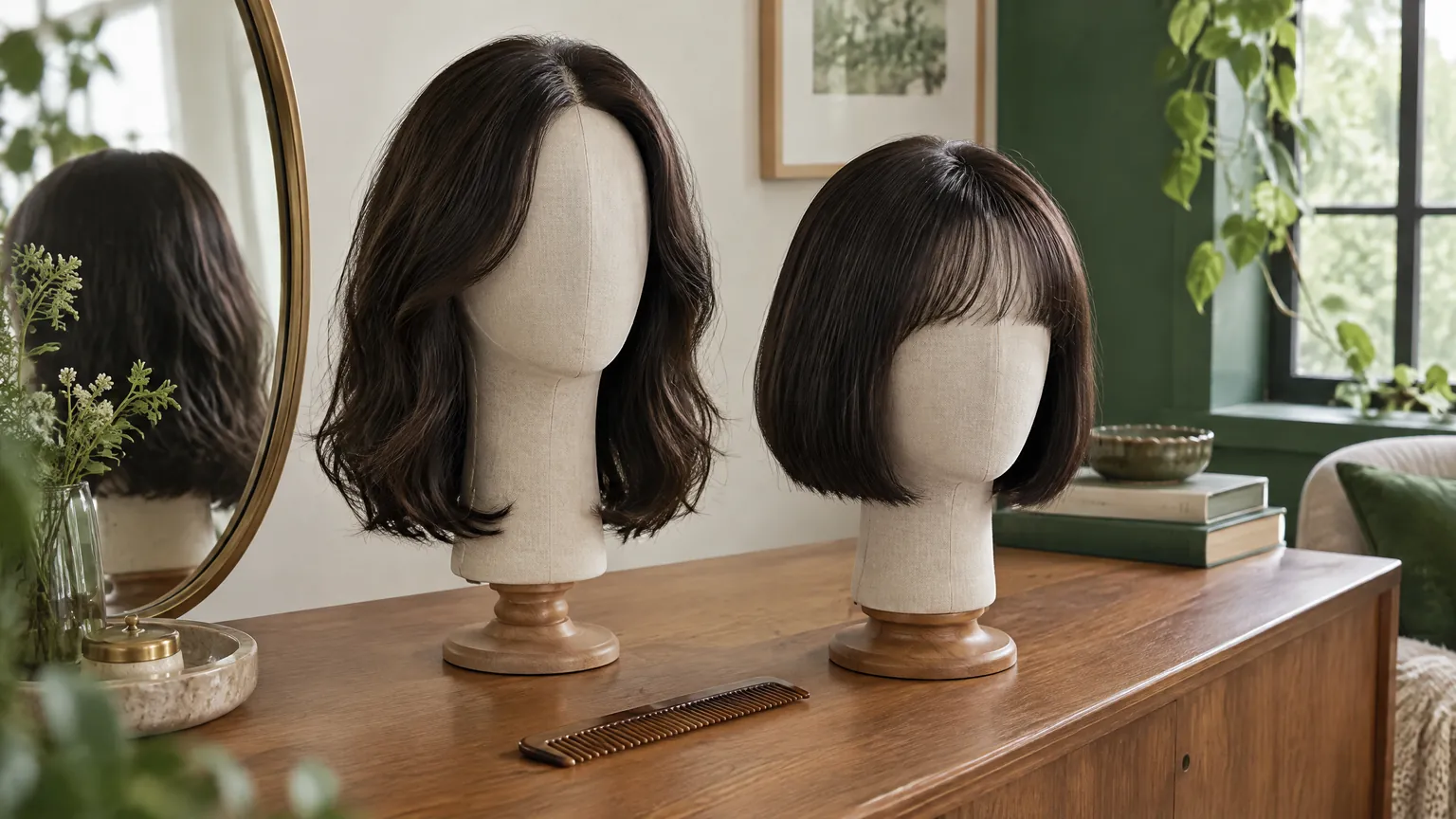
A bob wig at work: compare the jawline, glasses and collar
GotGear and OWNSTRAND share the same owner. This collection is not an independent recommendation. GotGear does not supply wigs or medical treatment; actual wig services are provided by OWNSTRAND, whose only known studio is in Kwun Tong. These articles provide general information, not medical advice.
The short answer
Choose a bob wig for work by comparing where its ends sit against your own jaw, spectacle frames and usual collar, rather than following a face-shape template. Check the outline from the front and side, then sit down, turn your head and look towards a screen. A pleasing still image is only part of the choice: comfortable fit, clear vision and a care routine you can manage matter just as much.

A work-day bob should make sense with the things you already wear and do. Its front corners might finish beside your jaw, while the back sits higher at the nape. Your glasses add another line across the face, and a shirt collar adds one below it. Compare those relationships on your own head before deciding that a catalogue photograph represents the right length. The useful question is not whether a bob is universally professional or flattering, but whether you like its outline and can wear it without repeatedly moving hair out of the way.
Start with the outline you want to see
Describe your preference in visible terms. You might want the jaw to remain exposed, a soft curve beside the cheeks, or a straight lower edge that echoes a shirt collar. These are personal choices, not corrections that every face needs. A fuller side can appeal to one wearer and feel distracting to another, even when both have similar facial proportions. Avoid letting a face-shape label make the decision before you have seen the actual wig.
Choose two contrasting reference images rather than a large collection of nearly identical ones. One could show a neat, blunt edge with little side volume; the other could show a lightly layered bob with a softer perimeter. Note what you like about each. Is it the length at the front, the exposed ear, or the way the fringe sits above the spectacles? That detail is more useful in a fitting discussion than saying you want something modern.
When browsing bob wigs, use the style descriptions and images to build a comparison, not to infer an exact result on your own head. Record whether the front is longer than the back and whether the ends turn in or out. Ask how the stated length is measured and whether the pictured outline depends on styling. A bob name alone does not tell you where its ends will fall against your jaw.
Compare lengths against your jaw and neckline
Use the jaw as a landmark, not a rule about what you should conceal. Look straight ahead with your shoulders relaxed. Then check a side view, because a bob that seems level from the front may slope towards the chin or rise at the back. If the parting or fringe differs between samples, note that too: otherwise you may attribute the whole change to length.
The following table is a set of trial observations, not a guarantee about how a particular product behaves. The same nominal length can sit differently with another cap fit, texture or head shape.
| Outline being considered | What to inspect at the jaw | What to inspect at work | Possible reason to keep comparing |
|---|---|---|---|
| Ends finishing above the jaw | How much ear and jaw remain visible | Space around spectacle arms and a headset | You prefer more coverage beside the face |
| Ends finishing beside the jaw | Whether the front corners align with the jaw or sit inside it | Hair moving towards the mouth when you lean forward | The edge needs frequent repositioning |
| Ends finishing below the jaw | The gap between the hair ends and neckline | Contact with your usual shirt collar | You like the extra length but not its contact with clothing |
| A longer bob nearing the shoulders | Whether the front and back make different outlines | Ends meeting shoulders when seated or turning | The shape changes more than you want during ordinary movement |
Compare the samples while wearing the same top. Changing from an open neckline to a high collar halfway through can make a length appear different even when the wig has not changed. Once you have a preferred outline, repeat the check with a second outfit that you genuinely wear to work.
Treat glasses as part of the fitting
Your glasses should not be an afterthought. Their upper rim can overlap visually with a fringe, while their arms occupy space beside the ears. Bring the pair you wear for most of the day rather than choosing a lighter or smaller pair just for the appointment. If you alternate between reading glasses and another pair, bring both and explain when you change them.
Put the wig on before replacing the glasses
The American Cancer Society advises removing glasses before trying on a wig and keeping the wig from covering the ears.1 Follow the fitting instructions supplied for the particular cap, then put your glasses back on. This makes it easier to observe whether an arm catches the edge or displaces hair. Do not pull the wig forward merely to make a fringe sit lower; ask whether the fringe or fit needs a different adjustment instead.
Check each side rather than assuming the contact is symmetrical. Look towards a screen and gently turn your head as you would when speaking to a colleague. Notice pressure beside the ears, a frame that no longer sits as usual, or a cap edge that moves when you take the glasses off. These are reasons to pause and discuss fit, not problems to disguise with more side hair.
Test the fringe while reading
A fringe can look tidy when you face the mirror yet fall across a lens when you look down. Read a short passage on your phone or a paper document during the trial, if permitted. Test both looking down and looking back up. Decide whether you are comfortable moving the fringe occasionally or whether you want a clearer area above the frame.
If trimming is discussed, ask what can be changed and how the wig should be positioned beforehand. Shortening the fringe is not the same as changing its density or direction, and a cut cannot be reversed by waiting for the wig hair to grow. Agree on the smallest useful change rather than requesting several alterations at once.
Bring the collar you actually wear
A bob's relationship with clothing is easiest to judge in motion. A stiff shirt collar, soft blouse neckline and jacket lapel present different contact points. Bring or wear your usual combination, including a lanyard if it occupies the same area. You do not need an elaborate wardrobe test; one ordinary work outfit and one common alternative can reveal the relevant differences.
Stand first, then sit with your shoulders in a normal position. Turn your head to either side and look down as if reading a document. Observe whether the ends meet the collar and change direction. Contact is not automatically a fault. You may enjoy a gently turned-out edge, or you may prefer the line to remain tucked inward. What matters is recognising the change before choosing the style.
Also try putting on the jacket you use in a cool office. If taking layers off is part of your day, consider how you will do that without pulling them across the wig. Macmillan suggests clothing that is easy to remove, such as a shirt or cardigan, rather than pulling garments over the head.2 That is a practical handling point, not a requirement to abandon your usual wardrobe.
Do not assume a shorter bob will automatically solve every collar problem. Its back length, layering and end direction still need inspection. Equally, do not dismiss a slightly longer option if it clears your preferred neckline comfortably. Compare the whole outline instead of treating the front length as the only measurement.
Match the fibre to your morning routine
The shape you like has to be considered alongside its care instructions. Macmillan explains that synthetic wigs generally have their style set into the fibres, while human-hair wigs may need regular cleaning and styling. Blended wigs can require particular care because their synthetic fibres may react badly to styling heat.2 These distinctions help frame questions, but they do not replace instructions for the individual wig.
If you want a repeatable outline before an early start, ask how the bob is expected to look after washing and drying. Find out whether its inward curve is part of the set style or needs to be recreated. If you like changing the parting or varying the ends, ask which changes the actual fibre and construction permit. Do not assume that every synthetic wig accepts heat or that every human-hair wig can be treated without restrictions.
The American Cancer Society cautions against using a dryer or curling iron unless the wig is heat resistant.1 Ask for the applicable instructions before trying to correct an end that has changed direction. A product photograph with smooth curves does not establish permission to use your own heated tool. For blended fibres, clarify the care method for the mixture rather than following generic advice for human hair alone.
Think about washing as a scheduling matter as well. Where will the wig dry, and how will you avoid needing it before it is ready? Ask what storage support is appropriate between wears; the American Cancer Society recommends a wig stand for short-term storage.1 A manageable care routine is a better reason to choose a fibre than the assumption that one material must always look more suitable for an office.
Separate the haircut from the full-wig fit
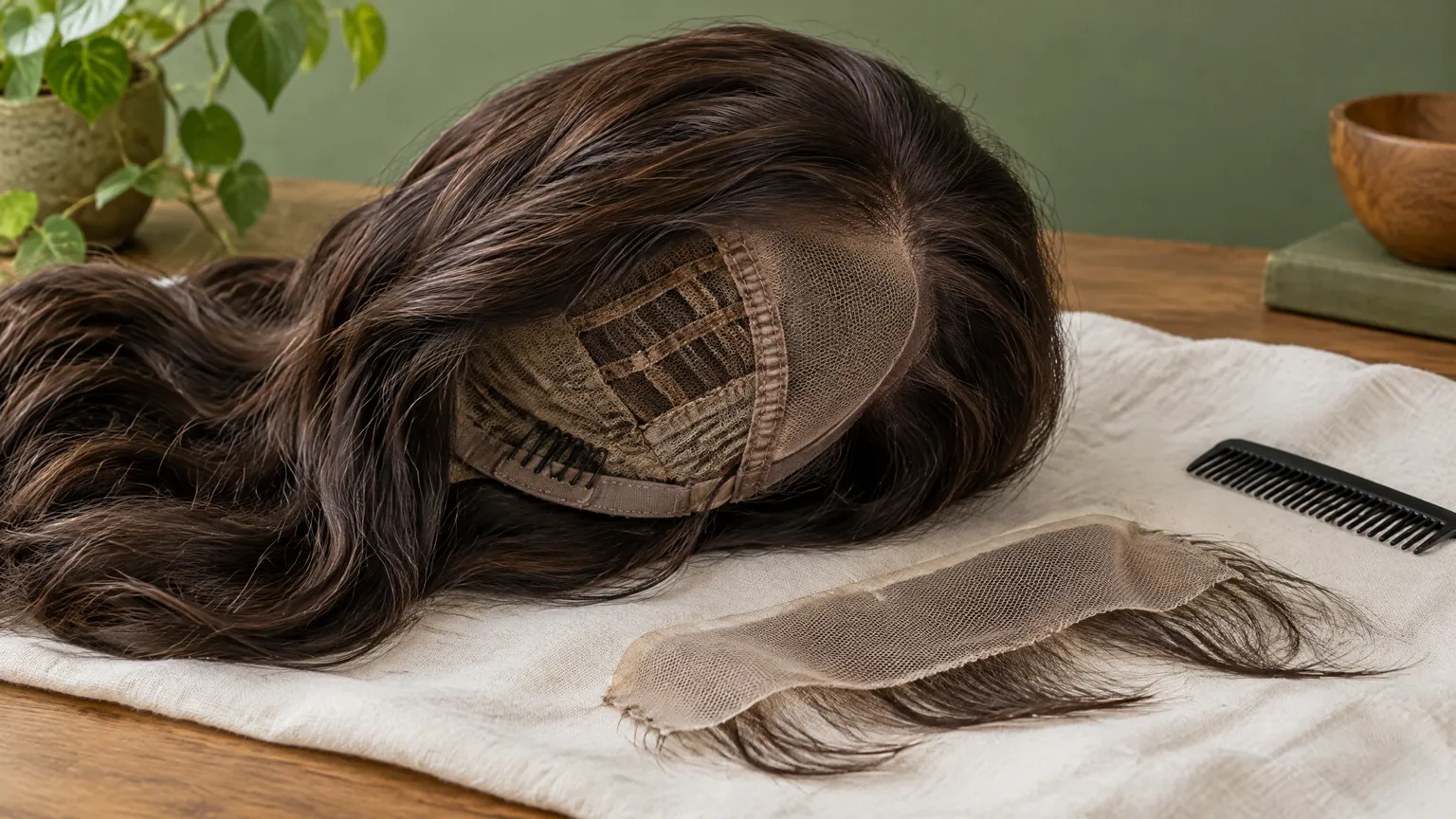
An attractive bob outline does not establish that the cap fits. Before concentrating on the ends, check the fitting method with the supplier. If you have your own hair beneath the wig, ask how it should be arranged for the trial and for everyday wear. A trial with a different arrangement may not tell you how the cap will sit on an ordinary morning.
In the women's wigs category, keep the full-head coverage question separate from the bob-length question. A full wig covers the entire head, whereas a topper adds coverage and volume over thinning hair at the top, as the American Cancer Society explains.1 A short hairstyle does not make these interchangeable. Establish which type of piece you are discussing before asking how its front corners or nape can be adjusted.
Ask whether the sample allows the parting you want and whether the ear area can accommodate your glasses comfortably. Do not infer parting freedom from length alone. If a style needs hair tucked behind an ear to suit your work routine, inspect the result rather than assuming that any bob can be worn that way with the same appearance.
Fit should not be judged by tolerating discomfort for a few minutes. If there is pressure or rubbing, stop and ask about the cause. Macmillan notes that a liner may help with irritation but can also make a wig move more, so it is not a universal fix.2 Persistent irritation, pain or sudden marked hair loss should be assessed by a qualified healthcare professional rather than handled as an appearance problem.
A hypothetical work-day comparison
Consider a hypothetical wearer who uses substantial spectacle frames, usually wears a collared shirt and spends part of the day reading documents. They like the front view of a jaw-length bob, but during a permitted trial its fringe moves across a lens when they look down. A slightly longer sample stays clearer at the front, yet its back ends meet the shirt collar when they turn. Neither observation proves that the style is unsuitable; it identifies the trade-off.
The next step would be to compare the same glasses and shirt with both samples, keeping the cap placement consistent. The wearer could ask whether the first fringe can be adjusted without changing the overall outline, and whether the second bob has another back-length option. They should establish whether those changes are possible before committing, rather than assuming that the pictured design can be altered freely.
Suppose the wearer values an unobstructed view more than a completely still perimeter. They might prefer the longer sample after seeing its movement. Someone who dislikes any hair touching a collar could decide differently. The useful result is a stated preference tied to a normal activity, not a claim that one jawline demands one haircut. This example is illustrative, not a customer account or a report of tested products.
Make a short, specific comparison record
Before a fitting discussion, write down the activities that could change your choice. Mention glasses, collars and any regularly used headset. If the headset presses in the same area as the cap or spectacles, bring it where practical and ask whether you may try it. Do not use it to force an uncomfortable sample to remain in place.
Use this checklist during an authorised trial:
- Wear your usual glasses and check both the front and side outline.
- Note where the front ends sit relative to your jaw, rather than recording only the catalogue length.
- Sit down, look towards a screen and read something with your head lowered.
- Turn your head while wearing your normal collar or jacket.
- Remove and replace the glasses gently, checking whether the cap or hair shifts.
- Ask which proposed changes concern fit, fringe, density or overall length.
- Obtain the fibre-specific care instructions and clarify the return or exchange terms before purchase.
The American Cancer Society specifically advises checking the return policy before buying, since retailers' conditions can differ.1 Ask how trying on, cutting or other alterations affect the applicable terms. Keep the answers alongside the style description so that you do not confuse a sample you liked with a different version discussed later.
For local browsing, OWNSTRAND's wigs Hong Kong information page can be a starting point for asking about samples and a fitting discussion. Describe the outline you want and the work items you need to accommodate, then confirm what can be considered for that piece. GotGear and OWNSTRAND share ownership; this article is an appearance-selection guide, not an independent endorsement of the linked provider.
Your final choice can be modest and precise: a bob whose front length you like, whose fringe works with your glasses, and whose movement against your collar you accept. Those observations give you a clearer brief than a trend name. Keep a record of any agreed adjustments and the care method, so the shape you select is connected to a routine you can actually maintain.
Common questions
Should a bob wig finish exactly at my jaw for office wear?
No single finishing point is required. Compare above-jaw, jaw-level and below-jaw outlines with your usual glasses and collar. Check the side view and seated movement as well as the front. The useful length is the one whose appearance and handling you prefer, not the one assigned to a face-shape category.
What should I do if a bob fringe keeps falling across my glasses?
First check cap placement and fit with the supplier rather than pulling the whole wig backwards. Read something with your head lowered during a permitted trial. Ask whether the fringe's length, density or direction can be adjusted on that piece, and agree on changes before any cutting takes place.
Can I use a straightener to turn collar-length ends inward?
Only use styling heat when the specific wig's instructions permit it, and follow any stated limits. Synthetic, human-hair and blended pieces do not share one care method. Ask whether the inward curve is set into the style or requires restyling, rather than treating a smooth catalogue image as evidence of heat resistance.
Sources & what they support
The scope below identifies what each reference supports. Citations do not imply independent endorsement of OWNSTRAND or any provider, and do not establish treatment benefits or guaranteed results.
- American Cancer Society: Wigs for Hair Loss (opens in a new tab)
Supports removing glasses before a wig trial, keeping the wig off the ears, the distinction between full wigs and toppers, heat-resistance precautions, short-term wig-stand storage and checking return policies. Its cancer-treatment guidance is not used to claim medical benefits or endorse a provider.
- Macmillan Cancer Support: Wigs for cancer treatment (opens in a new tab)
Supports differences in synthetic, human-hair and blended-wig care; easy-to-remove clothing rather than pulling garments over a wig; and the possibility that a liner helps irritation but increases movement. These practical points do not establish suitability or service conditions for any OWNSTRAND piece.