Curly wigs: compare curl placement before choosing a fibre
GotGear and OWNSTRAND share the same owner. This collection is not an independent recommendation. GotGear does not supply wigs or medical treatment; actual wig services are provided by OWNSTRAND, whose only known studio is in Kwun Tong. These articles provide general information, not medical advice.
The short answer
Choose the outline first: compare where the curls begin, where the wig is widest and how the ends sit against your clothes. Density alone cannot tell you how full a curly style will look. Once the shape works, compare standard synthetic, heat-friendly synthetic and human hair against the care instructions for the exact piece. A curl pattern you enjoy wearing and can maintain is more useful than a fibre label chosen without checking the finished silhouette.
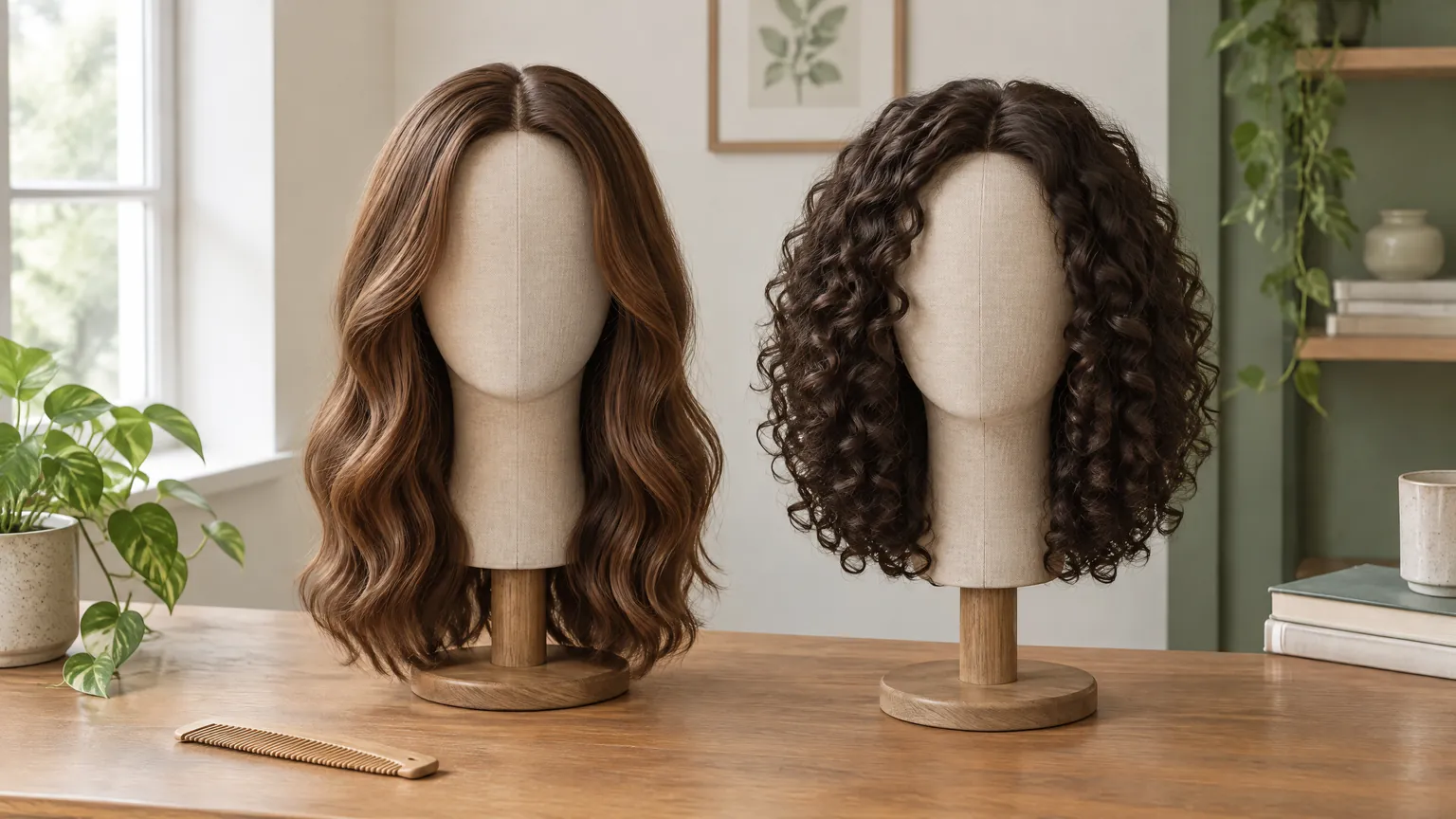
Two wigs can both be described as shoulder-length and curly yet produce very different outlines. One may sit relatively close to the crown, with curls opening beside the jaw. Another may have small curls from the roots, creating width higher on the head. Choosing between them is not simply a matter of ordering more or less hair. It is a matter of deciding where you want the shape to sit.
For a useful comparison, separate four questions: where does the curl start, how tightly does it turn, how much hair is present, and what supports the shape underneath? Fibre comes next because it determines how you maintain or change that outline. This guide concerns the wig itself, not treatments for naturally curly scalp hair.
Read the curl map before the density label
Think of curl placement as a simple map from crown to ends. Look for the first visible bend near the top, then follow the hair towards the temples, cheeks and neckline. A smooth upper section with curled ends can give a different impression from a style with curls throughout, even when the pieces contain a similar amount of hair.
Density describes how much hair is incorporated into a wig; visible fullness also depends on curl size, layering and how the hair is arranged. Do not treat a density description as a guarantee of either a restrained or a dramatic silhouette. Ask how the seller defines the term and compare photographs of the actual style.
When browsing curly wigs, shortlist shapes rather than treating every curled style as interchangeable. Save a front view and a side view, then describe the difference in plain language: curls beside the cheeks, a flatter crown, or more movement below the jaw. These observations make a product enquiry more precise than asking only for a natural-looking curly wig.
Photographs need interpretation. A model may have the front section tucked away, the curls separated for extra width, or the ends placed forward over the shoulders. Ask whether the photographed arrangement reflects the piece as supplied or additional styling. If a feature matters to your daily look, request a view that shows it without a hand holding the hair in position.
Compare the outline at three useful levels
Crown and cheek placement
At the crown, check whether you want height, visible curl texture or a smoother transition into the sides. These are separate preferences. A smoother crown does not necessarily mean a sparse wig, and a lifted crown does not by itself reveal cap construction. If the top shape is important, ask what comes from the cut and what requires styling.
Around the cheeks, look at the widest point rather than choosing from a fixed face-shape rule. Some wearers want curls that sit close to the sides of the face; others prefer a wider outline. Compare both against your own glasses and usual clothing neckline. Check whether the front curl falls towards your eyes when the head turns, not just whether it looks attractive in a still photograph.
A curled fringe needs its own assessment. Its resting length and the space it occupies above the frames of glasses may matter more than the total length of the wig. Before asking for it to be shortened, establish how it behaves in the approved styling arrangement. Do not cut a fringe while pulling the curl straight and assume it will rest at that same point.
Jaw, shoulders and nape
At the jaw and shoulders, inspect where the ends collect. A line of curls at one level can look quite different from graduated ends spread across several levels. Neither is inherently better. The practical question is whether the lower outline works with the shirts, jackets and bags you wear regularly.
The nape deserves a separate look because a front photograph often hides it. Ask whether the back finishes above your collar or rests against it. Macmillan notes that frequently wearing something over a wig creates friction and can shorten its useful life. That supports checking contact points, rather than assuming a hat or scarf will have no effect on the piece.1
Use this comparison to identify what needs checking, not as a universal styling prescription.
| Visible arrangement | What to inspect | Useful question before choosing |
|---|---|---|
| Curls begin close to the crown | Top height and width at the temples | Is this outline part of the supplied style or created during styling? |
| Smoother top with curls below the cheeks | Transition between the upper and lower sections | Can I see the side view without the front tucked back? |
| Small curls throughout | Definition and separation of individual curls | How should this exact pattern be detangled without losing its arrangement? |
| Loose curls concentrated at the ends | Where the ends meet the neckline | What is the resting length when the curls are not stretched? |
| Layered curls around the face | Shorter front sections near eyes and glasses | Can the front be arranged away from my face within the care instructions? |
Keep cap fit separate from visible fullness
A large outline does not establish that a wig is heavy, tight or secure. Likewise, a flatter style does not prove that its cap will feel comfortable. Treat cap dimensions, adjustment method and the way the hair is attached as separate information. Ask for those details rather than inferring them from the curl photograph.
If you are comparing full wigs, keep the comparison within that product type. A topper covers a local area and must work with surrounding hair; it is not simply a lower-density full wig. Mixing the two in one shortlist can obscure what each piece is intended to cover. For a full curly silhouette, establish whether you need a complete wig before debating fibre.
When checking fit, use the hairstyle and any liner you actually intend to wear underneath, following the supplier's fitting advice. Do not solve a cap that presses uncomfortably by choosing a less full-looking curl pattern. Appearance and fit need their own solutions. Persistent irritation or pain should be assessed by a qualified healthcare professional, not treated as a normal price of wearing the style.
Choose the fibre for the way you will maintain the curls
Standard synthetic fibre is worth considering when you want to preserve a supplied curl arrangement rather than repeatedly restyle it. Macmillan explains that synthetic wigs have their style heat-set into the hair and can be carefully hand-washed and left to dry. The exact product instructions remain important, particularly for curls and any construction-specific restrictions.1
The synthetic wigs category can help organise a material shortlist, but a category label is not permission to use a curling iron. Confirm whether the particular piece is standard synthetic or explicitly heat-friendly. Also ask whether its photographed curls return after the recommended wash routine or need a separate approved shaping step.
Heat-friendly synthetic fibre is a distinct option, not a synonym for indestructible hair. Jon Renau separates its care guidance into human hair, standard synthetic and heat-friendly synthetic. Its standard synthetic guidance prohibits hot styling tools; its heat-friendly guidance permits specified techniques under stated conditions. Those instructions concern its own fibres, so they should not be transferred automatically to another maker's wig.3
If a heat-friendly piece interests you, ask for written limits for that exact model, the tools permitted and the cooling procedure needed to set a curl. Consider whether you want this work as part of your routine. Being able to alter the curl is useful only if you can follow the process without guessing. Do not test heat tolerance on an unidentified piece.
Human hair may offer a different styling routine, but it should not be chosen on the assumption that the photographed curls maintain themselves. Macmillan notes that human-hair wigs may need regular cleaning and professional styling, while some can be maintained at home with appropriate equipment and supplier advice.1 Ask whether the shown curl is the hair's supplied texture or a finish that needs recreating after washing.
For a blend, obtain the care instructions for the combination rather than following human-hair advice alone. Macmillan warns that the synthetic component of blended wigs may stretch and frizz when exposed to a hairdryer or straighteners.1 A product containing human hair is therefore not automatically suitable for the tools you already own.
Detangle a curl pattern without copying a scalp-hair routine
A bottle intended for naturally curly hair does not establish compatibility with a curly wig. Start with the care sheet for the fibre and construction. Confirm which cleanser, conditioner or detangler is suitable and where it can be applied. The relevant aim is to care for the piece, not to make scalp-health or hair-growth claims.
Jon Renau's curl-specific synthetic guidance recommends a wide-tooth comb rather than a brush to preserve the curl pattern. It describes gently detangling from the ends upwards, reshaping curls with the fingers and allowing the wig to air-dry on a suitable stand.2 This is more relevant to its curly synthetic styles than a generic instruction to brush any wig. For a different product, check that its manufacturer permits the same method.
Work patiently with a small section instead of pulling through the entire length. If a tangle resists the approved method, stop and ask for advice rather than increasing force. The supplier should be able to explain how to support the hair during detangling and whether the curls should be separated or kept in their original groups.
Product placement also matters. Jon Renau tells users to keep conditioning sprays away from the base because these products can loosen knots.2 That is a reason to read construction-specific instructions, not a reason to avoid all conditioning. Ask which areas of your piece should receive product and which should remain clear.
Plan somewhere the wig can dry without being crushed. Follow the prescribed stand and drying method; do not promise yourself that it will always be ready by a particular hour. Macmillan warns about flames and heat from ovens or hairdryers, while Jon Renau instructs users to air-dry its standard synthetic styles.1 Keep the drying location away from kitchen heat and avoid improvising a hot-air shortcut.
Test the choice against an ordinary week
Hypothetical example: a Hong Kong office worker wants defined curls for daily wear, uses glasses and often wears a collared shirt. Their first shortlist contains a long style with curls from the crown and a shorter style with a smoother top. Both look appealing online, but their practical priorities are clear vision, manageable nape contact and limited morning styling.
Instead of deciding that one fibre is automatically superior, this reader asks for side and back views of both shapes. They check where the front section rests beside their glasses and where the back meets the collar. They then compare the actual care instructions, including detangling and what must happen after washing. A choice can emerge from these details without pretending that the outcome has been tested.
For your own shortlist, use the following checklist before making an enquiry or ordering:
- Mark where you want the widest part of the silhouette: crown, cheeks or lower lengths.
- Record the desired resting length, without measuring a curl pulled straight.
- Compare front, side and back views of the same style and arrangement.
- Ask for the exact fibre classification and the matching written care instructions.
- Check fit information separately from density and visible volume.
- Identify contact with glasses, collars, head coverings or bag straps.
- Confirm whether the photographed curls require restyling after washing.
- Read the seller's terms before any irreversible cutting or other alteration.
Keep the enquiry focused on decisions the seller can clarify. A useful message might say that you want curls beginning below the cheeks, a back that clears your usual collar, and a routine without hot tools. Ask which listed pieces meet those conditions and what remains uncertain. This is more actionable than requesting a particular density number without explaining the intended outline.
Turn online browsing into a precise enquiry
For local online browsing, the buy wigs online Hong Kong page is a starting point for comparing listed options and making product enquiries. Treat a listing as information to verify, not proof of current availability or suitability. Ask about the specific style, its fibre and the care routine that applies to it before committing to a choice.
If you are considering a custom direction, frame measurements, curl placement and any later adjustment as questions for the provider. Establish what can be specified at selection, what can be checked during fitting and what alterations are appropriate for the chosen piece. Do not assume every catalogue style can be reproduced in every fibre.
GotGear and OWNSTRAND share an owner; the linked pages are browsing resources rather than an independent recommendation. The useful decision remains yours: establish the outline you want, check whether the cap fits, and select a fibre whose instructions you are willing to follow. That order prevents a material label from distracting you from the curl placement you will actually wear.
Common questions
Does a fuller-looking curly wig always have higher density?
No. Curl size, where the curls begin, layering and the way the hair is arranged all affect visible fullness. A density label describes the amount of hair rather than the whole outline. Compare crown, cheek and lower-length views, then ask how the seller defines density for the specific piece.
Can I move curls away from my glasses with a curling iron?
Only consider hot tools if the exact wig's written instructions permit them. Standard synthetic fibre should not be treated as heat-friendly. First ask whether an approved non-heat arrangement can clear your glasses. If heat styling is permitted, obtain the model-specific method and limits rather than using another brand's instructions.
What should I ask about a human-hair wig shown with curls?
Ask whether the curls represent the supplied texture or a styled finish, and what happens after the recommended wash routine. Establish which tools and products are permitted, whether you can recreate the arrangement at home and whether professional styling is advised. The photograph alone does not answer those maintenance questions.
Sources & what they support
The scope below identifies what each reference supports. Citations do not imply independent endorsement of OWNSTRAND or any provider, and do not establish treatment benefits or guaranteed results.
- Macmillan Cancer Support: Wigs for cancer treatment (opens in a new tab)
General wig information on heat-set synthetic styles, human-hair maintenance, blended-fibre heat cautions, friction from head coverings and avoiding flame or damaging heat. Used for wig care only, not cancer treatment guidance or Hong Kong service claims.
- Jon Renau: Caring for Curly Hair (opens in a new tab)
Manufacturer-specific curly synthetic wig instructions recommending a wide-tooth comb instead of a brush, detangling from ends upwards, finger reshaping, air-drying and keeping conditioning sprays away from the base. Not presented as universal instructions for every maker.
- Jon Renau: Alternative Hair Care Guide (opens in a new tab)
Manufacturer-specific distinction between standard synthetic, heat-friendly synthetic and human-hair care, including prohibition of hot styling tools on standard synthetic fibre and conditional heat styling of its heat-friendly fibre. No temperature limits are generalised to other brands.