Grey wigs and custom percentages: preserve a familiar colour balance
GotGear and OWNSTRAND share the same owner. This collection is not an independent recommendation. GotGear does not supply wigs or medical treatment; actual wig services are provided by OWNSTRAND, whose only known studio is in Kwun Tong. These articles provide general information, not medical advice.
The short answer
A familiar grey wig colour depends on more than the percentage of white strands. The darker base, the placement of grey around the face and the hairstyle all need consideration. Use a percentage as a starting description, then compare physical samples in natural light and the indoor settings where you will wear the wig. Ask how the supplier defines the blend and records regional differences; neither a number nor a photograph guarantees an exact match.
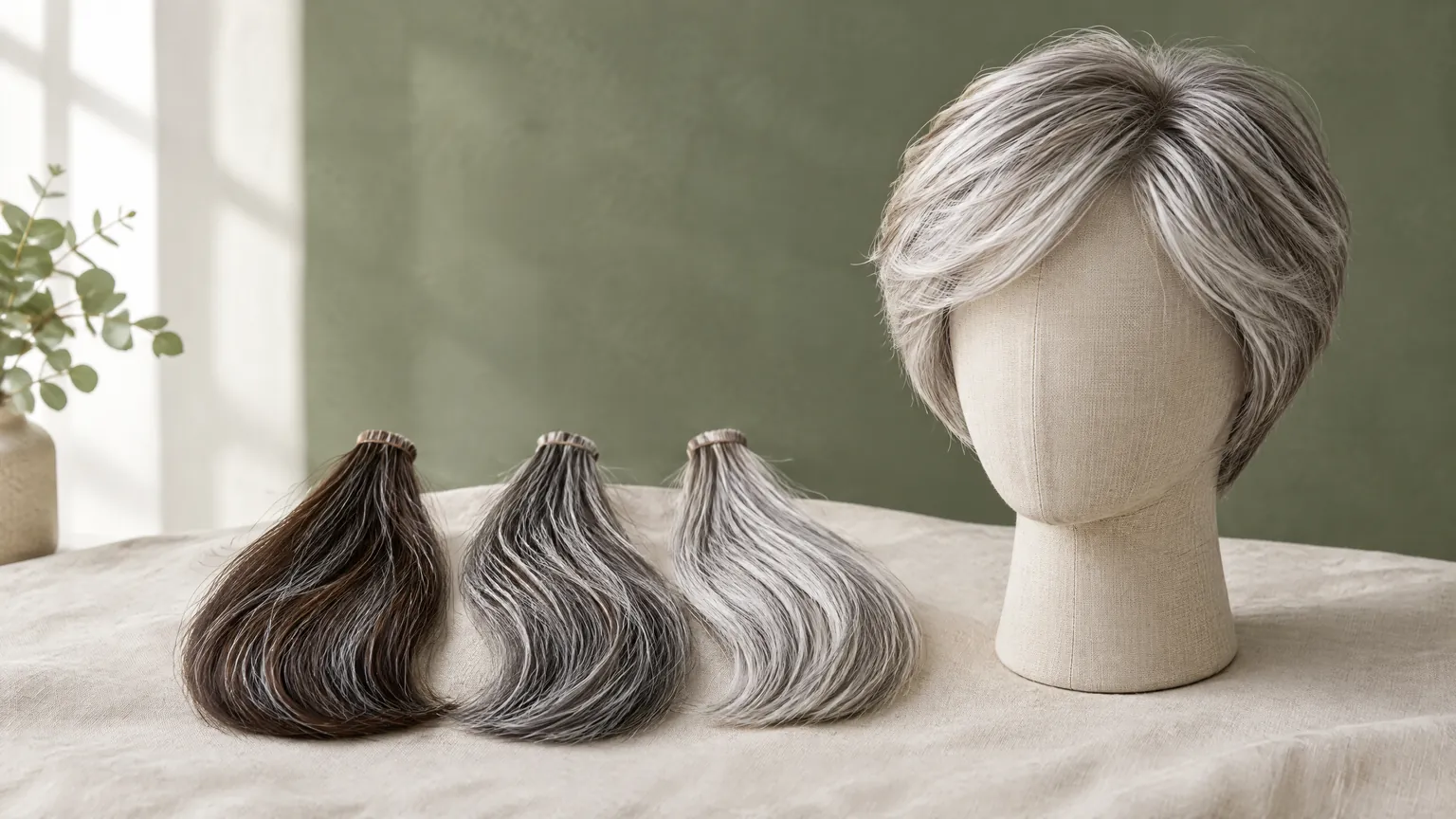
A wig can contain a seemingly suitable amount of grey yet still feel unlike your usual hair. Perhaps the temples are too dark, the fringe looks uniformly silver, or the back is lighter than you remember. These are different problems, and simply asking for more or less grey may not address them. A useful colour brief describes both the overall balance and where the lighter strands belong.
For someone who wants continuity rather than a new look, the aim is not necessarily to reproduce every strand. It is to identify the features that make the colour familiar in everyday settings. That might mean retaining dark hair behind the ears while preserving a lighter sweep at the front, or avoiding a uniformly white finish when the usual appearance is mixed.
What a grey percentage tells you—and what it leaves out
A percentage is useful only when the person selecting the wig and the person making it understand what it describes. Before discussing a preferred number, ask whether the supplier means a blend across the whole wig, a proportion within each section, or a named colour recipe. Also ask whether the proportion is based on strand count, material weight or another production convention. Do not assume different suppliers use interchangeable measurements.
A description such as thirty per cent grey does not, by itself, tell you the shade of the other seventy per cent. Nor does it specify whether the pale strands are bright white, soft silver or mixed grey tones. Against a darker base, the light strands may appear more distinct than against a lighter brown base. Compare actual combinations rather than deciding that one percentage must suit you.
When browsing grey wigs, treat the colour category as an entry point for closer questions. Identify which pictured balance interests you, then ask about the underlying dark shade and the arrangement of lighter strands. A catalogue image can help explain a preference, but it is not confirmation that the same blend can be supplied in a particular style or material.
Separate the amount from the arrangement
Grey content and grey distribution should be recorded separately. Manufacturer Jon Renau describes one of its grey blends as lighter at the front and darker at the nape, while another combines dark hair with white strands throughout and a lighter front. These are descriptions of that manufacturer's products, not universal colour standards. They illustrate why the placement of light strands matters as well as the overall colour label.1
For your own brief, describe the front hairline, temples, parting, crown and back in plain language. You might say that the temples should look noticeably lighter than the crown, but that you do not want an isolated white stripe. That communicates a visual preference more clearly than a single percentage applied everywhere. Ask which regional differences the maker can actually reproduce before treating the description as an agreed specification.
Build the blend around the darker base
Start by comparing the darker component independently of the grey. Is the familiar base close to black, dark brown or a softer brown? Does the sample look warmer than your reference, or does it seem too cool? These observations help narrow the choices without pretending that a colour name is a precise measurement. A white-and-black mixture and a white-and-brown mixture should not be treated as equivalent simply because their stated grey percentages match.
Then consider the lighter component. Some people want a clearly visible salt-and-pepper contrast; others prefer a less distinct mixture. Describe what you see rather than relying on the word silver alone. If two samples both carry a silver label, place them beside the same darker reference and inspect their difference. Keep the comparison manageable by changing one feature at a time.
The following table is a consultation aid, not a list of standard recipes or promised manufacturing options. It helps separate requests that can otherwise become tangled in a conversation about percentage.
| What feels unfamiliar | Detail to compare | Question to ask |
|---|---|---|
| The whole wig seems darker than expected | Dark base and overall light-strand content | Can we compare a softer base before increasing the grey proportion? |
| The face-framing area looks too dark | Front and temple distribution | Can the front be lighter while the back remains darker? |
| The blend looks striped | Size and spacing of pale sections | Is a more dispersed mixture possible in this construction? |
| The colour looks suitable on a swatch but not in the style | Parting, fringe and how the hair lies | Can we view the blend arranged in the intended hairstyle? |
| A topper looks separate from the remaining hair | Visible join at the sides and back | Can we compare the sample directly beside the hair it will meet? |
Once you have selected a plausible darker base, return to the grey balance. This avoids repeatedly increasing the white component to compensate for a base that was wrong from the start. It also makes the conversation more specific: you can identify whether the mismatch concerns darkness, tone, placement or the haircut rather than saying only that the wig does not look right.
Compare physical colour in useful light
The American Cancer Society recommends comparing a hair reference with wig swatches in natural light, outdoors or near a window. Its guidance also suggests photographs of the existing hairstyle when continuity is the goal.2 Those practical suggestions are useful for colour selection without implying that a reader has a medical condition or that a particular wig provides a medical benefit.
Use a physical swatch where one is available, and compare samples side by side under the same conditions. Do not judge one beside a window and another from a phone image taken elsewhere. For a Hong Kong routine involving indoor work and time outdoors, it is sensible to consider both a daylight view and the indoor lighting in which the wig will commonly be worn. The aim is an acceptable balance across relevant settings, not a promise that the colour will appear identical everywhere.
A simple comparison routine
First compare the darker base and the pale strands separately. Next step back and look at the overall blend around the face. Finally arrange the sample, where practical, in the direction the hair will lie. Ask yourself whether the feature that matters most—perhaps a lighter temple or a darker crown—remains recognisable.
Avoid allowing a single flattering view to settle the decision. Equally, do not chase tiny differences indefinitely. Decide which mismatch would trouble you in daily life and which variation you could accept. A clearly darker hairline may matter more to you than a slight change in the back, especially if the latter is usually covered by the hairstyle.
Photos are useful records of placement and shape, but should not replace a physical comparison when colour is critical. If the supplier permits sample photography, photograph the shortlisted blends together in the same setting and label your notes separately. Keep an unedited reference rather than relying on a filtered portrait as the colour target. A photograph remains a communication aid, not proof of an exact match.
Write a custom brief that can be understood
Instead of sending a percentage alone, combine it with the base colour, a regional description and a reference sample or photograph. OWNSTRAND's page about a custom wig with a percentage of grey hair provides a relevant starting point for asking how a proposed balance would be discussed. Confirm how the service records the blend and whether different proportions in particular areas are feasible; the enquiry page should not be read as a guarantee of colour matching.
A useful brief can say, for example, that maintaining the lightness at the temples is the priority, while the precise amount of grey at the back is less important. That gives the supplier a clear hierarchy if every detail cannot be reproduced. It also helps you avoid approving a technically described percentage that fails to preserve the feature you care about most.
Hypothetical example: the same number, two different impressions
Imagine a person whose usual hair is dark brown, with pale temples and relatively little visible grey at the crown. They are considering a nominal thirty per cent grey blend. One proposed arrangement spreads the pale strands evenly throughout; another places more of them around the temples while keeping the crown darker. This is an illustrative scenario, not a tested comparison or a recommendation for that percentage.
Even if both proposals are described with the same overall number, they do not answer the same appearance brief. The evenly dispersed option could make the crown look lighter than desired, while the second proposal might better reflect the person's stated priorities. The next step is to compare appropriate samples and ask whether the requested distribution can be made, not to assume that the second proposal will certainly match.
The person could record a short instruction: retain a dark-brown crown, keep the temples visibly lighter and avoid a solid white band at the front. Any agreed percentage would sit beside that description rather than replace it. If the supplier cannot reproduce the regional arrangement, that limitation should be clear before an order is confirmed.
Check the hairstyle and the area that must blend
Colour approval should not be detached from the intended silhouette. A swept fringe exposes a different part of the front from a fringe worn down. Hair tucked behind the ears makes the temple areas more visible. Compare the blend in the style you intend to use, rather than accepting a front-facing catalogue picture as the only relevant view.
Hair volume deserves attention too. Macmillan's advice on maintaining a familiar appearance suggests choosing a wig with the same volume as the existing hair, or slightly less.3 This does not establish a universal density target. It is a reminder that a familiar colour alone may not preserve a familiar look if the overall shape is much fuller than expected.
A full wig and a topper also pose different comparison tasks. A full wig covers the whole head, while a topper adds coverage to the top.2 With a topper, inspect the colour beside the remaining hair where the two will meet, including the side and back views. With a full wig, give more attention to the balance around the face and across the complete silhouette. Neither choice removes the need to check fit and practical styling.
For local enquiries, the custom human hair wig Hong Kong service page can help frame questions about measurements, hairstyle discussion and the eventual fitting. Ask how the colour decision relates to those stages and when adjustments can be discussed. Do not infer that every pictured colour, regional blend or construction is available for a custom order, or that completion and alterations follow a fixed timetable.
Confirm the material before planning colour care
Ask what the grey-looking strands are made from, not just whether the overall product is described as human hair. A blend may require different care from an all-human-hair wig. Macmillan explains that wigs can combine human and synthetic hair, and that mixed constructions may need special care because synthetic fibres can be affected by heated styling tools.3 That is a reason to verify the actual composition, not to assume anything about a particular supplier's product.
Do not plan to correct an unsatisfactory grey blend at home with dye, colour rinses or a toning shampoo before checking the instructions. The American Cancer Society specifically advises against using a colour rinse on a synthetic wig and warns against heated tools unless the wig is heat resistant.2 A method intended for someone's growing hair should not automatically become a treatment for an unfamiliar wig fibre.
Request care guidance for the exact piece, including which products are suitable and whether heat styling is permitted. If a shade needs attention later, describe the change to the supplier before attempting a correction. A clear record of the original sample and regional pattern is more useful than assuming that the initial percentage alone explains what has changed.
A checklist before confirming the blend
Use this checklist while the colour discussion is still open. It turns a general preference into details you can review, without requiring you to produce a technical manufacturing formula.
- Identify the darker base and compare it separately from the grey content.
- Confirm what the stated grey percentage measures and whether it applies uniformly.
- Describe the front, temples, crown and back, noting the area that matters most.
- Compare available physical samples in natural light and relevant indoor lighting.
- View the colour with the intended parting, fringe and approximate hair volume.
- For a topper, compare the visible meeting points with the remaining hair.
- Confirm fibre composition, care instructions and any limits on later colour changes.
- Record the approved sample, agreed distribution and the process for discussing discrepancies.
Ask the supplier to distinguish what has been agreed from what remains an enquiry. For example, liking a sample does not settle whether that blend can be reproduced in the chosen material. Nor does discussing a possible alteration establish that it is included or feasible after completion. Resolve those questions before approving the specification, and retain a copy of the relevant description.
The most useful stopping point is a blend that preserves your priority features in the settings that matter to you, with its limitations understood. A percentage can organise the discussion, but it cannot substitute for examining the darker base, regional distribution and hairstyle together. GotGear and OWNSTRAND share ownership; the service links here are enquiry resources, not independent endorsements or evidence of a guaranteed match.

Common questions
Does thirty per cent grey mean the temples will be thirty per cent grey too?
Not necessarily. Ask whether the supplier uses that number for the whole wig, every section or a particular blend recipe. The temples could be lighter than the crown even when one overall percentage is quoted. Record any regional differences separately and confirm what can actually be made.
Why can a suitable grey swatch look unfamiliar in a finished hairstyle?
The swatch does not show the complete arrangement around your face. A fringe, a different parting or a fuller silhouette can expose different areas of the blend. Compare the colour with the intended hairstyle where practical, and check natural light as well as the indoor conditions relevant to your routine.
Can I use a colour rinse to make a grey blend closer to my own hair?
Do not treat a colour rinse as a routine correction. The American Cancer Society advises against colour rinses on synthetic wigs. First establish the piece's fibre composition and read its care instructions. Ask the supplier about the specific mismatch before using dye, toning products or heated tools.
Sources & what they support
The scope below identifies what each reference supports. Citations do not imply independent endorsement of OWNSTRAND or any provider, and do not establish treatment benefits or guaranteed results.
- Jon Renau: Gorgeous Grey Collection (opens in a new tab)
Manufacturer descriptions of its own grey blends illustrate lighter fronts, darker napes and dispersed white strands. Supports the distinction between colour amount and placement, not universal percentage standards or endorsement of OWNSTRAND.
- American Cancer Society: Wigs for Hair Loss (opens in a new tab)
Supports comparing hair references and wig swatches in natural light, using hairstyle photographs, distinguishing full wigs from toppers, avoiding colour rinses on synthetic wigs and checking heat resistance before heated styling.
- Macmillan Cancer Support: Wigs for cancer treatment (opens in a new tab)
Supports considering familiar hair volume and explains that human-and-synthetic blends require material-specific care, including caution with heated styling. No UK funding, price, production-time or clinical claims are transferred to Hong Kong services.