
Hand-tied or glueless: construction does not settle every fit question
GotGear and OWNSTRAND share the same owner. This collection is not an independent recommendation. GotGear does not supply wigs or medical treatment; actual wig services are provided by OWNSTRAND, whose only known studio is in Kwun Tong. These articles provide general information, not medical advice.
The short answer
Hand-tied and glueless describe different features, so they are not necessarily competing choices. Hand-tying concerns how hair is attached to the cap; glueless concerns wearing the wig without adhesive. Neither label tells you whether the cap matches your head, whether its fastenings feel comfortable or whether the hair volume suits your preferred outline. Compare the full construction, try the intended fastening arrangement and assess density separately. A convincing photograph is not a substitute for those checks.
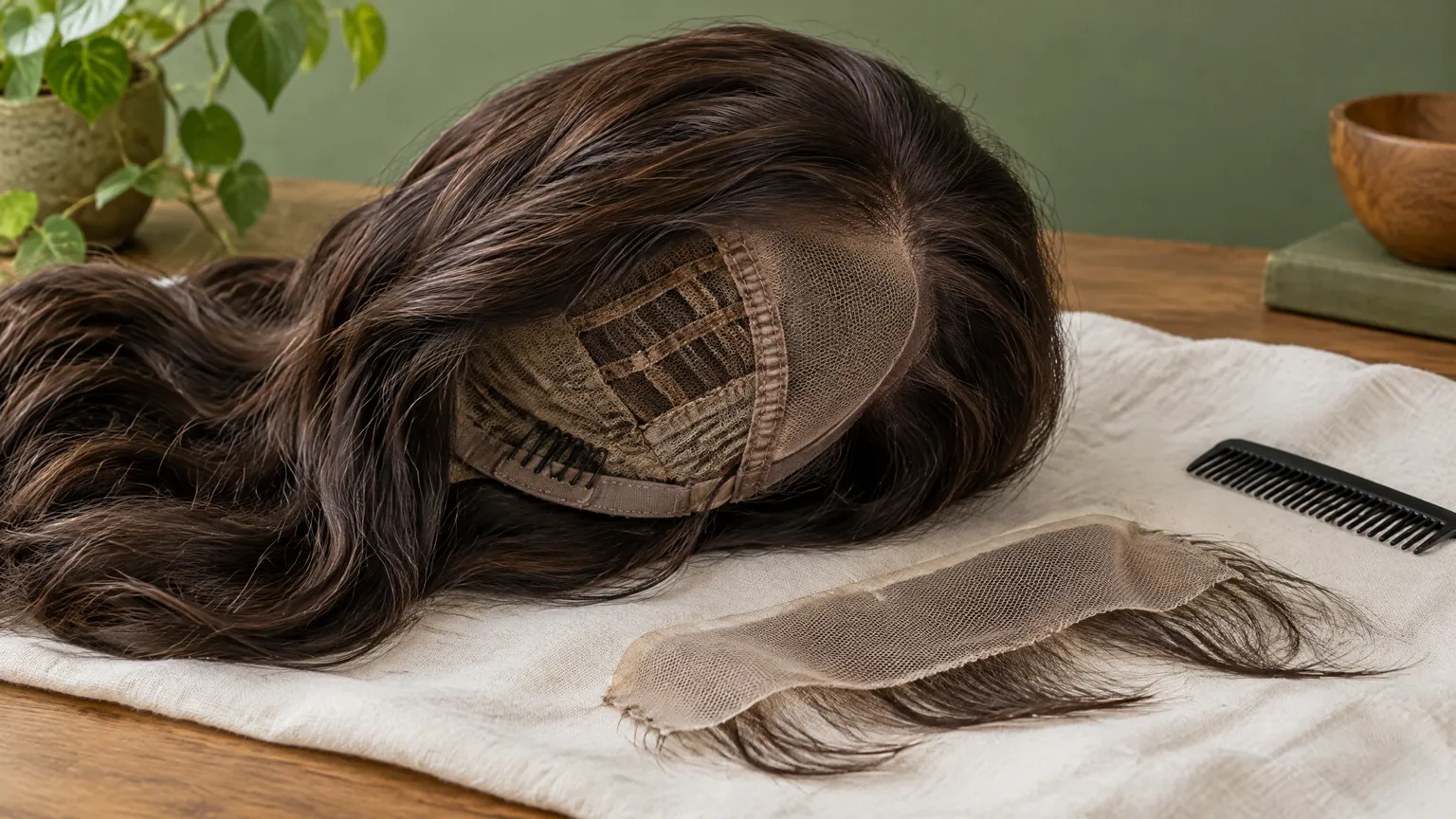
A wig can have hand-tied sections and be designed for adhesive-free wear at the same time. Choosing between those labels alone misses the more practical question: how does this particular cap sit on your head, with the hair underneath and the fastenings you actually intend to use? An attractive outline and a secure fit need separate checks.
GotGear and OWNSTRAND share ownership. The linked OWNSTRAND pages below are resources for browsing and product questions, not independent endorsements. This guide focuses on what to compare rather than declaring a construction the winner.
Separate construction, fastening and density
Hand-tying describes the attachment of individual hairs to a cap or a specified section of it. Jon Renau describes its hand-tied construction in those terms and associates it with hair movement. That manufacturer description helps explain the technique; it does not establish how every other brand's cap is built or how comfortable it will feel on a particular wearer.1
Glueless describes an adhesive-free wearing arrangement. It does not identify one universal cap material or fastening system. Ask whether the particular design relies on adjustable straps, an elastic band, clips, combs, another support or a combination. A cap may contain hand-tied areas while using one of these arrangements. Conversely, hand-tying alone does not tell you whether adhesive is required or optional.
Density is a third question: how much hair is present, and where is that fullness placed? The same fastening approach can accompany quite different outlines. A fuller crown, a flatter parting and longer ends also change what you see, even when two product descriptions use similar terminology. Keep these variables separate instead of assuming that a construction label determines the finished silhouette.
| Feature being compared | What it helps explain | What still needs checking |
|---|---|---|
| Hand-tied areas | How individual hairs are attached in those areas | Extent of hand-tying, cap shape, lining and contact points |
| Adhesive-free fastening | How the wig is intended to stay in place without glue | Actual supports, compatibility with underlying hair and movement |
| Hair density | Amount and distribution of hair | Crown height, parting appearance and coverage in the intended style |
| Cap measurements | Whether dimensions may suit the wearer | Head shape, hair underneath, ear position and adjustment range |
Read the whole cap, not just its headline feature
When reviewing a hand tied wig, ask which areas are hand-tied and what occupies the rest of the cap. Request an inside view or a clear explanation of the construction. The headline term is useful, but it should not stand in for details about the front edge, crown, sides and nape. Confirm those details for the specific product rather than assuming every item in a category is identical.
Look at where seams, edges and fastenings will contact your head. A feature that looks unobtrusive on the outside can still sit in an inconvenient position underneath. Glasses make the area around the ears especially worth checking: put them on during fitting and notice whether their arms compete with the cap edge. Your normal parting also matters because it determines which part of the construction will be most visible.
Distinguish the front edge from the rest of the cap
A description of a lace front concerns the front area; it does not, by itself, explain the whole cap. Ask how far the relevant section extends and whether the style supports the parting or swept-back look you want. Check the edge in ordinary room light as well as nearer daylight where possible. No construction can promise an invisible boundary in every angle, light or hairstyle.
Avoid making permanent changes merely to improve the first mirror impression. Before cutting an edge, removing a fastening or thinning the hair, ask about the intended fitting sequence and the consequences for later adjustment. A reversible fit check gives you more useful information than an early alteration that cannot readily be undone.
Assess adhesive-free security without over-tightening
For a glueless wig, the useful enquiry is not simply whether glue can be avoided. Ask what keeps that exact design in position and how those supports are adjusted. Confirm whether the arrangement shown is part of the product or uses an additional accessory. Also ask whether an adhesive-free setup changes how the front edge or parting can be worn.
Macmillan's wig guidance says a well-fitting wig should stay in place on its own and discusses clips as an option when a wearer has some of their own hair. It also recommends checking security with gentle movement.2 This supports testing the actual arrangement rather than treating every fastening as necessary. It is not a guarantee for every activity or head shape.
Underlying hair changes the fitting conditions. If you have longer hair, use the loose arrangement you plan to wear underneath, rather than a temporary bulky bundle that distorts the trial. If there is little or no hair beneath the cap, ask how the proposed fastening works in that situation. Do not assume a clip intended to grip hair can simply be used in the same way against a bare scalp.
Pressure is not proof of a good fit
When a cap slips, tightening every strap may hide the symptom without resolving the mismatch. Check its position and the shape of the cap first. Notice whether one edge lifts while another digs in, or whether a band feels secure only when it presses uncomfortably. Ask for reassessment instead of accepting pain as the normal price of security.
The American Academy of Dermatology warns that repeated pulling and tight hairstyles can cause hair loss, and identifies pain and stinging as reasons to change the arrangement.3 That is general hair-care guidance, not evidence that a particular wig causes or prevents a condition. Keep the hair underneath loosely arranged and stop using a setup that causes painful pulling. Persistent irritation, scalp pain or sudden noticeable hair loss needs assessment by a qualified healthcare professional.
Judge density through the hairstyle you will wear
A lower-volume outline may appeal if you want something close to your usual hair rather than a large change. Macmillan suggests matching existing hair volume or choosing slightly less when the aim is a less conspicuous transition.2 That advice supports considering your starting appearance, not treating minimal density as an objective standard of realism. Someone who normally wears a full style may prefer a different balance.
Use the guide to low density wigs to frame questions about the outline you want, then confirm how density is described for the specific design. Ask where the hair is concentrated and whether the label relates to the whole cap or selected areas. Do not assume the same descriptive term will produce identical volume across different lengths, textures or constructions.
Inspect the crown and sides separately. A curled style can occupy more visual space than a straight style, while the way a fringe falls can change the apparent fullness around the face. Compare samples in similar styling where possible. Otherwise, you may be judging the styling rather than the underlying amount of hair.
Try your intended parting and any routine behind-the-ear tuck. Check coverage at those positions instead of relying on the front view alone. Less hair does not automatically mean less noticeable construction, better airflow or less scalp contact. Those outcomes still depend on the cap, lining, arrangement and how the finished style is worn.
Run a fitting check that resembles your day
Start with the wig positioned as instructed, then change one thing at a time. Adjusting the band, moving the cap and adding a liner simultaneously makes it difficult to tell which change helped. Use a mirror to inspect the front, sides and nape, but also pay attention to what you feel. A good-looking photograph cannot record pressure behind an ear.
The following checklist is for ordinary fitting, not a claim that a brief trial proves all-day comfort. Stop any movement that is uncomfortable or unsafe for you.
- Arrange underlying hair as you intend to wear it, without tight pulling.
- Put on your usual glasses and check contact around both ears.
- Turn your head gently, look down and return upright; note any shifting.
- Check the front edge, nape and parting after movement, not only before it.
- Try the everyday hairstyle you want, including a fringe or gentle tuck.
- Identify any point that pinches, rubs or pulls, and ask what can be changed.
- Practise removing and replacing the wig using the proposed fastening method.
In Hong Kong, a routine may include outdoor humidity followed by air-conditioned rooms. Describe that routine during a fitting enquiry rather than asking whether a cap is simply breathable. Ask what contacts the scalp and how the arrangement should be managed if you become sweaty. A short indoor appointment cannot reproduce an entire commute, so comfort language should remain a starting point for questions, not a promise.
A hypothetical comparison: similar appearance, different compromises
Suppose a fictional office worker wears glasses, has some shoulder-length hair and wants a modest-volume bob for a commute and desk-based day. They compare a cap with hand-tied sections and a band-based fastening against another design with less visible fullness and clips. Neither option is a real product recommendation, and no outcome is assumed.
The first question is whether both samples can be fitted with the same loose arrangement of underlying hair. If one sits differently because of a bulky knot at the nape, the trial is not yet comparing the caps fairly. Next, the wearer checks whether the band position conflicts with their glasses and whether the clips grip without pulling. The quieter outline of one style does not cancel an uncomfortable fastening.
If the band-based sample stays in place only when tightened to discomfort, it needs reassessment. If the clip-based sample looks closer to the desired bob but pulls at the temples, that also needs reassessment. The useful response is to ask whether fit, fastening or styling can be changed, and what the supplier can actually provide. Do not conclude that all hand-tied caps or all clip arrangements will behave the same way.
This example shows why comparing several variables at once can mislead. First establish a workable cap position and comfortable wearing arrangement. Then compare the silhouette in similar styling. A design that appears fuller may need a style discussion; one that lacks the coverage required for the intended parting may simply not suit that look.
Ask what can be adjusted before committing
A practical enquiry describes the result you want and the problem you are trying to avoid. For example: you want a flat-looking crown, you wear glasses and you do not want adhesive in your routine. That is more informative than asking for the most natural or most comfortable wig, because those broad claims do not specify a fit requirement.
Ask whether the cap dimensions can be checked against your measurements and head shape. Clarify which supports are adjustable and whether changes to the density or outline are possible for that design. If cutting or thinning is discussed, confirm the scope before authorising it. A supplier's ability to alter one construction does not establish that the same alteration is suitable for another.
For an OWNSTRAND enquiry, confirm which catalogue descriptions apply to the item being discussed. If considering a hand-customised option, ask how head measurement, style discussion, later fitting and adjustment would work for your request. Do not treat a category page as confirmation of stock, an appointment, a particular fastening or a promised result.
Keep the wearing arrangement manageable
Adhesive-free wear does not eliminate care. The cap and any permitted liner or removable support still need appropriate cleaning. Macmillan notes that a lining can irritate the scalp, that a cotton liner may help some wearers, and that a liner can also make a wig move more.2 Adding one therefore means checking the fit again, not assuming it improves every arrangement.
Follow the specific care instructions for the fibre and construction, and ask how to clean around the fastenings without damaging them. Notice whether the same contact point becomes uncomfortable repeatedly. Do not keep adding tension or accessories to compensate for a cap that needs reassessment.
The useful choice is a combination you can position, secure, style and remove comfortably within your routine. Hand-tying, adhesive-free fastening and lower density can each answer part of that brief. None answers the whole fit question alone.
Common questions
Can a wig be both hand-tied and glueless?
Yes. Hand-tying concerns how individual hairs are attached to a cap or part of it; glueless concerns an adhesive-free wearing arrangement. Ask which areas are hand-tied and which fastenings the specific design uses. Neither description replaces a check of cap dimensions, pressure points and movement.
Does lower density mean a cap will feel cooler?
Not necessarily. Density describes the amount and distribution of hair, while comfort also depends on the cap, lining, underlying hair and wearing conditions. Compare the intended hairstyle and ask what touches the scalp. Do not treat a low-volume outline as evidence of guaranteed airflow or all-day comfort.
What should I do if an adhesive-free fit feels secure only when tight?
Ask for the cap position, dimensions and fastening arrangement to be reassessed rather than tightening further. Check whether underlying hair or an added liner changes the fit. Stop a setup that causes painful pulling. Persistent irritation, scalp pain or sudden noticeable hair loss should be assessed by a qualified healthcare professional.
Sources & what they support
The scope below identifies what each reference supports. Citations do not imply independent endorsement of OWNSTRAND or any provider, and do not establish treatment benefits or guaranteed results.
- Jon Renau: Hand Tied cap design (opens in a new tab)
Manufacturer explanation that its hand-tied construction attaches individual hairs and supports hair movement; used to explain the technique, not to substantiate universal comfort or endorse OWNSTRAND.
- Macmillan Cancer Support: Wigs for cancer treatment (opens in a new tab)
Practical guidance on matching existing hair volume, checking wig security, clips when underlying hair is present, and the comfort-versus-movement trade-off of a liner. UK financial and prescribing information is not applied to Hong Kong.
- American Academy of Dermatology: Hairstyles that pull can lead to hair loss (opens in a new tab)
Repeated pulling and tight hairstyles can cause hair loss; pain and stinging warrant changing the arrangement, hair beneath a covering should be loose, and hair loss merits professional assessment. No product-specific medical effect is claimed.