
Remy and other human-hair labels: what they do and do not tell you
GotGear and OWNSTRAND share the same owner. This collection is not an independent recommendation. GotGear does not supply wigs or medical treatment; actual wig services are provided by OWNSTRAND, whose only known studio is in Kwun Tong. These articles provide general information, not medical advice.
The short answer
Remy describes how human hair is aligned from root to tip; it is not a complete quality certificate. Other labels may describe fibre content, processing or length distribution, but they do not settle how a finished wig will fit, feel or behave after washing. Read each term alongside the product’s construction and care instructions. Before choosing, ask what the label means for that particular piece, what treatments it has received and which claims the supplier can document.
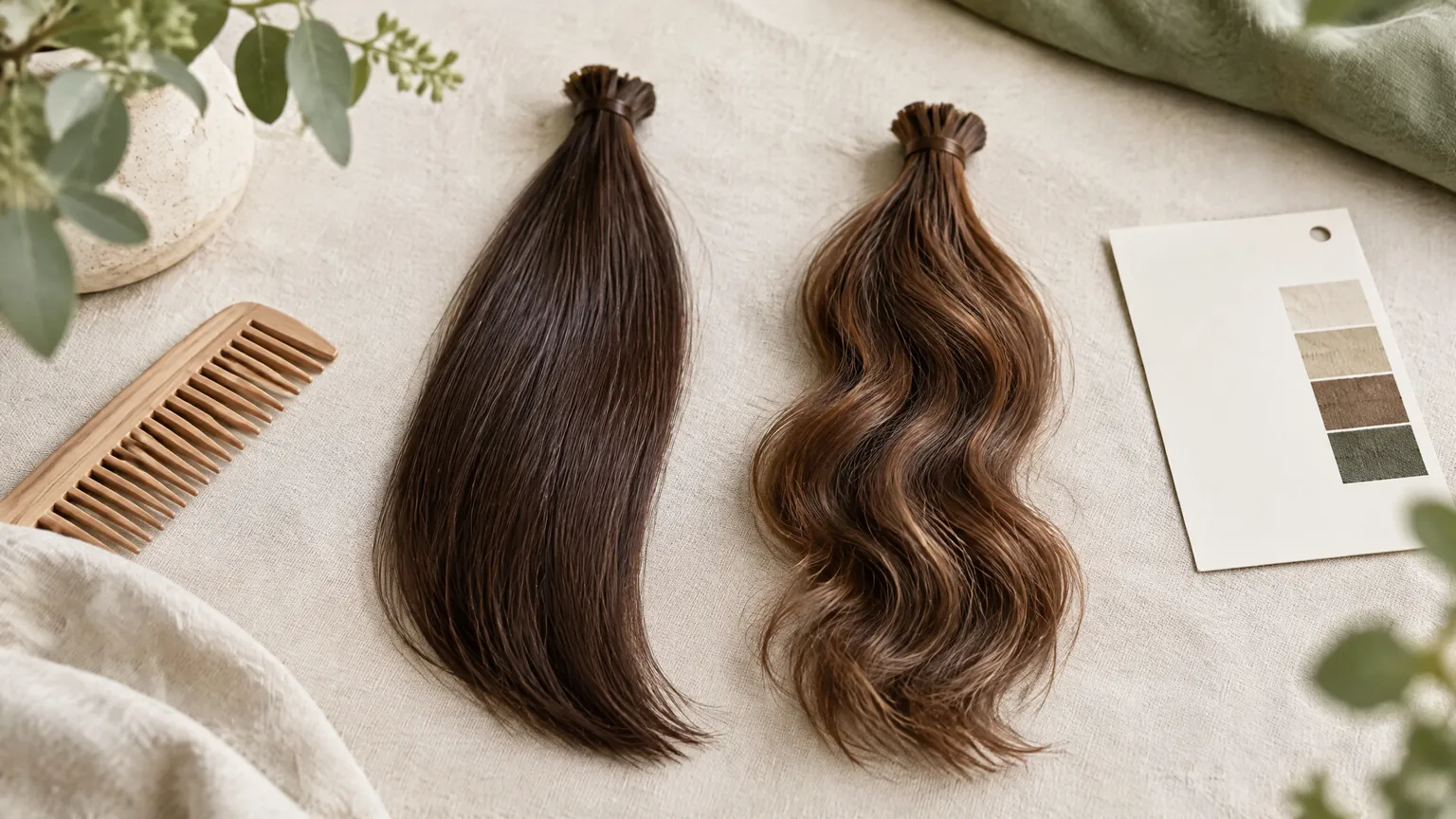
Remy answers one question, not every question
A wig description can combine several impressive-sounding words: Remy, virgin, premium, hand-tied and natural. The problem is not that these words are necessarily meaningless. It is that they address different things. A fibre description cannot tell you whether a cap presses behind your ears, and a construction description cannot establish how its hair was collected. Treating the whole line as a single quality grade hides the questions that matter when you actually wear the piece.
Wig manufacturer Jon Renau describes Remy hair as human hair collected and sorted so that root and tip ends travel in the same direction. It describes non-Remy hair as hair whose direction cannot be guaranteed, with processing used to remove part of the cuticle, the outer layer of the strand. Importantly, its explanation states that Remy and non-Remy do not themselves describe hair quality, origin or length. This is a manufacturer’s explanation of industry terminology, not an independent assessment of another seller’s products.1
That distinction makes Remy useful without making it decisive. Directional sorting is a characteristic you can ask about; it is not proof that a wig will never tangle, that its colour is untreated or that its cap suits your head. If a description promises all of those outcomes from the word alone, ask the supplier to explain each claim separately. A clear answer should identify the particular product rather than repeat the label.
For a more focused comparison, the OWNSTRAND guide to Remy human hair wigs provides a place to examine the Remy versus non-Remy distinction before making a product enquiry. Use the guide to frame questions about the specific piece you are considering, not as evidence that every listed style has the same fibre condition or construction.
Separate human-hair content from processing history
“Human hair” identifies the material being described. It does not, on its own, answer whether every fibre in the finished piece is human hair, whether different textures have been combined or whether the colour has been changed. Macmillan Cancer Support explains that a human-hair wig may contain hair from several people and that different hair types are often bleached and then dyed. Human hair should therefore not be read as a synonym for untouched hair.2
Ask what happened before the hair reached the cap
Request an explanation of the current colour and texture. Was the hair coloured, lightened or processed to create a wave? Does the supplier describe the whole piece as unprocessed, or only a component used during manufacture? These are questions, not assumptions that every wig undergoes every treatment. They help you distinguish an appearance you like from a processing history you still need to understand.
If you already colour or straighten your own hair, do not automatically transfer that routine to a wig. The starting condition may be different, and the finished piece includes attachment points and a base as well as loose strands. Ask which alterations are permitted and who can undertake them. Buying human hair is not blanket permission to bleach, perm or repeatedly heat-style the piece.
The same precision matters for blends. Macmillan notes that some wigs combine human and synthetic hair and may require special care because synthetic fibres can stretch and frizz when heated with a hairdryer or straighteners.2 Ask for the composition and instructions for the entire wig. Instructions that suit one component do not necessarily suit the mixture.
A label-reading table for the product page
The following table is a way to organise enquiries, not a ranking of materials. Some descriptions have a clear technical focus; others need the seller to define how the wording is being used. Record the answer against the particular model or commissioned piece rather than applying it to a whole catalogue.
| Description | Useful starting point | What remains unanswered | Question to put to the supplier |
|---|---|---|---|
| Human hair | A statement about fibre material | Full composition, processing history and cap design | Is the piece entirely human hair, and what treatments has it received? |
| Remy | Root-to-tip directional sorting in the explanation cited here 1 | Overall grade, origin, length and finished-wig comfort | How is the term defined and supported for this piece? |
| Non-Remy | Direction is not guaranteed in that explanation 1 | How the finished hair behaves with its prescribed care | What processing and maintenance instructions apply? |
| Virgin or unprocessed | Wording that needs a precise processing definition | Which treatments are excluded and which production stage is covered | Does this describe the finished hair, including its colour and texture? |
| Single-donor wording | A claim about collection from an individual | Documentation, processing and suitability for your style | What records support this claim, and what happened after collection? |
| Double-drawn wording | A prompt to clarify how lengths are sorted | Actual density, end fullness and weight | What does this mean in your specification, and can I examine the ends? |
| An origin label | A claim about provenance that needs clarification | Whether it refers to collection, processing or marketing terminology | Which location or process does the label actually identify? |
Avoid turning uncertainty into an automatic accusation. A short product page may simply omit details. Give the supplier an opportunity to clarify. If the answer still bundles provenance, softness and durability together without explaining them, keep those claims unresolved rather than filling in the gaps yourself.
Be especially careful with “premium” and origin words
“Premium” is not a substitute for a measurable specification. You can ask what it means here: a particular hair selection, cap method, density or finishing process. A reply based only on another flattering adjective does not give you a practical comparison. Translate the claim into something you can inspect or into a written condition that you can retain.
Likewise, an origin word does not by itself establish donor consent, a single donor or a complete supply chain. If provenance matters to your decision, ask what documents are available and which part of the journey they cover. A label should not be treated as proof of ethical sourcing merely because it names a place. This is a documentation question, separate from whether you like the hairstyle.
Compare the finished wig, not just loose hair
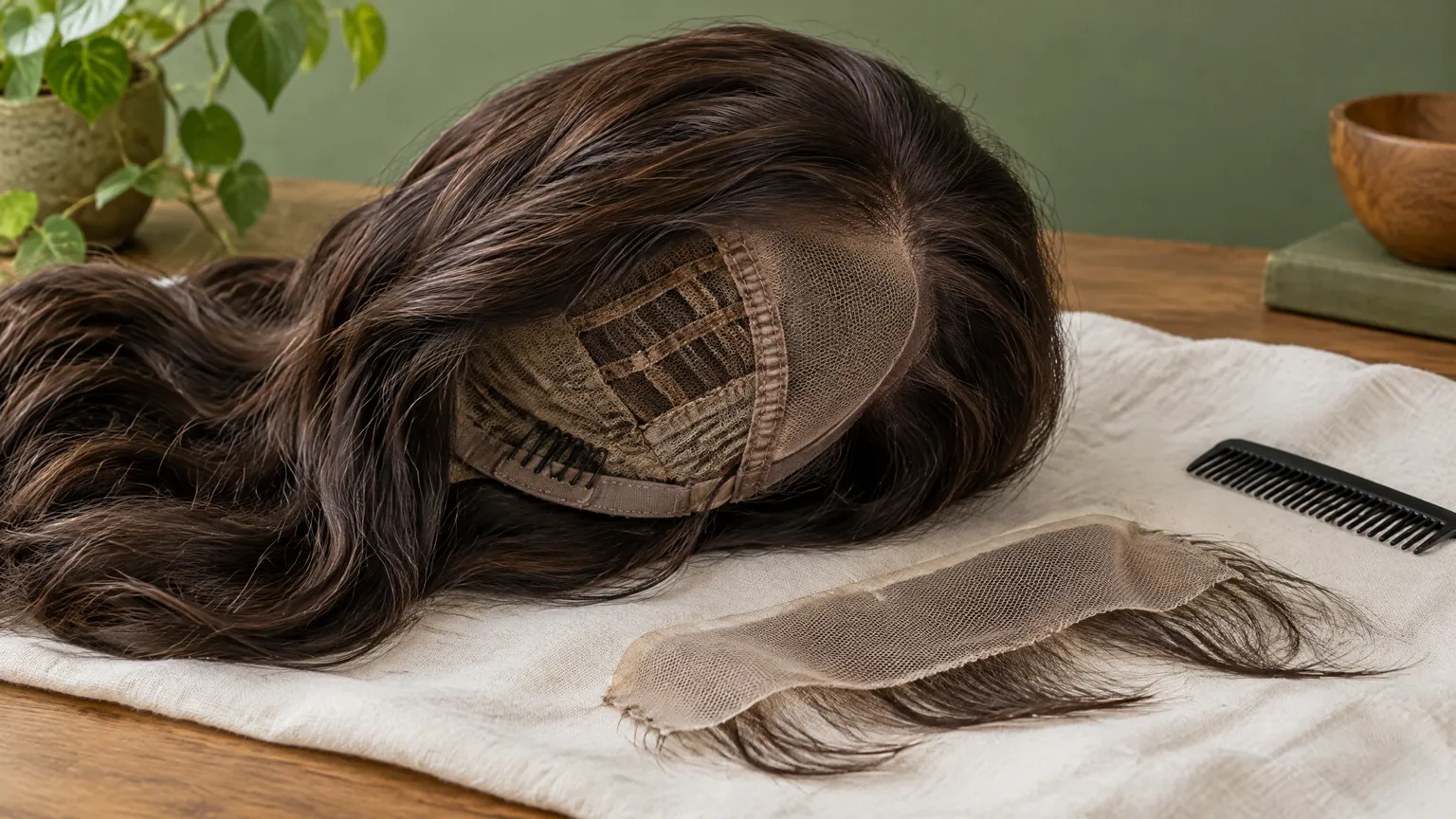
Two wigs with the same fibre label may leave you with different everyday decisions. Look at where you intend to part the hair, how much forehead you want exposed and whether the overall density resembles your preferred look. Ask to see the inside of the cap and to understand its adjustment method. Remy terminology does not answer any of these construction questions.
During a permitted fitting, check the front, sides and back without assuming that a polished photograph shows how the piece will sit on you. Notice pressure near the ears and whether the nape feels bulky when you turn your head. If you expect to wear glasses, check them with the wig rather than treating that interaction as an afterthought. These observations establish personal suitability; they do not authenticate the hair label.
You also need to compare the care burden across materials. Macmillan explains that conventional synthetic wigs have a set style and can be washed and left to dry, while human-hair wigs may require regular cleaning and styling by a professional.2 That difference can matter more than an adjective when your mornings are short. It is still necessary to follow the particular product’s instructions rather than assume every synthetic or human-hair piece behaves identically.
If that choice is still open, the OWNSTRAND comparison of human hair vs synthetic wigs is relevant to deciding which maintenance routine you want to investigate. Compare the routines with your available time and styling preferences, then confirm the selected product’s actual care limits. A fibre category is a starting point, not a promise of effortless wear.
Use a hypothetical workday to test the trade-offs
Hypothetical example: a Hong Kong office worker wants a shoulder-length style for meetings, wears glasses and usually has little time for styling before leaving home. They like the idea of changing the parting occasionally, but they are not interested in a complicated washing routine. This is an illustrative situation, not a customer account or a result from a product test.
For this person, a Remy label cannot settle the decision. They would first ask how the intended parting is supported by the cap and whether the sides work comfortably with their glasses. Next they would ask what the style looks like after washing under the prescribed routine, and which steps restore it to the appearance shown. The answers connect the specification to the actual workday.
A longer or fuller style could still appeal, but the wearer should examine what happens at the collar and nape rather than assuming that directional sorting removes every maintenance concern. Macmillan warns that repeatedly wearing a hat or scarf over a wig causes friction that can shorten its useful life.2 That supports a broader practical question: where will this person’s routine put repeated contact on the piece, and what care does the supplier recommend?
The outcome need not be a declaration that one material wins. If the wearer wants more styling flexibility, they may accept the maintenance explained for a particular human-hair piece. If the priority is a consistent set style, they can investigate an appropriate synthetic option. The sensible choice is the one whose confirmed limitations fit the routine, not the one carrying the longest string of labels.
Get usable answers before committing
When browsing human hair wigs, separate the look you want from the details still requiring confirmation. Keep the model or reference image with your enquiry, and ask which fibre composition, cap construction and adjustments apply to that selection. A catalogue category does not establish that a particular piece is currently available or that every alteration can be provided.
Use this checklist to turn a conversation into information you can compare:
- Record the exact piece or proposed specification, rather than only its marketing name.
- Ask for the human-hair or blended composition and the supplier’s definition of each fibre label.
- Clarify known colouring or texture processing, and any claims about donor numbers or origin.
- Check the cap interior, intended parting, adjustment points and compatibility with glasses during a permitted fitting.
- Obtain written washing, drying, detangling and storage instructions for that piece.
- Ask which cutting or styling changes are permitted and which require specialist help.
- Confirm any inspection, adjustment and aftercare arrangements before agreeing to them.
An incomplete answer is a reason to pause, particularly if the missing information affects your intended use. For instance, unclear heat instructions matter if you plan to change the shape regularly. Unclear provenance matters if documented sourcing is essential to you. You do not have to resolve every possible question, but you should resolve the ones that would change your decision.
Care instructions and comfort outrank reassuring labels
Ask for care instructions while you are choosing, not only after the piece arrives. Macmillan advises careful washing with slightly warm or cold water and warns against exposing wigs to flame or heat from an oven or hairdryer.2 Where a particular product permits controlled heat styling, obtain its explicit limits. “Human hair” alone is not an instruction to use your usual tool setting.
Do not use initial softness as proof of processing history or expected lifespan. It tells you how the sample feels at that moment. The more useful enquiry is how to maintain the finished piece, what changes are expected with normal wear and which concerns the supplier can assess. Avoid asking for a universal lifespan from the Remy label; frequency of wear and the prescribed routine are relevant details that the label does not contain.
Finally, none of these material descriptions establishes medical approval or suitability for a scalp condition. Macmillan notes that a wig lining can irritate the scalp and that liners may also affect how securely a wig sits.2 Treat comfort as a separate fitting issue. Persistent irritation, pain or sudden marked hair loss calls for assessment by a qualified healthcare professional, not a more prestigious fibre adjective.
The useful role of a label is to narrow a question. Remy can lead to a discussion of strand direction; human hair can lead to composition and processing questions. Neither replaces checking the cap, understanding maintenance or obtaining clear product-specific answers. Choose on that fuller description of the finished wig, with any unresolved claims left plainly unresolved.
Common questions
Does Remy mean the hair has never been coloured?
No. Remy concerns root-to-tip alignment, not a complete processing history. Ask whether the finished hair has been lightened, coloured or processed for texture. If a supplier also uses virgin or unprocessed wording, request a precise explanation of the treatments and production stages that wording covers.
Can I verify a Remy claim by touching the sample?
Touch can help you judge whether you like the sample’s feel, but it does not document collection or directional sorting. Ask how the supplier defines and supports the claim for that piece. Examine the finished wig’s construction and request its care instructions separately; those checks answer different questions.
What if two wigs both say Remy but have different caps?
Compare the caps on their own merits. Check the intended parting, adjustment method, pressure points and interaction with glasses during a permitted fitting. The shared fibre label does not establish equal comfort or styling options. Choose according to the confirmed construction and care routine, not the repeated label alone.
Sources & what they support
The scope below identifies what each reference supports. Citations do not imply independent endorsement of OWNSTRAND or any provider, and do not establish treatment benefits or guaranteed results.
- Jon Renau: Remy versus non-Remy hair (opens in a new tab)
Manufacturer explanation of root-to-tip alignment, cuticle processing in non-Remy hair, and the distinction between Remy terminology and hair quality, origin or length; not an independent endorsement of OWNSTRAND.
- Macmillan Cancer Support: Wigs for cancer treatment (opens in a new tab)
General material and care guidance: human hair may come from several people and be bleached or dyed; conventional synthetic style retention; human-hair maintenance; blended-fibre heat cautions; friction, careful washing and possible irritation from wig linings. UK funding and clinical eligibility guidance are not applied to Hong Kong.