Low-density wigs and toppers: lighter-looking does not mean less secure
GotGear and OWNSTRAND share the same owner. This collection is not an independent recommendation. GotGear does not supply wigs or medical treatment; actual wig services are provided by OWNSTRAND, whose only known studio is in Kwun Tong. These articles provide general information, not medical advice.
The short answer
A wig or topper can have a restrained amount of hair without being loosely fitted. Visible density describes the fullness of the style; security depends on how the cap or base fits and how the piece is supported. A lighter-looking option is not automatically cooler, gentler or more suitable for every wearer. Compare the silhouette you want with the coverage you need, then assess attachment and comfort separately before choosing.
Start with the silhouette, not a promise of comfort
The useful question is not simply whether a wig has less hair. It is whether that amount of hair creates the outline you want without leaving you unhappy with coverage. Someone accustomed to a fine fringe and a narrow ponytail may find a very full crown unfamiliar. Someone choosing a new, deliberately voluminous style may want exactly that fullness. Neither preference tells you whether the piece will stay in position.
Macmillan Cancer Support suggests matching the volume of your own hair, or choosing slightly less, when the aim is to resemble your existing style. Its guidance is written for people considering wigs during cancer treatment, but the visual comparison is useful: look at familiar volume rather than assuming the fullest option is the most convincing. It does not establish a density level that everyone should wear. 1
For an initial vocabulary check, OWNSTRAND's guide to low density wigs is a relevant resource to consult alongside actual samples. Ask what the density description means for the particular design, especially at the front, parting and crown. A label alone cannot show whether the finished silhouette will match your preference or whether the cap fits your head.
Bring a reference that shows the outline you like rather than only a close-up of an attractive face. A front view helps with the fringe and width around the temples; a side view reveals how far the crown rises. The purpose is to describe your desired appearance, not to ask a supplier to reproduce another person's hair exactly.
Separate density, coverage and weight
Density describes how much hair is present within a design. Coverage describes the area the base or cap is intended to cover. Weight describes the mass of the whole piece, including its base and fittings. Those are different purchasing questions. A small topper with abundant hair can look full without covering the whole head; a larger piece with restrained fullness can cover more area.
Length, curl and styling also affect the impression of volume. Compare pieces with a similar length and shape if you want to isolate density. Otherwise, you may be reacting to a lifted root or curled ends rather than the amount of hair. If physical weight matters to you, ask for the weight of the actual item rather than treating a density description as a substitute.
Decide whether you need local coverage or a full cap
A topper adds hair over a particular area and is usually considered together with the wearer's remaining hair. A full wig provides a complete hairstyle over a cap. The choice is not a progression from an inferior product to a superior one. It depends on the area you want covered, the hair available for blending and the proposed means of attachment.
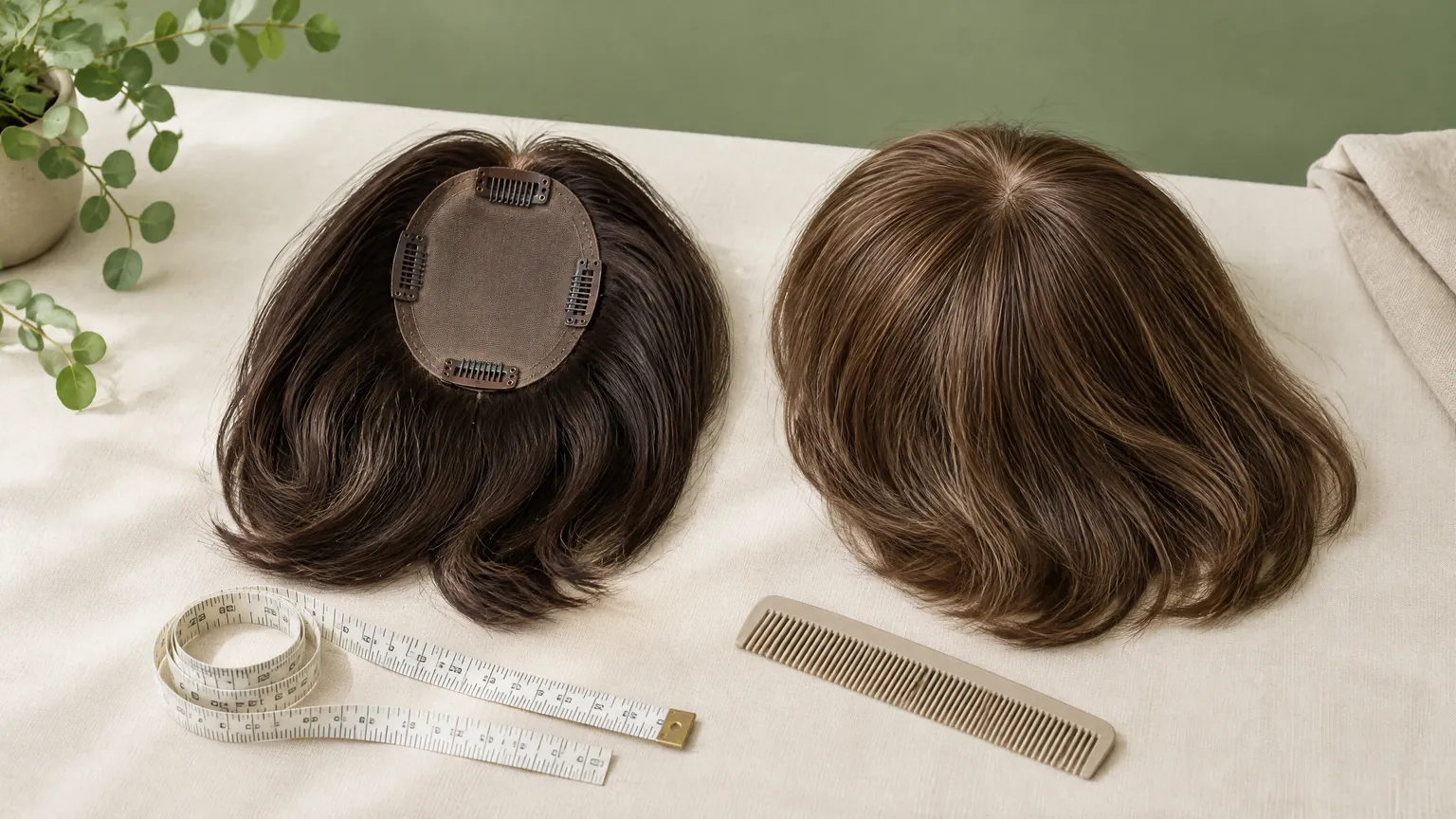
For clip-in designs, support must be considered beyond the visible thinning area. Manufacturer Jon Renau's topper guide says that measurements should begin and end where there is sufficient hair to support the piece. Its advice connects base selection with the places where clips attach, not just the patch the wearer wants to conceal. Treat its specific sizing instructions as guidance for its products, rather than a universal measurement formula. 2
When comparing hair toppers, make two separate enquiries: which base covers the intended area, and where would the proposed attachments sit? Then discuss the colour, length and fullness needed to blend with your own hair. A smaller base may appeal because it looks less extensive, but that is not a reason to accept poorly supported clips.
A topper can also create a mismatch if its upper layers are much fuller than the hair visible at the sides and ends. Examine the join in the complete hairstyle, including the back. Conversely, a restrained topper may meet your blending goal but fall short of a style with substantial height. Describe both coverage and appearance before narrowing the options.
Compare the separate decisions at a fitting
Use this table to keep an attractive silhouette from masking an unresolved fit question. It is a comparison framework, not a ranking of products.
| Decision | What a lighter-looking style may address | What still needs checking |
|---|---|---|
| Crown and fringe fullness | A closer match to a familiar, fine-haired outline | Whether you like the front, side and back views |
| Visibility at the parting | The amount of hair around the chosen part | Whether the base or attachments are visible in your normal styling |
| Topper coverage | Added hair over a selected area | Base dimensions and the hair available at attachment points |
| Full-wig fit | The appearance of the finished hairstyle | Cap size, positioning and adjustment without excessive pressure |
| Physical lightness | A preference for less apparent bulk | Actual item weight, length and base construction |
| Warm-weather wear | A less full-looking silhouette | Scalp contact, any liner and your experience during a trial |
If two samples look similar, turn attention to their interiors. Ask which parts contact your head, which adjustments are intended for routine use and how you would put the piece back in the same position. A fit that depends on somebody else making corrections every time may not match a rushed morning routine, even when the finished style looks right.
Do not use tightness as the test of security
Macmillan states that a well-fitting wig should stay in place on its own and discusses additional support options where appropriate. The important starting point is fit, not tightening every available adjustment. Its guidance also notes that a liner can sometimes make a wig move more, so an accessory added for comfort can change the fit that you assessed without it. 1
Check the complete arrangement you expect to wear. If that includes a liner, bring it into the comparison rather than introducing it after the fitting decision. Ask the supplier to explain the intended position and removal method for any proposed support. Clips, bands, tapes and adhesives are not interchangeable, and a method appearing in general advice does not mean it is suitable for your skin or offered for a particular piece.
Assess movement without ignoring pulling
A calm look in the mirror is only one part of everyday wear. With the supplier's guidance, turn your head, look down and sit back in a chair. Notice whether the front moves, an edge lifts or a particular attachment pulls. These gentle checks are not a guarantee for vigorous activity, but they can expose a positioning issue that a still photograph misses.
The American Academy of Dermatology explains that repeated pulling on hair can lead to traction alopecia, a form of hair loss. It identifies pain, stinging and crusts as warning signs in its guidance on tight hairstyles. This is not evidence that every clip-in topper is harmful; it is a reason not to treat discomfort from an attachment as proof that it is doing its job. 3
If a clip location feels painful, stop and have the arrangement reassessed rather than adding more tension. A change in base size or attachment approach may need discussion, but no alternative can be assumed suitable without assessment. Persistent irritation, pain or sudden marked hair loss should be evaluated by a qualified healthcare professional. A retail fitting is not a diagnosis.
Also examine your preparation underneath a full wig. Pulling your own hair back very tightly to reduce bulk can introduce a separate problem from the wig itself. The AAD advises keeping hair loose beneath a covering. The goal is a manageable foundation without creating pulling to achieve a perfectly flat appearance. 3
Plan for Hong Kong days, not just the fitting mirror
A routine that alternates between outdoor errands and indoor work raises different questions from wearing a piece briefly for a photograph. Describe your usual day: how long you expect to wear it, whether you need to change clothes and whether you normally sweep hair away from your face. Those details are more useful than asking for a universally comfortable density.
Macmillan's guidance considers cooling, scalp care and removal separately from appearance. It suggests taking a wig off when possible to let air reach the scalp and notes that the lining can irritate some wearers. Those points support assessing the whole wearing arrangement; they do not show that every reduced-density piece will feel cool or that a liner suits everyone. Follow the care instructions for the actual item. 1
Do not assume a style will work under every hat, with every pair of spectacles or through every clothing change. If these are part of your routine, discuss them during the fitting. A frame can occupy space near a cap edge; a garment pulled over the head can disturb a hairstyle. The useful question is how the complete combination behaves, rather than how it looks without your usual accessories.
Hypothetical example: a fine-haired office worker
Imagine an office worker whose preferred look is a modest side part with little crown height. They want additional coverage at the parting, wear spectacles and often remove a cardigan during the day. This is a hypothetical selection problem, not a customer account or a claim about a product's performance.
They might start by comparing a restrained topper with a low-volume full wig. The topper requires checks of base coverage, attachment support and blending at the sides. The full wig requires checks of cap fit and how it sits around the spectacles. If the topper's clips cannot sit comfortably on suitable hair, choosing less topper hair does not resolve the underlying support question.
The decision could go either way. A fuller sample might be visually wrong but securely fitted; a lighter-looking sample might have the preferred outline but require another size or design. Recording these outcomes separately prevents appearance from becoming a shortcut for comfort or security. The worker should not accept an unsuitable fit merely because one sample resembles their reference photograph.
Use a repeatable shortlist checklist
Take a short set of questions to each fitting so you can compare answers afterwards. Keep any photographs private unless you choose to share them, and request permission before taking pictures in a fitting space.
- Describe the desired outline at the fringe, parting, crown and sides.
- Confirm whether the piece is a full wig or a topper and which area it covers.
- Ask what the density description means for that exact design.
- Check cap positioning or topper attachment locations with the supplier.
- Try the intended liner and everyday accessories, if applicable.
- Note movement, lifting, pulling and any visible edge during gentle checks.
- Confirm care instructions and which adjustments require professional help.
Record appearance and wearing behaviour in separate notes. “Crown looks too full” is a styling observation. “Front shifts when I look down” is a fit observation. “Clip pulls near the part” is an attachment concern. Clear descriptions help the supplier address the actual issue instead of proposing a density change for every complaint.
For readers comparing wigs Hong Kong, OWNSTRAND's site provides a starting point for browsing and product enquiries. Ask which sample viewing, measurements and later fitting adjustments apply to the piece you are considering. GotGear and OWNSTRAND share ownership; this contextual link is not an independent endorsement, and a catalogue entry does not establish stock or appointment availability.
Choose a balanced result rather than the lowest density
The lowest-density option is not automatically the right one. Too little fullness for your chosen hairstyle can leave you constantly trying to create height; too much can feel visually unlike you. Either problem belongs in the appearance discussion. A shifting cap or poorly supported topper belongs in a separate fit discussion, even if both problems occur in the same sample.
A useful shortlist therefore includes a clear visual preference, an appropriate coverage area and an attachment arrangement you can understand and manage. Confirm how to position and remove the piece before treating the decision as complete. Lighter-looking hair and secure wear are compatible goals, but neither can be judged reliably from a density label alone.
Common questions
Does a low-density wig need stronger attachment?
Not simply because it has less visible hair. Assess the cap fit, intended adjustments and any support method for the actual design. If the wig moves during gentle checks, ask about positioning or sizing rather than assuming tighter attachment is the solution. Painful pressure is not a desirable sign of security.
Can I choose a smaller topper base to get a lighter look?
Base size should address coverage and suitable attachment locations, not just visual fullness. A smaller base may place clips where there is insufficient supporting hair. Discuss density and blending separately from base dimensions. If attachment pulls or feels painful, stop and have the arrangement reassessed rather than accepting it for the silhouette.
Will a lower-density style feel cooler during outdoor errands?
A density description cannot predict your comfort. Consider the actual piece's construction, scalp contact, length and any liner, then assess the complete arrangement during a trial. Ask about appropriate care and removal breaks for your routine. A less full-looking hairstyle is not a guarantee of cooler or irritation-free wear.
Sources & what they support
The scope below identifies what each reference supports. Citations do not imply independent endorsement of OWNSTRAND or any provider, and do not establish treatment benefits or guaranteed results.
- Macmillan Cancer Support: Wigs for cancer treatment (opens in a new tab)
In its cancer-treatment context, advises matching familiar hair volume or slightly less; discusses well-fitting wigs, additional support, liners that may affect movement, scalp irritation and taking a wig off when possible. Does not establish universal density or comfort outcomes.
- Jon Renau: All About That Base (opens in a new tab)
Manufacturer guidance distinguishes coverage area and base measurements and says clip attachment areas need sufficient hair to support the topper. Its product-specific sizing instructions are not presented as universal requirements.
- American Academy of Dermatology: Hairstyles that pull can lead to hair loss (opens in a new tab)
Repeated hair tension can lead to traction alopecia; pain, stinging and crusts are warning signs; hair should be pulled back loosely beneath coverings. Supports avoiding painful tension, not a claim that all toppers cause hair loss.