
Choose slatwall sign holders Hong Kong by confirming the printed format, reading distance, orientation and change routine. For brochures or leaflets, assess slatwall literature holders Hong Kong by pocket depth, document size and reach height.
Position slatwall sign holders Hong Kong without hiding products
Start by mapping each bay and confirm how frames will sit within the visual planogram without blocking SKUs. When planning slatwall sign‑holder installations in Hong Kong, position frames above or to the side of the stock face so that sightlines to product features and colourways remain clear. Specify a shallow projection where aisles are tight, and consider tilt options or anti‑glare lenses if lighting causes reflections from polished floors or glass shopfronts. Note any sprinkler lines, CCTV views and evacuation routes that limit how far frames may protrude.
Record the slat pattern and channel depth on your drawings, and confirm the panel core (MDF, composite or aluminium system) with the building or fit‑out contractor. In a written enquiry, request bracket type (integrated slat hooks versus backplate and hanger), projection, available angle adjustment and insert loading method. Ask suppliers to state material, thickness, finish and visible area, and to include a dimensioned sketch. Compare quotations using the same fields. On receipt, inspect clarity, edge finish and hook alignment, and check that the protective films are intact. Trial‑fit one unit in an out‑of‑the‑way bay to confirm it seats firmly in your slats and does not mask barcodes, RFID tags or security tethers.
Specify insert size and orientation for slatwall sign holders Hong Kong
Thoughtful insert planning determines legibility and workload. Decide the print format, expected viewing distance, and whether messages are portrait or landscape. As a common starting point, many retail teams use A4, A5 or DL inserts for back‑bar grids and seasonal messages; confirm exact sizes, bleed and margins in writing. If your store prints bilingual information, ensure the visible area does not crop Chinese characters or QR codes. Where glare is an issue, ask for matt or anti‑glare faces. Choose top‑ or side‑loading to suit your change routine and the paper grain.
In procurement documents, specify the precise aperture size, visible area, and any tolerance that could pinch laminated tickets. Request a simple template or a manufacturer drawing to validate print‑ready artwork. Confirm whether frames can rotate between orientations without new brackets. Note your change frequency (for example, daily promos versus monthly ranges) so suppliers can propose suitable loading styles. On delivery, test with sample inserts to verify smooth loading, that no sharp edge scuffs the prints, and that the pocket holds the sheet flat without bowing in humid conditions. Keep one unit aside as a reference sample for quality checks.
What should buyers compare for slatwall sign holders Hong Kong?
| Criterion | Straightforward requirement | More complex requirement | Evidence to provide |
|---|---|---|---|
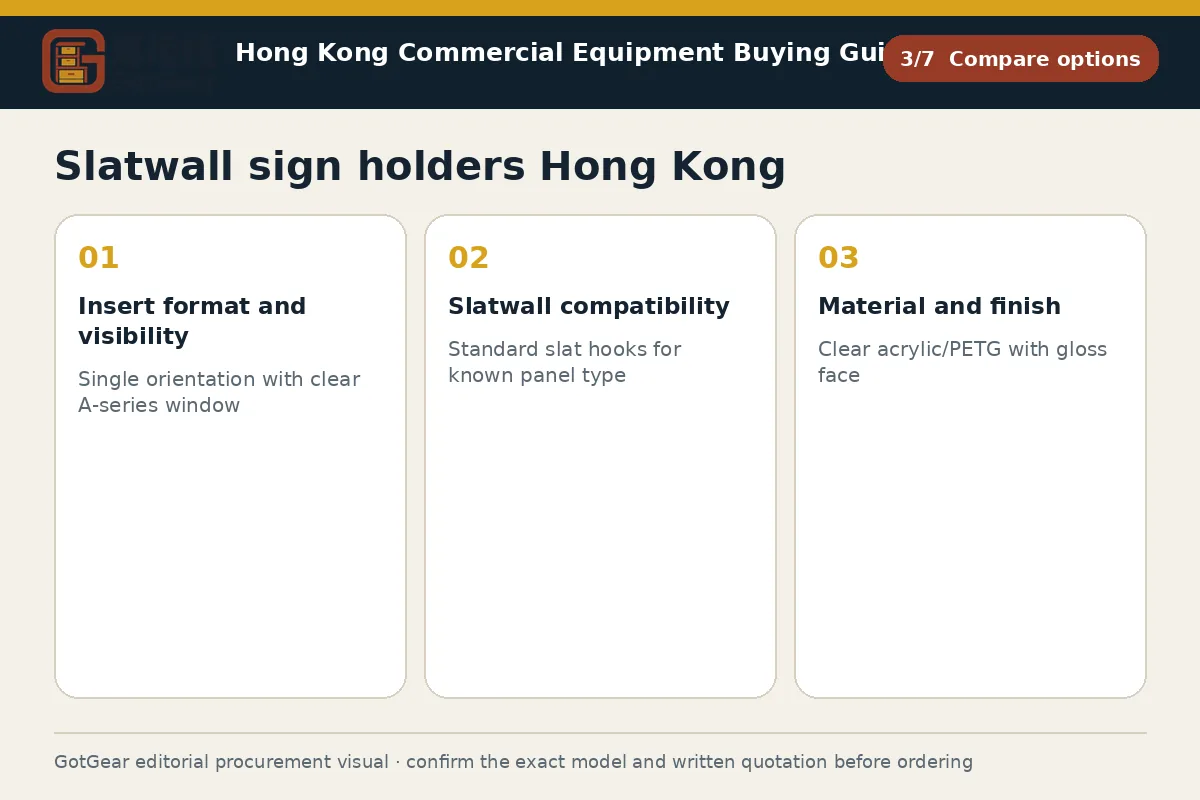
| Insert format and visibility | Single orientation with clear A‑series window | Rotatable frame with defined portrait/landscape visible areas | Provide printed format, bilingual needs, and required visible area |
| Slatwall compatibility | Standard slat hooks for known panel type | Adapter/backplate with angle/projection adjustment | Share slat pattern, channel depth and any protrusion limits |
| Material and finish | Clear acrylic/PETG with gloss face | Anti‑glare face, specific grade and thickness with cleaning note | Request material grade, thickness, finish and cleaning guidance |
| Access and change routine | Top‑ or side‑load pocket for daily swaps | Tamper‑resistant clip/magnetic front for public areas | State change frequency and any event/venue security requirement |
| Leaflet pocket capacity | Single pocket sized to one brochure | Multi‑pocket or deep pocket with weight guidance | Provide brochure flat/folded size, lamination and target refill cycle |
This framework helps buyers create comparable written enquiries. Final model specifications, availability, delivery and commercial terms must be confirmed in a formal quotation.
Use slatwall sign holders Hong Kong for offers and promotions
For clear and time‑bound promotions, prioritise frames that make message changes fast, clean and consistent. Quick‑access top‑loaders reduce handling in busy changeovers, while clip‑front or magnetic‑front styles add tamper‑resistance for public events or concourses. If you promote bundles or tiered offers, ensure the viewing window comfortably displays multi‑line text and any compliance statements. Consider the lighting direction at the bay; a slight downward tilt and a matt face can cut glare that hides small numerals. Where tickets belong at shelf level, assess a shelf‑edge sign holder as the more direct option.
In your enquiry, ask vendors to specify material grade, finish (gloss or matt), front cover type, opening force and whether spares (covers and hooks) are available. If your site has strict cleaning regimes, request the manufacturer’s cleaning guidance and compatibility with common agents. For pop‑up counters and cashwrap messaging, you may compare a freestanding acrylic sign holder for temporary work, noting that slatted fixtures remain neater for permanent bays. On receipt, check that frame faces are free from haze, the hook geometry matches your slats, and that repeated open‑close cycles do not loosen the mount when trialled in a quiet corner bay.
Plan leaflet access with slatwall literature holders Hong Kong and slatwall sign holders Hong Kong
Leaflet supply lives or dies on access. Define document size, pocket depth and the refill path before you shortlist. As an example starting point, tri‑fold and half‑page brochures are common; confirm exact flat and folded dimensions and whether lamination is used. Choose a pocket lip that holds stock in place yet allows an easy one‑hand pull, and consider finger cut‑outs for thicker booklets. In humid shops, specify materials and pocket geometry that limit curl and stick; ventilation slots can help with condensation near entrances. Plan reach heights so staff can replenish safely without ladders during trading.
When comparing slatwall literature holders Hong Kong, request internal pocket dimensions, front lip height, projection and bracket style in the quotation. Ask for guidance on maximum leaflet weight per pocket, subject to the panel and bracket used. Multi‑pocket modules suit category guides, while a single deep pocket may fit campus prospectuses. If your range moves to greeting-card display racks in Hong Kong or you run pop‑ups with gridwall sign holders in Hong Kong, check adapter options to keep a consistent ticket look. On receipt, inspect pocket seams for micro‑cracks, verify all edges are smooth, and test a full refill cycle with real brochures.
Slatwall sign holders Hong Kong decision checklist
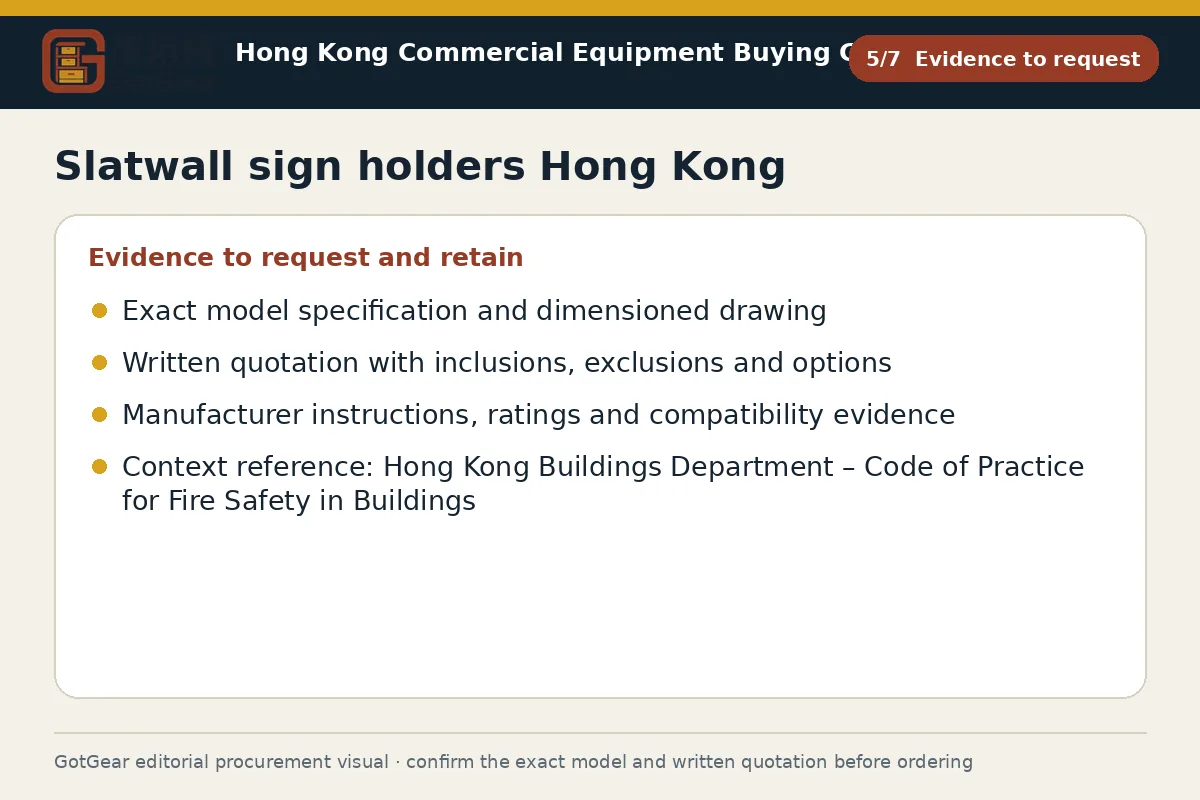
Confirm the panel: record slat pattern, channel depth and any site rules on protrusions. Define the message: printed format, reading distance, portrait or landscape, mono or bilingual. State the change routine so loading style matches your workflow. For quotations, request material grade, thickness, finish, aperture size, visible area, bracket type, projection and angle options. Note aisle width, reach height and lighting direction. Ask for drawings, samples and the maker’s cleaning guidance; where required by the venue or insurer, request a fire‑performance statement. On receipt, inspect clarity, edge finish, hook geometry and count. Test a trial fit in one bay and load real inserts and brochures to verify grip and visibility before full rollout.
- Operating use, quantity and expected frequency
- Dimensions, capacity, material and accessory requirements
- Delivery address, floor, goods lift and loading window
- Required documents, acceptance checks and after-sales arrangements
Key points for slatwall sign holders Hong Kong, slatwall literature holders Hong Kong
Hong Kong stores and showrooms often install within tight bays and narrow aisles, so specify shallow projections and confirm that holders do not intrude into escape paths. Many industrial buildings and malls require booking the loading bay and goods‑lift in advance; record lift car size and any trolley limits before delivery. Humidity can soften paper and cloud poorer plastics, so request finish details and a cleaning note from the manufacturer. Where venues or insurers require it, obtain the maker’s statement on material fire performance and fixing method acceptance. This is operational guidance, not legal advice.
Questions about slatwall sign holders Hong Kong
Which material suits humid Hong Kong shops better, acrylic or PETG?
Both are widely used; PETG tends to resist impact and stress‑cracking better, while clear cast acrylic offers high clarity. Ask the manufacturer for material grade, finish and cleaning guidance for your environment. For steamy entrances or near F&B counters, request a note on resistance to fogging and chemicals. Confirm final selection in the supplier’s written specification.
How do we keep bilingual tickets neat and readable?
Choose a visible area that accommodates both language blocks without cropping, and use matt or anti‑glare faces to protect fine characters. Side‑loading frames minimise edge wear on frequent changes. Request a drawing showing aperture and visible window, and ask for a simple artwork template so your team can confirm font sizes before ordering.
Can one frame system work across slatwall, gridwall and shelf runs?
Some frames accept adapter brackets to mount on multiple fixtures, but not all. Confirm bracket compatibility and safe projection for each surface. If you operate mixed fixtures, compare a gridwall sign holder Hong Kong or a shelf edge option for the relevant zones. Ask the supplier to state the exact bracket type and any required adapter in the quotation.
How do we reduce glare from ceiling LEDs on glossy tickets?
Specify matt or anti‑glare faces and consider a slight downward tilt to deflect reflections. Request material finish details and, if possible, a sample for an in‑store lighting check. Position frames outside direct lamp cones. If glare persists, enlarge the visible area so type can be set bigger; confirm final dimensions in the supplier’s drawing.
Continue with closely related procurement topics
These pages share equipment, operating or decision-stage signals with this guide.
Gridwall sign holder Hong Kong
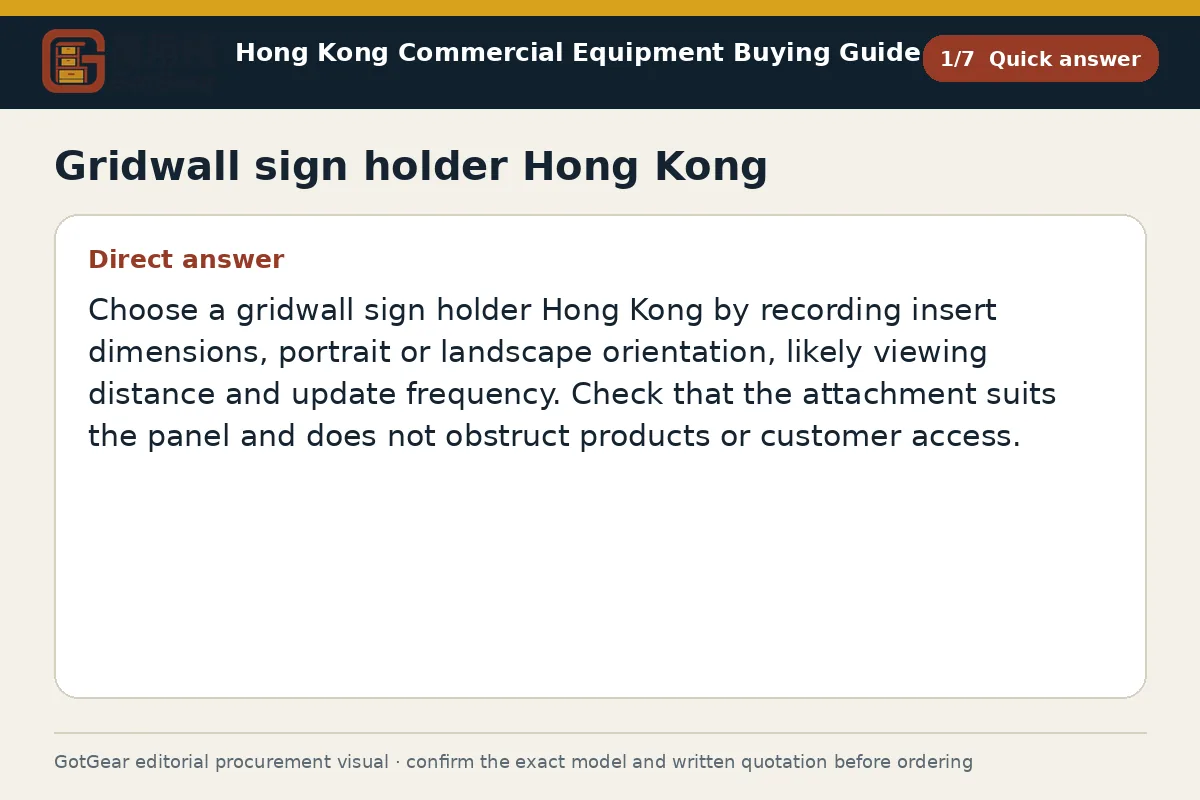
GotGear outlines practical checks for a gridwall sign holder Hong Kong, including insert size, orientation, viewing distance, mount type and update frequency to help retail teams keep signage clear and consistent.
Read the guide
Acrylic sign holder Hong Kong
Choose the right acrylic sign holder Hong Kong with GotGear by considering insert size, orientation, viewing side, and how often you will change inserts. Compare options for magnetic acrylic sign holder Hong Kong.
Read the guide
Tabletop sign holder Hong Kong
Check insert size, viewing distance and counter footprint when choosing a tabletop sign holder Hong Kong. Choose a QR code sign holder Hong Kong with the right code size, a clear scanning angle and suitable lighting from GotGear.
Read the guide
Slatwall display hooks Hong Kong
When selecting slatwall display hooks Hong Kong, check pack depth, hanging-hole format, facing count and panel fit for proper mounting. Compare slatwall display shelves Hong Kong for support and installation with GotGear.
Read the guideRelated topic indexOpen more English procurement pages2 topics
Browse additional equipment families, applications and procurement questions relevant to a wider buying brief.