
A training table with modesty panel Hong Kong should provide the intended visual screening without obstructing seated movement, wiring or room changes. Confirm the panel dimensions and attachment details for the proposed table configuration before placing an order.
Define coverage and clearance for training table with modesty panel Hong Kong
Start with seated ergonomics. Define how much of the lower body must be visually screened and how much space users need to move knees and feet. Record your typical chair model and seat height, plus any footrests. State the panel’s vertical coverage as a distance below the tabletop underside and its lateral width relative to the user’s position. As an example starting point, some buyers test a 260–320 mm drop and 75–85% width coverage per place, to be confirmed by the supplier after drawings. Ask for a dimensioned drawing showing the top and bottom panel edges referenced to the tabletop underside, not the floor.
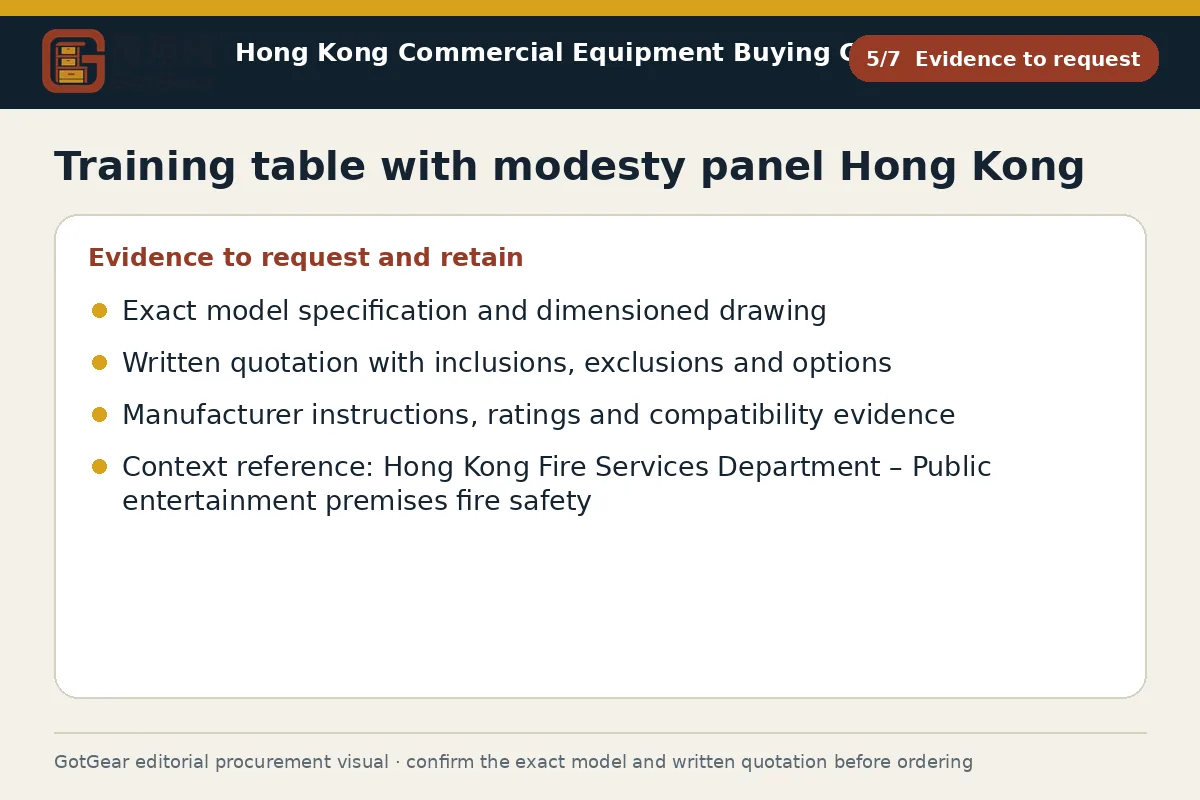
Confirm leg and toe clearance. Request the distance from the table’s front edge to the panel face, and from the panel bottom edge to the nearest obstruction (beam, stretcher, basket). As an example starting point, buyers sometimes review a 70–100 mm setback from the front edge and a 120–160 mm open zone for toes, subject to model limits. Note any under-table equipment such as power boxes that could clash. Where wheelchair access, uniform policies, or safeguarding expectations apply, have the building manager or competent adviser confirm the required coverage and that the quoted model can achieve it. The model specification and formal written quotation prevail.
Review front and side sightlines for training table with modesty panel Hong Kong
Sightlines decide whether the panel delivers modesty without creating visual barriers. Check what people in the opposing row, the aisle, and the presenter’s position can see when users lean forward, cross legs or adjust chairs. If recording or live streaming is planned, include low camera angles. In bright rooms, darker panel colours and low sheen can reduce distracting reflections. Perforated metal gives partial opacity at side angles; solid panels give stronger screening straight on but may look heavier.
Run a quick mock-up with one table, two chairs and masking board at the proposed depth to photograph front and side views. Share these photos and the seating plan with the supplier and request alternative profiles (straight, scalloped, tapered). As an example starting point, some teams align the panel’s top flush with the underside of the top and explore a variable bottom edge between 240–320 mm drop depending on row spacing, subject to confirmation. Ask for a scaled elevation showing the user outline, panel outline and sightlines from the opposite seat and nearest aisle; this drawing should be included in the quotation pack.
What should buyers compare for training table with modesty panel Hong Kong?
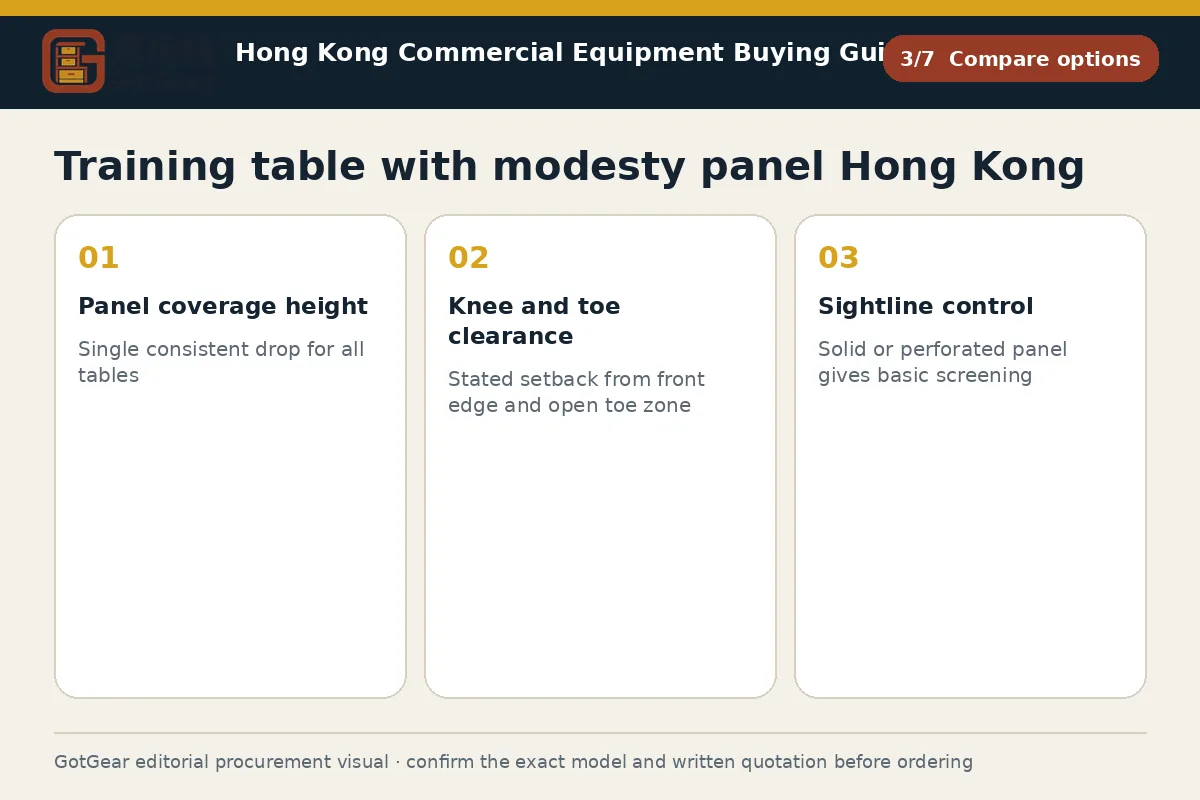
| Criterion | Straightforward requirement | More complex requirement | Evidence to provide |
|---|---|---|---|
| Panel coverage height | Single consistent drop for all tables | Variable drop by row/zone to suit sightlines | Dimensioned drawing with top/bottom offsets from tabletop underside |
| Knee and toe clearance | Stated setback from front edge and open toe zone | Clearance validated for specific chairs or assistive devices | Chair model dimensions and photos; clearance noted on drawing |
| Sightline control | Solid or perforated panel gives basic screening | Profile tuned for cameras/aisles with mock-up photos | Seating plan with front/side photos and supplier elevation |
| Mobility and folding | Panel compatible with chosen flip-top/nesting frame | Articulated or quick-release panel for ganging/servicing | Fold/nest clearance diagram and test images; nesting depth stated |
| Cable management | Simple grommet and basket with exit to floor | Integrated power with daisy-chain and umbilical routing | Cable path diagram, plug type, lead lengths and tray capacity |
This framework helps buyers create comparable written enquiries. Final model specifications, availability, delivery and commercial terms must be confirmed in a formal quotation.
Check mobility and cables on training table with modesty panel Hong Kong
Mobility, folding and wiring must work together. For flip-top or nesting frames, confirm the panel does not foul legs, stretcher bars, cable baskets or the floor when tops rotate. Ask whether the panel is fixed, hinged or split, and whether ganging brackets remain accessible. Request a short test video or photos of the exact frame with the proposed panel cycling through fold and nest. Note your route from store to room: measure doorways, corridors and the goods lift. As an example starting point, record the tightest clear opening (e.g., 800 mm) and lift cabin size (e.g., 1,300 × 1,900 × 2,100 mm), to be verified on site.
Define cable strategy early. State plug type and lead length required (for example, BS 1363 13A and 3.0 m, subject to confirmation), whether power daisy-chains between tables, and where cables exit: via grommets, rear edge, or an umbilical to a floor box. Specify basket or tray capacity and any strain relief. If metal panels contact power accessories, ask the competent electrician to sign off earthing and clearances as applicable to your venue. The model specification and written quotation prevail over examples.
Training table with modesty panel Hong Kong: Add panel dimensions to the brief
Add explicit, dimensioned panel data to your enquiry. For a training table with modesty panel Hong Kong, state the panel’s thickness, material and finish; the drop below the tabletop underside; the setback from the front edge; the lateral coverage per user and any central gap on shared tables; corner radius or chamfer; and whether perforations are required for ventilation and weight. Clarify if the panel is fixed, quick-release or articulated for flip-top frames, and whether access to cable baskets is needed during cleaning.
Request a drawing that references all measurements from the tabletop datum and shows fixings relative to frame members. Ask for a fixing schedule (type, size, quantity), maintenance and cleaning guidance, and finish samples or swatches to agree colour. Where insurers, the venue or an institution request documentation, seek written confirmation of materials, any fire-retardant claims, and maximum recommended spans for that model. On receipt, measure the first delivered set against the approved drawing and check that fasteners, edge quality and bilingual care labels match the quotation and manufacturer’s documents. The written quotation and model data prevail.
Training table with modesty panel Hong Kong decision checklist
Confirm the seated-use case with facilities and IT, then record chair model, table height, required visual coverage and minimum clearances. Measure the transport route from the loading bay to the room and note any management-office booking limits. Request dimensioned drawings showing panel offsets from the tabletop, folding/nesting clearances, and cable paths. Ask suppliers to state materials, finish, fixings, and whether panels are fixed, removable or articulated. Compare written quotations line-by-line against your measurements and photos, not just model names. Before approval, get finish swatches and, if relevant, venue or insurer documentation. On delivery, check panel drop, setback, edge quality, hardware count and that ganging, brakes and cable trays operate without fouling. Record any deviations in writing within the agreed window.
- Operating use, quantity and expected frequency
- Dimensions, capacity, material and accessory requirements
- Delivery address, floor, goods lift and loading window
- Required documents, acceptance checks and after-sales arrangements
Key points for training table with modesty panel Hong Kong
Hong Kong sites often mean tight lift cars, narrow service corridors and restricted loading windows controlled by the management office. Book vertical transport in advance and confirm whether tables must arrive unassembled to pass through an 800–850 mm door, then reassembled on floor. Humidity can be high; if you select steel panels, request a suitable powder coat and verify packaging to avoid transit rust. Many institutions need bilingual documentation, so ask for English and Chinese drawings and care guides to support internal approvals. This is operational guidance, not legal advice.
Questions about training table with modesty panel Hong Kong
Should we choose perforated or solid modesty panels?
Choose perforated for lighter appearance and some side-angle transparency; choose solid for stronger direct screening. Perforations can help airflow around under-table power. Solid panels hide more but look heavier and may concentrate scuffs. Ask the supplier for sample photos and a small finish swatch, then confirm the exact pattern, open area or smooth face in the written quotation and drawing.
Can a flip-top or nesting table use a full-depth modesty panel?
Yes, if the frame and panel are designed to articulate together without fouling the floor or stretcher bars. Some models use hinged or split panels to clear the mechanism. Request a fold-cycle drawing and photos of the specific frame with the proposed panel, and have the supplier confirm nesting depth and any limits in the formal quotation.
Can we retrofit panels to existing training tables?
Often, but only where the frame provides safe fixing points and clearances. Retrofitting may affect legroom, folding and ganging hardware. Ask for a site check or detailed photos with measurements of frame members, stretcher positions and under-table accessories. The supplier should propose brackets and issue a drawing; your building manager or competent adviser should confirm suitability before approval.
What documentation should we ask for before approval?
Request a dimensioned panel drawing, fixing schedule, materials and finish data, and any claims relevant to your venue (for example, fire-retardant laminates) in writing. If power is integrated, include a cable route diagram and plug type. Institutions may also need bilingual drawings and care guides. The model specification and the formal written quotation take precedence over examples.
Continue with closely related procurement topics
These pages share equipment, operating or decision-stage signals with this guide.
Flip top training table Hong Kong
GotGear guides buyers on comparing a flip top training table Hong Kong by folded footprint, movement routes and joining options. It also covers nesting training table Hong Kong and modular training table Hong Kong designs.
Read the guide
Mobile training desk Hong Kong
GotGear explains considerations for a mobile training desk Hong Kong, including mapping routes, floors and thresholds. It also helps assess a training table with lockable casters Hong Kong for movement, parking and storage.
Read the guide
Trapezoid training table Hong Kong
Compare trapezoid training table Hong Kong and semi circular training table Hong Kong to choose a layout for your training space. Consider cluster formation, seating edges, join details, leg positions and storage with GotGear.
Read the guide
Training chair with writing tablet Hong Kong
GotGear compares training chair with writing tablet Hong Kong, folding training chair with writing board Hong Kong and folding training chair with armrest Hong Kong, covering tablet size, access and stored footprint.
Read the guideRelated topic indexOpen more English procurement pages3 topics
Browse additional equipment families, applications and procurement questions relevant to a wider buying brief.