
For mobile training desk Hong Kong, first decide whether every caster, selected casters or a separate brake arrangement must secure the desk in use. Ask the supplier to identify the caster configuration and load assumptions, then verify the manufacturer’s instructions against the site conditions.
Map movement routes before selecting mobile training desk Hong Kong
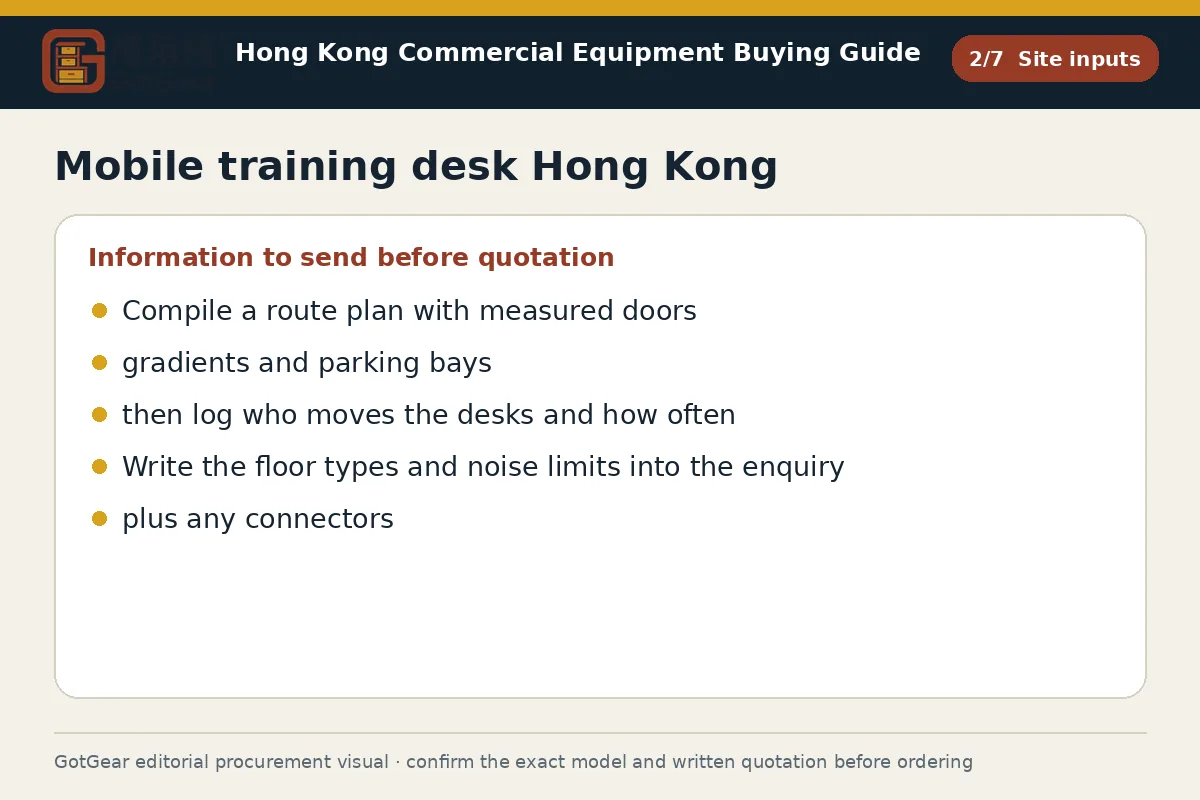
Before choosing frames, tops or brakes, plot the exact path each unit will travel. Note starting rooms, lift or stair interfaces, and final parking bays. Record door clear openings, corridor widths, low ceilings, and turning radii at corners. For a mobile training desk scenario in Hong Kong, sketch the route on a plan and label all pinch points. Add who moves the desks (teaching staff, AV team, porters) and at what frequency, since operator strength and time pressure shape brake and wheel choices.
Measure and write down hard dimensions as an example starting point only: door clear width, corridor width and lift car depth and height must be confirmed by the building manager. Photograph thresholds and floor transitions. Mark the steepest gradient and any ramps used. Identify holding areas near lifts for queuing trolleys and desks without blocking fire escape routes. Log any building-management booking rules for goods lifts and loading windows so delivery and training do not collide with peak tenant hours. This movement map becomes part of your enquiry pack and allows suppliers to confirm suitability, alternatives or on-site demonstration needs in writing.
Check floors, thresholds and parking points for mobile training desk Hong Kong
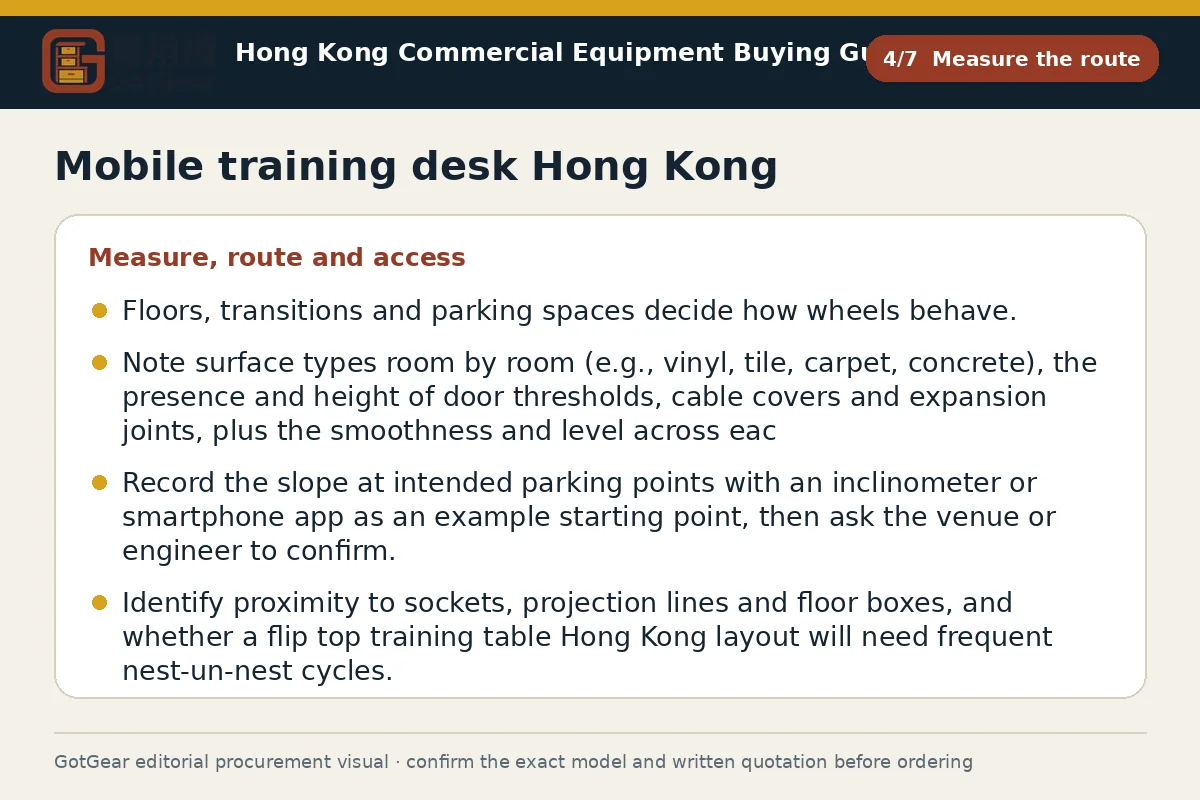
Floors, transitions and parking spaces decide how wheels behave. Note surface types room by room (e.g., vinyl, tile, carpet, concrete), the presence and height of door thresholds, cable covers and expansion joints, plus the smoothness and level across each area. Record the slope at intended parking points with an inclinometer or smartphone app as an example starting point, then ask the venue or engineer to confirm. Identify proximity to sockets, projection lines and floor boxes, and whether a flip top training table Hong Kong layout will need frequent nest-un-nest cycles.
Write into the brief any limits on noise (libraries, exam halls), scuffing sensitivity (polished stone), and humidity that might increase corrosion risk on metal parts. If desks will park in rows, specify bay length, nesting depth available and aisle clearance for safe egress. Where thresholds exceed an example starting point of a few millimetres, state that ramps or protectors are required and who provides them. Parking markers, bump stops or connectors reduce drift; if you intend to use training table connectors Hong Kong or ganging clips, include the make, quantity and the expected linking pattern so suppliers can advise on stability and brake configuration.
What should buyers compare for mobile training desk Hong Kong?
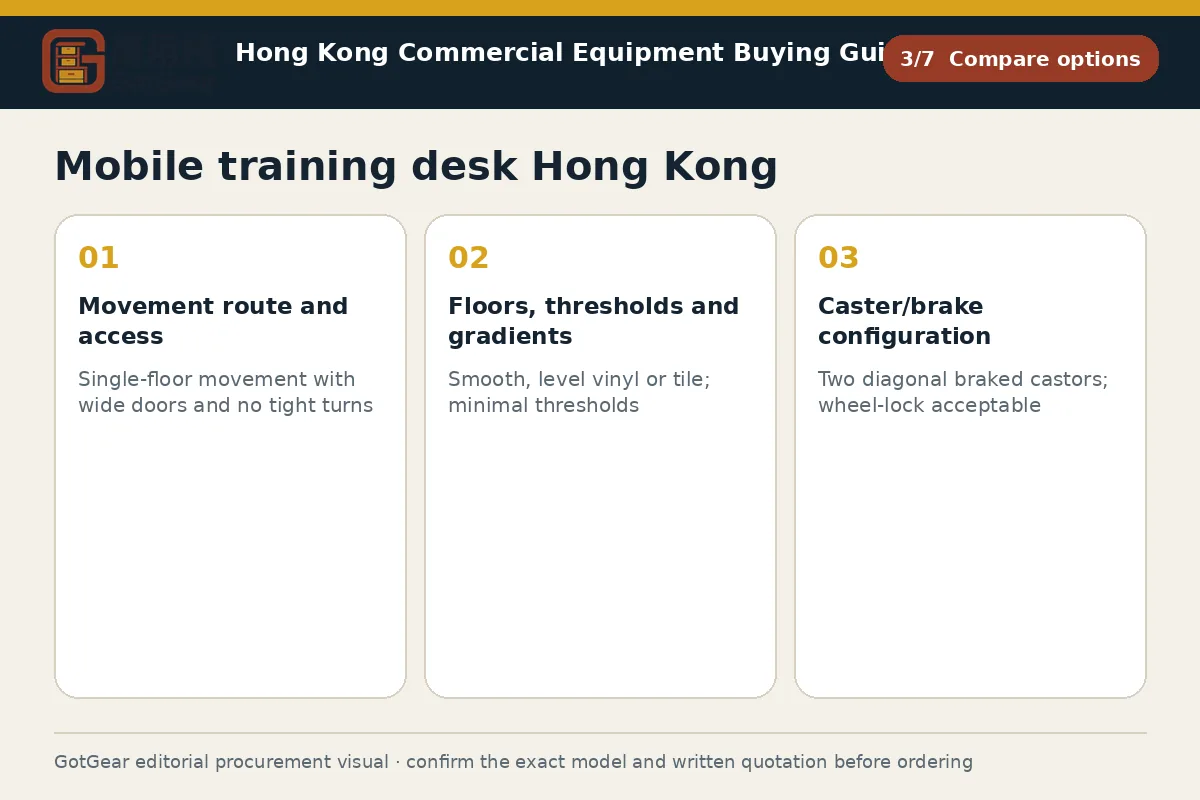
| Criterion | Straightforward requirement | More complex requirement | Evidence to provide |
|---|---|---|---|
| Movement route and access | Single-floor movement with wide doors and no tight turns | Mixed floors via goods lift with tight corners and queueing areas | Scaled plan with measured clear widths, lift car size and turning radii; route photos |
| Floors, thresholds and gradients | Smooth, level vinyl or tile; minimal thresholds | Carpet over underlay, raised thresholds, ramps or slopes at parking | Floor types, threshold heights (mm), measured gradient (%), noise/scuff limits |
| Caster/brake configuration | Two diagonal braked castors; wheel-lock acceptable | Four total-lock castors or centralised brake bar for sloped/public areas | Manufacturer drawing showing caster positions, brake type (wheel-only/total) and count |
| Stability and loading assumptions | Light laptop use; no leaning; standard tops | Heavy leaning, screens, modesty panels; clustering and frequent repositioning | Top dimensions, frame footprint, add-ons; any maker stability note or test summary |
| Storage, nesting and egress | Straight parking bay with ample aisle | Tight store, mixed sizes, egress kept clear during events | Nesting depth per unit, bay length, aisle clearance, parking layout sketch |
This framework helps buyers create comparable written enquiries. Final model specifications, availability, delivery and commercial terms must be confirmed in a formal quotation.
Mobile training desk Hong Kong: Decide when lockable casters are needed
Not every application demands full braking. A brief for a training table with lockable casters in Hong Kong is typically justified where floors are sloped, where users lean heavily on tops, where microphone or monitor arms add leverage, or where public events require extra resistance to accidental movement. In calm, flat classrooms, two braked castors may be enough; in multi-purpose halls or concourses, four total-lock brakes or a centralised foot-bar brake may be preferable.
Decide if the brakes must arrest both the wheel and the swivel (often called “total lock”), or only the wheel. State whether every wheel must lock, or selected wheels (e.g., two diagonal) are acceptable, and if a linking bar is required to lock both sides with one action. If modesty panels are specified, note that a training table with modesty panel Hong Kong may change centre-of-gravity and airflow (“sail” effect) during movement; ask the supplier to comment on this in writing.
Document the use profile: exam mode, breakout clusters, or touch-down benches within broader training room furniture Hong Kong. Say who will operate the brakes, how many times per day, and any accessibility needs. Request the supplier’s recommended brake choice for your site, and ask them to state the assumptions behind that recommendation so you can compare alternatives on equal terms.
Request caster and stability details for mobile training desk Hong Kong
Ask for precise wheel and stability information to avoid surprises. Request wheel diameter, tread compound (e.g., polyurethane, TPR), hub bearing type, swivel offset, and whether brakes are wheel-only or total lock. Specify the number and position of braked castors per table and whether a central brake bar is offered. Seek the frame footprint, leg geometry, and top sizes supported, plus stated static and rolling load capacities as example starting points for discussion, to be confirmed in the manufacturer’s instructions.
If considering flip-tops, request nested depth, interlock features and any anti-travel device. Ask how added accessories (power boxes, screens, modesty panels) affect tip resistance. For stability, request any internal test notes the manufacturer is willing to share, even if not to a formal standard, and a drawing showing caster layout under the top. If corrosion is a risk, ask about plated or stainless fasteners and maintenance guidance for humid sites.
When comparing quotations, line-item the brake configuration, wheel material, wheel size, frame finish, top dimensions, nesting depth and included accessories. Require model numbers, drawings, lead-time statements and any installation or user-training scope. For receipt checks, specify: all brakes engage and release cleanly; wheels swivel freely without flat spots; fixings are torqued per the maker’s instructions; units roll the intended route and settle without drift. Model specifications and the supplier’s formal written quotation prevail.
Mobile training desk Hong Kong decision checklist
Compile a route plan with measured doors, corridors, thresholds, gradients and parking bays, then log who moves the desks and how often. Write the floor types and noise limits into the enquiry, plus any connectors, modesty panels or flip-top needs. State the required brake approach: two braked, all braked or central brake bar, and whether total lock is needed. Request wheel diameter, tread type, frame footprint, nesting depth, load assumptions and drawings that show caster positions. Ask the supplier to confirm suitability in writing against your site conditions. Compare quotations line by line on the same fields and confirm delivery access and training. On receipt, test brakes and rolling behaviour on the actual route. The model specification and formal written quotation prevail.
- Operating use, quantity and expected frequency
- Dimensions, capacity, material and accessory requirements
- Delivery address, floor, goods lift and loading window
- Required documents, acceptance checks and after-sales arrangements
Key points for mobile training desk Hong Kong, training table with lockable casters Hong Kong
Hong Kong layouts often involve tight corridors, small goods lifts and managed loading bays. Before committing, confirm lift car size, door swing clearances and booking windows with the building management office, as delivery and commissioning time slots can be short. Humid conditions and coastal air can accelerate corrosion on brake hardware; consider plated or stainless fasteners and routine cleaning guidance from the maker. Public-event set-ups in malls or concourses may impose extra movement controls; always check venue and insurer requirements for your case. Request bilingual operation and care information so site teams and users can apply the instructions consistently.
Questions about mobile training desk Hong Kong
Do we need brakes on all castors or only some of them?
Choose brakes to match slope, usage and who will operate them. Two diagonal braked castors can be suitable on flat floors with light loads. All-braked or central-bar systems are safer where slopes, heavy leaning or public traffic are expected. Ask the supplier to state whether the brakes are wheel-only or total lock, and confirm against your site’s gradients and floor type.
Which wheel material is best for our floors?
Polyurethane or TPR treads usually roll quietly on tile and vinyl and are kinder to polished stone. Nylon can track well on some carpets but may be noisier on hard floors. Specify your exact surfaces and thresholds, and request the supplier’s written recommendation and a sample or demo if risk is high. Maker instructions and the quotation details prevail.
How should we compare quotations fairly?
Ask each bidder to state model numbers and provide drawings showing caster layout and brake type. Compare wheel diameter, tread, number and position of brakes, frame footprint, top size, nesting depth, finish and included accessories. Note any assumptions about floor, slope and operator. Ensure delivery access, assembly and training scope are noted, and let the formal written quotation govern.
Will flip-tops, connectors or modesty panels affect stability or braking?
Yes. Flip mechanisms change nesting depth and weight distribution; ganging connectors can reduce table creep; modesty panels add surface area and may catch airflow or user legs. Include these items in the brief and ask for a stability comment and brake recommendation. If available, request the maker’s test notes and confirm suitability for your specific site conditions.
Continue with closely related procurement topics
These pages share equipment, operating or decision-stage signals with this guide.
Training table with modesty panel Hong Kong
GotGear’s checklist for a training table with modesty panel Hong Kong covers panel coverage, knee clearance, cable routing, folding, nesting mobility and sightlines.
Read the guide
Flip top training table Hong Kong
GotGear guides buyers on comparing a flip top training table Hong Kong by folded footprint, movement routes and joining options. It also covers nesting training table Hong Kong and modular training table Hong Kong designs.
Read the guide
Training room furniture Hong Kong
Training room furniture Hong Kong helps you plan layouts for capacity, sightlines and writing space. Assess a training room table and chair set Hong Kong for circulation, reset labour and comfort with GotGear.
Read the guide
Trapezoid training table Hong Kong
Compare trapezoid training table Hong Kong and semi circular training table Hong Kong to choose a layout for your training space. Consider cluster formation, seating edges, join details, leg positions and storage with GotGear.
Read the guideRelated topic indexOpen more English procurement pages2 topics
Browse additional equipment families, applications and procurement questions relevant to a wider buying brief.