
For battery recycling bins Hong Kong, keep the stream separate and confirm what the responsible collection operator will accept. Follow manufacturer instructions and verify storage, handling, labelling, site conditions and applicable Hong Kong requirements; do not place damaged or unidentified items into a point unless the approved process permits it.
Confirm accepted types before planning battery recycling bins Hong Kong
Before selecting battery recycling bins Hong Kong, confirm precisely which chemistries and formats your receiving operator accepts. Ask for a current written acceptance list and provide photos of typical items on your site: tool-pack batteries, button cells, laptop and phone lithium-ion, NiMH/NiCd rechargeables, alkaline disposables, and any sealed lead-acid units. Clarify size limits, whether loose cells are allowed, and what to do with taped terminals. Agree what is excluded—damaged, swollen, leaking or unidentified batteries—plus the escalation route if they appear at the point.
Translate acceptance into a practical handling boundary. In your enquiry, specify tentative throughput by location type (office floors, retail back-of-house, workshops), target collection frequency, and interim storage conditions. Request product data for bin construction (for example, metal body or anti-spark liner), lid design, aperture dimensions, and any fire-mitigation features if offered by the manufacturer. Measure the proposed placement and route: doorway clear width, lift car size, turning radii and gradients. As an example starting point only, note the narrowest internal doorway and lift opening and compare with the bin’s stated external width and height; confirm turning space with the building manager. Ensure the model specification and the operator’s written acceptance prevail over assumptions before you order.
Write clear user instructions for battery recycling bins Hong Kong
Write user instructions that are short, bilingual and site-specific. Use clear steps: what may go in, what must not, and what to do if unsure. Where your operator requires it, state “tape terminals” and show the method with icons; if taping is not required, say so explicitly to avoid mixed practice. Include a maximum item size and a contact person for exceptions, such as swollen power banks. Position instructions at eye level and repeat on the lid. Align language style with your building’s waste policy and match wording to your waste stream labels Hong Kong so the stream is unambiguous.
For procurement, request durable labels with water-resistant laminate, UV-stable inks and strong adhesive suitable for humid plant rooms and semi-covered loading areas. Ask for Traditional Chinese and English wording in the same font size, plus pictograms for common chemistries. Specify fields to be pre-printed or left blank: location code, responsible department, emergency contact, and operator name. On receipt, inspect adhesion at the label edges, legibility under corridor lighting, and scratch resistance with a dry cloth test. Keep a nearby, weatherproof A4 holder for the SOP and the operator’s current acceptance sheet, and add a QR code to your site policy where permitted by building management.
What should buyers compare for battery recycling bins Hong Kong?
| Criterion | Straightforward requirement | More complex requirement | Evidence to provide |
|---|---|---|---|
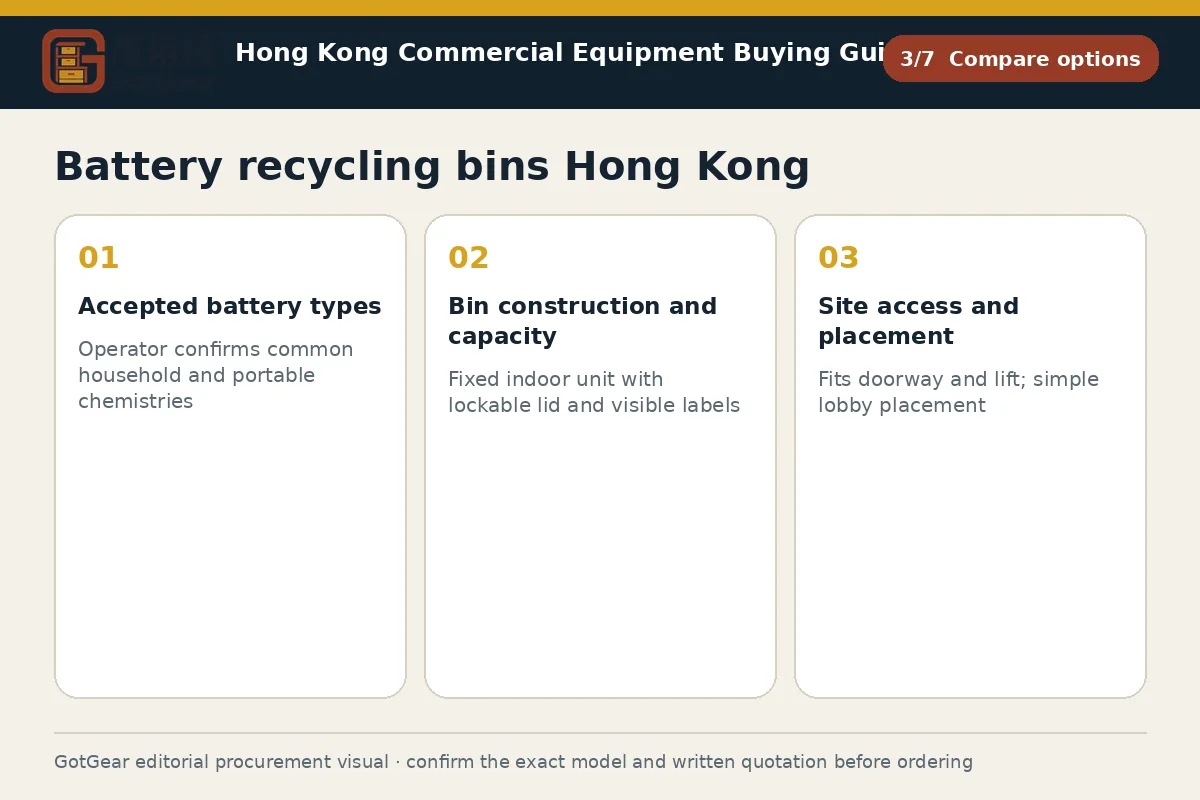
| Accepted battery types | Operator confirms common household and portable chemistries | Operator confirms multiple chemistries with size limits and taping rules | Provide photos of typical items and request a signed acceptance list |
| Bin construction and capacity | Fixed indoor unit with lockable lid and visible labels | Metal-bodied unit or inner caddy with stated fire-performance claims | Submit spec sheet: dimensions, usable volume, lid type, material and finish |
| Site access and placement | Fits doorway and lift; simple lobby placement | Route involves turns, ramps or shared lobbies with booking controls | Provide measurements, lift size, turning radii and loading-bay rules |
| Labelling and instructions | Bilingual basic label with allowed/not allowed | Durable pictograms, QR-linked SOP and location/responsible fields | Request label material, ink durability and sample artwork for approval |
| Collection service and documentation | Scheduled pick-up with receipt on collection | Exchange-container service and post-collection summary | Ask for written quotation, acceptance confirmation and evidence format |
This framework helps buyers create comparable written enquiries. Final model specifications, availability, delivery and commercial terms must be confirmed in a formal quotation.
Assign handling responsibility for battery recycling bins Hong Kong
Assign clear responsibility for daily checks, container security and escalation. Name a primary handler (facilities, concierge or lab tech), a deputy for leave cover, and a manager to approve exceptions. Define visible checks: container integrity, lid closure, correct labels present, no liquids or swollen items in sight, and safe clearance from heat sources. Set a realistic inspection cadence agreed with your insurer or competent adviser—an example starting point might be once per working day for public-facing lobbies—documented in a simple log. Provide task-specific training and PPE only where your risk assessment and the proposed model indicate it is necessary.
When buying, state whether you need lockable lids, a tamper-evident slot, and compatibility with any recycling bin enclosures Hong Kong already on site. Ask the manufacturer for written handling instructions, maximum recommended gross weight when full, wheel size and bearing type if mobile, and surface finish suitable for indoor/outdoor covered areas. Confirm the unit fits lifts and corridors along the removal route. If an inner caddy or transfer tub is used, request material specification and any fire-performance claims in writing, then verify with your insurer or safety adviser as applicable. Ensure the operator agrees, in writing, to collect from your nominated handover point within the building.
Review collection arrangements for battery recycling bins Hong Kong
Review the collection model before launch. Ask whether your operator provides exchange containers, decants into their own UN-style tubs, or requires you to bag and seal cells; confirm who supplies consumables. Get the minimum pick-up quantity, booking notice, weekday time windows, and procedures during adverse weather. In industrial buildings, check vehicle height limits, lift lobbies shared with tenants, and whether management office approval is needed for trolleying through common areas. Agree the response for exceptions such as swollen items and after-hours finds, including a phone contact.
Compare written quotations on identical ground: accepted chemistries, exclusions, provision of labels and containers, pre-collection checks, handover point, and evidence provided after collection (for example, a receipt or summary). Ask for an acceptance confirmation on company letterhead and insurance particulars relevant to their service, where available. If you co-locate fluorescent lamp recycling bins Hong Kong or operate a central recycling station Hong Kong, coordinate booking slots and staging space so special streams remain segregated. Before first lift booking, walk the route with the operator, validate lift and doorway measurements, and record any site-specific controls agreed with building management.
Battery recycling bins Hong Kong decision checklist
Confirm the operator’s written acceptance list and define your handling boundary in plain language. Measure the bin’s placement and removal route, then request specification sheets covering dimensions, construction, lid type and any fire-mitigation features. Draft bilingual instructions that match your waste policy, including what to do with damaged items. Assign named handlers, inspection cadence and escalation, recording these in a simple log. Align the container with existing enclosures and labels, and verify goods-lift and doorway fit. Obtain a written quotation that states accepted chemistries, exclusions, booking windows, handover point and post-collection evidence. Complete a route walk-through with the operator before the first collection.
- Operating use, quantity and expected frequency
- Dimensions, capacity, material and accessory requirements
- Delivery address, floor, goods lift and loading window
- Required documents, acceptance checks and after-sales arrangements
Key points for battery recycling bins Hong Kong
Battery collection points in Hong Kong often sit within tight lift cars, narrow service corridors and managed loading bays that require advance booking. Many buildings ask for bilingual signage and coordination with the management office for deliveries and special-waste movements. Humid conditions can affect label adhesion and corrode mild-steel finishes, so request suitable materials. During heavy rain or typhoon signals, service windows may change; agree contingency handovers. This summary highlights typical operating constraints only and is not legal or compliance advice for any particular site.
Questions about battery recycling bins Hong Kong
Which battery types can we place in our point?
Only the types your designated operator confirms in writing. Typical site mixes include alkaline, NiMH/NiCd, lithium-ion and button cells, but acceptance varies by service and condition. Send photos of items you generate and ask for any size, taping or packaging requirements. Keep the current acceptance sheet with the bin and update instructions when the operator’s scope changes.
Do we need a metal or fire-resistant bin for our site?
Choose construction based on your risk assessment, the bin’s location and the manufacturer’s guidance. Some models offer metal bodies or liners, which you should evaluate with your insurer or competent adviser. Request any fire-performance claims in writing and confirm siting clearances, ventilation and housekeeping with the building manager. The model specification and written quotation prevail.
How big should the container be, and how many do we need?
Size to your actual generation and collection frequency. As an example starting point, trial one small container near reception and one in back-of-house, then adjust based on fill rates and operator booking windows. Confirm lift and corridor fit before ordering multiples. Ask suppliers for external dimensions, usable volume and maximum recommended gross weight when full.
What should we do with damaged, swollen or unidentified batteries?
Do not place them in the public collection point unless your approved process explicitly allows it. Follow your operator’s documented exception pathway and your internal risk assessment for isolation, temporary containment and handover. Keep an emergency contact and escalation route with the bin. Request written guidance from the operator and the manufacturer before you open the point.
Continue with closely related procurement topics
These pages share equipment, operating or decision-stage signals with this guide.
Fluorescent lamp recycling bins Hong Kong
GotGear provides a checklist for fluorescent lamp recycling bins Hong Kong to confirm accepted lamp types, collection routes, site access controls, responsible handlers and steps to reduce breakage.
Read the guide
Recycling station Hong Kong
GotGear explains a recycling station Hong Kong, outlining accepted streams, signage, staff checks, volumes and transfer routes. We connect front of house recycling bins Hong Kong with back of house recycling bins Hong Kong.
Read the guide
Waste stream labels Hong Kong
When specifying waste stream labels Hong Kong, confirm accepted materials, wording, colours, visibility and bin location. Pair recycling bin stickers Hong Kong with larger recycling bin signage Hong Kong for guidance from GotGear.
Read the guide
Paper recycling bins Hong Kong
GotGear explains the differences between paper recycling bins Hong Kong, plastic recycling bins Hong Kong and glass recycling bins Hong Kong in contamination risk, filled weight, handling route and written collection rules.
Read the guideRelated topic indexOpen more English procurement pages1 topics
Browse additional equipment families, applications and procurement questions relevant to a wider buying brief.