
For waste stream labels Hong Kong, confirm accepted streams and wording with the responsible operator before artwork is approved. Labels and signs support communication but do not by themselves establish compliance; verify site requirements and applicable Hong Kong requirements separately.
Define accepted materials before writing waste stream labels Hong Kong
Start by getting the collecting contractor or site management to state, in writing, the exact materials accepted at each shared point. Ask for preferred stream names, bilingual wording, example items and any common contaminants to keep out. This avoids guessing and ensures waste stream labels Hong Kong match the operator’s routes, not a generic list. Where multiple buildings or venues share a recycling station Hong Kong, confirm any site-to-site differences before drafting artwork.
On site, record what users will see at the last metre: bin models, lid colours, panel sizes, approach direction and lighting. Measure the largest flat area available for labels, the lid aperture types and any curved radii that may affect adhesion. Note humidity, regular cleaning chemicals and vandalism risk. In your enquiry, specify substrate, adhesive type, finish, colour references and bilingual copy. Request operator-approved terminology and pictograms, plus a scale artwork proof. As an example starting point to be confirmed in your brief, plan main stream names with a minimum x-height sized for legibility from typical approach distances, and use high-contrast colour pairs agreed with the operator. The written quotation and approved artwork should prevail if there is any conflict.
Position recycling bin signage Hong Kong above waste stream labels Hong Kong where needed
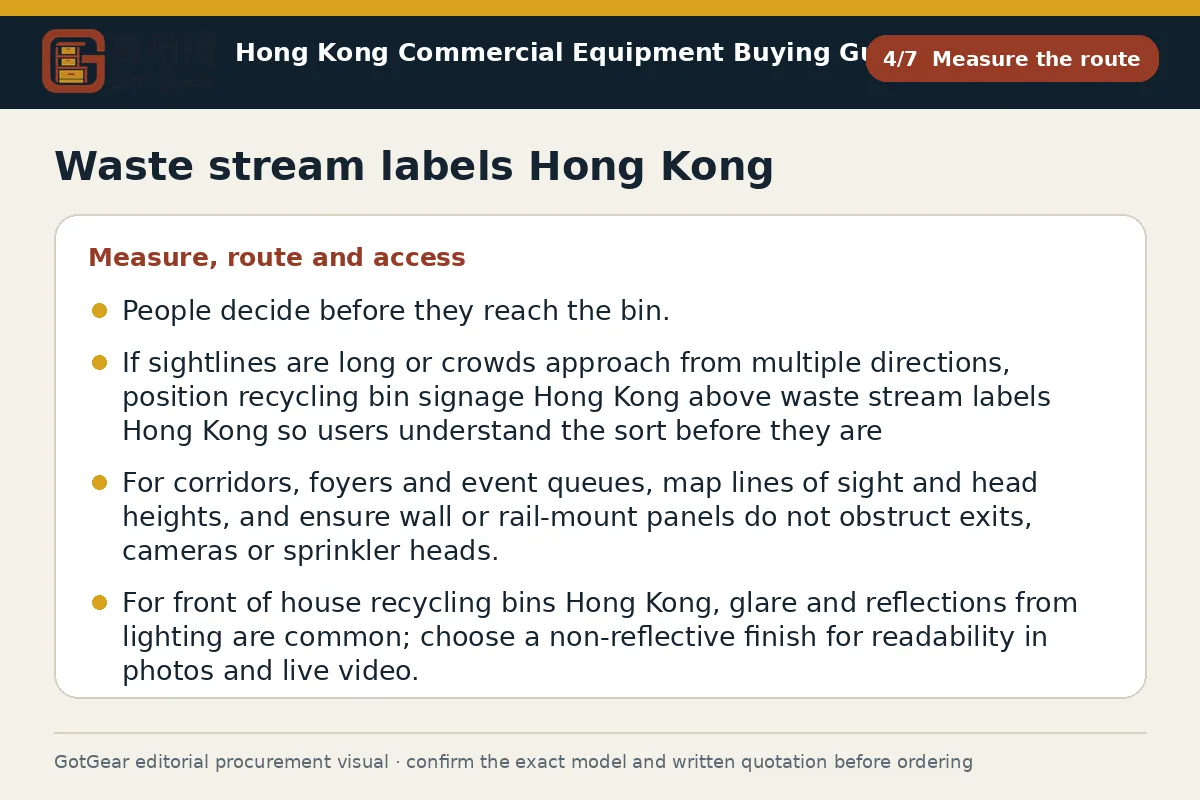
People decide before they reach the bin. If sightlines are long or crowds approach from multiple directions, position recycling bin signage Hong Kong above waste stream labels Hong Kong so users understand the sort before they are over the lids. For corridors, foyers and event queues, map lines of sight and head heights, and ensure wall or rail-mount panels do not obstruct exits, cameras or sprinkler heads. For front of house recycling bins Hong Kong, glare and reflections from lighting are common; choose a non-reflective finish for readability in photos and live video.
Measure wall widths, ceiling clearances and any soffits. Check what fixings are permitted by the landlord, school or venue, including drilling or adhesive-only rules on tiles, glass or metal cladding. In your request for quotation, state sign size, substrate (As a starting point, only: composite panel with a matte laminate), mounting method, fastener schedule, and whether anti-graffiti or cleanable laminates are required. For industrial buildings, confirm access via goods lifts and narrow stair cores; provide panel dimensions to ensure delivery and installation are physically possible. Ask for a scale layout showing bin spacing, sightlines and mounting heights for approval before production.
What should buyers compare for waste stream labels Hong Kong?
| Criterion | Straightforward requirement | More complex requirement | Evidence to provide |
|---|---|---|---|
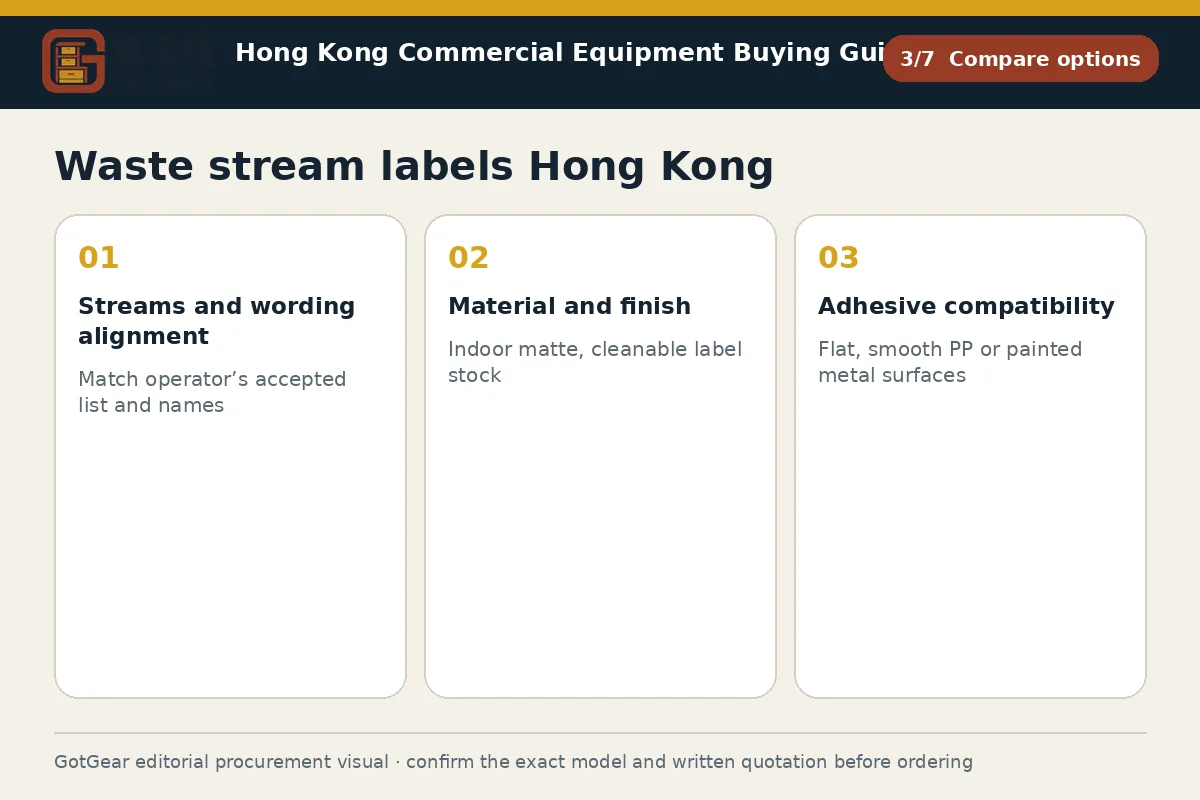
| Streams and wording alignment | Match operator’s accepted list and names | Include examples and common contaminants per location | Provide operator email confirmation and bilingual copy |
| Material and finish | Indoor matte, cleanable label stock | UV-stable film with anti-graffiti laminate for harsher areas | Attach datasheets and finish samples |
| Adhesive compatibility | Flat, smooth PP or painted metal surfaces | Curved or textured bins; high-tack or specialty adhesive | State bin make/material and adhesion test notes |
| Size and visibility | Bin-level labels sized to available flat areas | Above-bin signs sized for sightlines and mounting heights | Submit measured panels and mock-up photos |
| Bilingual and icons | Chinese and English with approved terms | Colour-blind-friendly icons and consistent colour rules | Share style guide and operator-approved artwork |
This framework helps buyers create comparable written enquiries. Final model specifications, availability, delivery and commercial terms must be confirmed in a formal quotation.
Use recycling bin stickers Hong Kong consistently with waste stream labels Hong Kong
At bin level, use recycling bin stickers Hong Kong consistently with stream names, colours and icons used on larger signs. Keep identical wording across lids, bodies and nearby direction arrows so staff and visitors can confirm the sort at a glance. If you operate paper recycling bins Hong Kong or battery recycling bins Hong Kong, the same rules apply: match the contractor’s acceptance, list relevant examples and place the label where the hand naturally moves to deposit.
Measure each bin’s flat zones, lid surface angle and smallest radius so suppliers can propose suitable die-cuts. Identify the substrate (powder-coated steel, HDPE or PP) and request a compatible adhesive; include a wipe-resistance requirement if strong degreasers are used by cleaning teams. Ask for edge-sealed, matte-laminated labels to resist humidity and avoid glare near windows. Provide a complete count by location and language split. Where possible, request an on-site adhesion test and a small pre-production sample. As an example starting point only, specify duplicate labels on both sides of freestanding bins to aid approach from either direction. Confirm delivery windows with the management office and check that packs fit through doorways and goods-lift cars. Inspect on receipt for colour accuracy, cut quality and correct quantities.
Test recognition and readability of waste stream labels Hong Kong
Before ordering volume, test recognition and readability of waste stream labels Hong Kong in real conditions. Print full-size mock-ups and tape them to the bins at the intended heights. Walk typical approach routes in daylight, under fluorescents and in car park lighting. Invite a small cross-section of users to sort mock items and note hesitations or mis-sorts. As an example starting point only, set a legibility goal at common approach distances and ensure Chinese and English are equally clear.
Capture photos of passers-by angles, note any obstructions and record the time of day when glare occurs. Use this evidence to adjust colour contrast, icon size, line spacing or panel positions. Ask your supplier to include one round of artwork amendments in the quotation and to issue a final, scaled proof for sign-off by the responsible operator and building manager. For multi-venue rollouts, establish a concise style guide covering names, colours and placement so future sets remain consistent without re-testing each time. Keep the mock-ups until the first production set arrives to compare output against the approved layout.
Waste stream labels Hong Kong decision checklist
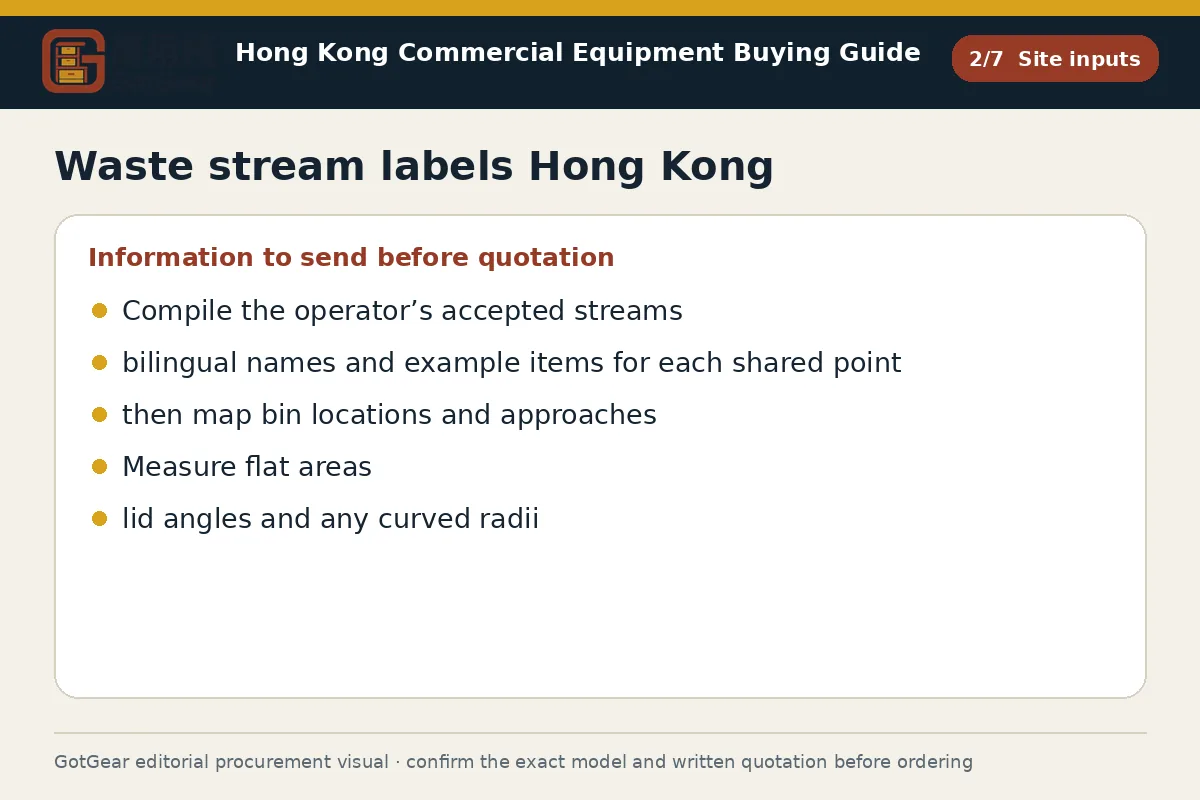
Compile the operator’s accepted streams, bilingual names and example items for each shared point, then map bin locations and approaches. Measure flat areas, lid angles and any curved radii; photograph each point. Confirm wall-mount permissions, drilling limits and access via goods lifts. Issue a written enquiry stating label and sign sizes, substrate, adhesive type, finish, colour references, bilingual copy and icon set, plus sample and proof requirements. Request sightline layouts for above-bin signs. Compare quotations on identical specifications and amendment rounds. Schedule delivery within building loading windows. On receipt, check colour accuracy, cuts, lamination, quantities and language splits. File supplier datasheets for materials, inks and adhesives, and keep operator approvals with the final artwork for audit or training.
- Operating use, quantity and expected frequency
- Dimensions, capacity, material and accessory requirements
- Delivery address, floor, goods lift and loading window
- Required documents, acceptance checks and after-sales arrangements
Key points for waste stream labels Hong Kong, recycling bin stickers Hong Kong, recycling bin signage Hong Kong
Hong Kong shared recycling points often sit in tight corridors, car parks or podium levels, with restricted drilling and short loading windows. Plan bilingual Chinese and English copy, and clear examples, because patrons and contractors vary by shift and language. Goods-lift and doorway dimensions can limit panel and frame sizes; confirm access before ordering. Humidity and frequent wet cleaning favour matte laminates and compatible adhesives. For public-facing venues and schools, obtain management-office approval on mounting methods and placement, and check if temporary signs are required during events or refurbishments. Treat any regulatory or programme rules as site-specific and verify them with the responsible operator before finalising artwork.
Questions about waste stream labels Hong Kong
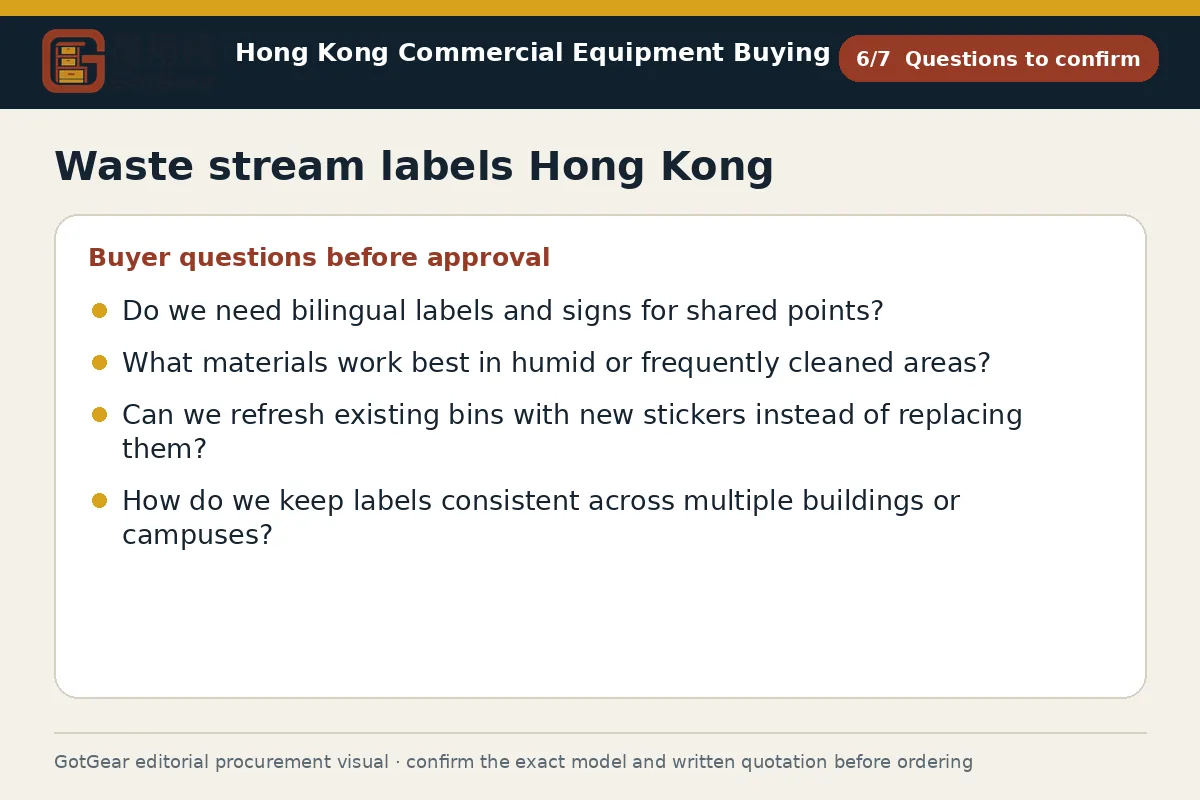
Do we need bilingual labels and signs for shared points?
Yes, bilingual Chinese and English messaging reduces errors across shifts, contractors and visitors. Include consistent stream names and example items in both languages, with equal prominence. Some sites may prefer additional languages or larger Chinese text; confirm preferences with the responsible operator, building manager or institutional approver before artwork is finalised.
What materials work best in humid or frequently cleaned areas?
Use durable films with compatible high-tack adhesives and a matte, cleanable laminate to resist humidity and glare. For wall signs, specify rigid substrates suited to permitted fixings. Cleaning chemicals vary by contractor, so request wipe-resistance guidance and a small on-site adhesion test. Treat any material choice as site-specific, confirmed in the supplier’s written specification.
Can we refresh existing bins with new stickers instead of replacing them?
Usually yes, if the surface is sound, clean and compatible with the proposed adhesive. Measure flat zones, confirm the substrate, and request die-cuts that avoid hinges and radii. Ask for a removal and surface-prep method from the supplier. If bins are damaged or heavily textured, new panels or lids may be needed; assess each model before committing.
How do we keep labels consistent across multiple buildings or campuses?
Create a short style guide that locks stream names, colours, icons, language order and placement. Agree it with the operator and building managers, then issue it with every enquiry. For new sites, request scaled layouts against photos before production. Where programmes differ by district or contractor, keep a variant sheet and note exceptions clearly to avoid mix-ups.
Continue with closely related procurement topics
These pages share equipment, operating or decision-stage signals with this guide.
Recycling bin enclosures Hong Kong
Use this site checklist to assess recycling bin enclosures Hong Kong and bulk waste containers Hong Kong. With GotGear, record measurements for gates, turning space, clearances, capacity and drainage to verify fit and access.
Read the guide
Recycling station Hong Kong
GotGear explains a recycling station Hong Kong, outlining accepted streams, signage, staff checks, volumes and transfer routes. We connect front of house recycling bins Hong Kong with back of house recycling bins Hong Kong.
Read the guide
Battery recycling bins Hong Kong
GotGear checklist for battery recycling bins Hong Kong specifies a separate collection point and outlines accepted battery types, storage and labelling, assigned handlers and the designated receiver.
Read the guide
Paper recycling bins Hong Kong
GotGear explains the differences between paper recycling bins Hong Kong, plastic recycling bins Hong Kong and glass recycling bins Hong Kong in contamination risk, filled weight, handling route and written collection rules.
Read the guideRelated topic indexOpen more English procurement pages2 topics
Browse additional equipment families, applications and procurement questions relevant to a wider buying brief.