
Choose a greeting card display rack Hong Kong by listing card sizes, number of designs, stock per pocket and the preferred browsing direction. Check replenishment access and sightlines so staff can refill the rack without making the assortment difficult to scan.
Match card formats to a greeting card display rack Hong Kong
Start with the cards, not the fixture. When planning a greeting card display rack Hong Kong, buyers should list each card format, envelope size and sleeve thickness before shortlisting models. Record orientation (portrait or landscape), whether the artwork bleeds near the bottom edge, and whether envelopes are square or DL. Pocket lips that sit too high can mask designs; if they sit too low, cards can slump. Ask suppliers to quote usable pocket width, inside depth, visible height, lip height and tier angle, and request a drawing that clearly labels those dimensions.
If formats vary, consider racks with adjustable dividers or mixed-width bays, and confirm the smallest and largest formats you need can sit without curling. For wall-based bays, integrating slatwall literature holders can extend capacity for odd sizes or gift enclosures. Where floor space is limited, a compact slatwall display tower can present narrow spines or mini-cards without stealing frontage from your main runs. For procurement, measure sample envelopes and sleeved cards with callipers, record maximum and minimum thickness per design bundle, and send photos with a ruler in frame. Note any banned materials or colour constraints from your mall or school, and provide the preferred card reveal (example starting point: 60–70% of face visible, to be confirmed against supplier samples).
Compare pocket count and depth on a greeting card display rack Hong Kong
Pocket count and depth determine how many designs you can display and how well they keep their shape in daily use. Map your planned designs to facings: spotlight the “always-on” core, then seasonal and local-artist ranges. As a practical starting point, a 20–25 mm pocket depth may hold 6–10 sleeved A6 cards, depending on stock thickness; confirm with supplier test-fits. Pockets that are too deep hide artwork and slow browsing, while overfilled pockets can scuff foil or embossing.
Specify pocket inside depth, clear width, vertical reveal, and the centre-to-centre spacing of tiers so rows will not shadow one another. Ask for a per-pocket recommended load, and whether shelves are reinforced under weight. For counters that need a hero selection near payment points, complement your main rack with acrylic display risers to stagger bestsellers without blocking sightlines. Add clear category headers on a tabletop sign holder so customers can scan quickly. When comparing written quotations, look for stated pocket counts per bay, replacement-pocket availability, and whether the quote includes end-panels, ticket strips and divider packs. Request a photo or video of a fully stocked bay using your sample cards wherever possible.
What should buyers compare for greeting card display rack Hong Kong?
| Criterion | Straightforward requirement | More complex requirement | Evidence to provide |
|---|---|---|---|
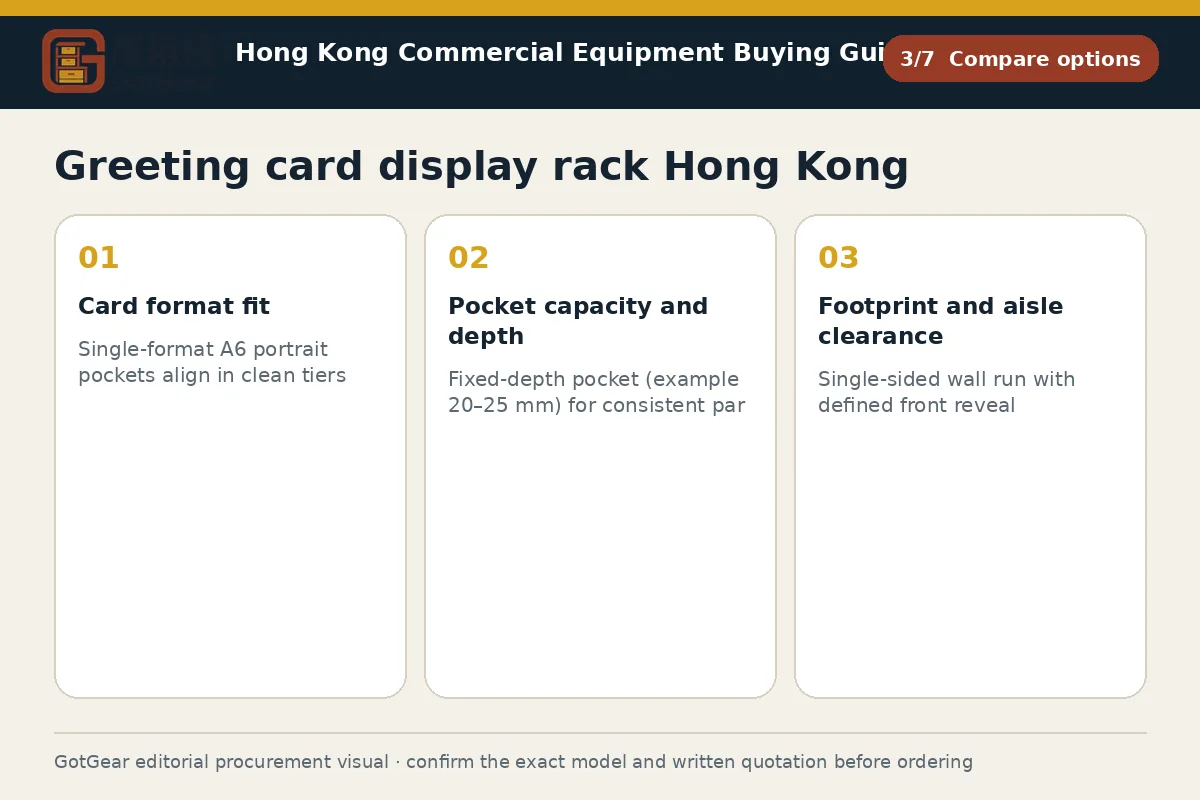
| Card format fit | Single-format A6 portrait pockets align in clean tiers | Mixed A6, square and DL, portrait and landscape across one bay | Provide envelope and sleeved-card dimensions, orientation mix and sample photos |
| Pocket capacity and depth | Fixed-depth pocket (example 20–25 mm) for consistent par | Variable-depth or stepped tiers to suit seasonal overstock | State target units per pocket and sample stack thickness to validate |
| Footprint and aisle clearance | Single-sided wall run with defined front reveal | Island, double-sided run with wheelchair turning and queue lines | Send a scaled plan with measured aisles, fire-route notes and any approvals sought |
| Mobility and stability | Levelling feet on flat floors | Braked castors plus anti-tip base/ballast for flexible layouts | Describe floor finish, ramps and slopes; request any available stability test summary |
| Replenishment and signage | Front-loading pockets with clip-on label strips | Back-load or lockable headers with bilingual category signage | Detail replenishment route, tote sizes and required label sizes/languages |
This framework helps buyers create comparable written enquiries. Final model specifications, availability, delivery and commercial terms must be confirmed in a formal quotation.
Plan browsing space around a greeting card display rack Hong Kong
A well-chosen rack still fails if the aisle plan doesn’t work. Sketch your browsing flow, entrances and queue lines, and mark obstructions such as pillars and fire equipment. Note the base footprint of shortlisted racks plus the turning radius if on castors. Set an example starting point for clear aisle widths that your venue can endorse, then obtain management-office confirmation; these figures should be treated as proposals until approved. Confirm the browsing face direction so customers do not block a pinch point or lift lobby.
In Hong Kong, access can dictate the model. Record goods-lift dimensions, door widths and any maximum load for the lift car and the floor where the rack will stand; share this with suppliers so they can confirm packed-carton sizes and assembly method. Check loading windows and delivery restrictions in industrial buildings, and whether uncrating must occur off-site. Ask for the assembled and packed dimensions on quotations, a parts list, and whether tools are included. For storefronts with humidity and air-conditioning cycles, specify finishes that resist corrosion and adhesive creep on ticket strips. On receipt, before moving to site, test-roll the unit (if mobile) across your tightest doorway and verify bumpers or feet won’t mark stone or timber finishes.
Keep replenishment practical with a greeting card display rack Hong Kong
Replenishment determines whether a tidy planogram survives trading. Decide if you need front-load, top-load or back-load pockets, and whether staff can service from the customer side without blocking aisles. Define a target “par” per pocket (example starting point: two to three facings behind the front card) and confirm that depth supports it without bowing. Ask suppliers for label-holder compatibility, pocket ID options, and whether you can source spare dividers and label strips locally for quick swaps.
Operationally, set up bilingual pocket labels and category headers so staff and customers read them confidently. If you batch-pick from the stockroom, measure your totes and trolleys, then ensure shelf heights and base frames allow them to stage near the rack. Request an assembly and care manual in English and Chinese, cleaning guidance for acrylic or powder-coated parts, and a list of replaceable components. For venues that demand stability documentation, ask the manufacturer for a statement of intended use and any available test summary; what is required varies by venue and insurer. Check that castors (if specified) are braked and that anti-tip feet or ballast kits are fitted as instructed. Finally, trial a live refill during a quiet hour to confirm sightlines remain clear and the assortment is easy to scan.
Greeting card display rack Hong Kong decision checklist
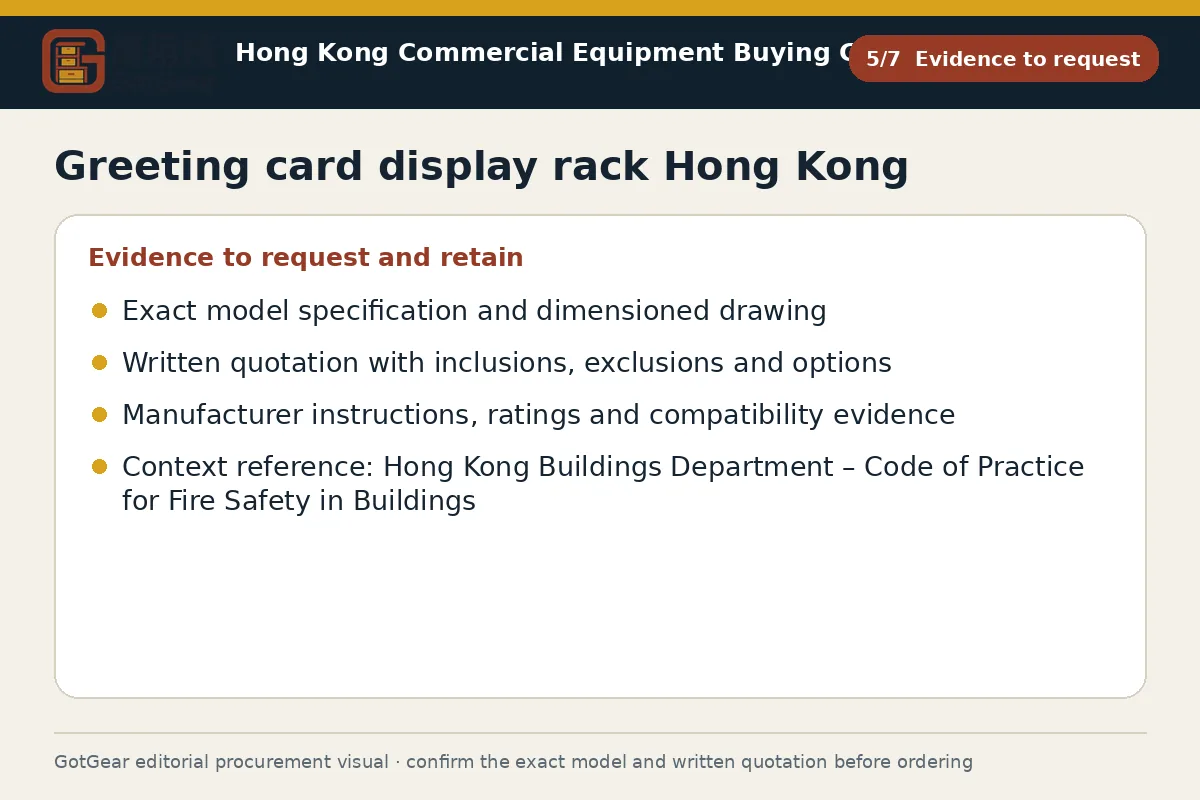
Document card formats with envelope and sleeve sizes, then specify pocket inside width, inside depth, visible height, lip height and tier spacing in your enquiry. Map designs to required facings and set an example pocket par to test with supplier samples. Measure aisles, doors and goods-lifts; include a marked plan and the preferred browsing direction for approvals. Ask quotations to state assembled and packed dimensions, per-pocket capacity guidance, finish, castor/foot type and included accessories. On delivery, count parts, inspect pocket edges, verify stability components and check bilingual instructions. Where your venue or insurer requires it, request a statement of intended use and any available stability or material test summary. The model specification and formal quotation should always prevail.
- Operating use, quantity and expected frequency
- Dimensions, capacity, material and accessory requirements
- Delivery address, floor, goods lift and loading window
- Required documents, acceptance checks and after-sales arrangements
Key points for greeting card display rack Hong Kong
Hong Kong sites often combine tight lift cars, narrow service corridors and short loading windows, so confirm packed-carton sizes and pre-book goods-lifts before committing to a large floor-standing rack. Many malls and institutions require management-office approval of aisle widths and fixture stability; submit drawings for sign-off early. Humidity and air-conditioning cycles can affect adhesives on ticket strips and cause condensation on acrylic, so choose finishes accordingly. Provide bilingual labels where customers or staff expect both Chinese and English. The above are practical constraints, not legal advice; venue rules prevail.
Questions about greeting card display rack Hong Kong
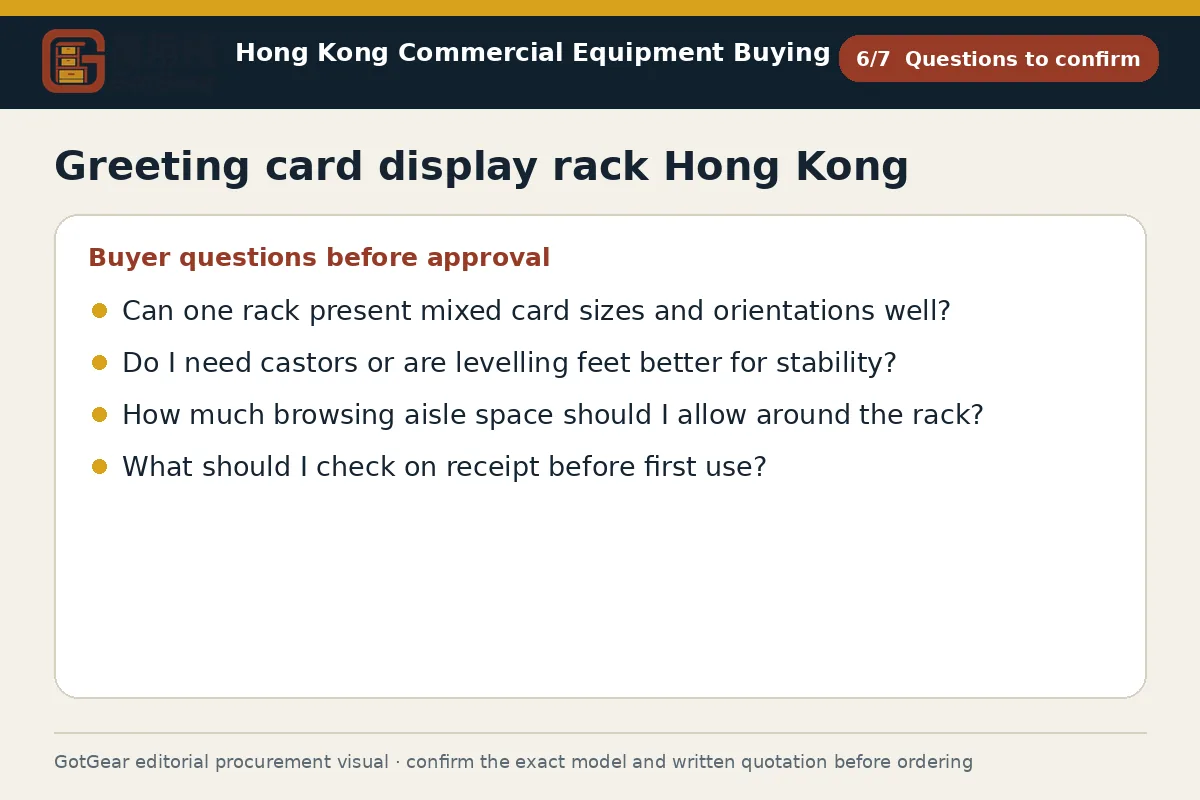
Can one rack present mixed card sizes and orientations well?
Yes, with adjustable dividers or a mix of pocket widths, a single unit can show A6, square and DL cards together. The trade-off is some wasted space or reduced reveal on one format. Ask for a dimensioned drawing and, ideally, a test-fit photo using your samples. If a clean grid is critical, split formats across bays and label clearly.
Do I need castors or are levelling feet better for stability?
Use castors if you reconfigure frequently or must wheel fixtures to back-of-house after trading; specify braked, furniture-grade units. Levelling feet generally provide a steadier feel for permanent runs. Check your floor finish and ramps, and ask the venue if wheeled fixtures are restricted. If anti-tip kits or ballast are offered, follow the manufacturer’s instructions.
How much browsing aisle space should I allow around the rack?
Provide enough clearance for customers to pause and for others to pass. An example starting point is planning main thoroughfares wider than side aisles, then validating with the building or mall manager against site conditions and crowd patterns. Fire egress requirements and queue layouts vary by venue, so only approved drawings should guide final placement.
What should I check on receipt before first use?
Count all components against the packing list, confirm that pocket widths and depths match the quotation, and feel for sharp edges. Inspect fasteners, level adjusters or castors, and ensure the brakes engage. Assemble according to the bilingual manual, wipe clean, fit strips and category headers, and apply anti-tip measures as specified. Report transit damage immediately to the supplier.
Continue with closely related procurement topics
These pages share equipment, operating or decision-stage signals with this guide.
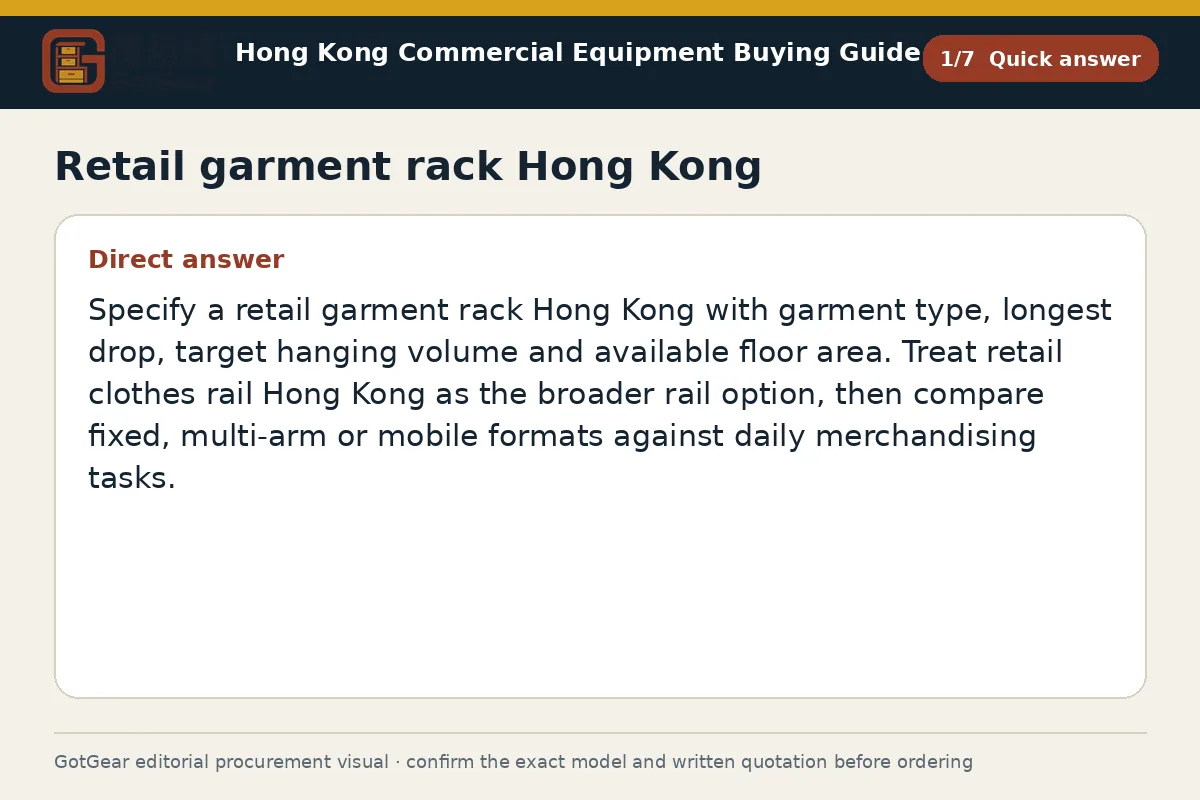
Retail garment rack Hong Kong
At GotGear, assess garment type, longest drop, target volume and floor area to choose a retail garment rack Hong Kong that suits your store. Compare fixed and mobile retail clothes rail Hong Kong to decide on layout.
Read the guide
Acrylic sign holder Hong Kong
Choose the right acrylic sign holder Hong Kong with GotGear by considering insert size, orientation, viewing side, and how often you will change inserts. Compare options for magnetic acrylic sign holder Hong Kong.
Read the guide
Slatwall display hooks Hong Kong
When selecting slatwall display hooks Hong Kong, check pack depth, hanging-hole format, facing count and panel fit for proper mounting. Compare slatwall display shelves Hong Kong for support and installation with GotGear.
Read the guide
Slatwall wire baskets Hong Kong
GotGear guides you through comparing opening size, depth, containment, access, attachment and capacity to select slatwall wire baskets Hong Kong for loose or irregular goods.
Read the guideRelated topic indexOpen more English procurement pages2 topics
Browse additional equipment families, applications and procurement questions relevant to a wider buying brief.