Waves and a middle part: planning a finish that works beyond photographs
This column offers salon and styling information and links to Vit So, a hair website under the same ownership. Hair services are provided by Vit So, not GotGear.
The short answer
A wearable wavy middle part starts with the finish you can manage on an ordinary morning, not the most polished reference photograph. Separate the wave pattern from the cut and parting, explain your treatment history, and agree how much drying and product use you will accept. If you also colour your hair, discuss root maintenance as a separate service with its own scope and safety checks. A perm should support that routine, not be assumed to replace it.
Describe the morning, not just the photograph
A photograph can show an attractive centre opening, soft bends around the eyes and a tidy outline above the ears. It cannot tell you how the hair was dried, what product holds it there, or how much arranging happened before the shutter clicked. Before asking for that finish, decide what you want when you leave home without a special occasion to prepare for.
Start with three observations: where your hair naturally separates, what the front does after ordinary drying, and which areas you keep pushing out of your face. Note whether the hair feels flat at the crown but bulky at the sides. These details give the consultation a practical starting point without requiring you to diagnose your hair or choose a chemical method yourself.
A useful reference set includes a front view, a side view and a less polished version of the same general shape. Explain what you like in each. You might want the forehead opening from one image but less side volume than another. A reference is a vocabulary aid, not evidence that a particular result can be reproduced on every head of hair.
GotGear and Vit So share ownership. The salon links in this article provide related information to help you frame questions; they are not independent recommendations or reports of a personal salon visit.
Separate the waves from the middle-part outline
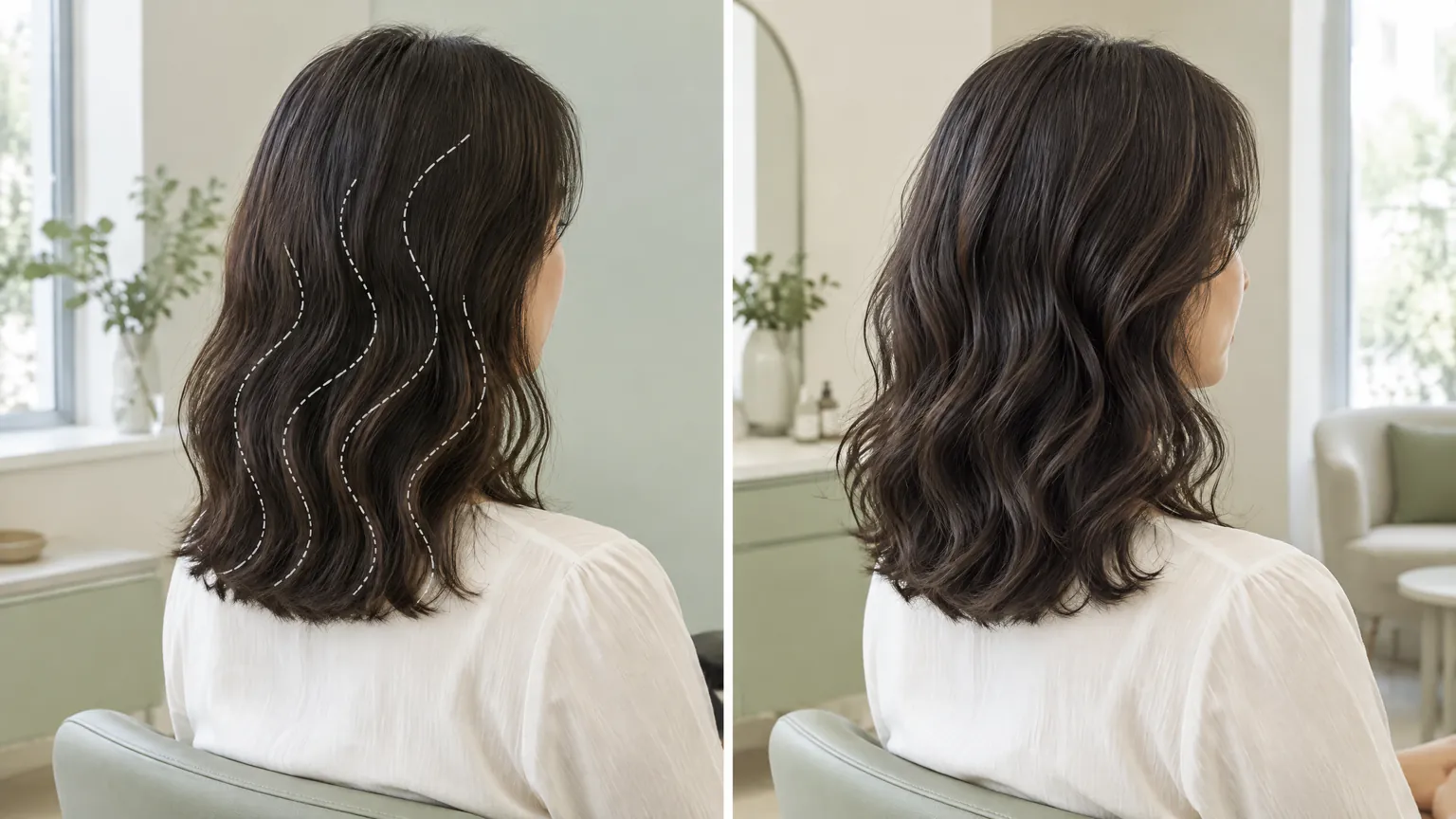
A wave pattern describes how the lengths bend. A parting describes where the hair divides and falls. The cut determines how those elements sit around the face and above the ears. Treating all three as a single look makes it harder to explain a problem: hair falling into your eyes might need a discussion about length and direction rather than simply more curl.
If your priority is movement rather than a strongly defined curl, Vit So’s guide to a wavy perm for men is a relevant starting point for discussing the texture you have in mind. Bring the conversation back to your own hair: where should the bend be visible, and where would extra width be unwelcome? Do not choose a treatment solely from the label attached to an image.
Choose what the front should do
Describe the fringe in ordinary actions. Should it stay above your eyebrows, sweep aside when you put on glasses, or fall forward when left alone? Explain whether you are comfortable moving it back into place during the day. A perfectly balanced front in a photograph is a different preference from a loose opening that allows some unevenness.
It also helps to identify your non-negotiable. Someone who dislikes hair touching their lenses needs a different brief from someone who enjoys long pieces framing the cheeks. Neither preference makes a particular perm suitable by itself. It tells the stylist what the cut and finish need to accommodate if a chemical service is appropriate.
Decide how exact the parting must be
A centred line and a centre-opening silhouette are not necessarily the same request. You may want the overall balance of two sides without wanting a sharply visible line. Ask whether your natural direction allows the proposed arrangement with the amount of daily styling you are willing to do.
For a comparison focused on the front outline, the middle part perm guide can help you describe the difference between an open centre and a curved fringe shape. Use it to name your preference, then ask what is realistic for your current length and condition. The photograph remains a reference, not a promised outcome.
Compare finishes by the work they ask of you
Rather than ranking styles from fashionable to unfashionable, compare their demands. The table below is a consultation tool, not a prediction of what a perm will deliver. Each option still needs an assessment of the hair and a clear explanation of the finish.
| Finish preference | What to show or describe | Daily task to discuss | Trade-off to settle |
|---|---|---|---|
| Loose waves with a soft centre opening | Movement through the front without a ruler-straight line | Whether light arranging after drying is enough | Accepting some unevenness versus wanting exact balance |
| More defined waves on both sides | Separate visible bends and a deliberate outline | How to arrange the waves without repeated brushing | Definition versus a softer, less organised appearance |
| Longer face-framing front | Where the ends should sit beside glasses or cheekbones | Moving the front clear of the eyes | More framing length versus more contact with the face |
| Neater sides with movement mainly on top | Side profile and the area above the ears | Keeping the top and sides visually connected | A tidy outline versus more obvious contrast as the cut grows |
Ask for an explanation of the simplest acceptable finish, as well as the most polished one. If the preferred look depends on several drying stages that you will rarely perform, changing the brief is more sensible than assuming you will acquire a new routine overnight. There is no need to decide the product or tool sequence before the stylist has assessed the hair.
Make treatment history part of the design brief
Hair that looks similar in two photographs may have very different processing histories. Record previous bleaching, colour, straightening and perming as accurately as you can, including home treatments. If the dates are uncertain, say so. Explain which lengths were treated rather than describing the whole head as either natural or coloured.
The American Academy of Dermatology warns that appearance-enhancing treatments can leave hair dry and brittle, and advises caution with perming to avoid long-lasting damage.1 That is a reason to discuss condition before choosing the desired wave, not a reason to assume every previously coloured head is unsuitable. Suitability needs an individual assessment; a style name cannot provide one.
Tell the stylist about rough-feeling ends, tangling or breakage you have noticed, but do not convert those observations into a diagnosis. Ask whether a cut and non-chemical styling demonstration would be a reasonable first step, or whether the desired texture should be deferred. Keep the option of not proceeding open rather than treating the consultation as a commitment to a perm.
Distinguish an allergy check from a styling decision
Colour safety is a separate question from whether waves will suit the cut. The FDA explains that a dye reaction can occur even after previous uneventful use, and that a skin test does not rule out every reaction. Its guidance is to follow product instructions and perform the specified skin test before each use.2 Ask what checks are required for the proposed colour product rather than assuming a past appointment clears you indefinitely.
The FDA also advises against dyeing or relaxing an irritated, sunburned or damaged scalp. For dyeing after bleaching, relaxing or perming, it advises waiting at least 14 days.2 This is safety guidance, not automatic clearance at the end of that interval or confirmation of a salon’s booking policy. Discuss the actual product instructions, hair condition and proposed sequence before arranging services.
If a perm causes excessive stinging or burning, the AAD advises immediate rinsing and consultation with a dermatologist.1 Tell the person carrying out the service promptly; do not quietly endure symptoms for the sake of the finish. Persistent irritation, pain or sudden marked hair loss needs assessment by a qualified healthcare professional, not a promise of cosmetic repair.
Plan root colour without turning it into an automatic extra
A middle opening can make the root area easy to see, so colour maintenance may enter the same conversation as the waves. Keep the decisions distinct. First decide whether the difference between the new growth and existing colour actually bothers you. Then explain whether you want coverage at the roots, a change in overall shade, or simply a clearer understanding of the available scope.
For that enquiry, the root touch up price page is a service-scope reference, not a substitute for confirmation of your appointment total. Ask what counts as root work in your case, whether the existing lengths need separate attention, and which finishing steps are included. Do not assume that adding a perm turns colour maintenance into part of the same service.
A useful enquiry states the previous colour date if known, describes the visible new growth and identifies any lightened lengths. Ask whether consultation, cutting, drying or other proposed steps change the agreed scope. If the stylist recommends something beyond the root area, request the reason and a revised total before agreeing. These are questions to confirm, not assertions about what a particular salon includes.
Avoid booking around an imagined universal maintenance calendar. The acceptable amount of visible regrowth is partly a personal preference, while treatment suitability and sequencing require a separate assessment. If your immediate concern is the front shape, say that plainly. It may help keep a colour discussion from obscuring the decision you came to make.
Build a care routine that respects the new texture
The everyday objective is manageable hair with less unnecessary handling. The AAD recommends washing according to how dirty or oily the hair becomes, applying shampoo to the scalp, using conditioner after washing and being gentle when detangling. It also advises limiting heat tools and choosing low or medium heat when they are used.3 A fixed routine copied from a reference model is not a substitute for those needs.
Ask how that guidance applies to your hair and the particular service. Request clear aftercare instructions, including when to resume washing or styling after the treatment. Do not import a waiting rule from an unrelated product or assume instructions for naturally wavy hair are identical to those for your newly treated hair.
For drying, the AAD recommends gently absorbing moisture with a towel or T-shirt rather than rough rubbing. It advises careful detangling, with the approach adjusted to hair type.3 A styling demonstration should therefore explain both how to arrange the desired finish and how to avoid repeatedly disturbing the hair to chase perfect symmetry.
Discuss two realistic versions of the routine: an ordinary morning and a more polished occasion. For the ordinary version, ask which step matters most and which is optional. For the polished version, ask how to use any recommended tool safely. If you dislike product residue or wearing the front away from your face, mention that before the routine is finalised.
A hypothetical brief for an ordinary working week
Consider a hypothetical Hong Kong office worker who wears glasses, has previously coloured lengths and likes a centre-opening fringe. They are willing to dry the front deliberately but do not want to use a curling tool every morning. Their main frustration is the fringe touching the lenses; visible root growth is a secondary concern. This is an illustrative planning example, not a customer account.
A practical brief would prioritise clearance around the glasses and ask for movement that does not require a perfectly drawn parting. The worker would bring a side photograph as well as a front reference, disclose the colour history, and ask whether their current length and condition support the proposed texture. They would request separate explanations for the perm and root-colour scope rather than assuming both could happen together.
If the proposed finish requires more styling than they accept, they can change the outline or ask to see a non-chemical version first. If the processing history raises concerns, they can postpone the texture decision. The useful result of the consultation is a clear choice, including the choice not to proceed, rather than an obligation to reproduce the reference.
Before agreeing to the work, use this checklist:
- Show front and side references, and name the feature you want from each.
- Describe what happens with your usual drying method and how long a routine you will actually maintain.
- Explain glasses, face-contact preferences and the amount of asymmetry you accept.
- Give your chemical-treatment history, marking uncertain dates as uncertain.
- Ask what condition or scalp concerns would mean changing or deferring the service.
- Keep root colour, cutting, perming and finishing scope clear, and confirm the proposed total without assumptions about inclusions.
- Request aftercare instructions and a demonstration of the ordinary-day finish.
The best brief for this purpose is not the most elaborate one. It makes the desired front shape understandable, leaves room for an honest suitability assessment and sets limits on the work you will do at home. That gives waves and a middle part a role in everyday life, instead of leaving their appeal confined to a carefully arranged photograph.

Common questions
Do I need a perfectly straight centre line for this look?
Not necessarily. Describe whether you want an exact line or simply an opening between two sides of the fringe. Ask how your natural direction and current cut affect that choice. A looser outline may match your preference better, but it still needs an individual discussion rather than a guarantee from a reference photograph.
What should I tell the stylist if I wear glasses?
Explain where the fringe touches your frames or lenses, and whether you mind moving it aside during the day. Bring a side view as well as a front reference. Agree where the front should finish when dry, and ask what arranging is needed to keep the proposed shape comfortable.
Can root colour and a perm simply be booked as one refresh?
Do not assume they can or should be combined. Disclose the processing history and ask about the proposed sequence, product instructions and required checks. Confirm the scope of each service separately. General guidance about treatment spacing does not establish that your hair is suitable or that a particular appointment arrangement is available.
What if I cannot reproduce the polished finish at home?
Before committing, ask for an ordinary-morning version of the routine and identify its essential steps. If the reference depends on more drying or tool use than you accept, adjust the brief. A cut and non-chemical styling demonstration may be worth discussing before choosing a chemical service.
Sources & what they support
The scope below identifies the information supported by each reference; a citation is not an endorsement of a salon or a guarantee of results.
- Coloring and perming tips for healthier-looking hair — American Academy of Dermatology (opens in a new tab)
Appearance-enhancing treatments can cause dryness and brittleness; perming requires caution, and excessive stinging or burning warrants immediate rinsing and dermatologist consultation.
- Hair Dyes — US Food and Drug Administration (opens in a new tab)
Dye reactions can occur despite previous uneventful use; follow product skin-test instructions each time; a negative test does not exclude reactions; avoid dyeing or relaxing an irritated, sunburned or damaged scalp; wait at least 14 days after bleaching, relaxing or perming before using dye.
- Tips for healthy hair — American Academy of Dermatology (opens in a new tab)
Wash according to dirt and oil, apply shampoo to the scalp, condition after washing, detangle gently, absorb moisture without rough rubbing and limit heat with low or medium settings when used.