A human-hair topper brief: base, fibre and custom enquiry scope
GotGear and OWNSTRAND share the same owner. This collection is not an independent recommendation. GotGear does not supply wigs or medical treatment; actual wig services are provided by OWNSTRAND, whose only known studio is in Kwun Tong. These articles provide general information, not medical advice.
The short answer
A useful human-hair topper brief starts with the area you want to cover and where the piece could attach, not just a preferred colour. Add your usual parting, hair texture, desired density and realistic care routine. Then ask which base and fibre options can meet that brief, and what any custom proposal actually includes. Human hair does not settle fit or comfort, and a custom enquiry does not establish availability until the provider confirms the specific work.
Start with the coverage problem, not the catalogue photograph
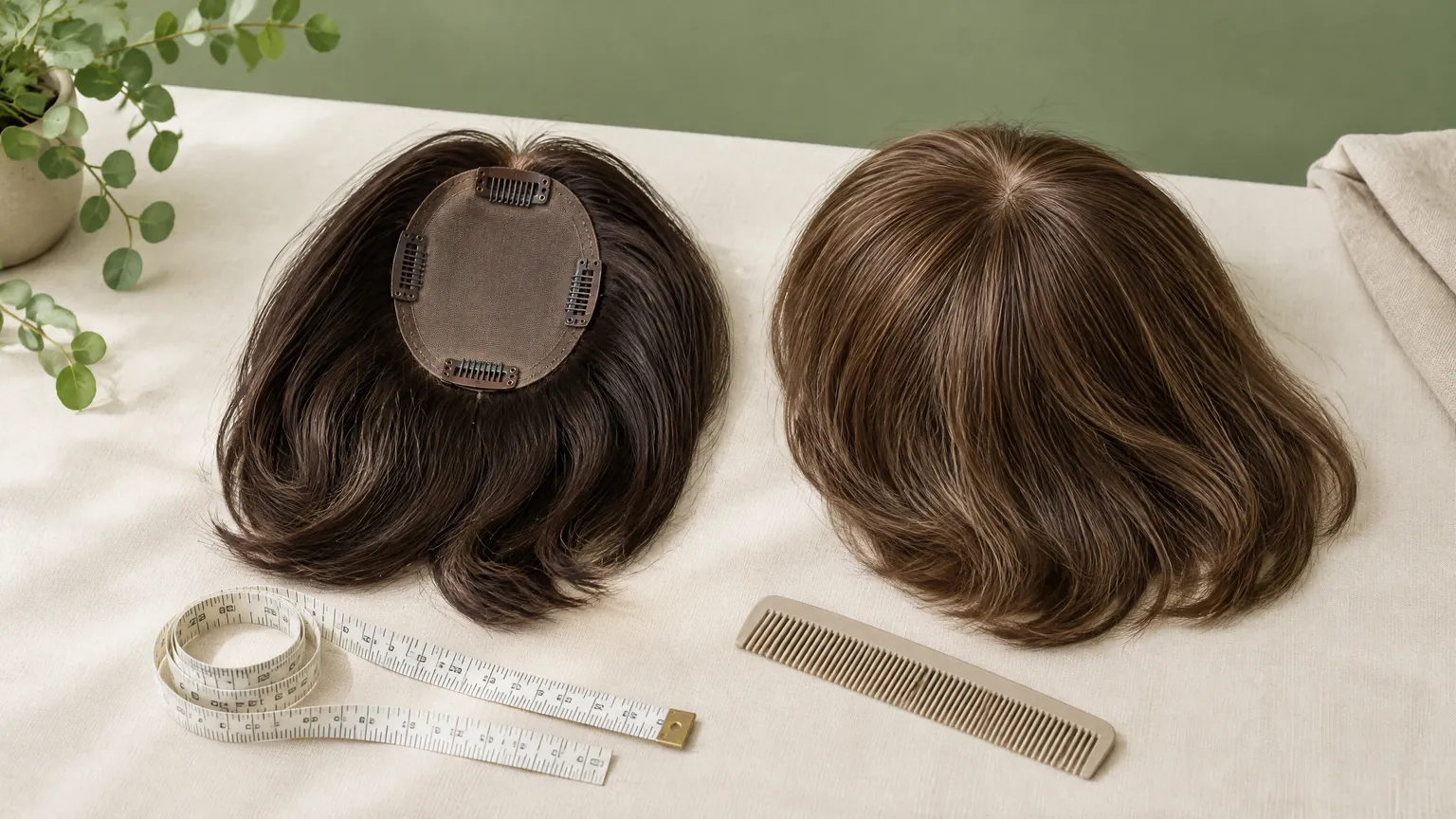
A topper is a partial hairpiece intended to work with the hair that remains visible around it. That makes the boundary between the piece and your own hair central to the decision. A photograph showing an attractive finished style cannot tell you whether the base covers your intended area, whether its attachment points are suitable, or how its ends will blend with your current haircut. Define those needs before discussing a particular design.
Write down whether you want coverage along a parting, over the crown, towards the front, or across a wider section of the top. Describe the appearance you want without trying to diagnose why your hair looks different. A cosmetic consultation can address coverage and styling preferences; it is not a substitute for a medical assessment of new or unexplained hair loss.
The human hair topper resource is a useful starting point for a fibre-specific enquiry, but bring a coverage brief rather than assuming that every pictured option can be supplied or customised. Ask the provider to distinguish the hair fibre from the base construction and attachment method. Those are separate parts of the same piece, and each needs its own confirmation.
GotGear and OWNSTRAND share ownership. This article is a practical selection guide, not an independent endorsement or a report of a visit, fitting or product test.
Measure the base and examine where it would attach
Manufacturer Jon Renau's topper measuring guide separates the coverage area from the measurements needed to position attachments. It advises measuring front to back and side to side, with the measurement boundaries reaching areas with sufficient hair to support the clips. That is a useful distinction: the visible area you want to cover is not necessarily the complete footprint of a suitable base. Its own sizing allowance should not be treated as a universal rule for another provider's construction.1
For an initial enquiry, a rough coverage sketch is more useful than a confident but unverified size selection. Mark your usual parting and the front edge you hope to keep visible. Note where you think clips might sit, but leave their suitability to a fitting discussion. A base that looks neatly matched to the coverage area on paper may position its attachments in places that cannot comfortably support them.
Base size is not the same as hair length
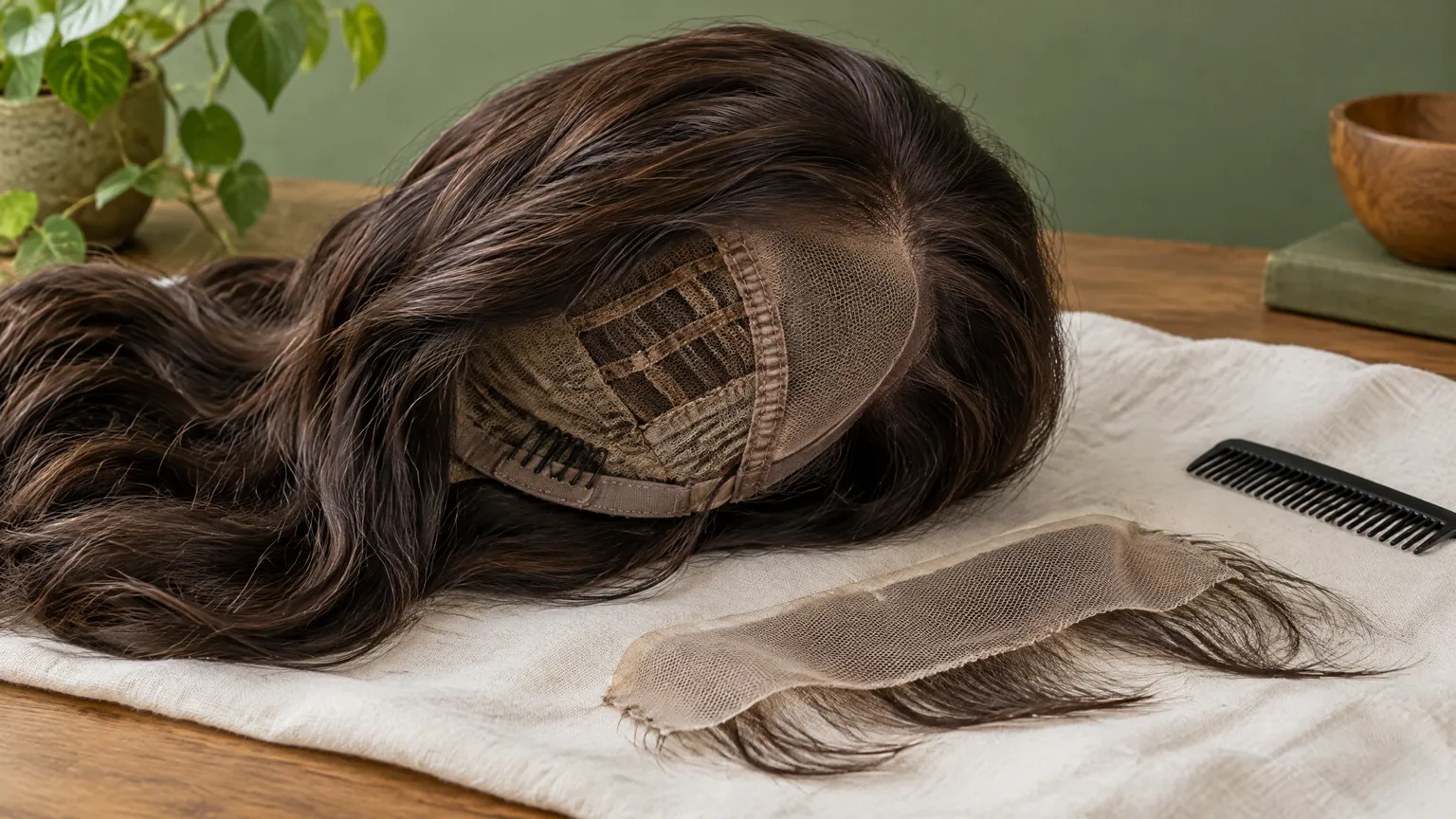
Ask for both the base dimensions and the supplied hair length. Longer hair does not enlarge the base or move its attachment points. Equally, choosing a broader base is not simply a way to request more volume: it changes the area covered and the positions where the piece meets your own hair. Ask to see the underside of a relevant sample so the description corresponds to a physical construction.
Terms such as lace, monofilament, silk top and hand-tied describe different construction features, not a single quality ladder. If one appears in a proposal, ask which part of the base uses it and what that means for your intended parting or exposed front edge. Do not assume that a translated material name establishes the same construction, or that a catalogue term confirms the option is available for custom work.
Attachment comfort needs its own decision
The American Academy of Dermatology warns that repeated pulling from tight hairstyles and attachments can contribute to hair loss. Its advice also treats pain, stinging and scalp crusting as reasons to change a pulling style promptly.3 This does not mean every topper causes such problems. It does mean that a secure-looking result should not be achieved by accepting persistent pulling or discomfort.
If a proposed clip position feels sore, ask for the fitting to be reassessed rather than tightening it further. If there is not enough suitable hair at the intended attachment points, ask whether a different base or another type of hairpiece should be considered. Do not improvise adhesive or a different attachment system without appropriate guidance. Persistent irritation, pain or sudden marked shedding warrants assessment by a qualified healthcare professional, not merely another styling adjustment.
Choose fibre for the care routine you can actually maintain
Human hair is a material choice, not a promise of an effortless match. Macmillan Cancer Support notes that human-hair wigs can contain hair from several people and may have been bleached and dyed. It also explains that they may need regular cleaning and styling, while some can be cared for at home with suitable equipment and guidance.2 These general fibre considerations are relevant to a topper enquiry, although the instructions for the specific piece must govern its care.
Ask whether the proposed fibre is entirely human hair or a blend, and how its processing affects the permitted care routine. A human-hair label does not tell you how a particular colour was achieved or whether further colouring is advisable. If changing the colour is part of your plan, ask the provider to assess the actual piece. Do not assume that dyeing, bleaching, perming or straightening will be suitable simply because the fibre is human hair.
Macmillan describes conventional synthetic wigs as having their style set into the fibre, making them comparatively straightforward to maintain. It separately cautions that blended fibres may need special care because their synthetic content can be affected by heated styling tools.2 These are reasons to compare routines, not to dismiss synthetic hair. A repeatable ready-to-wear shape may suit someone who does not want to restyle after cleaning.
Think through an ordinary week. Can you leave the piece to dry in an appropriate place? Are you comfortable following detangling and styling instructions? Would a morning routine that depends on reshaping the hair be realistic? Request written washing, drying, storage and heat guidance for the proposed fibre and base. Do not borrow instructions from another wig, even if the two pieces look similar.
Compare the parts of the proposal separately
A useful comparison records unresolved questions rather than declaring one material or construction best. The following table can sit beside two sample descriptions or proposals. Its purpose is to make differences visible before a fitting or order, including differences that a front-view photograph may hide.
| Decision | Information to compare | What should not be assumed |
|---|---|---|
| Coverage and base | Front-to-back and side-to-side dimensions, shape and intended placement | Longer hair provides a larger attachment area |
| Attachment | Method, proposed positions and how removal is demonstrated | A tighter fit is necessarily a better fit |
| Fibre | Human hair, synthetic or blend; piece-specific care instructions | All fibres tolerate the same heat or treatments |
| Parting and front edge | Intended parting, visible edge and relevant sample construction | A construction name guarantees every hairstyle |
| Blending | Colour, texture, density and finished length beside your own hair | A colour name alone establishes a match |
| Service scope | Measurements, fittings, finishing and later adjustments | Custom work automatically includes every stage |
Colour matching deserves more detail than choosing a shade name. Describe the colour near your roots and through the lengths, especially if they differ. If grey hair is part of your appearance, state whether you want the topper to reflect it and ask how any proposed proportion would be represented in a sample. Consider the transition at the sides and back, not just the top in a mirror.
Density also belongs in the brief. A dense piece may not blend with finer hair underneath, even when its colour is close. Ask to compare the overall outline, the thickness through the ends and the appearance of the intended parting. If your goal is a subtle change, say so explicitly; the provider should not have to infer that from a reference photograph with much fuller hair.
Separate supplied length from finished length. Blending may involve cutting the piece, your own hair, or neither, depending on the proposal. Ask what is intended before agreeing to an irreversible change. A reference image should help communicate an outline or fringe preference, not serve as a guarantee that the same result can be reproduced on a different base and haircut.
Make the custom enquiry specific enough to answer
The phrase custom can cover very different work. It might refer to a piece made to agreed specifications, modifications to an existing piece, or selection followed by fitting and finishing. Before comparing proposals, ask the provider to state which meaning applies. A colour choice and a trim should not be confused with a separately specified base construction.
The custom hair topper Hong Kong resource can help frame an enquiry about that exact service category. Ask whether topper-specific custom work is currently offered for your requested coverage and fibre, which elements can be specified, and which require sample or fitting confirmation. A custom-selection service described more generally does not establish that every topper base, attachment or finish can be commissioned.
Ask whether sample viewing, measurements, a discussion of hairstyle and grey proportion, completion fitting and adjustments would apply to your particular topper proposal. Confirm separately whether washing, cutting and blow-drying form part of the agreed work. These are scope questions, not promised inclusions. Ask how requirements are recorded and when you would review them before the work proceeds.
Keep essential preferences distinct from negotiable ones. Suitable coverage and tolerable attachment are not the same kind of preference as a slightly different fringe length. If the requested construction is not offered, ask what a proposed alternative changes. That makes it possible to decide whether the alternative addresses the original need instead of accepting it merely because it resembles the reference image.
Read a quote as a description of work
Use the hair topper prices enquiry resource to establish the scope attached to a proposal, rather than treating a general page as a complete quote. Request a written description of the piece and the services being discussed. The important question is whether the proposal answers your brief and makes clear which work is included, optional or not offered.
A useful description identifies the fibre, base dimensions, intended colour and finish. It should also explain the proposed attachment method and distinguish the supplied piece from any fitting or styling service. Ask whether later changes are assessed separately, and what happens if you request a different parting or colour after the specifications have been agreed. Confirm applicable terms before committing, without assuming a particular returns or alteration policy.
Ask who will explain routine care and how you can raise a fit concern after collection, if that support is offered. Clarify whether an adjustment means repositioning attachments, changing the cut or doing something else. Written detail helps you compare like with like; an appealing photograph and the word custom are not enough to define the work.
A hypothetical brief for an everyday office routine
Consider a hypothetical Hong Kong reader who wants to cover a wider-looking centre part while keeping her shoulder-length haircut. She prefers a modest change in volume and does not want a routine that depends on frequent heated styling. This is an illustrative selection scenario, not a customer account or a claim about any provider's results.
Her initial brief could describe the centre-part area, her usual parting position, the visible root colour and the texture through her ends. She would ask for a proposed base footprint and an explanation of where attachments would sit. She would also ask how the finished density could be assessed beside her own hair, rather than ordering from a photograph of a much fuller hairstyle.
If she asks about human hair, the next discussion should include the washing and styling work required for the specific piece. If that routine is more demanding than she wants, she could compare a fibre option that retains its shape more readily, provided the provider offers one. She would keep the coverage requirement unchanged while reconsidering the fibre, rather than confusing the two decisions.
If custom work is proposed, she would request confirmation of the specifications, review stage and finishing scope. If the piece pulls during a fitting, she would pause the decision and ask for reassessment. Neither a close colour match nor a custom label would resolve that separate attachment concern.
Take a short confirmation checklist to the discussion
Use this checklist to turn the enquiry into a record you can check against the eventual proposal. Leave uncertain points open for assessment rather than filling them with guesses.
- Describe the coverage area and usual parting; bring an optional reference image for the intended outline.
- Request proposed base dimensions and attachment positions, with an explanation of their suitability.
- Confirm the fibre composition and obtain care instructions for that specific piece.
- Compare colour, texture and density alongside your own hair where samples are offered.
- Separate supplied length from any agreed cutting or blending work.
- Confirm whether topper-specific custom work is offered and record exactly what can be specified.
- Obtain written fitting, finishing, adjustment and applicable order terms before committing.
After the discussion, you should be able to explain why the proposed base fits the coverage brief, how the fibre fits your routine and what the provider has agreed to do. If one of those answers remains vague, ask a focused follow-up. The aim is not to obtain every possible feature. It is to select a manageable piece with a clearly understood scope, without trading attachment comfort for appearance or treating unconfirmed options as available.
Common questions
Does a human-hair topper need a larger base than a synthetic one?
Fibre alone does not determine the base size. Coverage, placement and the proposed attachment points need to be assessed separately. Ask for the actual base dimensions and where attachments would sit. A longer or fuller human-hair piece is not a substitute for an appropriate base footprint.
What should I clarify before asking for a custom topper?
Ask whether the provider offers topper-specific custom work for your coverage requirement, then establish what custom means in that proposal. Confirm which base, fibre and appearance details can be specified. Record whether measurements, fittings, cutting and later adjustments are included or need separate agreement.
Should I accept pulling if the topper looks well blended?
No. Appearance and attachment comfort are separate decisions. Ask for a fitting reassessment if clips pull or cause soreness rather than simply tightening them. Persistent irritation, pain or sudden marked shedding should be assessed by a qualified healthcare professional; a styling consultation cannot diagnose the cause.
Sources & what they support
The scope below identifies what each reference supports. Citations do not imply independent endorsement of OWNSTRAND or any provider, and do not establish treatment benefits or guaranteed results.
- Jon Renau: All About That Base (opens in a new tab)
Manufacturer guidance distinguishing coverage areas from front-to-back and side-to-side base measurements, and the need for sufficient hair at clip attachment points. Its brand-specific sizing allowance is not presented as universal.
- Macmillan Cancer Support: Wigs for cancer treatment (opens in a new tab)
General wig fibre facts: human hair may come from multiple donors and be bleached and dyed; human-hair care may involve regular cleaning and styling; conventional synthetic styles are set into the fibre; blends require appropriate care around heat. No UK pricing, entitlement or production timing is applied to Hong Kong.
- American Academy of Dermatology: Hairstyles that pull can lead to hair loss (opens in a new tab)
Repeated pulling can contribute to hair loss; pain, stinging and scalp crusting are warning signs requiring a change in pulling hairstyles, and hair-loss concerns warrant qualified assessment. This is general safety context, not a claim about an individual topper or a diagnosis.