
Women's wig or hair topper: which part of your look needs to change?
GotGear and OWNSTRAND share the same owner. This collection is not an independent recommendation. GotGear does not supply wigs or medical treatment; actual wig services are provided by OWNSTRAND, whose only known studio is in Kwun Tong. These articles provide general information, not medical advice.
The short answer
Choose a full wig when you want to change the whole hairstyle or cover more than the top of your head. Consider a topper when the change is localised and you want to keep your own hair visible around it. Neither choice follows automatically from how much hair you have. The attachment, blend and daily routine must also work for you, while unexplained hair loss or persistent scalp discomfort needs qualified medical assessment rather than a shopping decision.
Start with the part of the hairstyle you want to change
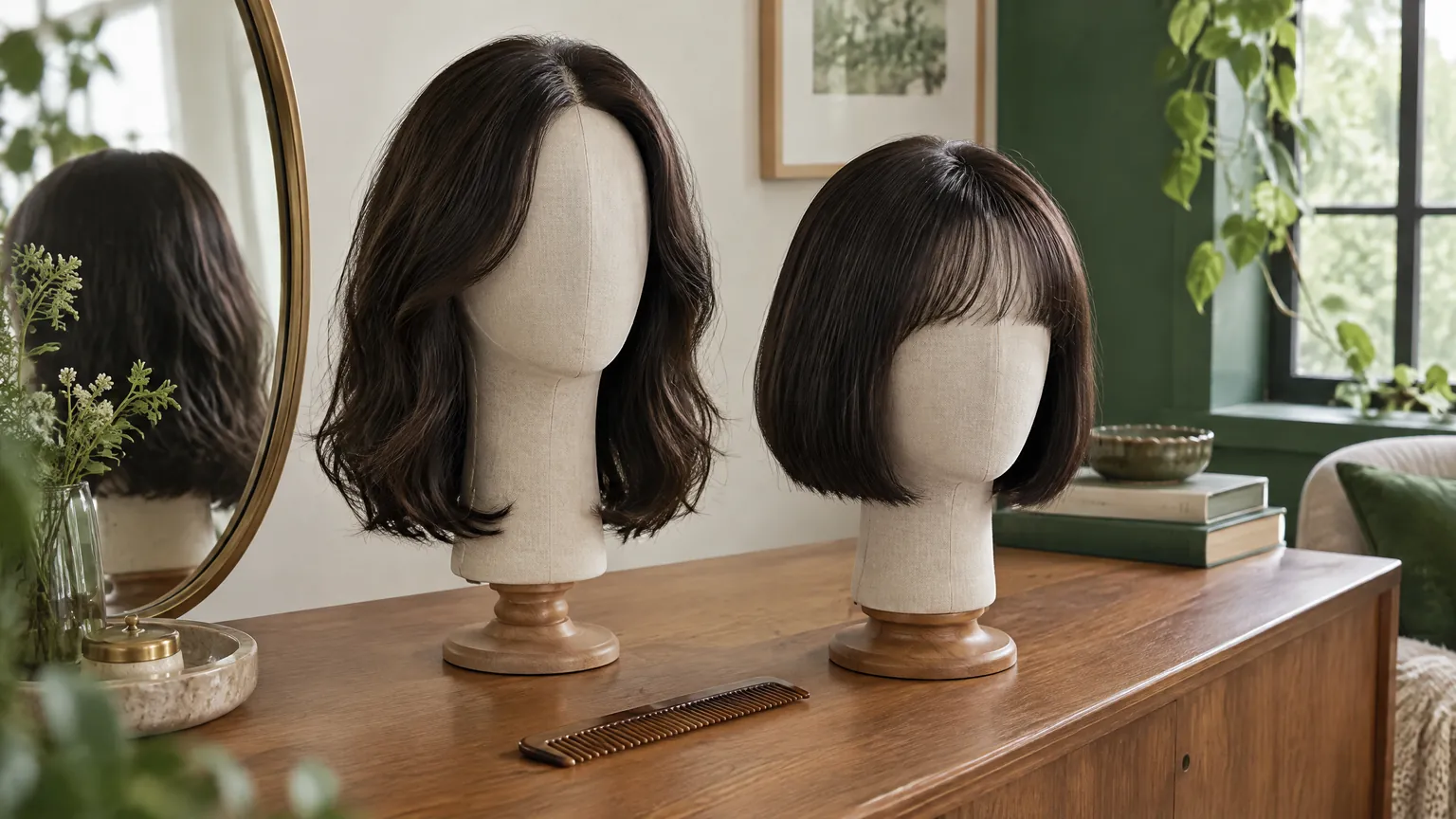
A wider-looking parting, a flatter crown and a wish for a completely different haircut are different appearance goals. Before choosing a product, describe the change in one sentence: ‘I want more coverage along my parting’, for example, or ‘I want a shorter style without cutting my own hair’. This separates the area you want to alter from the amount of hair a product happens to contain.
The American Cancer Society describes a hair topper or top piece as adding coverage and volume to thinning hair at the top of the head, while a full wig covers the whole head.1 That is a useful starting distinction, not a medical recommendation. You can choose a wig for a style change without having hair loss, and you can decide against a topper even when the area you want to cover is small.
Look at your hair from the front, both sides and the back. A mirror alone can hide the crown, so a second mirror or photographs taken for your own reference may help. Note whether you want to keep your forehead hairline, side lengths and nape visible. These are appearance observations, not a way to identify the cause or severity of hair loss.
A local change still needs enough room to blend
A topper has to meet the surrounding hairstyle somewhere. If its ends sit above your own layers, if the crown has much more volume than the sides, or if its texture differs sharply from the hair below, the change may be more noticeable than intended. Think about the finished outline rather than simply looking for the smallest base. Ask how the proposed piece would blend without requiring uncomfortable attachment or unwanted cutting.
When a full wig makes the more coherent change
A full wig is worth comparing when your goal involves the front, crown, sides and back together. Perhaps you want a bob while keeping your natural hair long, or a different colour throughout rather than additional coverage in one area. Its practical advantage is that the main hairstyle comes from one piece; you do not have to match every exposed section of your own hair to it.
For this kind of whole-style change, the women's wigs section at OWNSTRAND is a starting point for browsing and product enquiries. Use it to narrow the silhouette you want, then ask about the particular cap, fit and adjustment process. A catalogue picture does not establish that a style is currently available or that the pictured construction will suit your head.
Keeping your own hair underneath still requires planning. Ask for a demonstration of how to arrange it loosely and evenly before putting on the specific wig. A bulky section at the back can change how the cap sits, while pulling the hair tightly to flatten it creates a separate comfort concern. The American Academy of Dermatology advises keeping hair loose beneath coverings and warns that repeated pulling can cause traction-related hair loss.2
A whole-head style also means checking the edges. Look at the forehead position, the areas around the ears and the nape, not only the parting. Macmillan recommends comparing a familiar style with a similar amount of hair, or slightly less, when the goal is continuity.3 More density is therefore not automatically a better match. Ask whether the fringe or overall shape can be adjusted, and confirm the scope before agreeing to any alteration.
When a topper preserves more of the existing hairstyle
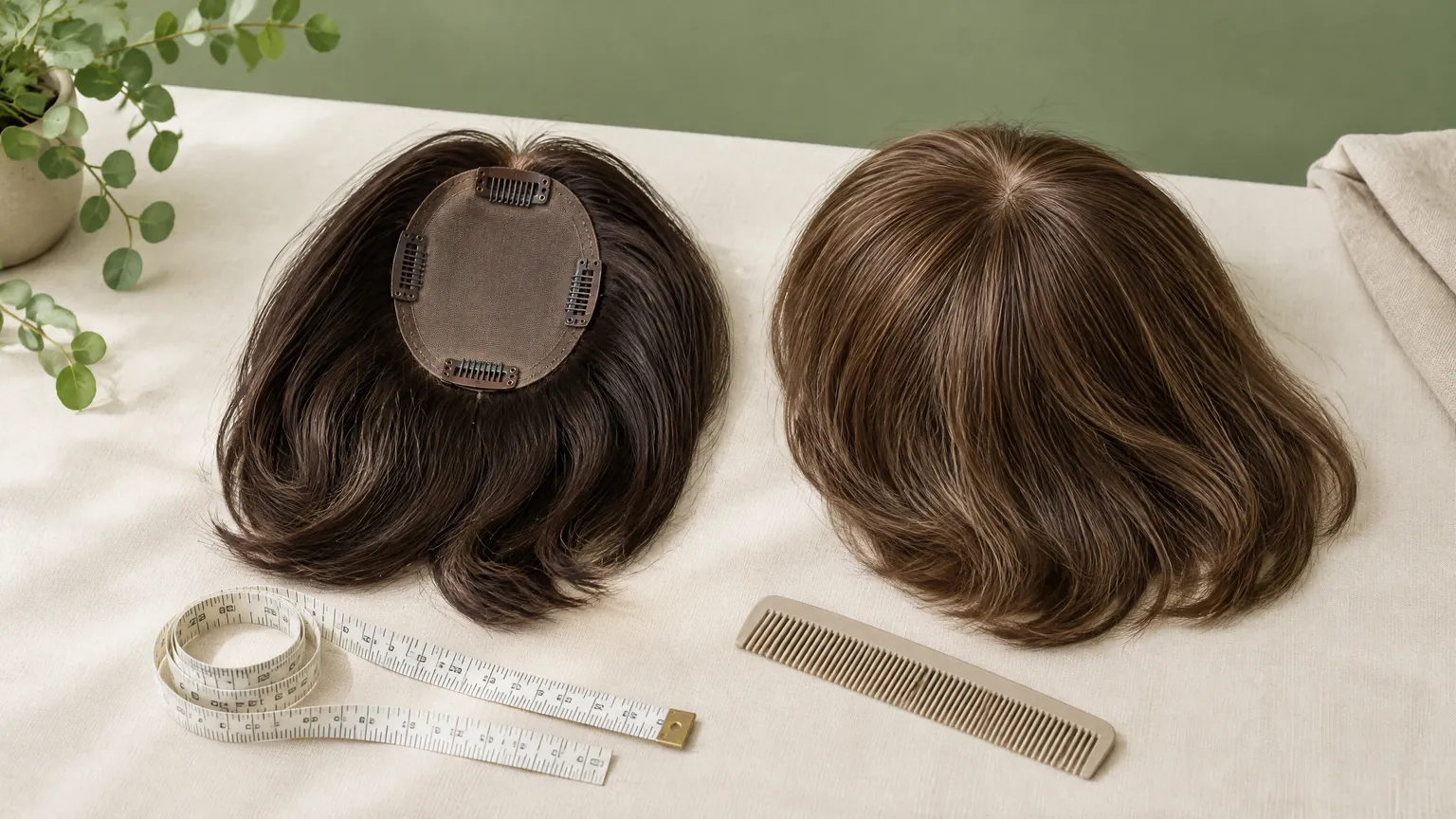
A topper is worth considering when you like your side lengths and back shape but want a change at the parting or crown. Unlike a full wig, it is intended to work with visible surrounding hair. This can preserve a familiar hairstyle, but it makes the match between the piece and your own hair central to the decision.
When browsing hair toppers, keep a note of the area you want covered, your usual parting and the length you want to retain. Ask the supplier how a proposed base and attachment would work with that outline. Do not select solely by a colour name or assume that every item shown can be ordered in a different size or construction.
Check the blend in more than one position
Compare the piece with the visible lengths near a window as well as under indoor lighting. The American Cancer Society recommends natural light when matching hair to wig colour swatches.1 For a topper, also compare the roots, ends and any grey distribution. A close match at the crown may still contrast with lighter or differently coloured lengths.
Check texture after arranging the hair in the way you normally wear it. Straight ends beneath a more waved piece, or a dense top above fine side sections, may create an outline you do not want. The answer might be a different piece rather than repeatedly styling your own hair to accommodate it. If blending requires a haircut, decide in advance which hair may be cut and how much.
Attachment deserves the same attention as colour. Macmillan notes that clips may help secure a wig or hairpiece when someone has some of their own hair.3 That does not mean any remaining hair is a suitable anchor for any clip. Ask where the proposed attachments would sit and how to release them without tugging. If securing the piece hurts, stop rather than treating the discomfort as proof that it is firmly fitted.
Compare coverage and routine together
The useful question in a hair topper vs wig comparison is not which category looks more natural in general. It is which one can deliver your intended outline with an acceptable fit and a routine you can maintain. Use the guide as a comparison resource, then confirm the details of the actual piece rather than relying on category labels.
| Decision point | Full wig | Localised topper | What to check before choosing |
|---|---|---|---|
| Area of change | Supplies the main hairstyle across the head | Changes coverage or volume at the top | Identify which areas you want to keep visible |
| Relationship with your own hair | Hair underneath must be arranged for the cap | Exposed hair needs to blend with the piece | Check the sides, back and transition between lengths |
| Fit and attachment | Depends on cap fit and the securing method | Depends on base placement and attachment design | Ask for fitting and removal demonstrations |
| Colour or texture change | Can present a different overall colour or texture | A strong contrast may complicate blending | Compare under indoor light and daylight |
| Morning routine | Arrange underlying hair and position the wig | Position the piece and blend visible hair | Rehearse the steps without assistance |
| Care planning | Follow instructions for the complete wig | Follow piece instructions while caring for your own hair | Ask about washing, drying and permitted styling |
Coverage and material are separate choices. A topper is not automatically easier to maintain because it covers less area, and a full wig is not automatically difficult. Macmillan explains that many synthetic wigs retain a set style, while human hair wigs may need more cleaning and styling support.3 The particular fibre and care instructions matter more than an assumption based on size.
Do not assume a hairdryer or straightener is permitted. The American Cancer Society advises against heated styling tools unless the wig is heat resistant.1 Ask for the instructions for the exact product, including any temperature limits. Neither ‘human hair’ nor a general catalogue label should substitute for those instructions.
Make the fitting resemble an ordinary day
A fitting should answer whether you can wear the piece as you actually live, not just whether it looks attractive while you sit still. Bring the glasses or other ordinary accessories you regularly use. Check whether the area near the ears interferes with them, and whether looking down changes the placement. Avoid adding equipment or accessories that the supplier has not said are compatible.
If comfortable and practical, turn your head, look down and lean forward gently. Macmillan suggests bending over and gently shaking the head to check that a wig or hairpiece stays secure.3 There is no need to pull at it or simulate extreme movement. Ask about your intended activity separately; a piece that feels steady during a quiet fitting has not been tested for exercise or strong wind.
Rehearse putting it on and taking it off
Ask the fitter to demonstrate placement, then try it yourself with guidance. Notice whether you can identify the front, align the piece and undo the securing method without pulling your own hair. A style that needs precise blending may be acceptable if you enjoy that task, but less suitable if you need a simple morning routine. Neither preference makes one category better for everyone.
Consider how you will handle washing days and storage at home. Ask what the piece should rest on, which products are appropriate and how to know it is dry enough to wear. Avoid assuming a universal washing frequency: the supplier's instructions and your pattern of use should guide it. Include time for the visible natural hair too, especially when a topper relies on that hair for the finished look.
For a Hong Kong commute, include the transition between outdoor travel and an indoor workplace in your questions about comfort. A shorter fitting cannot establish how you will feel after a full day. Ask how to remove the piece when needed and what to do if it feels uncomfortable. Do not accept a general promise that a particular cap or base will always feel cool.
A hypothetical choice with two different answers
Consider a hypothetical office worker who wants more coverage along her parting but likes her shoulder-length hair at the sides and back. She normally wears it loose and does not want a major colour change. A topper could be a sensible first comparison because her intended change is localised. During a fitting, however, she would still need to check whether the piece blends with her lengths and whether its attachments sit comfortably.
Now change one detail: she wants a short, dark bob for work while keeping her longer, lighter hair unchanged underneath. A full wig could better match that goal because the desired change involves the complete hairstyle. A small topper would leave the unwanted contrast at the sides and back unless she changed her own hair as well.
These are hypothetical appearance decisions, not reports of a customer's result. They also show why the size of an area alone does not decide the purchase. If neither option fits comfortably or creates the intended shape, she can pause the decision rather than forcing a choice between two unsuitable pieces.
Questions to settle before committing
Use this checklist during a product enquiry or fitting. It turns a broad preference into details that can be demonstrated or confirmed, without assuming that every supplier offers the same adjustments or follow-up services.
- Describe the area and style you want to change, including what must remain unchanged.
- Confirm the exact cap or base construction, dimensions and securing method of the proposed piece.
- Ask to see the front, sides and back with your own hair arranged as intended.
- Practise placement and removal, and report any pulling, pressure or irritation.
- Confirm what cutting or styling is proposed, whose hair would be altered, and what is included.
- Obtain product-specific care instructions and clarify adjustment, exchange and return conditions before agreeing.
Keep the medical question separate from this checklist. The AAD explains that hair loss has different causes and that a dermatologist can assess them.2 Sudden marked shedding, persistent irritation, pain or a changing area of hair loss should prompt qualified medical assessment. Buying a different piece does not identify the cause, and cosmetic coverage should not be described as treatment or promised regrowth.
GotGear and OWNSTRAND share ownership. The linked pages are related browsing and enquiry resources, not independent endorsements. The practical decision remains yours: choose the coverage that matches the intended change, then verify the blend, fit and care of the actual product before committing.
Common questions
If only my parting looks sparse, do I have to choose a topper?
No. A topper is a category to compare for localised coverage, not an automatic answer. Its blend and attachment still need to work with your hair. A full wig may better suit a whole-style change. Unexplained or changing hair loss should be assessed separately by a qualified healthcare professional.
What should I check when matching a topper to my existing lengths?
Compare the roots, ends, grey distribution, texture and density in daylight and indoor light. Look at the sides and back, not just the parting. Ask where the piece ends and whether blending would require cutting your own hair or styling it differently each morning.
Does a full wig mean I can ignore the hair underneath?
No. Your own hair still needs to be arranged comfortably for the cap, without pulling it tight. Practise placement and removal with the proposed wig, and check the edges around the forehead, ears and nape. Follow the product's care instructions and seek help if discomfort persists.
Sources & what they support
The scope below identifies what each reference supports. Citations do not imply independent endorsement of OWNSTRAND or any provider, and do not establish treatment benefits or guaranteed results.
- American Cancer Society: Wigs for Hair Loss (opens in a new tab)
Defines top pieces and full wigs; supports natural-light colour comparison and avoiding heated styling tools unless the product is heat resistant. Its guidance is written for cancer-related hair loss, not an endorsement of any supplier.
- American Academy of Dermatology: Hairstyles that pull can lead to hair loss (opens in a new tab)
Supports avoiding repeated hair tension, arranging hair loosely beneath coverings, responding to painful styling and obtaining professional assessment of hair loss. Does not establish the suitability of a particular topper or clip.
- Macmillan Cancer Support: Wigs for cancer treatment (opens in a new tab)
Supports comparing familiar hair volume, possible clip use where remaining hair permits, gentle movement checks and differences in synthetic and human hair care. Cancer-treatment guidance is used for these practical fitting points, not to predict individual comfort or health effects.