A widening part: map the topper coverage without self-diagnosis
GotGear and OWNSTRAND share the same owner. This collection is not an independent recommendation. GotGear does not supply wigs or medical treatment; actual wig services are provided by OWNSTRAND, whose only known studio is in Kwun Tong. These articles provide general information, not medical advice.
The short answer
Choose a topper by mapping both the area you want to conceal and the surrounding hair that would support its attachment. A wider-looking part alone cannot tell you the cause of hair loss or whether clips are suitable. Record front-to-back and side-to-side coverage, then compare the actual base outline and clip positions during a fitting. If attachment pulls, hurts or irritates the scalp, stop rather than tightening it; persistent symptoms or sudden marked shedding need qualified medical assessment.
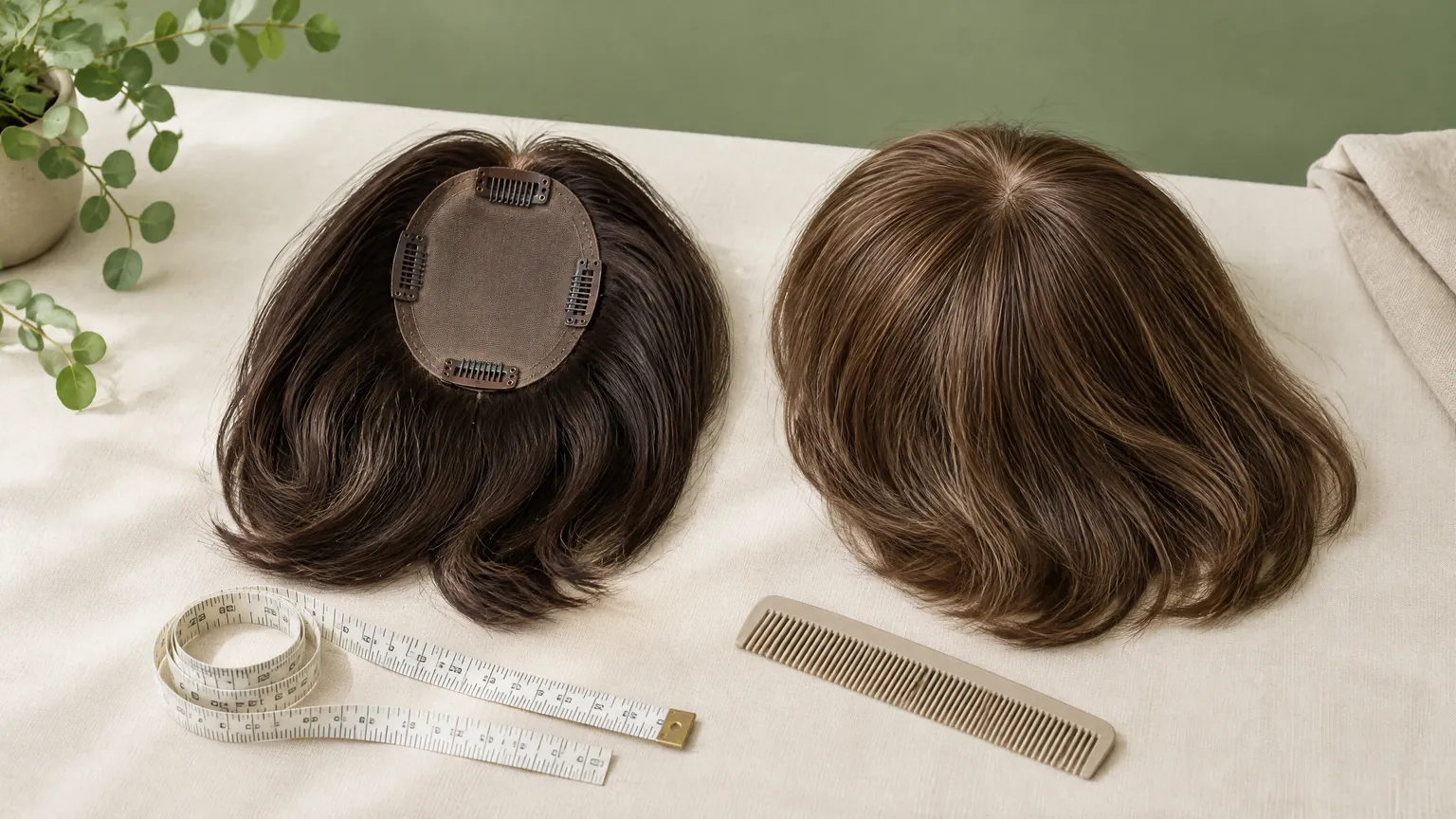
A topper that hides a visible part can still be the wrong fit if its clips land on hair that cannot comfortably support it. Start with two separate questions: what appearance do you want to change, and where could the piece attach without pulling? Neither question requires you to label a hair-loss condition. They require a clear view of your usual hairstyle and a careful comparison with the underside of the proposed piece.
GotGear and OWNSTRAND share ownership. The linked OWNSTRAND pages below are related-site resources for comparing options, not independent recommendations. The practical aim here is to help you take useful observations to a supplier while keeping medical questions with qualified healthcare professionals.
Describe the visible change, not a diagnosis
A part can look different when you move it, flatten the roots or stand under overhead lighting. For a useful appearance comparison, look at clean, dry hair arranged as you normally wear it. Avoid comparing a tightly pulled style with a loose one and assuming that the difference represents a change in hair density. Note whether your concern is a narrow strip along the part, a wider area around it, or the crown behind it.
The American Academy of Dermatology explains that a widening part can occur in female pattern hair loss, but other causes can look similar. It recommends a dermatologist's assessment to distinguish them. A photograph or shopping measurement therefore cannot establish why the change is happening. You can explore cosmetic coverage without treating a product description as a diagnosis or a topper as a treatment.1
When comparing a hair topper for widening part, describe the area you want covered in everyday terms: where it begins, where it ends and whether the concern continues towards the crown. That is more useful for discussing appearance than adopting a seller's hair-loss stage label. Ask the supplier to explain which part of the proposed base covers your mapped area and which parts exist mainly to support attachment.
Keep a simple visual record
If you are comfortable taking photographs, use similar lighting, camera position and hair arrangement each time. One overhead view and a view from behind can help you describe an area that is difficult to see in a mirror. Keep the images private unless sharing them serves a clear fitting purpose. A photograph may help communication, but it does not establish scalp health or prove that a clip position is suitable.
Do not keep moving the part until you find the most alarming angle. Choose the hairstyle you actually want to wear and record what coverage it needs. If the appearance changes noticeably, update the map rather than forcing an earlier measurement to remain correct. Sudden marked shedding, persistent irritation or pain should prompt qualified medical assessment, not simply a search for a larger piece.
Make separate maps for coverage and attachment
Think of the coverage map as the area you want the topper base and hair to conceal in your intended style. The attachment map records where the clips of a particular piece would sit. These maps overlap, but they are not interchangeable. A base might span the visible area while positioning a front clip on the very hair you were hoping not to load.
Use a soft measuring tape and, if helpful, assistance from someone you trust. Record the front-to-back extent and the widest side-to-side extent of the area you want covered. State which measurement is which and use the same unit throughout. Follow the scalp gently without pulling the tape tight. Do not scrape the scalp or tug hair aside to create a sharply defined boundary.
Jon Renau's manufacturer guidance separates the area needing coverage from the hair needed for attachment. It advises measuring in relation to areas with sufficient hair and checking that the hair at the clip locations can support the piece. It also specifies an allowance for its own sizing approach.2 That supports checking beyond the visible strip, but it is not a universal margin or a medical test of hair strength.
Add landmarks to the dimensions
Write down where the proposed front edge would sit relative to your natural hairline and where the back edge would end relative to the crown. Note a side part or an uneven area rather than assuming everything is symmetrical. An outline with these landmarks is more informative than two numbers alone: two areas can share the same maximum dimensions yet have quite different shapes.
At a fitting, compare the underside of the actual piece with that outline. Ask where every clip would land before it is fastened. Hair that looks denser in a picture is not automatically suitable for repeated attachment, and scalp comfort cannot be judged from a catalogue. If the planned clip locations are uncertain, leave the suitability decision open rather than interpreting your map as permission to wear the piece.
Compare the base outline, not just the size label
The base is the foundation that carries the added hair and attachment points. Hair length describes how far the fibres extend; it does not describe the base's coverage. A long-haired piece can have a small foundation, while a shorter style can sit on a wider one. Keep these measurements separate when looking through product descriptions.
Labels such as small or medium are useful only within a stated range. Even a numerical base description needs clarification: which dimension is width, which is front-to-back length, and does the outline taper? A rectangular measurement cannot show a curved front edge or a narrower rear section. Request a clear underside view or a demonstration with the candidate positioned over your map.
| Feature to compare | What it helps establish | What still needs checking |
|---|---|---|
| Front-to-back base extent | Whether the foundation reaches the mapped rear area | Front-edge position and where the rear clips land |
| Side-to-side base extent | Whether the foundation spans the mapped width | Tapered edges and side-clip support |
| Actual outline and clip layout | How the attachment points relate to surrounding hair | Comfort and stability during an appropriate fitting |
| Added hair length and density | How the piece may blend with the intended hairstyle | Bulk, styling demands and suitability for attachment |
| Parting design | Whether the intended part can be represented | The specific product's permitted parting direction |
Use a hair topper base size guide to prepare these comparison questions, rather than treating a size label as a complete fitting decision. Ask how the quoted dimensions relate to the visible outline and whether the clip positions can be shown. A larger base may reach a different attachment area, but bigger is not automatically more comfortable or more appropriate.
Avoid choosing extra coverage solely as insurance against an unknown future change. It may create a different outline to blend or place clips somewhere unexpected. Compare candidates against your present map, then ask what would trigger a reassessment. Manufacturer guidance also recognises that coverage needs and attachment areas can change.2 That makes a repeatable record useful without requiring you to predict a medical outcome.
Treat clip support as a limit, not a challenge
A clip-in hair topper deserves a discussion about attachment as well as appearance. Ask the supplier to show how it would be positioned and removed, and how its clips relate to your existing hair. Do not assume that any visible hair can support any piece, or that a secure-feeling closure proves the attachment is suitable for repeated wear.
The American Academy of Dermatology warns that repeated stress and pulling on hair can cause traction alopecia. Its guidance identifies pain from tightly pulled hair, scalp stinging and crusting as reasons to change the hairstyle immediately.3 This is evidence about tension-related harm, not a clinical certification of a particular topper. The practical implication is to take pulling seriously rather than accepting it as the price of a convincing appearance.
Do not add force, extra backcombing or more clips simply to overcome slipping. Stop and ask whether the base, placement or attachment approach is unsuitable. A painful fitting is not a useful test of endurance. If irritation persists after removal, seek qualified medical advice. Anyone already receiving scalp treatment should ask their healthcare professional about relevant wearing restrictions without expecting the seller to make medical decisions.
Where suitable clip support is absent, compare other forms of coverage instead of forcing a clip-based choice. A full wig or a head covering changes the fitting problem, but neither is automatically free from pressure, rubbing or discomfort. The AAD also notes that tight hair beneath coverings and repeated rubbing can be problematic.3 Changing the product category still requires attention to fit and the way natural hair is arranged.
Test the intended hairstyle and ordinary movements
Once attachment is considered appropriate, inspect the appearance in the style you actually plan to wear. Check the front edge, sides and crown rather than judging only the part from above. Look at how your own hair meets the added hair: a mismatch in curl pattern, length or density may create a visible transition even when the colour seems close.
Parting design matters here. Do not assume that every topper allows the part to be moved freely or that a front edge will work equally well with hair brushed backwards. Ask for the specific piece's restrictions. If your usual look includes a fringe, loose side part or tucked-back sides, show that arrangement before discussing any trimming or styling changes.
With the supplier's guidance, make ordinary gentle movements: turn your head, look down and return upright. Check for a lifting edge or a localised tug. Avoid pulling the piece to prove it is secure. A brief fitting can identify obvious problems, but it cannot establish all-day comfort, so ask what instructions apply if discomfort develops later and what adjustment or follow-up arrangements can be confirmed.
For a Hong Kong routine involving outdoor walking and air-conditioned interiors, ask about the candidate's care after perspiration, drying requirements and removable-wear routine. These are questions about the specific material and construction, not reasons to assume a product will remain comfortable in every setting. Keep any work requirement, such as a head covering, in the discussion because it may change how the piece can be worn.
A hypothetical example: an off-centre part and crown concern
Consider a hypothetical office worker who wears an off-centre part and notices more visible scalp along it, with an additional area at the crown. This is an illustration, not a customer account. Her goal is modest coverage with her existing shoulder-length hairstyle, not a dramatic increase in volume. She records the intended part and maps the crown separately so the fitter can see that the concern is not just a straight strip.
The first candidate appears to cover the part from the front. From behind, however, its base ends before the mapped crown area, and one proposed clip position lies within an area she has marked as uncertain for support. Rather than closing the clip more firmly, she asks to compare another outline and to reassess attachment. The map helps reveal a mismatch; it does not decide whether either piece is safe.
A different base might address the rear coverage while creating an edge that is harder to blend with her normal style. She would therefore compare the underside, the visible result and comfort together. If pulling occurs, the fitting pauses regardless of which option looks better. If she also reports sudden marked shedding or persistent scalp symptoms, the cosmetic discussion does not replace a healthcare appointment.
Take a focused checklist to the fitting
A useful enquiry gives the supplier enough information to compare coverage without asking you to disclose unnecessary medical history. Bring your dimensions, landmarks and intended hairstyle. Describe any discomfort that is relevant to wearing a piece, while leaving diagnostic questions to healthcare professionals. Confirm arrangements directly rather than assuming a particular model is available to try or that changes can be completed immediately.
- Record front-to-back and side-to-side coverage with units and named starting points.
- Mark the crown, intended part and any area where attachment needs further assessment.
- Ask to see the actual base outline and every clip position before fastening.
- Compare the front, sides and rear in your intended hairstyle, not only an overhead view.
- Pause for pulling, pain or scalp irritation; do not solve these by tightening attachment.
- Confirm product-specific removal, cleaning and reassessment instructions before deciding.
Keep the final decision in three parts: enough coverage for your chosen appearance, an attachment approach that is appropriate for your circumstances, and a care routine you can realistically follow. A topper need not answer why a part is widening to be considered as an appearance option. It does, however, need more scrutiny than a matching colour and an appealing photograph.
Common questions
Can I choose a topper by measuring only the width of my part?
No. Record front-to-back coverage as well as width, including any crown area you want concealed. Then compare the candidate's actual outline and clip locations. The visible strip and the hair available for attachment are different considerations, so a measurement alone cannot establish a suitable fit.
Should I move up a base size if the clips pull?
Pause the fitting rather than treating a larger size as an automatic solution. A different outline might move the clips, but it still needs an attachment and comfort assessment. Pain or irritation is not proof of security, and persistent symptoms should be assessed by a qualified healthcare professional.
What should I record if I wear an off-centre part?
Record the part you intend to wear, the widest coverage area and its position relative to the hairline and crown. Note asymmetry rather than centring the map by default. Ask whether the specific topper supports that parting direction and check its rear coverage as well as the front view.
Sources & what they support
The scope below identifies what each reference supports. Citations do not imply independent endorsement of OWNSTRAND or any provider, and do not establish treatment benefits or guaranteed results.
- American Academy of Dermatology: Could it be female pattern hair loss? (opens in a new tab)
A widening part can occur in female pattern hair loss; other causes can look similar, and a dermatologist should distinguish the cause. Does not support diagnosing readers or prescribing treatment.
- Jon Renau: All About That Base (opens in a new tab)
Manufacturer guidance distinguishes coverage area from attachment support, records front-to-back and side-to-side measurements, specifies a sizing allowance for its approach, and recognises changing coverage needs. Used as product-fitting guidance, not independent clinical evidence or endorsement of OWNSTRAND.
- American Academy of Dermatology: Hairstyles that pull can lead to hair loss (opens in a new tab)
Repeated pulling can cause traction alopecia; pain, stinging and crusting warrant changing a tension-producing hairstyle. Tight hair beneath coverings and rubbing can also be problematic. Does not certify any topper or attachment method as safe.