
Men’s wigs, toupees and hair systems: choose coverage before terminology
GotGear and OWNSTRAND share the same owner. This collection is not an independent recommendation. GotGear does not supply wigs or medical treatment; actual wig services are provided by OWNSTRAND, whose only known studio is in Kwun Tong. These articles provide general information, not medical advice.
The short answer
A full wig covers the scalp, while a toupee usually covers a local area, particularly the top of the head, and blends with the hair left around it. Hair system is a broader label that does not, by itself, tell you the coverage or attachment method. Start with the area you want to cover, then check the base, fit, styling and removal routine. These practical details matter more than whether a seller uses a traditional or newer name.
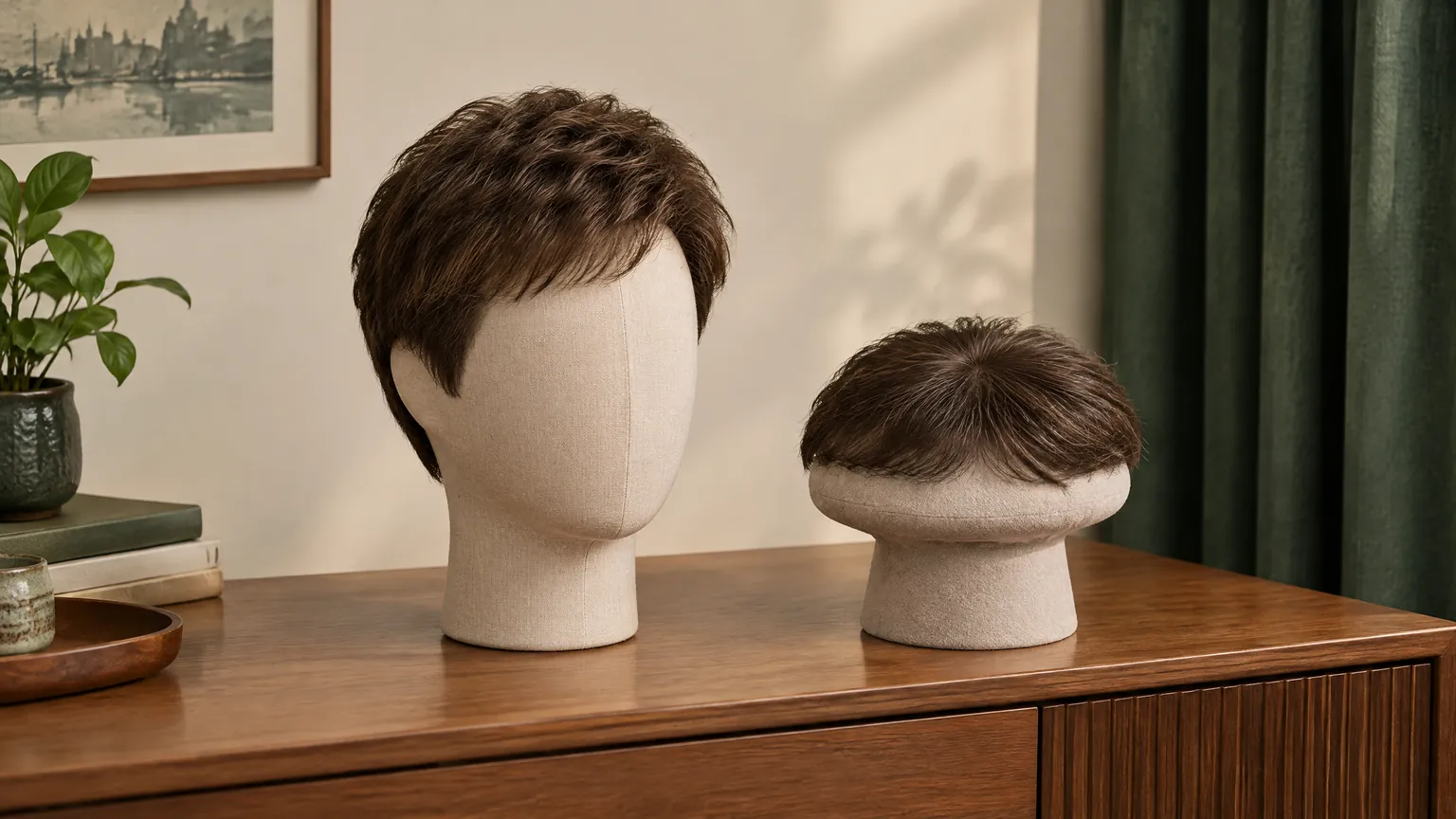
A man looking for more coverage at the crown may encounter wigs, toupees, toppers and hair systems in the same search. The names overlap, but the products do not necessarily do the same job. A piece that depends on blending with hair at the sides is a different proposition from a cap that supplies the whole hairstyle. Choosing well starts with understanding that difference, rather than finding the most reassuring label.
GotGear and OWNSTRAND share ownership. The linked pages in this article are resources for checking product descriptions, not independent recommendations.
Full coverage and local coverage solve different problems
A full wig is designed to cover the entire scalp. A toupee is generally a partial piece used over an area of thinning or baldness, especially on the top of a man’s head. A published dermatology review makes this distinction explicitly. The National Alopecia Areata Foundation also separates full wigs from toppers, which blend with existing hair to provide local coverage and volume.1
Full coverage can be worth considering when you want the front, sides, crown and back supplied as one hairstyle. It does not require you to match a separate top piece to an exposed lower section in the same way. That does not eliminate fitting work: the cap still has to sit correctly, the front edge needs an appropriate position, and the shape around the ears and nape needs attention. Full coverage is also an appearance choice, not a category reserved exclusively for someone with complete hair loss.
When browsing men's wigs, use the category as a starting point and check whether the individual option actually provides full-scalp coverage. Ask how your existing hair would sit underneath it and whether the supplied shape can be adjusted to the hairstyle you want. A category name cannot tell you how a particular cap will feel or how much fitting it requires.
Local coverage leaves some of your own hair visible. The useful question is not simply whether you have enough hair left, but where that hair is and how it meets the edge of the piece. Hair retained around the temples does not automatically provide a good match for a piece intended only for the crown. The coverage shape must correspond to the area you want to disguise.
What a toupee tells you, and what it does not
Toupee usually points towards partial coverage at the top rather than a whole-head cap. It does not specify a single fibre, base material or fixing method. The dermatology review describes matching the proportion of grey hair and notes that some toupees can be supplied uncut for styling with the wearer’s own hair.1 These are useful design considerations, not promises about any particular seller’s service.
A toupee information page is therefore most useful when read alongside a description of the proposed coverage area and the hair that will remain visible. Check whether the front hairline is included, how the back edge would meet your own hair, and who would handle the initial cut and later blending. Do not assume that every local piece comes ready to match your existing haircut.
Density deserves the same attention as colour. A very full top can look disconnected from finer hair at the sides, even if the shade is close. Check the transition from several angles rather than judging only a front-facing photograph. Texture, direction and length also affect whether the two sections read as one hairstyle. These are appearance checks you can make without trying to diagnose why the hair has thinned.
Hair system is a label that needs a specification
The words hair system can describe different arrangements. NAAF’s glossary even defines a wig as a removable hair system offering full scalp coverage. The dermatology review separately describes hair integration systems, in which existing hair is drawn through openings in a mesh.1 Neither usage supports treating every product called a system as a bonded top piece, or treating every system as interchangeable with a full wig.
If you are comparing a hair system, translate the label into a short practical specification: the area covered, the base shape, the attachment method and the intended removal routine. Ask whether the description refers just to the hairpiece or also to fitting and ongoing maintenance. The word system alone does not establish what work is included or which arrangements are available.
This matters when two descriptions seem similar. One may describe a removable crown piece; another may describe a piece intended for an adhesive routine. They might provide similar coverage but require very different handling. Conversely, two differently named products may have similar bases and coverage. Compare the construction and instructions, not a presumed hierarchy in which a newer term automatically means a better result.
Compare the physical choices side by side
The table below is a reading aid, not a universal classification of every catalogue. The coverage distinctions are supported by the review and NAAF; the questions help expose details a label leaves unanswered.1
| Description you encounter | Coverage to establish | Main practical issue | Question to ask |
|---|---|---|---|
| Full wig | Entire scalp, including sides and back | Cap fit and the whole hairstyle | How will the cap accommodate my own hair and fit around my ears? |
| Toupee or local hairpiece | A defined area, often the top | Matching the exposed surrounding hair | Where will each edge sit, and who will blend the cut? |
| Topper | Local coverage, often at the crown | Blending and any reliance on existing hair for clips | What hair must remain available at the attachment points? |
| Hair system | Full or partial; ask rather than infer | The specific base and maintenance arrangement | What exactly is supplied, and how is it fitted and removed? |
Separate fibre from coverage. Both full wigs and partial pieces can use human hair or synthetic fibres. Traditional synthetic fibres are designed to hold their style, while heat-friendly synthetics permit limited heat styling under the maker’s instructions. Human hair generally involves more washing and styling work.2 None of those fibre descriptions establishes whether a piece covers the entire scalp or how it attaches.
Likewise, a lace front describes a feature at the front hairline, not a full coverage map. NAAF explains that a lace front can be combined with other cap constructions.2 If your preferred style leaves the forehead exposed, ask to see the front edge in that style. If the main concern is a crown parting, examine that area too; one attractive hairline photograph cannot answer both questions.
Attachment and removal are separate decisions
The review identifies clips, tape and adhesive among hairpiece attachment options. Clips allow removal when desired, but repeated use at the same site can cause hair breakage, and the weight of a piece pulling on existing hair can be a concern.1 A smaller base therefore should not automatically be described as gentler. What matters is how the actual piece is supported and how that support feels.
Macmillan advises checking how a wig stays in place and notes that clips may be usable when some existing hair remains. It also explains that a liner can change how much a wig moves.3 These points show why security is a fitting question rather than an adjective on a product page. Any accessory has to be assessed together with the piece, not assumed to improve every fit.
Ask for the correct fitting and removal instructions for the proposed arrangement. Do not infer that an adhesive product is intended for sleeping, swimming or continuous wear simply because it is called a system. Nor should a general guide to removable wigs be applied unchanged to a bonded piece. Clarify what you can do yourself, what requires assistance and how you would manage removal if discomfort develops.
Persistent irritation, pain or sudden marked hair loss should be assessed by a qualified healthcare professional. A cosmetic fitting is not a diagnosis or a treatment. If you are receiving medical treatment that affects scalp sensitivity, ask your care team about suitable attachment materials and removal; Macmillan makes this caution specifically for people receiving cancer treatment.3
Fit the choice to an ordinary week
Workdays, exercise and getting ready
Describe your routine in concrete terms. A short walk from public transport, a long outdoor shift and exercise after work create different practical questions. Rather than asking whether a piece is suitable for Hong Kong’s weather in general, ask how to manage sweat, clean the base and remove the piece under its specific instructions. A material name is not a guarantee of comfort throughout a humid day.
If you want to remove the piece every evening, say so at the outset. If morning handling needs to be straightforward, ask to see the placement process and the checks for correct orientation. Macmillan recommends becoming accustomed to a wig at home and removing a removable wig at night and for showering.3 That guidance should not be taken as a maintenance schedule for a different, bonded arrangement.
Haircuts, washing and styling
A partial piece has a continuing relationship with your own haircut. As the sides and back grow, the transition may need attention even when the piece itself has not changed. Ask how to keep that relationship consistent and who should make adjustments. With full coverage, ask instead how to manage the hair underneath and whether the cap fit needs reassessment when your own hair changes.
Get care instructions for the actual fibre and base. NAAF describes different maintenance demands for traditional synthetic, heat-friendly synthetic and human hair products.2 Macmillan also stresses following wig-care guidance.3 Do not transfer a heat-tool setting or cleaning method from one product to another merely because both are marketed to men.
A hypothetical crown-coverage decision
Consider this hypothetical example: a man has a visibly thin crown, keeps hair at the sides and back, wears glasses and wants to remove his piece at home each evening. He prefers a modest amount of volume rather than a much fuller hairstyle. This is an invented planning example, not a customer account or a claim about results.
A local piece is worth comparing because it addresses the crown while leaving his existing lower haircut visible. He would still need to establish the base footprint, the available attachment points and the transition at the back. If the piece uses clips, the condition of the hair at those points matters. If another proposed arrangement uses adhesive, its removal requirements must match his preference rather than being assumed equivalent.
A full wig offers a different comparison: it supplies the sides and back too, but he must check how his retained hair affects cap fit and how the ear area works with his glasses. Neither option wins by name. The decision turns on the fitting, the visible blend and the routine he can realistically maintain.
Bring a coverage brief to the fitting
You do not need technical vocabulary to prepare a useful enquiry. A recent photograph of your usual hairstyle can communicate shape and colour, while a written description can explain the area you want covered. Share only what is necessary for the appearance discussion; a retailer does not automatically need your full medical history. If photographs are requested, ask how they will be used and whether you can proceed without unnecessary images.
Use this checklist to turn a broad enquiry into specific decisions:
- Identify whether you want crown-only, top-and-front or full-scalp coverage.
- Describe the hair you intend to keep visible, including grey proportion and usual cut.
- State whether you want regular removal at home and ask how that would work.
- Check the front, crown, side and back views in your intended style.
- Try your glasses with the proposed fit and mention any required headwear.
- Request product-specific washing, drying, attachment and removal instructions.
- Confirm which measurements, cutting, adjustment and follow-up work are included before proceeding.
During an agreed fitting, check whether ordinary movements disturb the position and whether you can recognise the correct placement yourself. Ask for a demonstration rather than accepting reassurance that a piece is simply secure or natural-looking. Record the actual coverage and handling details so that later comparisons refer to the same requirements. The clearest choice is the one you can describe without relying on its marketing name.

Common questions
Can a product called a hair system cover the whole head?
Yes, the term is not restricted to local top pieces. NAAF’s glossary uses hair system when describing a full-coverage removable wig. Ask for the actual coverage map, base construction and attachment instructions. The label alone does not establish whether a product covers the crown, includes the front hairline or supplies the sides and back.
What if my crown is thin but my sides still have hair?
Compare a local piece with a full wig rather than assuming one is mandatory. A local piece needs a suitable edge transition and a colour, texture and density that work with the visible hair. A full wig supplies the whole hairstyle, but you still need to check cap fit over the hair you retain.
Does choosing a toupee mean I can remove it every night?
Not necessarily. Toupee describes a type of partial coverage, not a single fixing method. Clips, tape and adhesive arrangements have different handling requirements. Tell the provider that evening removal matters to you, then ask for a demonstration and product-specific instructions. Do not infer a removal or overnight-wear routine from the name alone.
Sources & what they support
The scope below identifies what each reference supports. Citations do not imply independent endorsement of OWNSTRAND or any provider, and do not establish treatment benefits or guaranteed results.
- All that a Dermatotrichologist needs to know about Hair Camouflage: A Comprehensive Review (opens in a new tab)
Distinguishes wigs covering the entire scalp from toupees covering local top areas; describes hair integration systems, grey matching, attachment options and potential breakage from repeated clipping or traction.
- NAAF: Wigs and Toppers — Understanding the Basics (opens in a new tab)
Distinguishes full wigs from partial toppers, describes fibre and cap construction choices, explains lace-front combinations and defines a wig as a removable full-coverage hair system.
- Macmillan Cancer Support: Wigs for cancer treatment (opens in a new tab)
Supports fitting and security checks, the role of remaining hair in clip use, possible movement with liners, care instructions and removable-wig routines; advises people receiving cancer treatment to consult their care team about tape and removal.