
The best multi purpose room furniture Hong Kong, when incorporated into a plan, supports the priority activities without making routine resets impractical. Compare handling effort, storage volume, user suitability and cleaning needs across complete layouts before choosing a furniture mix.
Rank activities before selecting multi purpose room furniture Hong Kong
Start by ranking the room’s top activities in order of institutional priority and reset difficulty: assemblies, exams, training, community meals, movement classes, town-halls or worship. Consider who participates (students, elderly users, wheelchair users, mixed corporate teams), the capacity each activity demands, and the tightest turnaround between bookings. When planning multipurpose-room furniture, Hong Kong teams should map the most demanding reset scenario and choose families that serve this without burdening daily use.
Translate that ranking into measurable requirements. Record clear internal dimensions, door and corridor widths, lift car and door sizes, and any gradients or thresholds on the route to store. Ask your building manager for the permitted floor load and any noise or protection rules. Build a comparison sheet requesting unit weight, open and folded footprint, stack height per trolley (as a data field, not a fixed value), surface and edge materials, underframe type, glide or castor diameter, linking/ganging method, signage or row-number options, and availability of writing tablets or modesty panels where needed. For upholstered items, request the manufacturer’s statements of materials and any fire-performance documentation only if required by your venue or insurer. Capture photo references of finishes under your actual lighting so you can judge glare for exams and colour fidelity for AV-heavy events.
Test layouts with each user group for multi purpose room furniture Hong Kong
Prove the shortlist by running layout tests with each user group. Mark plans on the floor with tape, then populate with sample chairs and tables or accurate cardboard footprints. Time a full reset with the volunteers who will actually handle the kit, including the lift run, turning at corridor corners, and parking in store. Observe wheelchair turning circles, bag-stowage, sightlines to stage and projection, and audibility. Note trip risks at table feet, or chair feet catching cable covers.
Ask suppliers for scale drawings, CAD blocks, and—where feasible—demonstration units for a supervised mock-up. Validate egress aisle widths and door clearance with your building manager and competent safety adviser for the proposed event modes; do not assume a classroom layout suits assemblies. Capture handling notes such as who operates flip-top latches, how ganging clips are fitted, and whether gloves are required. When comparing written quotations, confirm the same scope: accessories (clips, trolleys, linking plates), delivery to the operating floor, stair carries if lifts are unsuitable, and packing removal. Request bilingual quick set-up guides so caretaking teams and volunteers can reproduce tested layouts consistently.
What should buyers compare for multi purpose room furniture Hong Kong?
| Criterion | Straightforward requirement | More complex requirement | Evidence to provide |
|---|---|---|---|
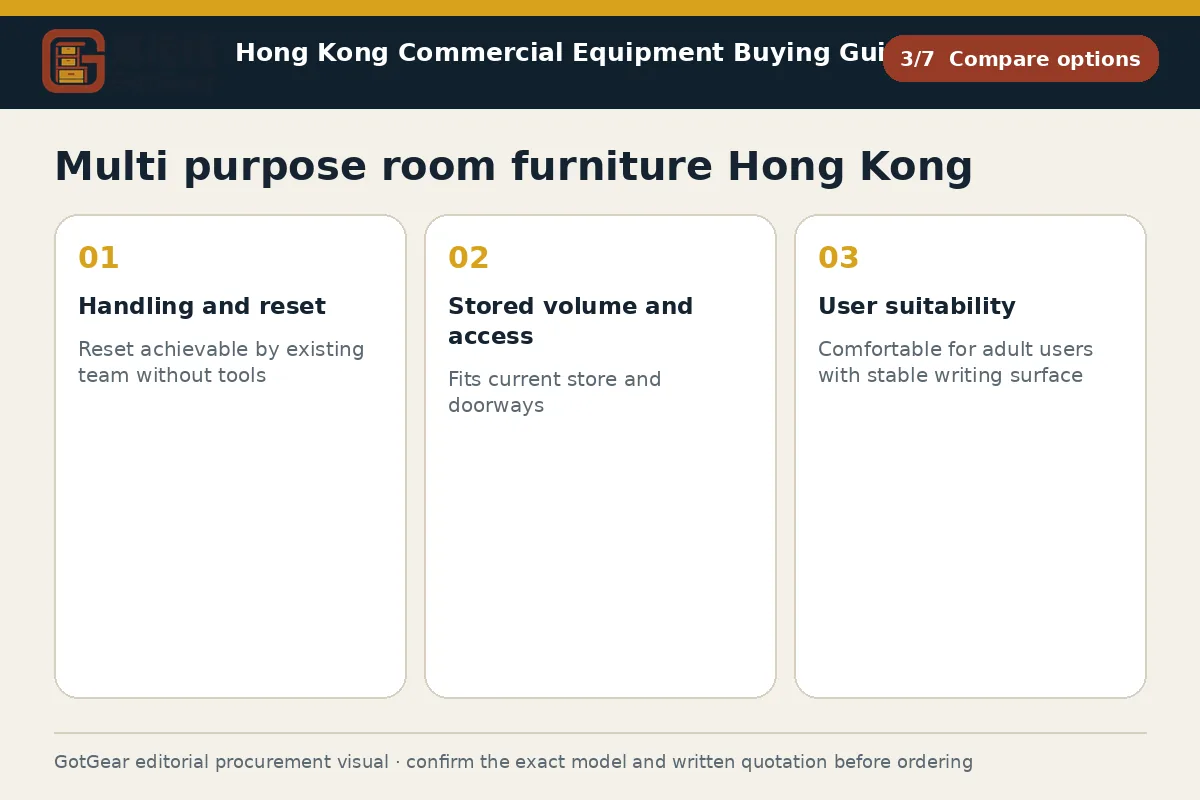
| Handling and reset | Reset achievable by existing team without tools | Example: two staff to reconfigure 60 seats in 10–15 minutes; confirm locally | Provide team size, reset timing window, lift booking and route notes |
| Stored volume and access | Fits current store and doorways | All trolleys fit lift car and turning space on route to room | Submit room/store drawings, door and lift dimensions, turning radii |
| User suitability | Comfortable for adult users with stable writing surface | Mix covers children/elderly users and wheelchair spaces where planned | Share user profiles, target seat heights, armrest needs, wheelchair counts |
| Durability and cleaning | Wipe-clean, sealed finishes suitable for routine disinfectants | Humidity-tolerant materials and available spare glides/parts | State cleaning chemicals, humidity concerns, spare-part expectations |
| Documentation and approvals | Bilingual spec and maintenance guides supplied | Relevant test summaries or declarations if required by venue/insurer | List documents required, approval process owner, any insurer notes |
This framework helps buyers create comparable written enquiries. Final model specifications, availability, delivery and commercial terms must be confirmed in a formal quotation.
Plan storage and handling for multi purpose room furniture Hong Kong
Storage and handling determine whether good layouts can be used in real life. Choose furniture families that stack, fold or flip densely, and specify compatible trolleys with brakes, corner bumpers and castors sized for your floor finish. Map the store’s clear length, depth, height and door swing, and route to the room, including lift car dimensions and allowable axle loads as provided by the building manager. In industrial buildings, align deliveries with management-office loading windows and vehicle restrictions.
Use provisional calculations only as starting points to discuss with suppliers. Example starting point: allow approximately 1.5–2.0 m² floor area per 100 linking chairs on trolleys, and keep loaded trolley heights within typical lift clearances; confirm your actual limits in writing. Example starting point: a flip-top training table might occupy 0.12–0.18 m³ when folded; ask for precise folded dimensions and stack spacing for your chosen model. In humid conditions, prefer corrosion-resistant frames and fasteners, sealed edges and non-absorbent tops.
In your RFQ, request trolley specifications (overall dimensions, wheel diameter, tyre material, brakes), recommended maximum stack heights, protective covers, and the estimated gross weight of typical loads. Ask for handling instructions and any risk notes for manual handling. On delivery day, coordinate a clear route, lift booking and temporary floor protection, and ensure all packaging is removed to store cleanly.
Set cleaning and inspection routines for multi purpose room furniture Hong Kong
Write cleaning and inspection routines into the purchase decision so teams can keep furniture safe and presentable. Obtain the manufacturer’s care instructions and confirm surface compatibility with your disinfectants and detergents; test on an offcut or unseen area. In Hong Kong’s humidity, prioritise wipe-clean, sealed finishes, ventilated storage and dry-down time after mopping. Example starting point: schedule a quick weekly hardware check for loose fasteners and glides, then adjust interval after your risk review.
Define acceptance checks on receipt: match quantities and finishes to the purchase order, inspect for transit dents, wobble, sharp edges, snags on upholstery, and proper operation of folding or flip mechanisms. Photograph any non-conformance before signing the delivery note and seek written resolution from the supplier. If your venue or insurer requires it for the chosen model, request relevant declarations or test summaries (for example, structural load or upholstery fire performance); the model specification and formal written quotation always prevail. Keep a simple register noting issue dates, repairs and replacement parts used, and store bilingual cleaning guides close to the store so caretakers and volunteers can follow the same standard between resets.
Multi purpose room furniture Hong Kong decision checklist
Confirm priority activities, capacities and the most demanding reset scenario, then measure the room, store and full access route, including lift car and door sizes. Build a like-for-like RFQ requesting unit weight, open/folded footprints, stack density per trolley, materials, glides or castors, and compatible accessories. Ask for trolley specifications, delivery-to-floor service and bilingual quick guides. Test layouts with users, time a full reset and validate egress with building management. On receipt, inspect finishes and mechanisms before signing. For models where your venue or insurer requires it, collect relevant declarations or test summaries. Use this guide to compare specifications and prepare a written enquiry so quotations can be weighed fairly against the agreed scenario.
- Operating use, quantity and expected frequency
- Dimensions, capacity, material and accessory requirements
- Delivery address, floor, goods lift and loading window
- Required documents, acceptance checks and after-sales arrangements
Key points for multi purpose room furniture Hong Kong
Hong Kong venues face tight goods-lifts, narrow corridors and small stores, so folded size, stack stability and trolley manoeuvrability matter as much as comfort. Many buildings also require delivery bookings and dock passes via the management office, which can constrain reset schedules. Humid summers challenge finishes and hardware if cleaning leaves moisture trapped. Prepare bilingual set-up and care notes for mixed teams, and confirm any event-mode limits with your building manager. This guidance is operational, not legal advice.
Questions about multi purpose room furniture Hong Kong
How much store space do we need for chairs and tables?
As a starting point only, plan an indicative area with suppliers using your exact models and trolleys. For example, 100 linking chairs on trolleys might occupy around 1.5–2.0 m² and a bank of ten flip-top tables could need about 1.5–2.5 m in lineal parking. Treat these as discussion figures and confirm final volumes from manufacturer drawings and a site measure.
Which finishes cope best with humidity and frequent cleaning?
Favour corrosion-resistant frames (aluminium or properly coated steel), sealed edges, polypropylene shells and high-pressure laminate or compact laminate tops. These typically tolerate neutral detergents and routine disinfection. Always verify chemical compatibility with the manufacturer for your chosen model, test on a discreet area first, and ensure storage allows air circulation so moisture cannot linger in stacks.
Can one table type cover exams and banquets?
Often yes—shortlisted flip-top or folding tables with stable frames, discreet latches and non-glare tops can serve both. For exams, prioritise depth, modesty coverage and cable management if power is used; for banquets, check linen compatibility and edge protection. Confirm dolly options, turning space and lift fit so resets between modes stay practical within your booked windows.
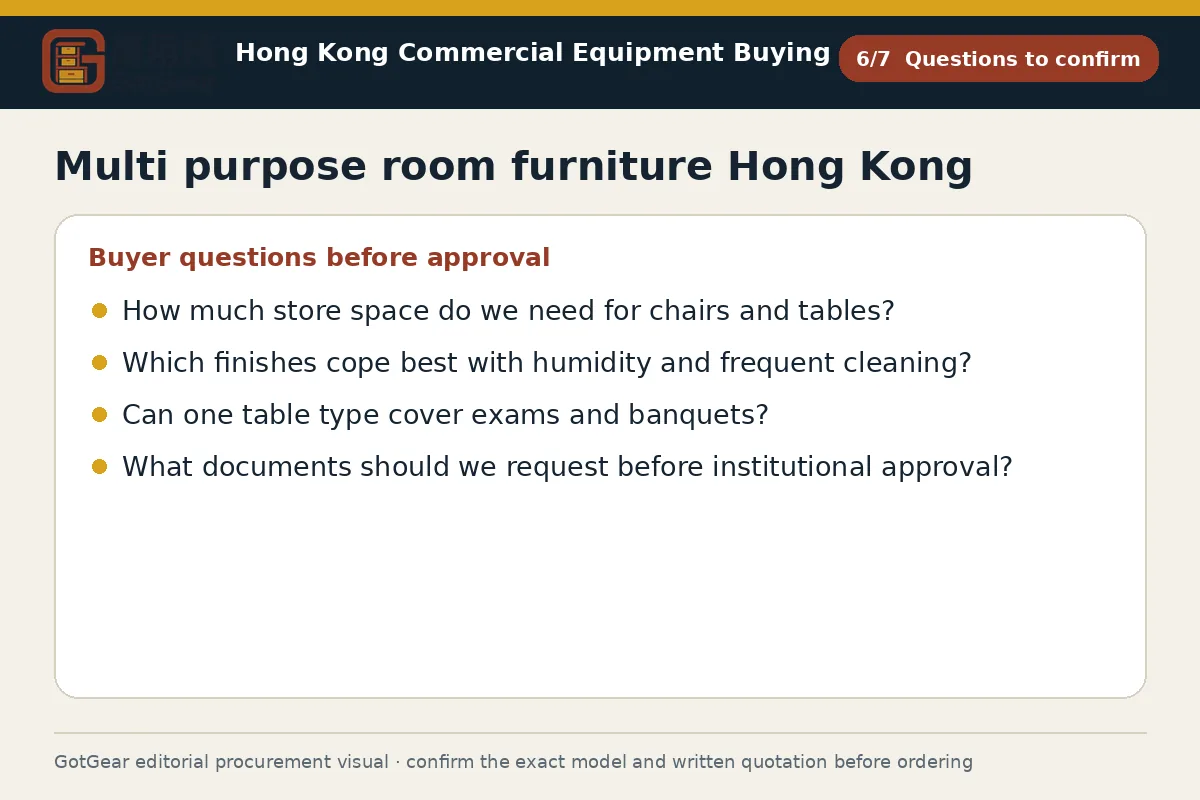
What documents should we request before institutional approval?
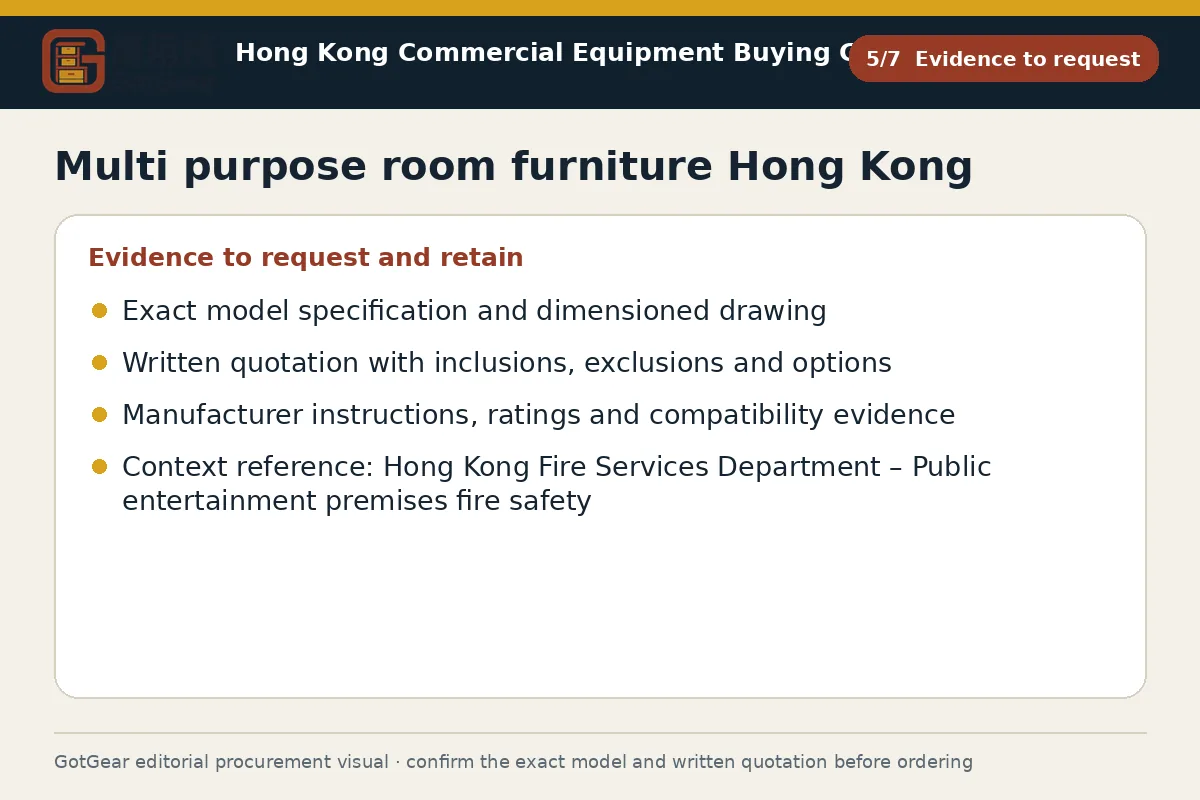
Ask for detailed specification sheets, assembly and maintenance instructions, finish samples, and—if applicable for your venue or insurer—relevant test summaries or declarations (for example structural or upholstery fire performance). Request trolley and handling data, warranty statements, and bilingual quick set-up guides. The model specification and formal written quotation define the offer; seek written clarifications for any assumptions.
Continue with closely related procurement topics
These pages share equipment, operating or decision-stage signals with this guide.
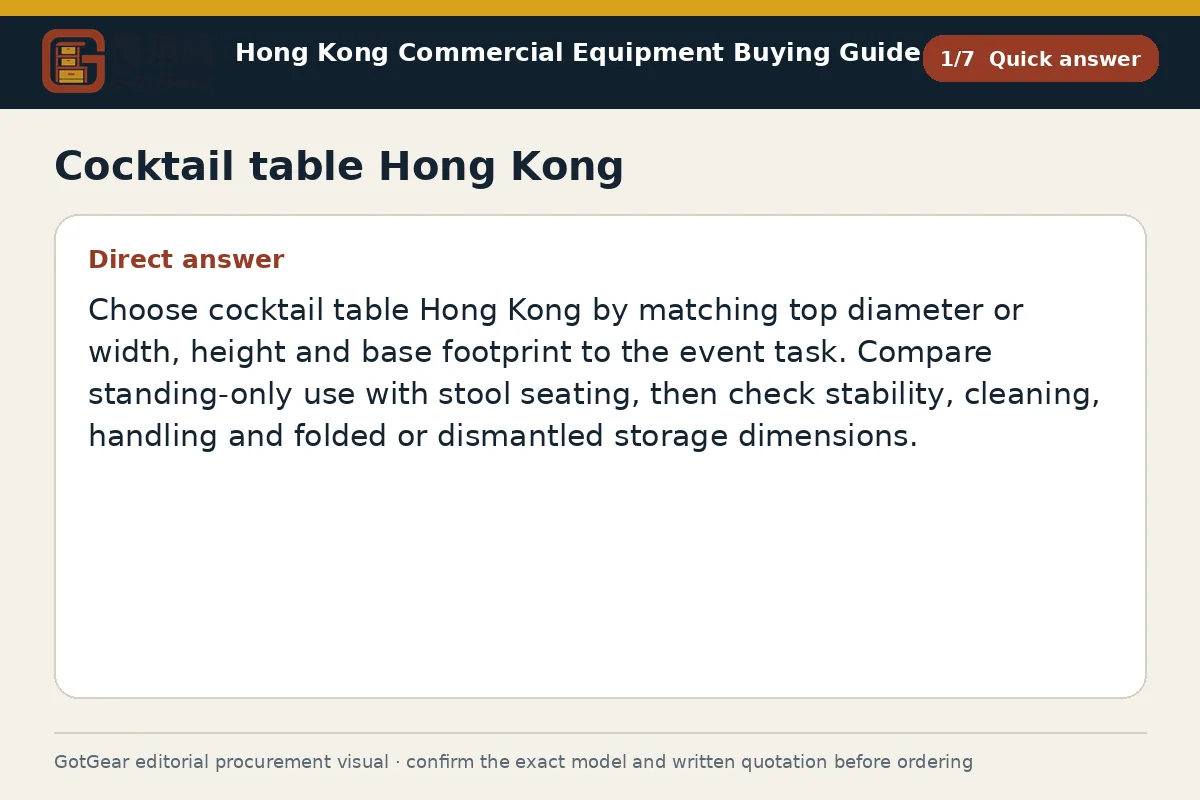
Cocktail table Hong Kong
GotGear explains how a cocktail table Hong Kong performs in terms of top diameter, height, floor footprint, stability, circulation and storage. It also outlines how it differs from a bar height table Hong Kong.
Read the guide
Flip top training table Hong Kong
GotGear guides buyers on comparing a flip top training table Hong Kong by folded footprint, movement routes and joining options. It also covers nesting training table Hong Kong and modular training table Hong Kong designs.
Read the guide
Stackable chair with armrest Hong Kong
GotGear compares stackable chair with armrest Hong Kong and stackable chair with casters Hong Kong in a review that evaluates access and table fit, stacking method, mobility and floor behaviour across available models.
Read the guide
Chair ganging clips Hong Kong
GotGear provides a checklist for chair ganging clips Hong Kong that guides assessment of chair compatibility, secure connection and release, row layout, floor conditions and inspection for linked chair row seating Hong Kong.
Read the guideRelated topic indexOpen more English procurement pages1 topics
Browse additional equipment families, applications and procurement questions relevant to a wider buying brief.