
For community hall furniture Hong Kong, prioritise furniture that the responsible team can safely set up, use and store for the hall’s actual programme. Compare quotations against the same item schedule, dimensions and handling requirements, and verify manufacturer instructions, site conditions and applicable Hong Kong requirements.
List users and events for community hall furniture Hong Kong
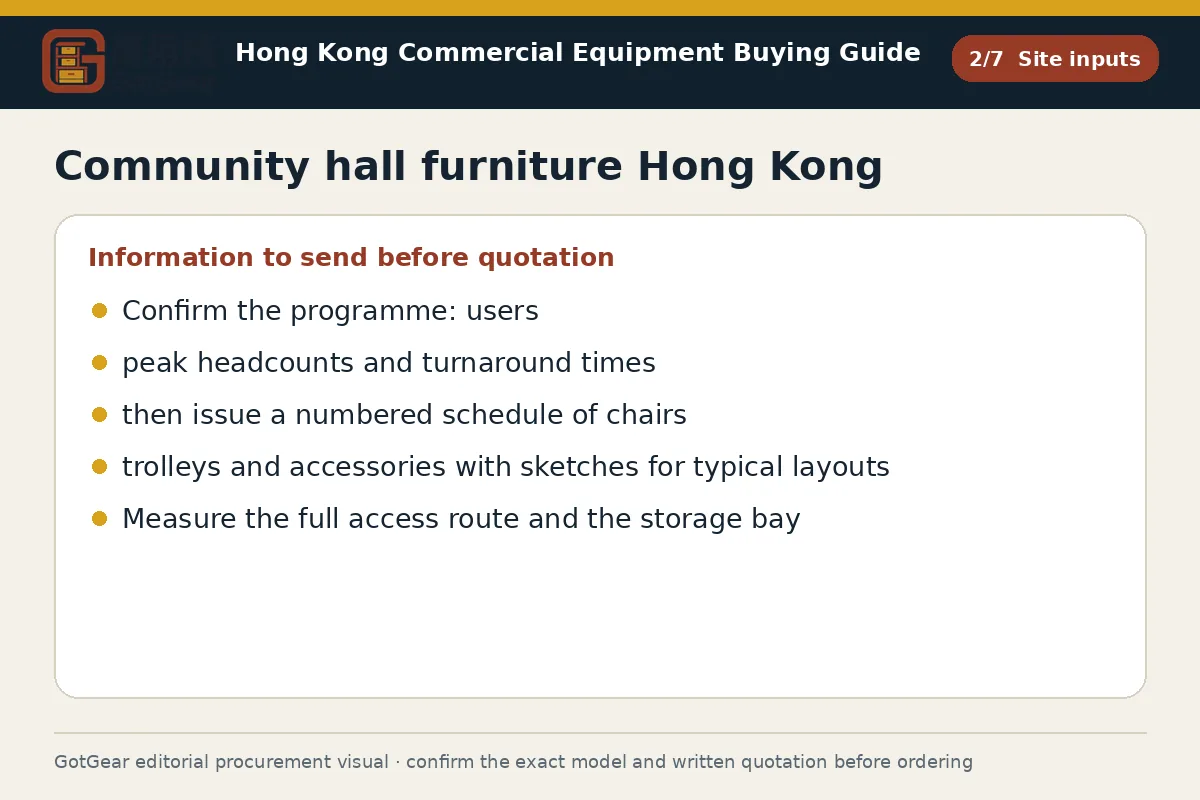
Begin by mapping who will use the hall, how often, and for what purposes. List regular users (senior clubs, youth groups, faith services, classes) and occasional users (fairs, ceremonies, community meals, rehearsals). For each user type, state the expected headcount, preferred layouts and the turnaround times required between bookings. Use common layout names so quotations align: theatre, classroom, banquet, cabaret, examination and exhibition. Note any speaker platform, AV control table, registration desk or coat stand. Record who moves furniture for each booking (venue team, contractor, or organiser) and the level of supervision available.
Translate this into a numbered-item schedule covering: chairs, folding tables, lectern, stack/dollies, chair trolleys, table trolleys, screens, mobile stages and storage accessories. For every layout show minimum and peak quantities and the reset time available. Flag mobility and safeguarding needs such as armchairs on aisle ends, prams parking and wheelchair spaces. For consistency across suppliers, attach a sketch for each event seating layout Hong Kong, which buyers commonly recognise, with aisle locations and emergency exits clearly marked by the venue. This schedule also anchors the enquiry for community hall furniture Hong Kong so that respondents quote for the same scope rather than make assumptions.
Include access and cleaning needs in community hall furniture Hong Kong
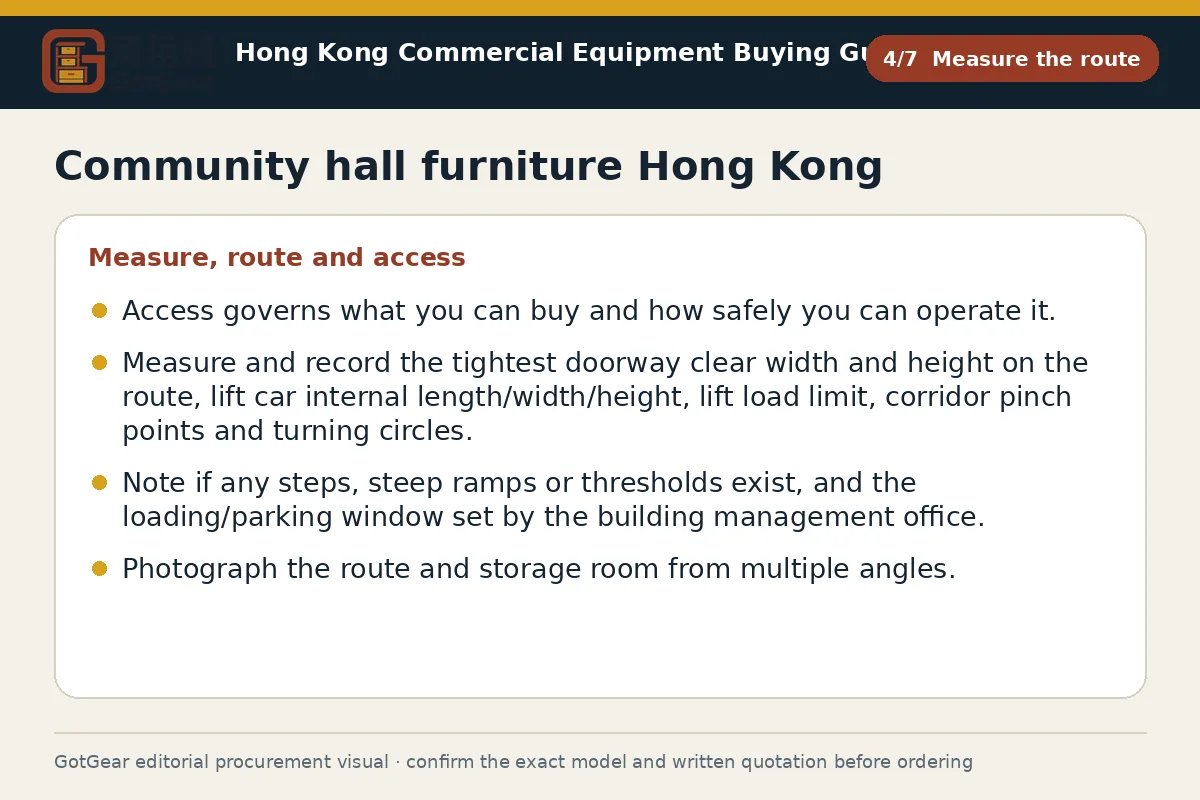
Access governs what you can buy and how safely you can operate it. Measure and record the tightest doorway clear width and height on the route, lift car internal length/width/height, lift load limit, corridor pinch points and turning circles. Note if any steps, steep ramps or thresholds exist, and the loading/parking window set by the building management office. Photograph the route and storage room from multiple angles. Ask suppliers to confirm folded/stacked dimensions and trolley turning radii against these site constraints in writing.
Cleaning and durability need equal weight. State floor types (timber sports floor, vinyl, tile, carpet) so glides and castors can be matched to avoid marks. Specify wipe‑clean surfaces and rust‑resistant frames if storage is humid; request written care instructions and compatible disinfectants in bilingual format. Where fabrics are proposed for acoustic or comfort reasons, ask for spill protection options and removable or replaceable covers. If you expect open food service, ask for edge protection on table tops and sealed panel edges to prevent moisture ingress. Identify where wet items can air‑dry without blocking egress routes.
What should buyers compare for community hall furniture Hong Kong?
| Criterion | Straightforward requirement | More complex requirement | Evidence to provide |
|---|---|---|---|
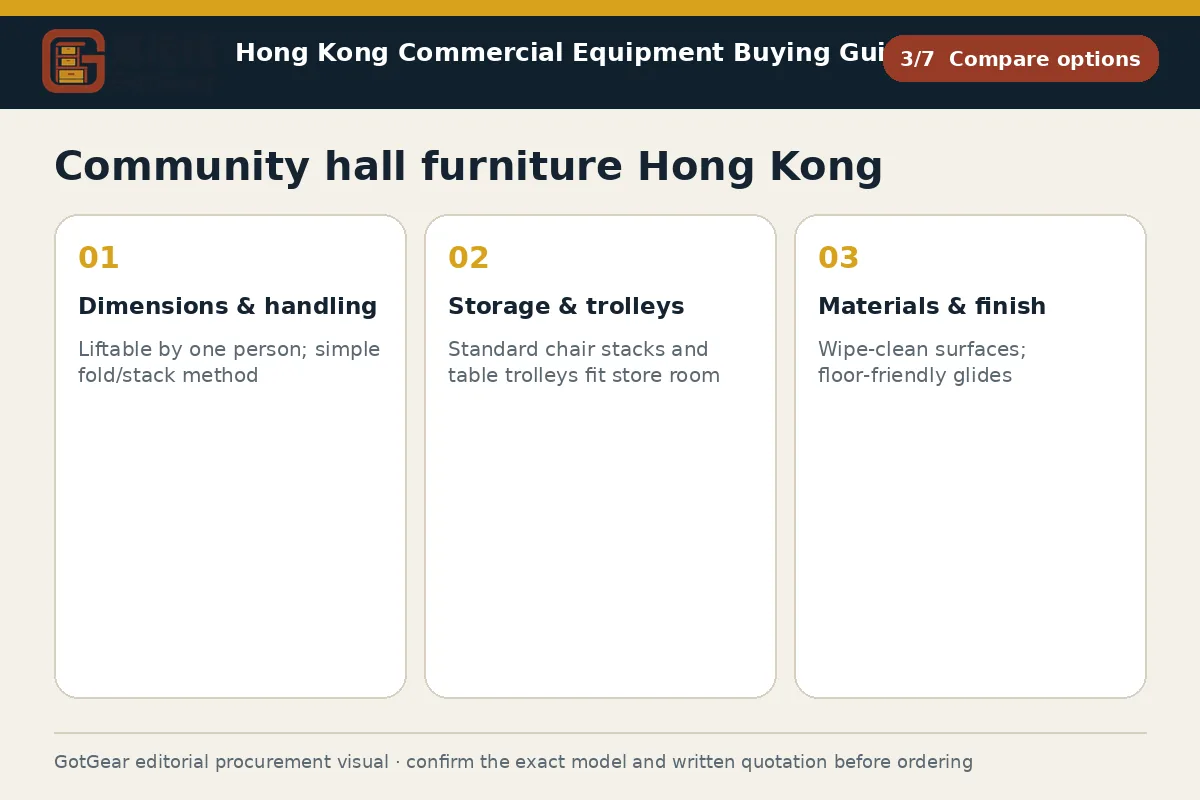
| Dimensions & handling | Liftable by one person; simple fold/stack method | Set maximum unit weight, folded thickness and stack height suited to routes | Measured doors, lift car and turn spaces; route photos; reset time |
| Storage & trolleys | Standard chair stacks and table trolleys fit store room | Defined bay size; specify stack footprint and trolley turning radius | Store dimensions, ceiling height, door width; floor type; proposed trolley drawings |
| Materials & finish | Wipe‑clean surfaces; floor‑friendly glides | Humidity‑resistant frames; edge protection; fabric care and replacement plan | Cleaning agents list; humidity note; finish colour/texture samples |
| Event controls | Basic static seating for meetings | Row linking, numbering and gangways aligned with licence/insurer needs | Layout sketches; aisle positions; accessory compatibility statements |
| Delivery & aftercare | Weekday delivery with packaging removal | Lift booking support; bilingual labels; spares, warranty and method statement if requested | Loading window, vehicle limits; building rules; warranty terms; contact for aftersales |
This framework helps buyers create comparable written enquiries. Final model specifications, availability, delivery and commercial terms must be confirmed in a formal quotation.
Set handling and storage limits for community hall furniture Hong Kong
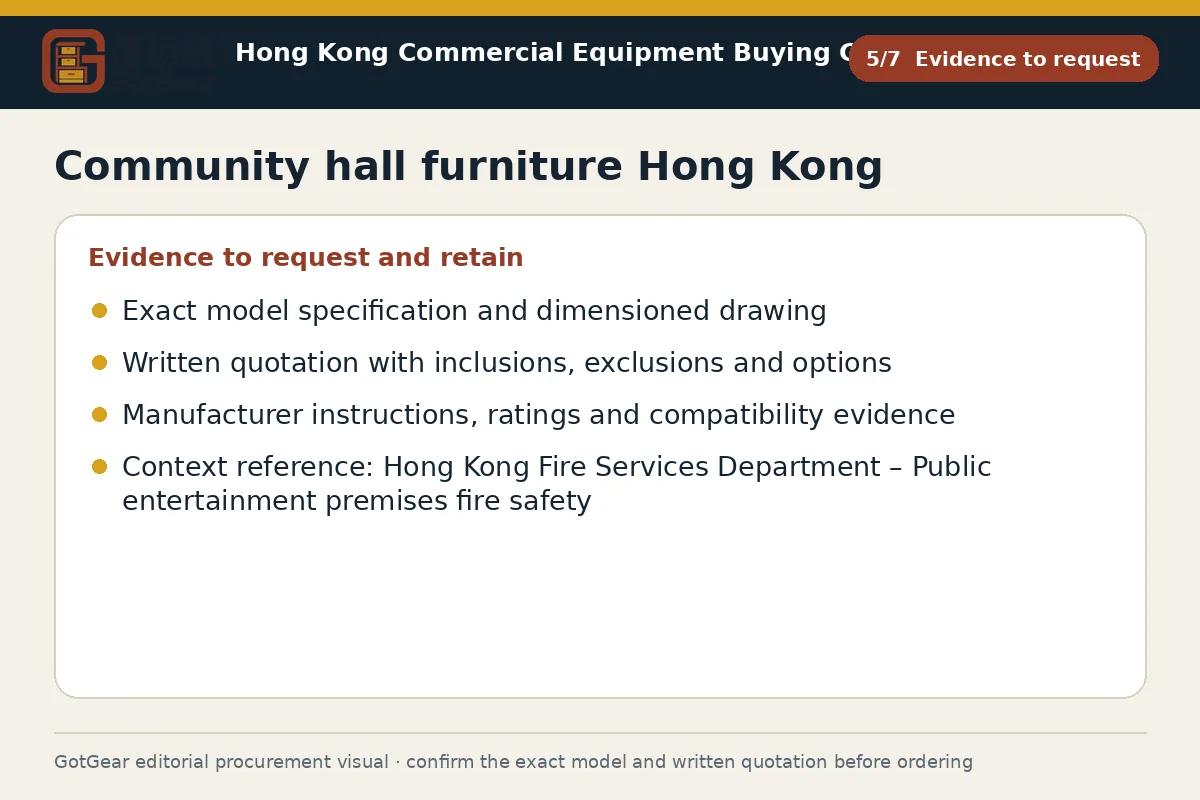
Handling and storage limits protect users, furniture and the building. In your enquiry, set out the maximum acceptable unit weight for manual handling, preferred stack height per chair type, and the maximum push weight for loaded trolleys. Any figures should be framed as an example starting point and confirmed by the supplier and your safety adviser after a site review. Ask manufacturers to state recommended stack quantities, trolley compatibility and whether linking clips or chair frames can be moved while stacked. Record the minimum reset time available so respondents can propose realistic handling methods.
Define the storage bay: internal dimensions, door width, ceiling height, ventilation, floor loading information if known, and sprinkler head clearances if applicable per the building manager. Request folded thickness and stacked footprint for each item so you can check how many stacks or trolleys actually fit. Ask for protective accessories such as corner guards, non‑marking castors, and chair‑leg glides suitable for your floor. Require asset labels and bilingual handling stickers if your institution mandates them. Make clear whether equipment will be moved by staff, volunteers or external contractors, and whether training or a demonstration is expected on first delivery.
Compare quotations for community hall furniture Hong Kong consistently
To ensure consistent comparison of quotations, issue a fixed item schedule and ask suppliers to complete it without renaming items. For each line, request the model name, manufacturer, open and folded dimensions, unit weight, seat height (for chairs), top size and thickness (for tables), frame and surface materials, finish colour, stack height, trolley type, and any accessories. Ask for product sheets, exploded drawings for serviceable parts, and written handling and cleaning instructions. Stipulate that any deviations must be listed in a clarifications section so they are visible during evaluation.
Assess operational fit as well. For seated public events, note any need for row linking, seat numbers, or gangways that align with your licence or insurer; the controls discussed for temporary event seating in Hong Kong are often relevant. If acoustics matter, request alternatives (e.g., upholstered vs hard‑seat) offered as options, with the cleaning implications stated. Where performances occur, confirm whether tip‑up chairs, mobile staging, or lecterns are included and the reset time they require.
Compare delivery and aftercare: the quoted lead time against your loading window, packaging removal, goods‑lift booking support, bilingual labels, spare parts availability, and warranty terms. If your building requests a delivery method statement, ask suppliers to provide one. For institutional approval, request samples for trial where practical. Where your programme mirrors multi‑purpose room furniture commonly used in Hong Kong, ask for modularity options that reduce storage space. If you intend a multi‑year rollout with a venue furniture supplier located in Hong Kong or elsewhere, ask for evidence of model continuity. The model specifications and the formal written quotation must always prevail.
Community hall furniture Hong Kong decision checklist
Confirm the programme: users, peak headcounts and turnaround times, then issue a numbered schedule of chairs, tables, trolleys and accessories with sketches for typical layouts. Measure the full access route and the storage bay, capturing door and lift dimensions, load limits and turning spaces. State floor types and cleaning agents used, and ask for bilingual handling and care instructions. Define example limits for unit weight, stack height and push weight to be confirmed by the supplier and your safety adviser. Require written confirmation that folded sizes, stack quantities and trolleys fit your access and storage. Compare quotations only against the same schedule, dimensions and handling requirements, listing deviations in a clarifications table. Check delivery arrangements against building rules, and inspect samples where possible. On receipt, verify counts, finish, stability, glides, trolleys and documentation before sign‑off; the model specification and formal quotation prevail.
- Operating use, quantity and expected frequency
- Dimensions, capacity, material and accessory requirements
- Delivery address, floor, goods lift and loading window
- Required documents, acceptance checks and after-sales arrangements
Key points for community hall furniture Hong Kong
Hong Kong venues often rely on tight goods lifts, narrow corridors and short loading windows controlled by the management office, so access measurements should be verified before committing to heavier or bulkier models. Many community halls are in industrial or mixed‑use buildings with weekday delivery curfews and vehicle height restrictions. Humidity can accelerate corrosion in storage rooms without ventilation, so finishes and fasteners should be matched accordingly. For ticketed or public functions, seating layout and row‑control practices may be reviewed by the licensee or insurer; confirm with the venue manager and applicable Hong Kong requirements. This summary is operational guidance, not legal advice.
Questions about community hall furniture Hong Kong
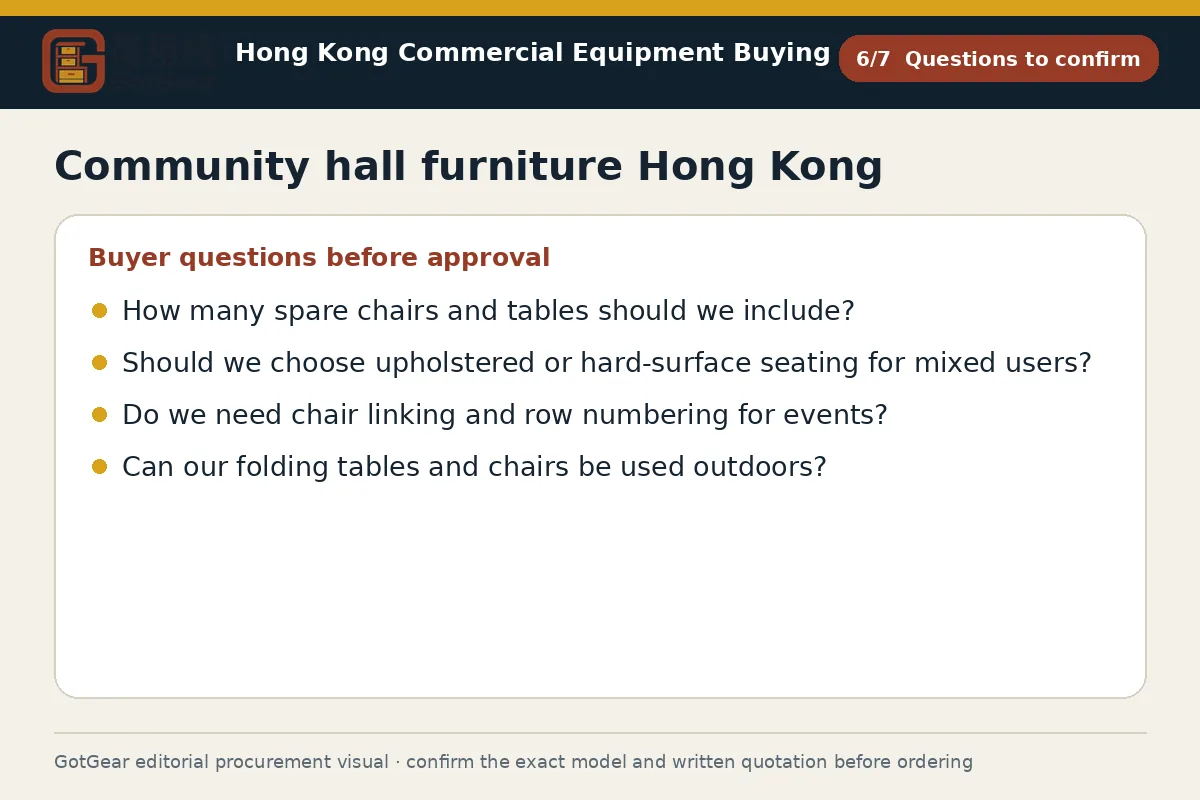
How many spare chairs and tables should we include?
Hold a small operational reserve so resets and breakages do not affect capacity; an example starting point is 5–10% of each line item. The right figure depends on your programme, storage size and replenishment lead time, and should be confirmed with your supplier and venue management before purchase. The written quotation and model specification take precedence.
Should we choose upholstered or hard‑surface seating for mixed users?
For mixed, high‑turnover use, hard‑surface options such as polypropylene or wood seat shells are easier to clean and store. Upholstery can improve acoustics and comfort, but increases maintenance and humidity risk. Ask the manufacturer for spill‑protection options, cleaning guidance and sample swatches, and confirm with your insurer or venue policy if specific finishes are preferred.
Do we need chair linking and row numbering for events?
If you host public or ticketed events, linking clips and row identifiers can aid orderly aisles and counting and may be requested by your licensee or insurer. Requirements vary by model, venue and event type. Confirm with your venue manager against applicable Hong Kong requirements and ask the supplier to detail compatible accessories in writing.
Can our folding tables and chairs be used outdoors?
Occasional covered outdoor use may be feasible with weather‑resistant finishes and non‑marking castors, but long exposure to sun and rain shortens service life. Ask the manufacturer to confirm permitted use for the specific model and provide care instructions. After each outdoor use, dry thoroughly before stacking to prevent corrosion or warping; follow the formal specification.
Continue with closely related procurement topics
These pages share equipment, operating or decision-stage signals with this guide.
Flip top training table Hong Kong
GotGear guides buyers on comparing a flip top training table Hong Kong by folded footprint, movement routes and joining options. It also covers nesting training table Hong Kong and modular training table Hong Kong designs.
Read the guide
Trapezoid training table Hong Kong
Compare trapezoid training table Hong Kong and semi circular training table Hong Kong to choose a layout for your training space. Consider cluster formation, seating edges, join details, leg positions and storage with GotGear.
Read the guide
Training table with modesty panel Hong Kong
GotGear’s checklist for a training table with modesty panel Hong Kong covers panel coverage, knee clearance, cable routing, folding, nesting mobility and sightlines.
Read the guide
Stackable chair with armrest Hong Kong
GotGear compares stackable chair with armrest Hong Kong and stackable chair with casters Hong Kong in a review that evaluates access and table fit, stacking method, mobility and floor behaviour across available models.
Read the guideRelated topic indexOpen more English procurement pages1 topics
Browse additional equipment families, applications and procurement questions relevant to a wider buying brief.