
Use chair ganging clips Hong Kong only where the chair manufacturer permits the connection method and the complete row is suitable for the site. Follow the manufacturer’s instructions, inspect each set-up and verify the layout against venue conditions and applicable Hong Kong requirements.
Confirm chair compatibility before buying chair ganging clips Hong Kong
Before any purchase, confirm that the proposed links match the exact chair frame and spacing used at your venue. Provide the supplier with the chair make and model, or clear measurements of tube/profile shape, outside dimensions at the linking point, leg-centre spacing, seat pitch, and whether under-seat bracing or skirts obstruct access. Include whether the chair is plain, has tablet arms, or is a stackable chair with armrest Hong Kong, as arms can alter the gap and angle available for the connector. If specifying chair ganging clips Hong Kong, request a model-specific compatibility statement rather than a generic fit claim.
Send front, side and underside photos of one chair on a plain background, plus a short video showing how chairs touch when placed side-by-side. Ask if the clip is handed (left/right), reversible, or symmetrical, and whether any adaptor is required for non-round frames. For humid stores or coastal districts, request material/finish guidance and a cleaning note that tolerates your approved sanitisers. Where industrial-building access or tight back-of-house corridors apply, confirm how links are supplied (bagged sets, colour-coded pairs) to avoid mix-ups at speed. As an example starting point, request one on-site trial set to test fit and row alignment; the model specification and the supplier’s written quotation should always prevail.
Check connection and release steps for chair ganging clips Hong Kong
Before final approval, map the full connection and release sequence and verify that it suits your team and event tempo. Ask the manufacturer to document whether links are tool-less, the direction of engagement, the permitted angle tolerance when chairs are not perfectly aligned, and the fingertip clearance to avoid pinching. If a release tool is needed, confirm the quantity to stage per row and whether a lanyard or tether is recommended. Request bilingual, pictorial instructions so stewards can assemble consistently across shifts.
Time a supervised mock build on your floor type and record the steps: align chairs, engage front or side, confirm latch, and test that the row can be nudged without disengaging. Note whether the link remains captive to one chair during teardown to prevent loss, and whether stacked chairs still nest without damage once links are parked. If your storage plan uses trolleys, confirm the clip does not snag upholstery, glides or frames when moving through doorways and into lifts. As an example starting point, agree a target minutes-per-row and crew allocation for internal planning only; verify the figure with your venue, stewarding contractor and the manufacturer’s written guidance.
What should buyers compare for chair ganging clips Hong Kong?
| Criterion | Straightforward requirement | More complex requirement | Evidence to provide |
|---|---|---|---|
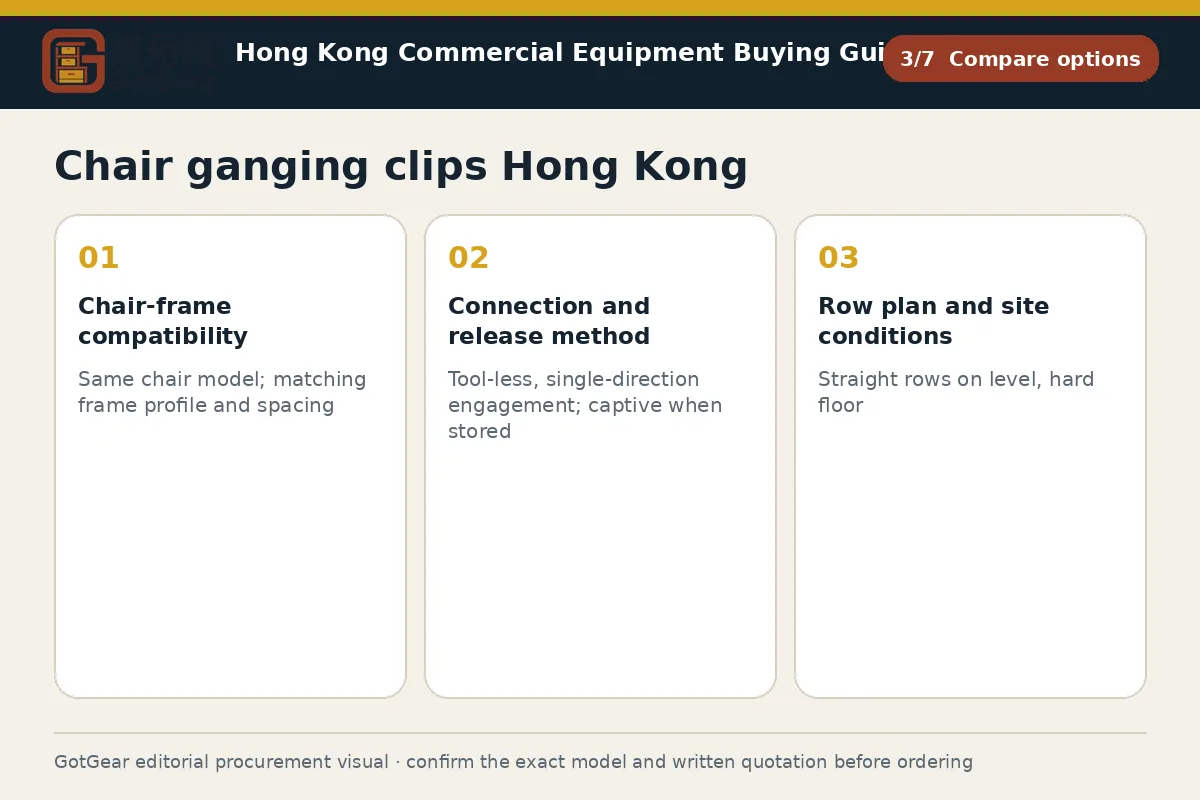
| Chair-frame compatibility | Same chair model; matching frame profile and spacing | Mixed models or armrests requiring adaptors; non-standard profiles | Model code, tube/profile dimensions, leg spacing, clear photos |
| Connection and release method | Tool-less, single-direction engagement; captive when stored | Tooled release, handed parts, or differing left/right variants | Manufacturer’s instructions, video, and a brief SOP |
| Row plan and site conditions | Straight rows on level, hard floor | Curved runs, slopes/steps, or sensitive finishes requiring protection | Scaled plan with seat pitch and aisle breaks; floor notes and photos |
| Materials, finish and care | Indoor use; standard polymer/steel finish | Humid/coastal storage or frequent sanitising; enhanced corrosion resistance | Material/finish specification, care sheet, and a trial sample |
| Logistics and approvals | Normal-hour delivery; lift access confirmed | Industrial-building loading windows; management-office permits; bilingual labels | Access dimensions, delivery window, contact details, approval emails |
This framework helps buyers create comparable written enquiries. Final model specifications, availability, delivery and commercial terms must be confirmed in a formal quotation.
Use chair ganging clips Hong Kong as part of a plan for linked chair row seating Hong Kong
Row linking should be designed into your floor plan rather than added at the last minute. Supply a scaled drawing with seat pitch, row lengths, aisle breaks and any curvature so the supplier can confirm whether your chosen links accommodate the geometry. If you need slight curves, ask for the maximum lateral offset or angle the connector allows before stress or accidental release is likely. For sloping or stepped floors, detail the rise and the chair foot contact area so the supplier can flag any stability considerations. When preparing an event seating layout Hong Kong, embed the connection method into the layout notes your ushers will follow.
If you operate multi-use spaces or a community hall, share whether you will move from exam to concert mode, or to temporary event seating Hong Kong. Clarify if acoustic, sports, or ceremony set-ups require different aisle patterns or row breaks so you can order the right quantity and variant. For procurement clarity, state the planned maximum row length for linked chair row seating Hong Kong and whether end chairs need finishing caps or signage holders.
Discuss floor protection, especially on polished concrete or timber. Confirm whether the link allows micro-adjustments without lifting the chair, and request instructions for overcoming small undulations. As an example starting point, calculate links as “adjacent pairs per row”, then add a buffer for loss and spares; the written quotation, model specification and venue rules should prevail.
Chair ganging clips Hong Kong: Inspect before each seating set-up
Treat links as components that age with use. Before each set-up, inspect for cracks, deformation, sharp burrs, worn hinges or springs, glazing on polymer surfaces, swollen pads, or corrosion at contact points. Test-fit a few samples onto the actual chair frames that will be used that day; if an adaptor is part of the system, ensure it locks firmly and cannot rotate under crowd movement. Any damaged items should be quarantined, labelled and recorded for replacement planning.
In Hong Kong’s humidity, confirm approved cleaners and avoid chemicals that embrittle plastics or strip protective coatings; ask the manufacturer for a short care sheet in bilingual form to match institutional approval processes typical of community hall furniture Hong Kong. Store clips in ventilated bins away from heat sources and direct sun, and use colour-coded or QR-labelled sets so crews can pick the correct variant quickly for different chair banks. Coordinate with the management office on loading windows and lift bookings so replacement parts can arrive before build. As an example starting point, maintain a small, sealed reserve of spares for unexpected losses; confirm the level with your venue manager, your stewarding contractor and the supplier’s written recommendations.
Chair ganging clips Hong Kong decision checklist
Confirm chair model codes, frame profile and spacing, with photos and a short video to show side-by-side contact. Obtain a written compatibility statement from the manufacturer for the exact connection method. Provide a scaled row plan with seat pitch, aisle breaks and any curvature, and detail floor type, slope or steps. Agree the connection and release steps, tools if any, and bilingual instructions. Validate stacking, trolley movement and lift access. Specify materials/finish and cleaning agents tolerated. Compare quotations item-by-item for link variant, handedness, packaging, quantities, spares and delivery timing. On receipt, inspect for defects, test-fit on the target chair, and quarantine nonconforming pieces. Keep records of approvals and the final layout that was verified on site.
- Operating use, quantity and expected frequency
- Dimensions, capacity, material and accessory requirements
- Delivery address, floor, goods lift and loading window
- Required documents, acceptance checks and after-sales arrangements
Key points for chair ganging clips Hong Kong, linked chair row seating Hong Kong
Venues in Hong Kong often work within tight back-of-house routes, small goods lifts and short loading windows controlled by a building management office. Confirm lift car and doorway dimensions and agree delivery timing in writing so boxes of links and any sample chairs can pass without rework. Humid stores and coastal air increase corrosion risk; request care instructions and suitable finishes. Public events may trigger additional venue or insurer conditions on seating plans; seek competent, site-specific guidance rather than assuming general rules.
Questions about chair ganging clips Hong Kong
Can I link different chair models in the same row?
Only if the manufacturer confirms the exact models are compatible with the proposed connector and angle tolerance. Without that, mixing frames can create uneven gaps and unreliable engagement. Provide photos, dimensions and a short on-site trial before approval. Keep the written compatibility statement with your layout pack and ensure the formal quotation reflects the confirmed configuration.
How many links do I need per row?
Plan one link between each adjacent pair of chairs, then add a buffer for loss and spares. As an example starting point, 20 chairs in a straight row typically require 19 links. Curved rows, handed connectors or aisle breaks can change the count, so confirm the final quantity and any variant types in the supplier’s written quotation and model specification.
Can links be used for curved or angled rows?
Some connectors allow a limited angle between chairs; others require straight alignment. Provide the intended radius or lateral offset, and request the manufacturer’s maximum allowable angle or offset in writing. Trial a short segment on your actual floor to verify comfort and stability, and record the result in your layout notes for stewards to replicate consistently.
What should I check on receipt of the links?
Open a sample of each box to inspect for cracks, deformation, missing parts and rough edges, then test-fit on the actual chair frame. Verify handedness or variant codes match your purchase order, and that bilingual instructions are enclosed. Record batch identifiers and keep any nonconforming pieces quarantined pending written advice from the supplier or manufacturer.
Continue with closely related procurement topics
These pages share equipment, operating or decision-stage signals with this guide.
Training table with modesty panel Hong Kong
GotGear’s checklist for a training table with modesty panel Hong Kong covers panel coverage, knee clearance, cable routing, folding, nesting mobility and sightlines.
Read the guide
Stackable chair with armrest Hong Kong
GotGear compares stackable chair with armrest Hong Kong and stackable chair with casters Hong Kong in a review that evaluates access and table fit, stacking method, mobility and floor behaviour across available models.
Read the guide
Training chair with writing tablet Hong Kong
GotGear compares training chair with writing tablet Hong Kong, folding training chair with writing board Hong Kong and folding training chair with armrest Hong Kong, covering tablet size, access and stored footprint.
Read the guide
Cocktail table Hong Kong
GotGear explains how a cocktail table Hong Kong performs in terms of top diameter, height, floor footprint, stability, circulation and storage. It also outlines how it differs from a bar height table Hong Kong.
Read the guide