
Match each location to the item envelope, working quantity and replenishment method. Check clear shelf dimensions rather than relying on nominal cabinet or bay width.
Open front storage bins Hong Kong — Map Reach, Item Size and Pick Frequency
Start with the operator, not the bin. Map each SKU’s envelope (maximum length, width and height including protective bags or tags) to the picker’s reach and the expected touches per shift. As an example starting point to be confirmed, many teams place fast‑movers between approximately knuckle and shoulder height, with heavy items below elbow height. Record whether the pick is single‑handed or two‑handed, and whether gloves are worn, because this affects the minimum clear opening and lip height the hand can comfortably clear.
When teams specify open front storage bins Hong Kong, they should capture site constraints alongside SKU data. Measure clear shelf width and depth between uprights and backstops, not nominal bay size. Note any overhanging sprinkler heads, door closers and light fittings that reduce usable height. For each shortlisted bin family, request internal dimensions, clear front opening (height and width), front‑lip height, divider pitch, and the rated load per bin as stated in the model specification. When reviewing quotations, compare like‑for‑like on these written fields, plus the proposed colour options for visual coding. If access runs through tight aisles or goods‑lifts, confirm the largest pre‑assembled module that can pass without unpacking. Ask for bilingual label options where mixed teams are present, and summarise the pick frequency bands you intend to use so suppliers can advise suitable sizes.
Open front storage bins Hong Kong: Configure Active Pick Locations
Configure the active pick face so each movement is deliberate. Define primary pick locations for high‑frequency lines and nearby reserve stock for quick top‑ups. Where batch waves are common, consider sloped shelves for gravity presentation and finger clearance, with backstops to prevent push‑through. Colour‑code by product family or hazard, and use dividers to stabilise odd‑shaped items without over‑constraining access. Where two‑bin Kanban is appropriate, size both primary and backup bins for the working quantity plus a buffer aligned to your replenishment window.
When sourcing picking bins Hong Kong, state whether locations are on static racking, louvre panels, rails or mobile trolleys, and request compatibility confirmations from the bin manufacturer, not just the reseller. Specify the bin series code, divider and label‑holder part numbers, and whether stop‑tabs or rear hangers are required. If items are delicate electronics, flag any antistatic requirement so ESD‑safe variants can be proposed with documentation. For fast, multi‑line kits, cross‑reference any plan to integrate with a warehouse bin storage system Hong Kong or to support kitting with material flow bins Hong Kong. Ask for photographs or a sample of the exact bin profile to confirm finger access before committing the whole pick face.
What should buyers compare for open front storage bins Hong Kong?
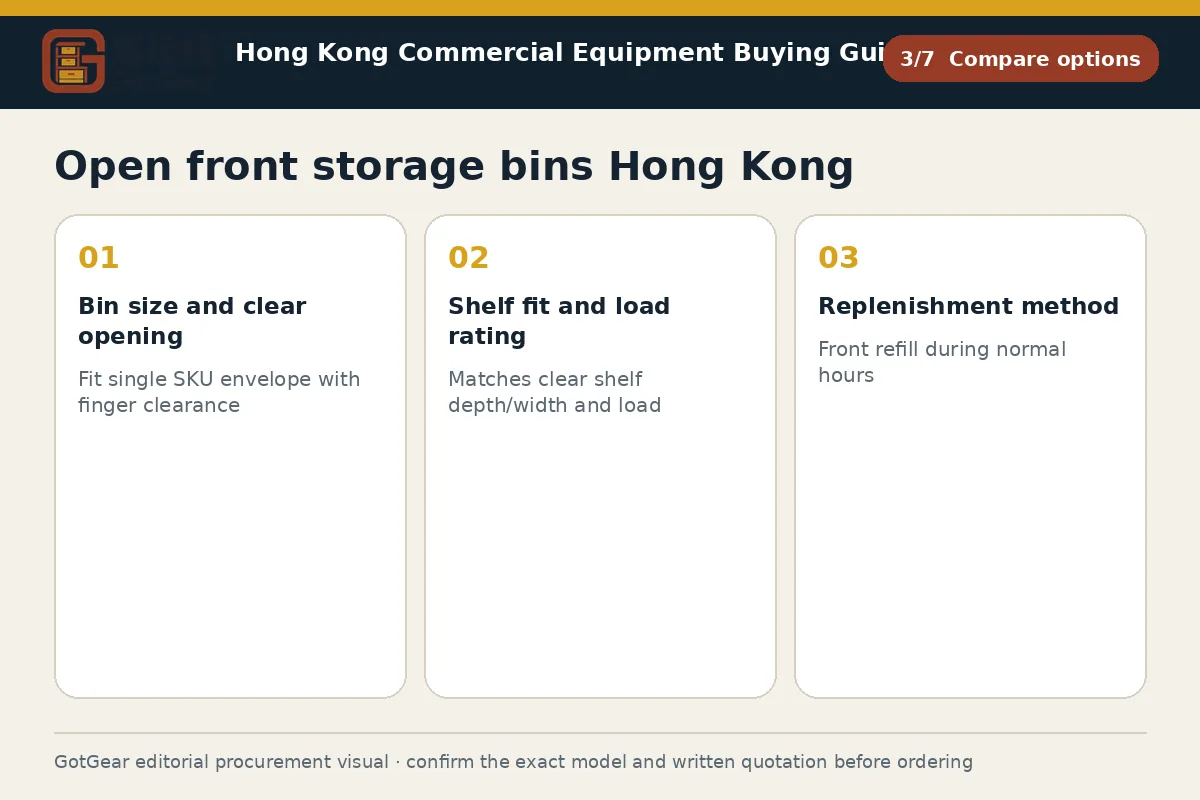
| Criterion | Straightforward requirement | More complex requirement | Evidence to provide |
|---|---|---|---|
| Bin size and clear opening | Fit single SKU envelope with finger clearance | Mixed SKUs using dividers and two‑bin Kanban | Provide max L×W×H, glove use, pick frequency and required clear opening |
| Shelf fit and load rating | Matches clear shelf depth/width and load | Sloped/gravity shelves or mobile racking | Share clear shelf dimensions, per‑shelf load, rack/trolley model and backstop details |
| Replenishment method | Front refill during normal hours | Rear‑feed gravity lanes or top‑ups in public areas | Describe refill route, aisle width, loading window and separation from picking |
| Material and environment | Standard PP/HDPE for indoor stockrooms | ESD‑safe, UV‑resistant or food‑contact variants | State material preference, ESD need, humidity exposure and documentation required |
| Labelling and WMS | Paper labels in front holders | Barcodes, colour bands and bilingual layout | Send label size, symbology, language policy and a sample file for validation |
This framework helps buyers create comparable written enquiries. Final model specifications, availability, delivery and commercial terms must be confirmed in a formal quotation.
Open front storage bins Hong Kong: Check Shelf Fit and Refill Access
Check the shelf and surrounding pathway are as suitable as the bin. Measure clear shelf depth from the inner face of the upright to any backstop, and confirm that bin handles or lips will not collide with doors, posts or edge guards. As an example starting point to be verified, allow a small clearance margin around the bin to avoid rubbing when loaded. If refills occur from the rear or during public‑access hours, plan for backstops, safety signage, and a defined refill route that does not interrupt picking. Where step‑stools or ladders are needed, ensure the stance area is flat and wide enough.
For open bays and cabinets, request written confirmation of per‑shelf load rating, compatible bin load rating, and the fastening method for rails or louvre panels. State if trolleys, pallet jacks or lift tables must pass the aisle during top‑ups. In older industrial buildings, confirm goods‑lift and doorway limits and whether modules must be delivered knocked down. If sanitation matters (catering, healthcare, schools), ask for the resin type and cleaning agent compatibility. To compare shelf storage bins Hong Kong, review bin material (e.g., PP or HDPE as proposed), UV and humidity suitability, and whether vented bases are offered for airflow—always deferring to the model specification and your site’s approval.
Open front storage bins Hong Kong — Set Labels and Working Quantities
Define labels and working quantities at the same time. Decide the minimum, maximum and reorder trigger per SKU, then size bins to present the working quantity without burying labels. Choose label holders that protect cards from humidity and cleaning, and decide if barcodes, QR codes or colour bands are needed for rapid scans. Provide a sample label layout showing bilingual fields, font size and any hazard icons, and agree the label position so it remains readable when the bin is full.
When finalising open front storage bins Hong Kong, include in your enquiry the label‑holder aperture size, card stock thickness, and whether adhesive or slide‑in pockets are preferred. If scanning, state the barcode symbology and target X‑dimension, and request a clear window or recess that keeps codes flat. As an example starting point, you might trial a 25–40 mm label height, to be confirmed against your WMS and viewing distance. For very small parts, consider drawer containers Hong Kong; for mixed fasteners and clips, evaluate automotive parts storage bins Hong Kong. On receipt, test that labels sit securely, scanners read reliably under typical lighting, and that spare holders match the bin series code.
Open front storage bins Hong Kong decision checklist
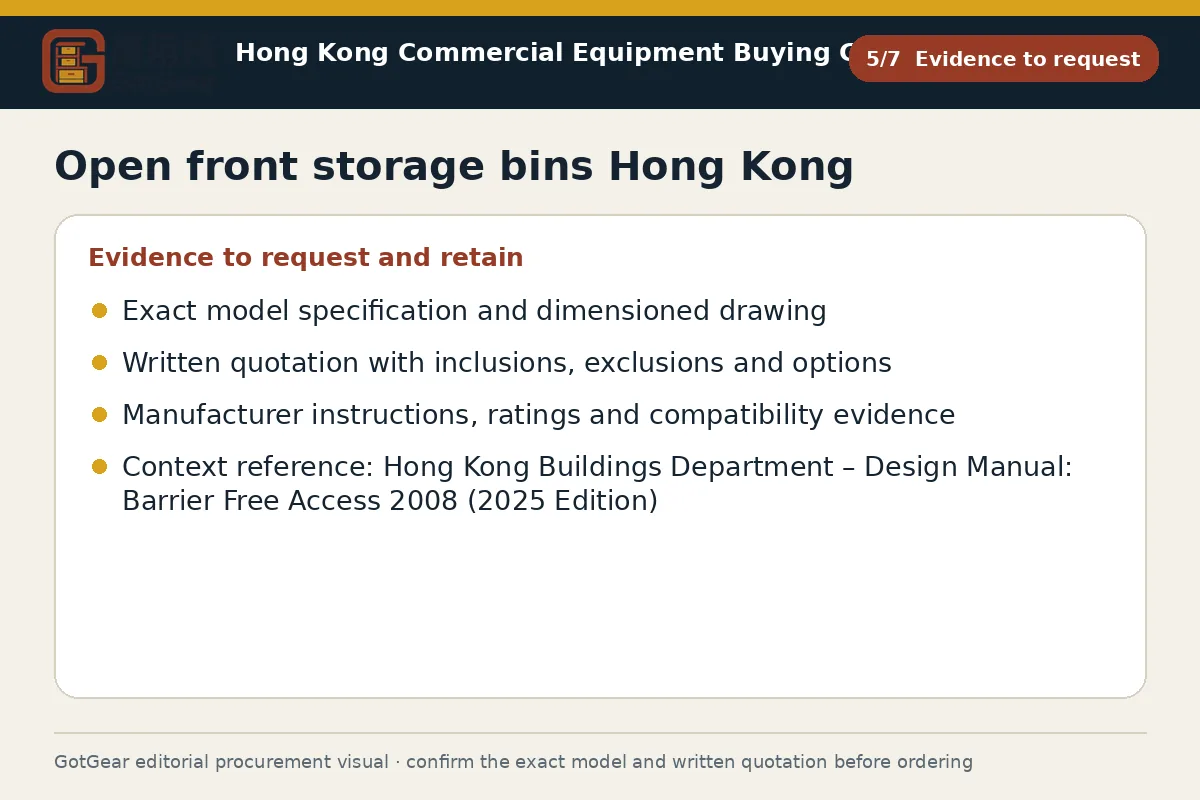
Begin by measuring clear shelf width, depth and usable height, and record aisle widths, obstructions and the largest module your goods‑lift and doors can pass. List each SKU’s envelope and classify pick frequency, then sketch the intended reach zones. In your enquiry, request internal bin dimensions, clear front opening, lip height, divider pitch, material and rated bin load, plus compatibility with rails, louvre panels or trolleys. State replenishment method and any ESD, hygiene or colour‑coding needs. Ask for sample photos or a trial bin to verify finger clearance and label readability. Compare written quotations strictly on the same fields and the exact series codes. On receipt, inspect moulding quality, stability when loaded, label‑holder fit and any warping. Where documentation is required by your site, request it from the manufacturer. Book deliveries within building loading windows in coordination with management.
- Operating use, quantity and expected frequency
- Dimensions, capacity, material and accessory requirements
- Delivery address, floor, goods lift and loading window
- Required documents, acceptance checks and after-sales arrangements
Key points for open front storage bins Hong Kong, picking bins Hong Kong, shelf storage bins Hong Kong
Hong Kong facilities often operate within tight floorplates, with narrow aisles, small goods‑lifts and managed loading windows. Before placing orders, confirm the largest assembled unit that can be transported from loading bay to store, including lift car size, door clearances and turning spaces. Humidity can soften some labels and adhesives; request materials suited to non‑air‑conditioned hours where applicable. If bins are visible to the public or used at events, coordinate with the venue or building manager on presentation standards and access control. Many teams require bilingual labelling; share your language policy early. If specific certifications are needed, seek manufacturer documentation aligned to your insurer or institutional approval rather than assuming a default rule.
Questions about open front storage bins Hong Kong
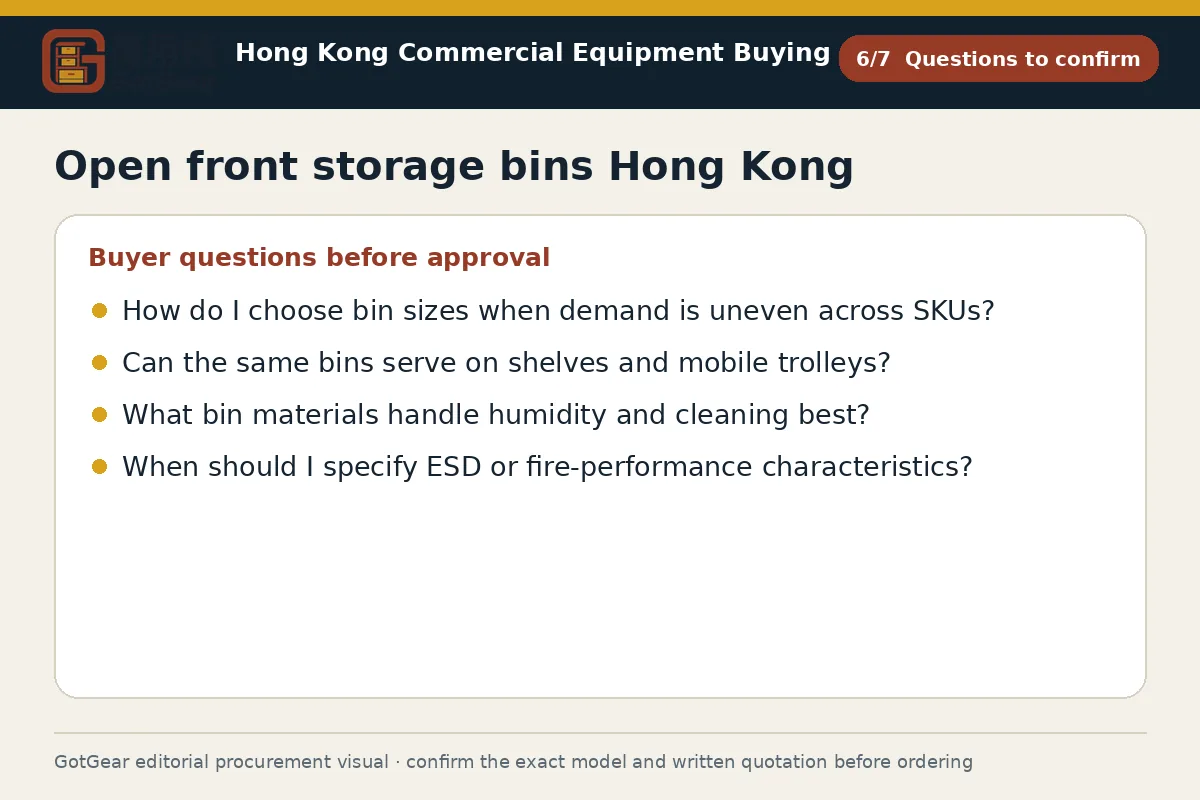
How do I choose bin sizes when demand is uneven across SKUs?
Size to the working quantity of each SKU, not the carton, and group by pick frequency. Use dividers or two‑bin Kanban for small, fast‑moving parts while reserving deeper bins for bulky lines. If space is tight, standardise on a short list of sizes for interchangeability, validated with a sample pick run and your model specifications.
Can the same bins serve on shelves and mobile trolleys?
Often yes, if the bin series is compatible with both louvre panels or rails and flat shelves. Ask for written compatibility between the bin code and your trolley or rack model. Confirm that stop‑tabs, rear hangers and label holders are included, and check wheel size and thresholds along the route to avoid jolting parts free.
What bin materials handle humidity and cleaning best?
Polypropylene and HDPE bins are common choices; some offer vented bases for airflow. If regular sanitising is expected, request the resin type and a cleaning compatibility statement from the manufacturer. For electronics handling, ask whether antistatic or ESD‑safe variants are available with documentation acceptable to your site and insurer.
When should I specify ESD or fire‑performance characteristics?
Specify ESD only when handling components sensitive to static; request the maker’s compliance statement and test method. Fire‑performance or low‑smoke requirements may be set by your building manager, venue or insurer for certain areas. Confirm locally what applies before ordering, and ensure the final written quotation states the exact model and rating.
Continue with closely related procurement topics
These pages share equipment, operating or decision-stage signals with this guide.
Plastic storage bins with dividers Hong Kong
GotGear provides practical guidance to help teams choose plastic storage bins with dividers Hong Kong, including how compartment sizes and refill triggers support line-side movement for material flow bins Hong Kong.
Read the guide
Tipping bins Hong Kong
GotGear helps buyers compare tipping bins Hong Kong by compartment size, dispensing access, mounting position, refill method and labelling.
Read the guide
Drawer containers Hong Kong
GotGear compares drawer containers Hong Kong by depth and labelling to help you choose the right parts drawer cabinet Hong Kong or transparent drawer storage cabinet Hong Kong.
Read the guide
Produce crates Hong Kong
GotGear explains considerations for produce crates Hong Kong, comparing airflow, temperature control and stacking practices. It also covers cold storage plastic crates Hong Kong and food distribution crates Hong Kong.
Read the guideRelated topic indexOpen more English procurement pages3 topics
Browse additional equipment families, applications and procurement questions relevant to a wider buying brief.