
Use this format for repeated access to small items where individual compartments improve identification. Check filled weight, mounting instructions and the effects of an open or removed compartment.
Tipping bins Hong Kong — Match Compartments to Part Size and Dispensing Needs
Start by mapping component dimensions and picking behaviour to the compartment geometry. For buyers who are shortlisting tipping bins Hong Kong, list each part family, the typical pick quantity per reach, and the heaviest filled compartment you expect. Request internal compartment width, depth and height, usable volume, lip design, tilt angle and stop, and maximum filled mass per compartment and per assembled module. If fine parts are dispensed by pinch or tweezers, ask for the front opening size and whether the lip allows scooping without snagging. For mixed fasteners, check static-divide options and whether dividers lock to resist migration during tilting.
Refill frequency drives downtime and mess risk. Confirm if compartments can be topped up in situ, refilled from the rear, or removed as drawers. Ask whether removing a single bin affects adjacent units' stability. Specify window clarity and label slot size so identifiers remain readable in workshop lighting. As an example starting point only, trial a compartment nominally 75 mm wide for small screws and 120 mm wide for bulkier clips, then confirm the final size in your written enquiry. If you need open grab access instead, compare open front storage bins Hong Kong; for higher segregation and dust control, review drawer containers Hong Kong; and where parts must be locked with tools, consider tool storage cabinet Hong Kong. Sector users can also shortlist automotive parts storage bins Hong Kong for model-specific assortments.
Tipping bins Hong Kong — Set a Practical Operator Reach Zone
An effective operator reach zone reduces strain and mis-picks. Measure bench height, the floor-to-first-row distance, and the furthest point reached when a bin is tilted open. Capture photos of the intended wall or frame and note obstructions such as trunking or window handles. Request the module’s projection when closed and when fully tilted, plus the vertical clearance needed to remove a compartment. As an example starting point only, set the top-row handle near 1,450–1,550 mm above floor level for most standing operators, and the lowest row near 750–900 mm, then confirm with your safety lead.
Where parts are accessed from both sides of an aisle, check that a tilted bin does not intrude into the walking path. For benches beneath windows or in narrow corridors, ensure the tilt arc clears sill edges and door swings. Ask for glare-reduced windows if overhead lighting causes reflections on labels. In multi-user cells, assess queueing: as an example starting point only, model one operator per 600–900 mm module width, then agree the final spacing in the written brief. Request sample labels to confirm font size and bilingual layout are legible at your expected viewing distance.
What should buyers compare for tipping bins Hong Kong?
| Criterion | Straightforward requirement | More complex requirement | Evidence to provide |
|---|---|---|---|
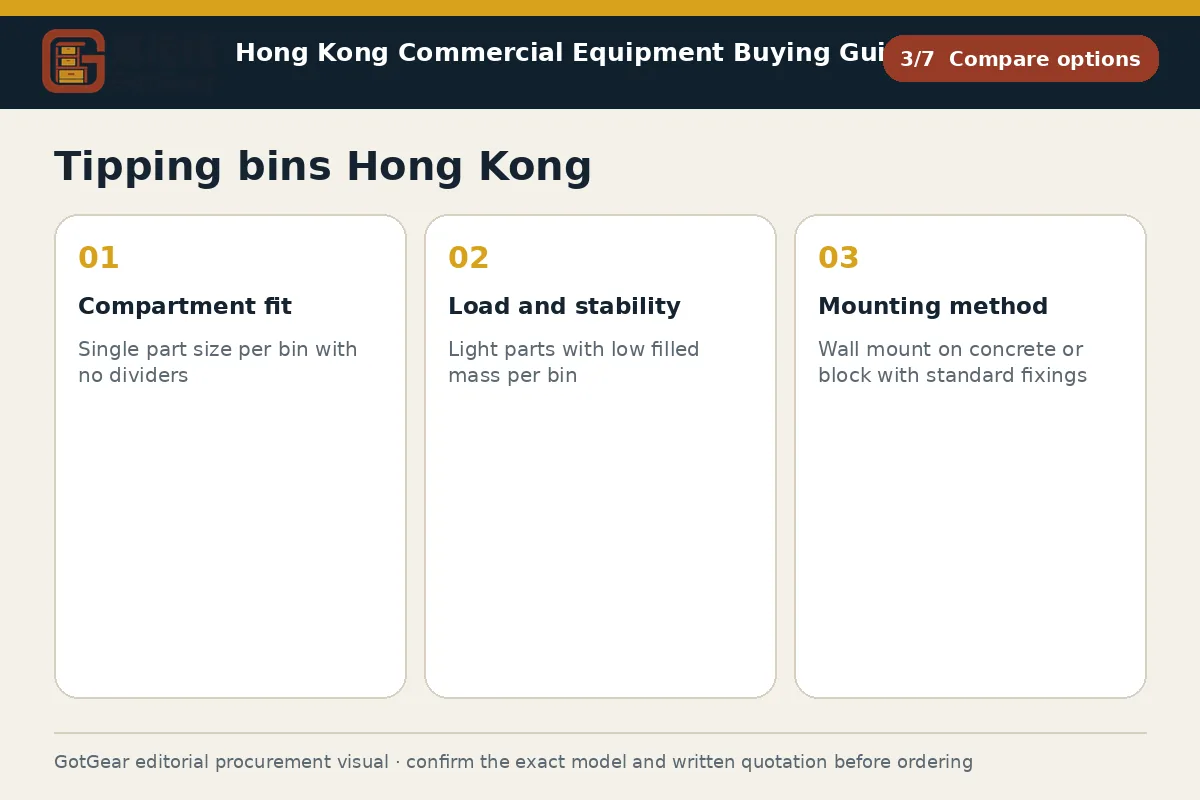
| Compartment fit | Single part size per bin with no dividers | Mixed sizes using fixed dividers or multiple bin widths | Provide part dimensions, pick method and photos; request internal W×D×H and divider options |
| Load and stability | Light parts with low filled mass per bin | Higher mass parts near the bottom rows with verified bracket/fixing ratings | State expected filled mass per bin; ask for per-bin and per-bracket limits and substrate guidance |
| Mounting method | Wall mount on concrete or block with standard fixings | Plasterboard or uncertain substrates requiring backers/adapters | Share wall photos, thickness if known, and ask for hole pattern, fixing spec and load per fixing |
| Operator reach | Single operator, standing, direct front access | Multi-user aisles or benches under windows/obstacles | Provide bench height, aisle width and obstructions; request closed/tilt projections and clearance |
| Cleaning and spares | Periodic wipe-down, standard labels | Oily processes, anti-static needs, stocked spare compartments | Ask for cleaning guide, chemical compatibility, material data and replacement-part codes |
This framework helps buyers create comparable written enquiries. Final model specifications, availability, delivery and commercial terms must be confirmed in a formal quotation.
Tipping bins Hong Kong — Check Mounting, Refill Access and Labels
Mounting and refill logistics must suit your building fabric and shift rhythm. Confirm whether the module is wall-mounted, fixed to louvre panels, benchtop-framed, or on a floor rack, and request overall footprint, bracket hole pattern, and fixing size. In Hong Kong industrial units with concrete or block walls, drilling may require building-management approval; ask for the module’s maximum permissible load per fixing and per bracket, and include substrate photos. For plasterboard partitions, ask the supplier to propose rated anchors or a backer plate, then confirm with your competent contractor. Note the clearance above and to the sides for safe refill without blocking escape routes.
For replenishment, state if you prefer rear-loading hoppers, front-flip refills, or full bin removal. Ask how the unit behaves if one compartment is removed, and whether an anti-drop latch is fitted. In humid areas, specify materials and label media that resist curling and clouding. Request label window size, barcode compatibility, and whether bilingual inserts are supplied. As an example starting point only, plan a 200–300 mm free zone above the top row for refilling, then confirm with the manufacturer’s drawing. If your process needs free-grab bins nearby, reference open front storage bins Hong Kong; for traceable kitting, see drawer containers Hong Kong.
Tipping bins Hong Kong — Plan Cleaning and Compartment Replacement
Cleaning and parts replacement influence lifetime cost and uptime. Ask for the materials list for bins and frame, including polymer type, hinge design, and any anti-static or UV additives. Request the manufacturer’s cleaning guidance and a chemical-compatibility chart for the coolants, cutting oils, sanitisers or detergents used on site. As an example starting point only, trial a warm-water and neutral-detergent wipe-down regime per shift for oily parts areas and per week for dry stores, then confirm a site-specific interval with your supervisor.
Confirm whether individual compartments, windows and labels are replaceable, and if replacement codes match across sizes and colourways. Ask if bins are interchangeable between modules of the same series to simplify spares. For metal frames, consider corrosion-resistant coatings or stainless hardware where humidity is high; request documentation on finish type and thickness. Plan for wear points: hinges, tilt stops and latches. As an example starting point only, hold a small buffer of spare compartments for the most-used sizes, then validate quantity in the written brief. On receipt, inspect for stress-whitening at hinge lines, window clarity, latch engagement and consistent labelling slots before signing off.
Tipping bins Hong Kong decision checklist
Confirm component families, typical pick quantities and filled compartment masses, then request internal compartment dimensions, usable volume, lip shape and maximum filled mass per bin and per module. Record the intended mounting surface, bench height and any obstructions, and ask for closed and fully tilted projections. Specify your refill method, clearance needs and bilingual label format, including barcode size. Compare written quotations for materials, hinge type, latch design, load ratings by fixing and by bracket, and whether removal of a single bin affects stability. Before delivery, align loading schedules with building management. On receipt, check bin clarity, hinge action, tilt stops, label fit and hardware completeness, and request manufacturer cleaning guidance, chemical-compatibility notes and replacement-part codes where applicable. Model specifications and the formal quotation prevail.
- Operating use, quantity and expected frequency
- Dimensions, capacity, material and accessory requirements
- Delivery address, floor, goods lift and loading window
- Required documents, acceptance checks and after-sales arrangements
Key points for tipping bins Hong Kong
Facilities in Hong Kong often work within tight goods-lift cars, narrow stair cores and short loading windows coordinated by building management. Measure the route from loading bay to install point, including door widths and lift cabin depth, and share photos when you request quotations. Wall drilling in multi-tenant industrial buildings may need prior approval; confirm substrate and fixing proposals in writing. Humidity can haze poor-quality windows and peel labels, so specify materials and media accordingly. Where bilingual identification is required, ask for label templates supporting both English and Chinese. None of this is legal advice; your manager, landlord and the model’s documentation should confirm final requirements.
Questions about tipping bins Hong Kong
How do I choose compartment sizes for mixed small parts?
Group parts by footprint and pick method, then request internal width, depth and lip design for each compartment family. Trial with sample items to verify scoop clearance and visibility. As an example starting point only, test 75–100 mm widths for screws and 120–150 mm for clips, then confirm final sizes in your written brief and quotation.
What load ratings should I ask for when wall mounting?
Request the maximum filled mass per compartment, per row and per bracket, plus the permissible load per fixing in your substrate. Provide wall photos and note concrete, block or plasterboard. As an example starting point only, model 1–3 kg per compartment, then confirm bracket and anchor capacities with the supplier’s documentation and your competent contractor.
Are tilting compartments suitable for humid or oily environments?
Yes, if materials and labels resist oils and moisture, and the frame finish tolerates humidity. Ask for a chemical-compatibility chart and cleaning guidance for your specific fluids. Consider anti-drop latches and rear-loading to reduce spills. Confirm any anti-static or additive claims with the manufacturer’s data before specifying for sensitive areas.
Can I reuse existing louvre panels or benches?
Often, with adapter brackets or frames matched to common hole patterns and bench depths. Send photos and measurements of panel pitch, hole size and bench overhang, and request the module’s footprint and projection when tilted. The supplier should confirm compatibility in writing, or propose a frame or backer plate if the substrate is unsuitable.
Continue with closely related procurement topics
These pages share equipment, operating or decision-stage signals with this guide.
Open front storage bins Hong Kong
Choose open front storage bins Hong Kong by assessing reach zones, item dimensions, refill access and shelf depth. Compare picking bins Hong Kong and shelf storage bins Hong Kong with guidance from GotGear.
Read the guide
Plastic storage bins with dividers Hong Kong
GotGear provides practical guidance to help teams choose plastic storage bins with dividers Hong Kong, including how compartment sizes and refill triggers support line-side movement for material flow bins Hong Kong.
Read the guide
Industrial parts cabinet Hong Kong
GotGear presents a Hong Kong guide comparing capacity, access control and layout for storage choices. It covers industrial parts cabinet Hong Kong, tool storage cabinet Hong Kong and component storage cabinet Hong Kong.
Read the guide
Plastic storage cabinet Hong Kong
Choose a plastic storage cabinet Hong Kong by checking shelf and bin layout, door clearance and access to fit your space. At GotGear, explore lockable storage cabinet Hong Kong and bin storage cabinet Hong Kong.
Read the guideRelated topic indexOpen more English procurement pages2 topics
Browse additional equipment families, applications and procurement questions relevant to a wider buying brief.