
Record the commodity, packed weight, airflow need, temperature range, stacking pattern and cleaning process. Verify material and hygiene suitability for the actual route with the manufacturer.
Produce crates Hong Kong — Balance Ventilation and Product Protection
For produce crates Hong Kong, purchasing teams should start by pairing airflow requirements with bruise‑prevention measures. Specify the commodity, the packed weight per crate and any liner or padding. Ask suppliers for the side and base perforation percentage, the average hole size and whether the vent pattern protects edges and label areas. As a starting example, leafy greens often benefit from greater side venting while stone fruit may need smaller openings and smoother contact points; confirm the final figures in the model specification and quotation.
Check how the rim, corners and base distribute loads in motion over dock plates, tail‑lifts and hand trucks. Request drawings that show ribbing, corner radius and the base type (smooth, grid or reinforced), plus the stated impact‑resistance method at your target temperatures. Note any conveyor, roller pitch or tote‑dolly used on site and set minimum clearance and snag‑risk limits in the enquiry. If using liners or absorbent pads, state thickness and placement so the supplier can advise on ventilation trade‑offs. For warehouse labelling, define required label recesses or card holders, barcode window size and visibility when stacked. Ask for a manufacturer food‑contact declaration and material identification to support internal hygiene reviews and to ensure your QA and insurer are comfortable with the selected construction for the intended route.
Produce crates Hong Kong — Check Stack Pattern and Empty Returns
Confirm how crates build stable, safe unit loads and how empties come back. Map your pallet footprints and goods-lift, doorway and vehicle constraints, including door widths and lift car depth. As an example starting point, test whether a 600 × 400 footprint pattern will fit your pallet and lift plan; the signed model specification and quotation must prevail. Request external dimensions with tolerances, inter-stack compatibility within the series, and whether the rim interlocks during cross-stacking.
Define full-crate stacked height, the maximum layers per pallet, and the static and dynamic stack-load conditions you will subject them to. As an example starting point, specify that a representative sample stack be trialled at your packed weight for the expected number of layers. For empty returns, decide between nestable or foldable formats and state the target return ratio, banding/strapping method and any dolly or cage you use. Record cleaning-centre access and whether returned empties are washed on-site or by a third party. On receipt, inspect for lid fit, rim flatness, burr-free openings and consistent nesting depth; photograph any deviation and reconcile against the quotation and approved drawings.
What should buyers compare for produce crates Hong Kong?
| Criterion | Straightforward requirement | More complex requirement | Evidence to provide |
|---|---|---|---|
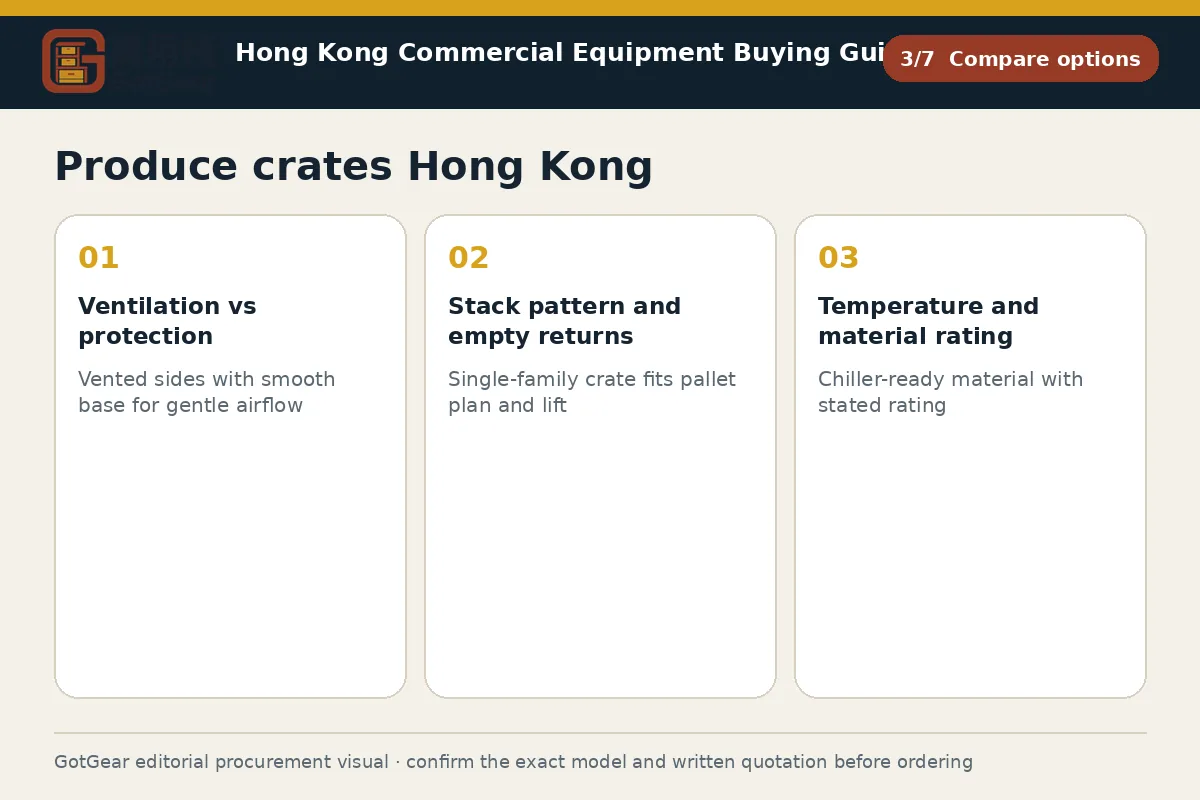
| Ventilation vs protection | Vented sides with smooth base for gentle airflow | Tailored vent pattern and hole size by commodity and label zones | Target perforation %, hole size, label area and commodity list |
| Stack pattern and empty returns | Single-family crate fits pallet plan and lift | Interlocking rims, cross-stack stability and foldable/nestable return ratio | Pallet layout, lift/door sizes, max stack height, return ratio goal |
| Temperature and material rating | Chiller-ready material with stated rating | Sub-zero impact resistance and thermal-cycling acceptance | Route temperature profile, material ID, test evidence requested |
| Cleaning and hygiene | Smooth surfaces; compatible with common detergents | Tunnel-washer parameters and chemical limits confirmed in writing | Detergent type/strength, washer temperature, sanitation workflow |
| Labelling and traceability | Barcode/label area remains visible when stacked | RFID option, card holders and tamper-evident lids | Label dimensions, location, UID scheme and bilingual text needs |
This framework helps buyers create comparable written enquiries. Final model specifications, availability, delivery and commercial terms must be confirmed in a formal quotation.
Produce crates Hong Kong: Define Temperature and Route Conditions for Produce Crates
Cold-chain planning must define temperature exposure, dwell times and handling style on every leg before selecting cold storage plastic crates that Hong Kong users can rely on. Document the minimum and maximum temperatures per site and transit stage, plus glove use, condensation risk, and where crates meet metal dock edges. As an example starting point, confirm if the crate must tolerate sub-zero storage and transfers into chilled preparation rooms; the signed model specification and quotation take precedence.
Request the material (e.g., PP or HDPE), stated temperature rating, and any low-temperature impact or drop-test evidence at your declared range. Note detergent type, concentration and water temperature in your washer so the supplier can confirm chemical compatibility and thermal cycling limits. Plan drainage: specify whether base perforation is required to shed meltwater or condensate, or if a solid base with a liner is preferred to protect labels. For tracking, state your barcode or RFID method, label location and whether freezer-grade adhesives or mechanical holders are needed. Include bilingual routing codes if your teams operate across Cantonese and English work instructions, and set a requirement for legible markings after repeated sanitation cycles.
Produce crates Hong Kong: Extend the Brief Beyond Whole Produce
Many routes mix whole produce with prepared items. Frame your brief so the same crate family can support light processing, catering and distribution tasks where Hong Kong buyers of food-distribution crates must manage requirements such as lids, tamper evidence and liquid control. If packing cut fruit or salad, define maximum fill level, liner type, expected free liquid and whether absorbent pads are allowed. Request lid type (clip-on, hinged, or sealable), visibility for venue checks, and proof the lid stays seated in transit at your stated stack height.
For seafood, herbs or ice-supported displays, record drainage needs, splash control and the separation measures you use to avoid odour or allergen carryover. State whether crates ride on dollies in kitchens, and quote the turning radius and threshold heights they must clear. In schools, hospitals or public-event venues, list any required colour coding, lockable lids or tamper tabs subject to site policy; seek manufacturer statements that materials are food-contact suitable and compatible with your cleaning chemicals. Define label privacy, if any, and note where bilingual product names and expiry data must appear without being obscured by condensing surfaces.
Produce crates Hong Kong decision checklist
Begin with the commodity list and packed weight per crate, then write the airflow, drainage and protection targets. Add external dimensions with tolerances, rim style and base type, plus the pallet pattern and stacked height you intend to use. Define the temperature profile by route leg, handling gloves, label method and cleaning process. Note access constraints, lift and doorway sizes, and how empties return and are secured. Ask for material identification, food-contact declaration, low-temperature and stack-load evidence aligned to your profile. On quotation, compare vent area, impact and chemical-compatibility statements, pallet fit and return ratio side-by-side. On delivery, sample-check dimensions, lid fit, nesting depth and mould quality before releasing to operations. Use GotGear’s structure to prepare a clear written enquiry; the supplier’s formal specification and quotation prevail.
- Operating use, quantity and expected frequency
- Dimensions, capacity, material and accessory requirements
- Delivery address, floor, goods lift and loading window
- Required documents, acceptance checks and after-sales arrangements
Key points for produce crates Hong Kong, cold storage plastic crates Hong Kong, food distribution crates Hong Kong
Hong Kong distribution often hinges on tight access and clockwork loading windows. Before ordering, measure goods-lift door width, car depth and lobby turning space, plus any ramp or threshold a loaded pallet must cross. Many industrial buildings schedule dock slots and require management-office coordination; build those times into your crate-count and empty-return plans. Summer humidity and frequent temperature cycling can loosen labels and trap condensate, so specify drainage and freezer-grade labelling where relevant. If working in wet markets, public venues or institutions, ask the venue or building manager to confirm any hygiene, colour-coding or tamper-control expectations in writing. Treat those local constraints as procurement inputs, then have the supplier confirm suitability in the formal quotation and product datasheet.
Questions about produce crates Hong Kong
Should I choose vented or solid crates for mixed produce?
Use more venting when airflow and condensation control are priorities; use fewer or smaller openings when surface protection and label hold are critical. For mixed routes, specify side venting with a less-perforated base and add a liner where needed. Confirm the final perforation pattern, hole size and base type in the model specification and written quotation.
What material works best for chillers and freezers?
Both PP and HDPE are used; the key is the manufacturer’s stated temperature rating and impact performance at your actual minimums. Request low-temperature drop or brittleness evidence that matches your declared route. If crates move from sub-zero to ambient frequently, ask for thermal-cycling guidance and cleaning-chemical compatibility, then verify acceptance with your internal QA and insurer.
Are foldable crates worth it if return space is tight?
Foldables can lift the empty-return ratio but add hinges and seals to inspect. If you need very compact empties, define the target return ratio, washing method and any limits on hinge exposure to strong detergents. Trial a sample through your lift, washer and strapping process before committing, and ensure spares and replacement parts are available per your maintenance plan.
What should I check when the crates arrive?
Measure external dimensions and tolerances, confirm rim interlock and lid fit, and check for burrs around vents that could snag liners or labels. Test nesting or folding depth and sample a stacked load at your packed weight. Verify markings, barcodes and label holders are legible and secure. Photograph variances and reconcile them against the approved drawings and quotation.
Continue with closely related procurement topics
These pages share equipment, operating or decision-stage signals with this guide.
Plastic storage bins with dividers Hong Kong
GotGear provides practical guidance to help teams choose plastic storage bins with dividers Hong Kong, including how compartment sizes and refill triggers support line-side movement for material flow bins Hong Kong.
Read the guide
Warehouse totes Hong Kong
GotGear provides a checklist for dimensions, packed weight, closure type and empty-return routing for warehouse totes Hong Kong. GotGear also reviews retail distribution totes Hong Kong and e-commerce fulfilment totes Hong Kong.
Read the guide
Collapsible pallet containers Hong Kong
GotGear offers a Hong Kong guide to collapsible pallet containers Hong Kong, comparing load capacities, handling interfaces, access and empty returns with lockable pallet containers Hong Kong and plastic bulk containers Hong Kong.
Read the guide
Hygiene plastic pallets Hong Kong
GotGear explains how to compare construction, cleaning agent compatibility and inspection needs for hygiene plastic pallets Hong Kong. It also guides assessment of cleanroom plastic pallets Hong Kong against site protocols.
Read the guideRelated topic indexOpen more English procurement pages2 topics
Browse additional equipment families, applications and procurement questions relevant to a wider buying brief.