
Classify inventory by dimensions, turnover, contamination sensitivity and job ownership. Put frequently picked items within a suitable reach zone and use consistent location codes.
Automotive parts storage bins Hong Kong — Segment Stock by Size and Turnover
Begin by grouping service consumables, job-kitting parts and irregular spares by physical size and expected pick frequency. For buyers shortlisting automotive parts storage bins Hong Kong for their facility, measure the longest, widest and tallest packaged dimension of each part family, then select bin internal dimensions that give workable finger clearance. As an example starting point only, test-fit one or two parts in a sample bin size before confirming the full order; the formal model specification and written quotation must prevail.
Record shelf and rack measurements precisely: usable bay width, internal depth, clear height under beams, lip height and shelf thickness. Note aisle widths, turning circles and any obstructions. In older industrial buildings and podium car parks, confirm goods-lift car size and door clear openings with building management, plus loading-window restrictions for deliveries. Request from suppliers: bin material (e.g., polypropylene; oil/solvent resistance), load rating per bin, divider options, label-holder style, stack or rail compatibility, and temperature/humidity tolerances. Ask for drawings with internal and external dimensions and the recommended maximum stack height where applicable. When comparing quotations, check that unit counts, colours, dividers, rails and any cabinets are itemised; confirm whether end-stops, wall-fixing hardware and label cards are included or excluded so the scope is unambiguous in procurement files.
Automotive parts storage bins Hong Kong — Control Labels and Job Allocation
Set out how technicians will find the right part and how supervisors will allocate stock to work orders. Define a consistent location code that mirrors your shelving, then pick a label system that matches the bin design. If using open-front styles, check the slot size and orientation of the label holder, and whether clear label covers are supplied. For drawers, confirm the printable card cut size and whether barcode or 2D codes remain readable once inserted. Where bilingual identification is required, test that both English and Chinese descriptors fit legibly on the chosen label width.
Decide whether job kits need dedicated totes, drawers or sealed boxes that travel from stores to the bay without relabelling. Shortlist product types to suit the workflow, for example open front storage bins Hong Kong for quick visual picking, or drawer containers Hong Kong where small fasteners must not spill. Request evidence of printer compatibility (thermal-transfer, laser or handwriting cards) and any anti-smear finish on label covers. On receipt, inspect that label holders are firmly moulded or riveted, dividers fit without rocking, and drawer runners slide smoothly. Keep a small acceptance log with bin SKU, batch, and any cosmetic or moulding defects, and escalate discrepancies against the supplier’s written specification.
What should buyers compare for automotive parts storage bins Hong Kong?
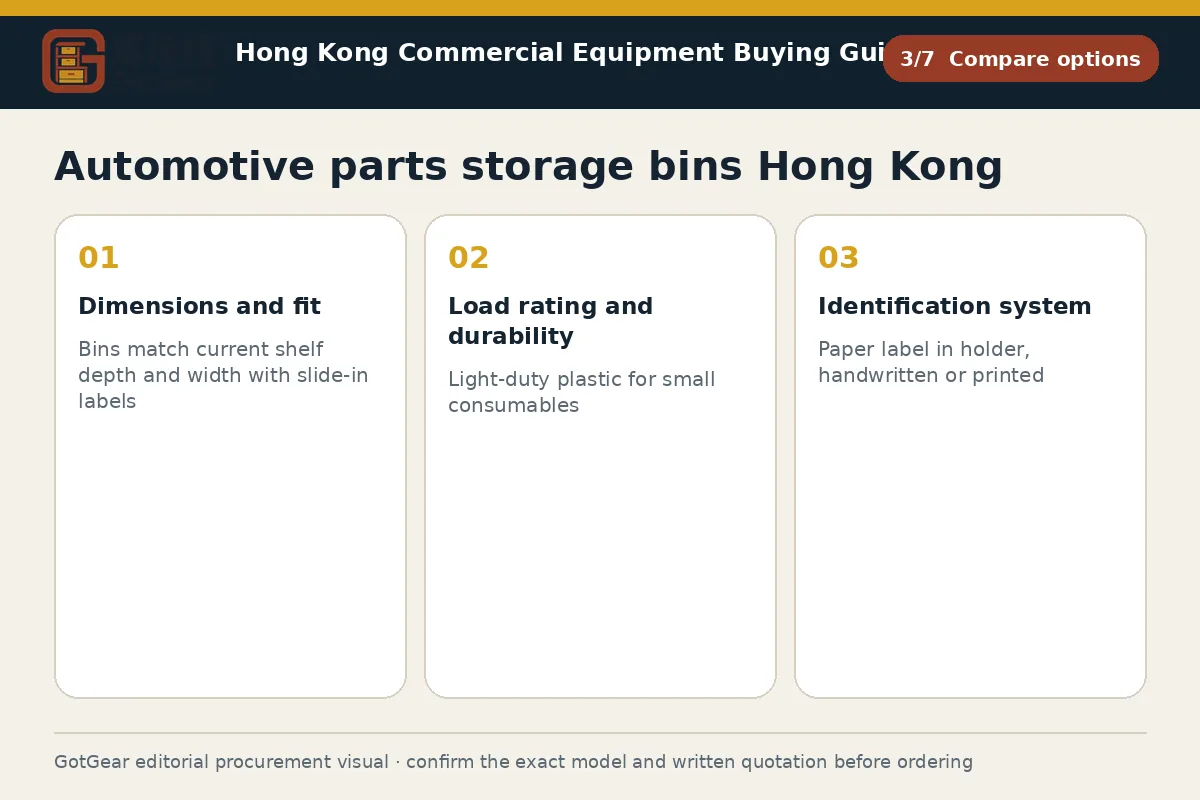
| Criterion | Straightforward requirement | More complex requirement | Evidence to provide |
|---|---|---|---|
| Dimensions and fit | Bins match current shelf depth and width with slide-in labels | Mixed system across shelves, louvre panels, rails and drawers | Provide bay internal W×D×H, lip height, rail type, and lift/door constraints |
| Load rating and durability | Light-duty plastic for small consumables | Heavier bins or drawers for metal parts in oily areas | List heaviest item mass, part geometry, and exposure to oil/heat (examples) |
| Identification system | Paper label in holder, handwritten or printed | Bilingual barcodes/2D codes with protected covers and location codes | State label slot size, printer type, languages, and symbology required |
| Replenishment method | Manual top-up to a simple min/max level | Two-bin Kanban, cards, or integrated tipping mechanisms | Share target service level, refill frequency, and trigger responsibility |
| Housekeeping and contamination | Smooth bins with optional lids for dust control | ESD variants and sealed kits; cleaning with approved agents | Name cleaning chemicals, ESD policy, and any enclosure or lock needs |
This framework helps buyers create comparable written enquiries. Final model specifications, availability, delivery and commercial terms must be confirmed in a formal quotation.
Automotive parts storage bins Hong Kong — Set Fast-Moving Locations and Refill Rules
Create a forward pick zone for the most frequently used items, placing them between approximate knuckle and shoulder height for safe access. Use clear-front or hopper-front bins where quick counting matters, and keep slower lines at lower or upper tiers. Define minimum and maximum refill quantities by line; as an example starting point only, test a two-bin method on your top ten parts and refine levels after observing a week of actual picks. If your team uses tipping bins Hong Kong for very small items, verify that the tipping action will not trap labels or damage delicate parts.
Document who triggers replenishment, how often stores sweep the fast-mover area, and what evidence they record (e.g., signed min/max card or barcode scan). In quotations, ask for options that support visual control: colour-coded bins, integrated card holders, and end-cap frames for quick reference charts. Confirm interface with shelves, louvre panels or rails, and request the recommended fixing hardware. Consider ergonomics along the full path: trolley space, thresholds, and lift reliability during busy loading windows. If environmental controls are needed for sensors or ECUs, evaluate antistatic variants and seek datasheets that state surface resistivity and grounding method, with insurer or competent adviser input where required.
Automotive parts storage bins Hong Kong — Plan Housekeeping and Contamination Controls
Plan how you will keep bins clean, dry and free from cross-contamination between oils, brake fluids, abrasives and electronics. Specify lids or dust covers for sensitive parts, and choose smooth internal surfaces that wipe down easily. Where chemicals are present, request the manufacturer’s chemical-resistance table for common workshop agents and confirm that printed labels and adhesives will not degrade. In Hong Kong’s humidity, trial a small set of bins to monitor label curl and condensation before committing to a large order, and document the outcomes in your procurement file.
Agree housekeeping roles: who empties swarf traps, who replaces cracked dividers, and who audits expired kits. As an example starting point only, schedule a monthly wipe-down for the fast-mover zone, then adjust with your safety officer’s advice. If mounting on walls or mezzanine handrails, obtain management-office approval for fixings and load, and ensure the model’s rated capacity matches your intended contents. Where fumes, dust or theft risk exist, consider relocating high-value or hazardous items into an enclosed industrial parts cabinet Hong Kong. For electronics, assess ESD-safe bins, grounding points and wrist-strap storage, subject to site policy and any insurer guidance.
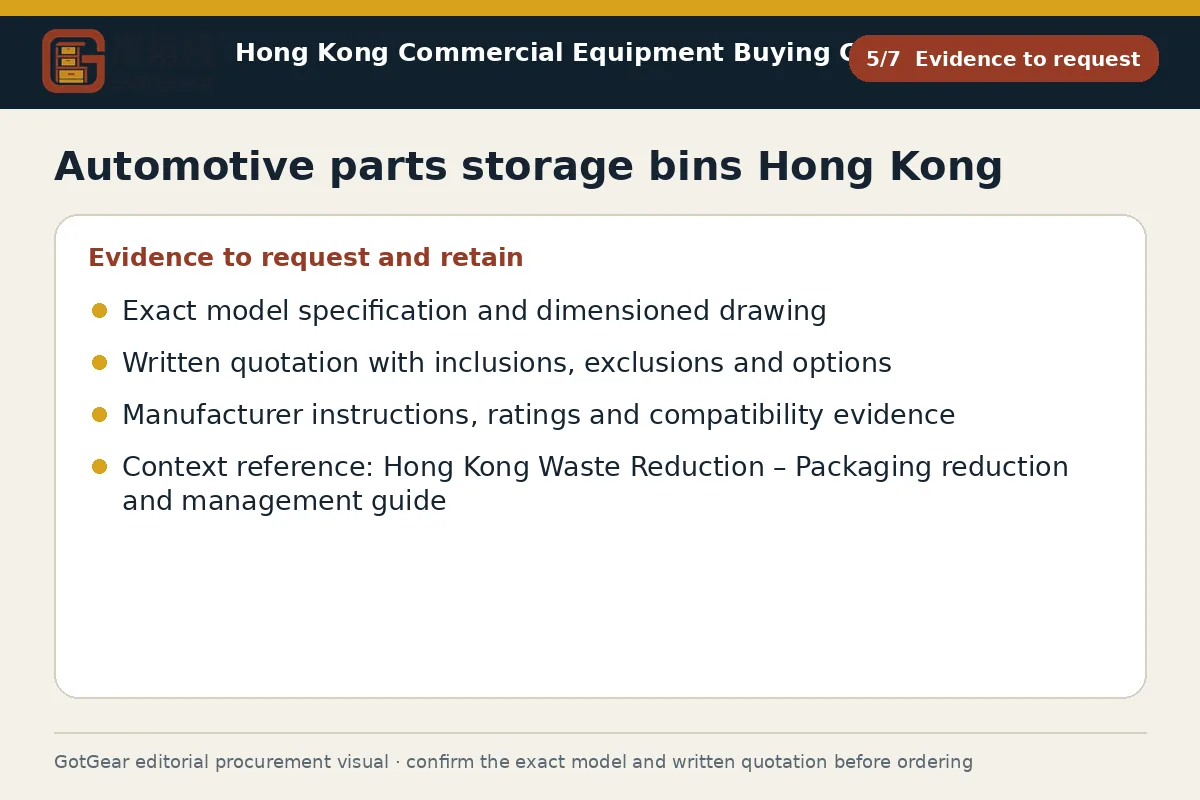
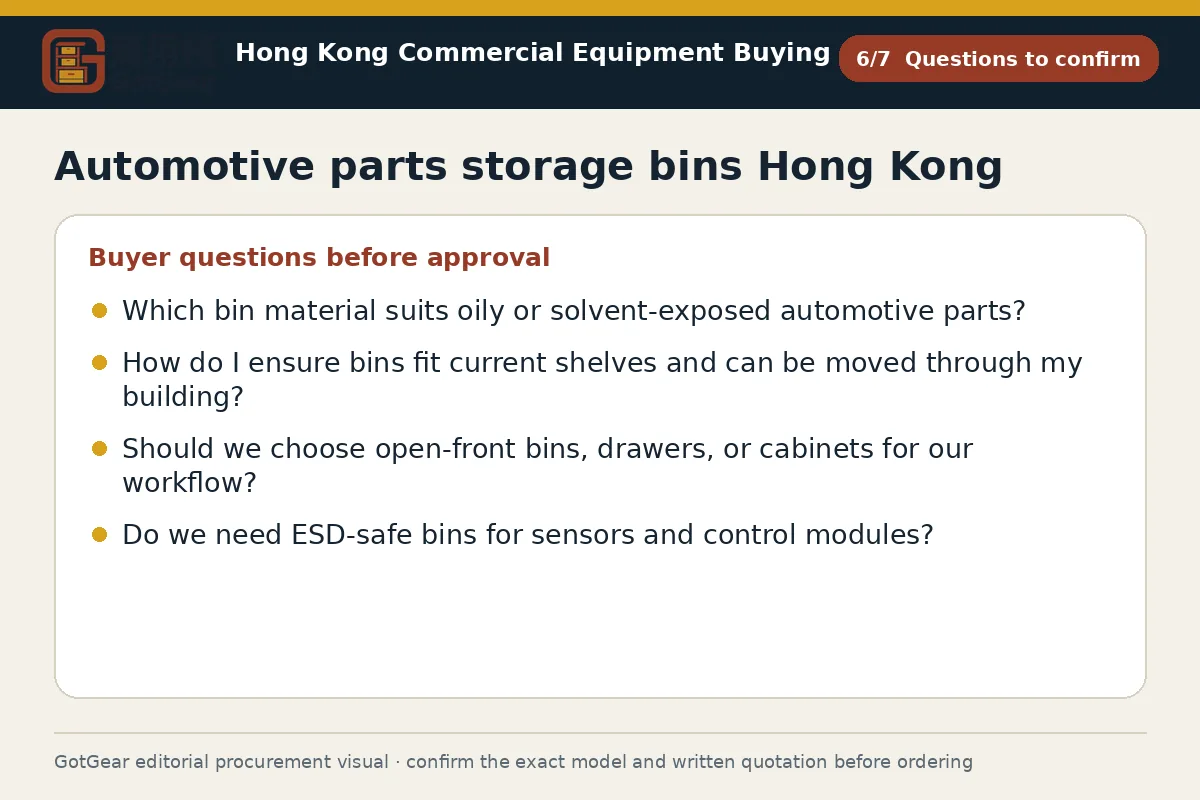
Automotive parts storage bins Hong Kong decision checklist
Start by mapping your parts into size and turnover groups, then measure shelves, rack depths and the full delivery path from loading bay to install location. Shortlist bin materials for oil and solvent exposure, and confirm load ratings against your heaviest examples. Choose an identification method that fits your label printers and bilingual needs, and lock down a location code format. Define fast-mover pick faces and a min/max or two-bin replenishment rule, naming who signs off refills. In your enquiry, request drawings with internal/external dimensions, divider options, rail compatibility, and label-holder specs. Compare quotations line by line for inclusions such as covers, dividers and fixings. On receipt, inspect moulding quality, label-holder fit, divider stability and any odour or residue. Keep a defects log and confirm any variances against the written specification.
- Operating use, quantity and expected frequency
- Dimensions, capacity, material and accessory requirements
- Delivery address, floor, goods lift and loading window
- Required documents, acceptance checks and after-sales arrangements
Key points for automotive parts storage bins Hong Kong
Hong Kong workshops often contend with tight goods-lift cars, narrow corridors and managed loading windows; confirm lift car dimensions, door clear openings and booking rules with the building office before ordering. High humidity and salt-laden air can warp labels and embrittle some plastics over time, so request material and adhesive data from manufacturers. Bilingual labelling is common in mixed teams; verify label holders fit both English and Chinese text. Where wall fixings or mezzanines are involved, seek management approval. These practical notes are operational guidance, not legal advice.
Questions about automotive parts storage bins Hong Kong
Which bin material suits oily or solvent-exposed automotive parts?
Polypropylene bins are commonly selected for general workshop oils; for aggressive solvents, ask for the manufacturer’s chemical-resistance table and test samples before rollout. If metal chips or heat are present, evaluate stronger polymers or steel drawers. Always confirm material grade, additives and intended use in the supplier’s written specification and seek adviser input where chemicals are a concern.
How do I ensure bins fit current shelves and can be moved through my building?
Measure the internal width, depth and height of each bay and note any lips or beams. Then confirm goods-lift car size, door width, corridor turns and the path to stores. Provide these to suppliers and request drawings with internal and external bin dimensions. Treat any example sizes as starting points only; the quoted model specification governs final fit.
Should we choose open-front bins, drawers, or cabinets for our workflow?
Open-front bins suit high-visibility fast movers; drawers prevent spillage of small fixings and aid separation; lockable cabinets protect high-value or hazardous items. Consider open front storage bins Hong Kong for line-side access, drawer containers Hong Kong for precision parts, and an industrial parts cabinet Hong Kong for controlled access. Trial a small area before full deployment to validate ergonomics.
Do we need ESD-safe bins for sensors and control modules?
If handling static-sensitive devices, ESD-safe bins can reduce risk when paired with proper grounding and procedures. Requirements depend on your equipment, insurer and any customer standards. Request datasheets stating surface resistivity and test method, and review with a competent adviser. For mixed areas, segregate ESD stock and use clear signage and dedicated handling tools.
Continue with closely related procurement topics
These pages share equipment, operating or decision-stage signals with this guide.
Warehouse bin storage system Hong Kong
GotGear explains warehouse bin storage system Hong Kong, including how to size pick faces, set capacity and define refill triggers. The guide also covers Kanban bins Hong Kong and FIFO picking bins Hong Kong.
Read the guide
Perforated Euro containers Hong Kong
GotGear provides a checklist to compare perforated Euro containers Hong Kong and vented plastic crates Hong Kong for food handling and cold chain, covering airflow, drainage, containment and cleaning considerations.
Read the guide
Bread crates Hong Kong
GotGear offers a checklist for bread crates Hong Kong that covers loaf and tray dimensions, packed weight, ventilation and stacking, vehicle and trolley fit, route cycle, cleaning and returns.
Read the guide
Reusable plastic crates Hong Kong
GotGear explains how reusable plastic crates Hong Kong are issued, sorted and inspected. It also outlines loss management, plastic crate colour coding Hong Kong and plastic crate cleaning and sanitising Hong Kong.
Read the guideRelated topic indexOpen more English procurement pages2 topics
Browse additional equipment families, applications and procurement questions relevant to a wider buying brief.