
To plan spare parts shelving Hong Kong, list representative part sizes and weights, the heaviest items, SKU count and access frequency. Add bin dimensions, location-labelling rules, replenishment workflow and a measured store layout so buyers can compare like-for-like proposals.
Group spare parts shelving Hong Kong by size, weight and pick frequency
When planning spare parts shelving Hong Kong, start by sorting SKUs by size, weight and how often they are picked. Measure representative length, width, height and net weight, and list the true heaviest parts, not just the typical ones. Build a simple A/B/C frequency list from work orders: A for daily picks, B weekly, C monthly or less. Place A‑items between knee and shoulder height, B above or below, and C at upper levels. Identify oily, sharp or loose components that need trays, liners or mesh backs to prevent drops and contamination.
Record constraints that will drive grouping. Confirm binning for small fasteners versus open shelves for belts, bearings and motors. Decide where kitting benches and returns staging sit relative to the fast‑mover zone. Check goods‑lift car, door and corridor sizes so assembled bays or longest shelf components can move safely; provide actual measurements to bidders. As an example starting point to validate, many stores choose shelf depths in the 300–450 mm band, but the final depth should follow measured parts and bin footprints. If your store also holds tools, coordinate bay spacing with workshop shelving Hong Kong so aisles and ergonomics stay consistent.
Build bin and label locations into spare parts shelving Hong Kong
Standardise bins before placing any order. Select two or three bin footprints that fit your common parts, then document their external size, lip height and how they stack. Specify minimum clear shelf openings and shelf pitch so stacked bins slide without snagging. Request shelf‑edge label holders and dividers that match your bin plan. In humid stores, choose rigid holders and label materials that resist condensation and cleaning spray. Finalise your location‑code syntax early, with bilingual text and barcode or QR if your CMMS supports scanning.
Include a visual key in your enquiry: colour bands for critical spares, symbols for hazardous items, and bay/level numbering. Reference warehouse rack location labels Hong Kong so vendors understand durability and readability expectations. Ask for a label proof showing fonts and character height. Provide a simple plan that marks target bay counts per zone and the intended bin footprints on each shelf. This lets suppliers confirm usable compartments after allowing for uprights, stop‑ends and side clearances, and helps prevent surprises when stock is transferred.
What should buyers compare for spare parts shelving Hong Kong?
| Criterion | Straightforward requirement | More complex requirement | Evidence to provide |
|---|---|---|---|
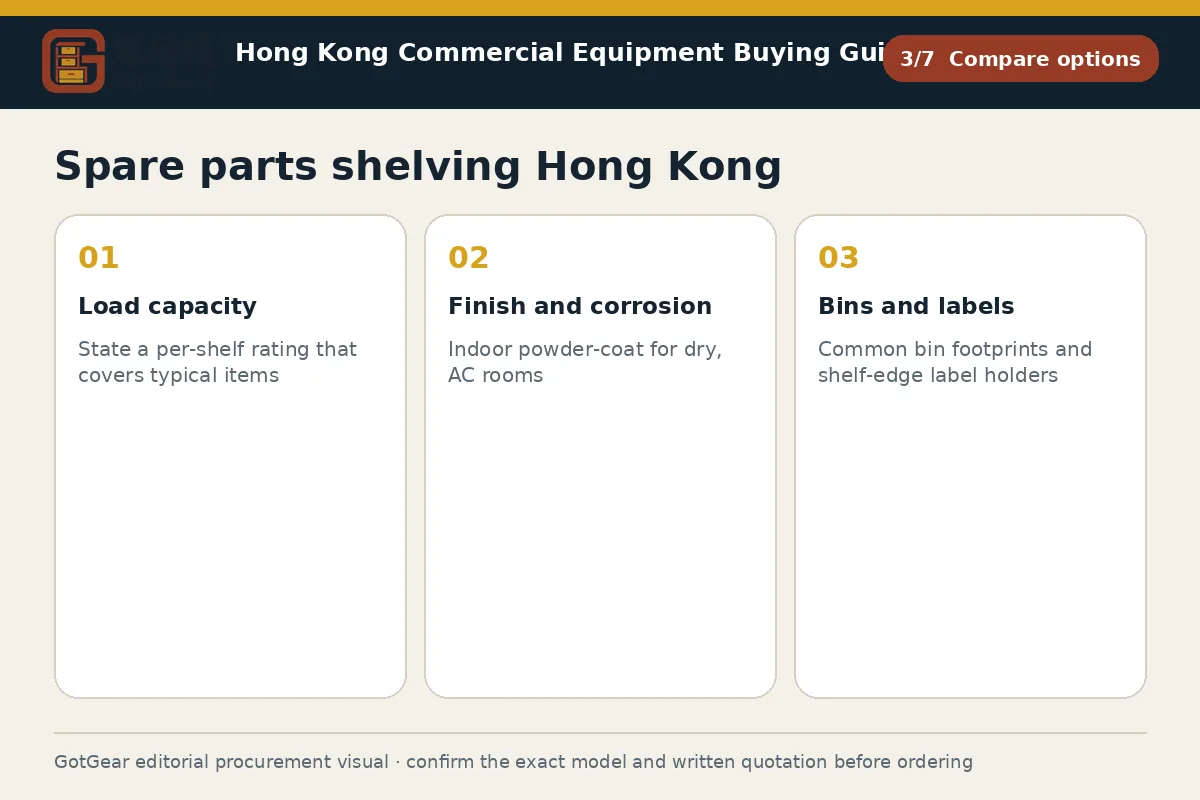
| Load capacity | State a per‑shelf rating that covers typical items | Include per‑bay rating and placement for heaviest SKUs | List weights of representative parts and true outliers |
| Finish and corrosion | Indoor powder‑coat for dry, AC rooms | Galvanised/zinc‑rich finish with stainless fixings for damp zones | Note humidity, cleaning routines and any semi‑open exposure |
| Bins and labels | Common bin footprints and shelf‑edge label holders | Pre‑cut dividers, colour bands, bilingual + barcoded labels | Provide bin external sizes, label mock‑up and code syntax |
| Fit and access | Bays fit room height and goods‑lift car | Breakdown delivery, stair carry or timed windows | Measure lift/doors/turns; share photos and booking rules |
| Installation and approvals | Freestanding with levelling feet | Anchoring/bracing, cladding and egress clearances | Supply floor notes and any manager approval for fixing |
This framework helps buyers create comparable written enquiries. Final model specifications, availability, delivery and commercial terms must be confirmed in a formal quotation.
Specify spare parts shelving Hong Kong and shelving for machinery parts Hong Kong
Turn your plan into a specification buyers can compare line‑by‑line. State target bay height, number of levels, minimum clear opening per shelf, and required minimum load per shelf and per bay as confirmed by your heaviest groupings. Define steel gauge, shelf type (solid, perforated or wire), and finish suitable for Hong Kong humidity. Where you need shelving for machinery parts Hong Kong, call out options such as reinforced shelves for motors, drip trays for lubricated spares, mesh backs to stop roll‑off and retainers for round stock.
Add accessories and constraints that affect cost and fit: end panels, back cladding, anti‑spill lips, bin rails, levelling shims, and whether anti‑tip bracing or anchoring is required by your building manager. Note floor condition, tolerances and any gradient. Quote expected aisle widths and maximum assembled bay height so units can navigate lifts and corridors. To keep comparisons clean, request model codes, drawings and an industrial shelving specification Hong Kong summary with every proposal. If your parts area adjoins workshop shelving Hong Kong or wider industrial shelving Hong Kong, ask vendors to confirm compatibility of finishes and post profiles. Delivery method, installation scope and waste removal should be stated in the formal written quotation; quoted model specifications and that document prevail.
Map replenishment and retrieval around spare parts shelving Hong Kong
Design replenishment and retrieval processes around the layout so put-away, picking and cycle counts remain smooth. Establish a defined route from goods-in to quarantine (if used), and from there to the bay using clear signage and verified location codes. For small fast-movers, two-bin or card Kanban can trigger restock without spreadsheets; for bulky spares, set min–max at bay level and use visual reorder flags. Keep heavy regular picks at waist height and use steps only for genuinely occasional access, following manual-handling limits set by your competent adviser.
Factor in Hong Kong realities: loading-bay booking windows and lift reservations often require batch-based restocking, so schedule accordingly and coordinate with the management office. If aisles are narrow, specify trolleys and dollies that fit, and lay out cross-aisle passing points. Document who picks, who replenishes and who audits labels, then set a cycle-count plan by zone. Finally, capture returns-to-stock and scrappage routes to prevent empty bins migrating; mapping these flows around spare parts shelving Hong Kong reduces congestion and errors.
Spare parts shelving Hong Kong decision checklist
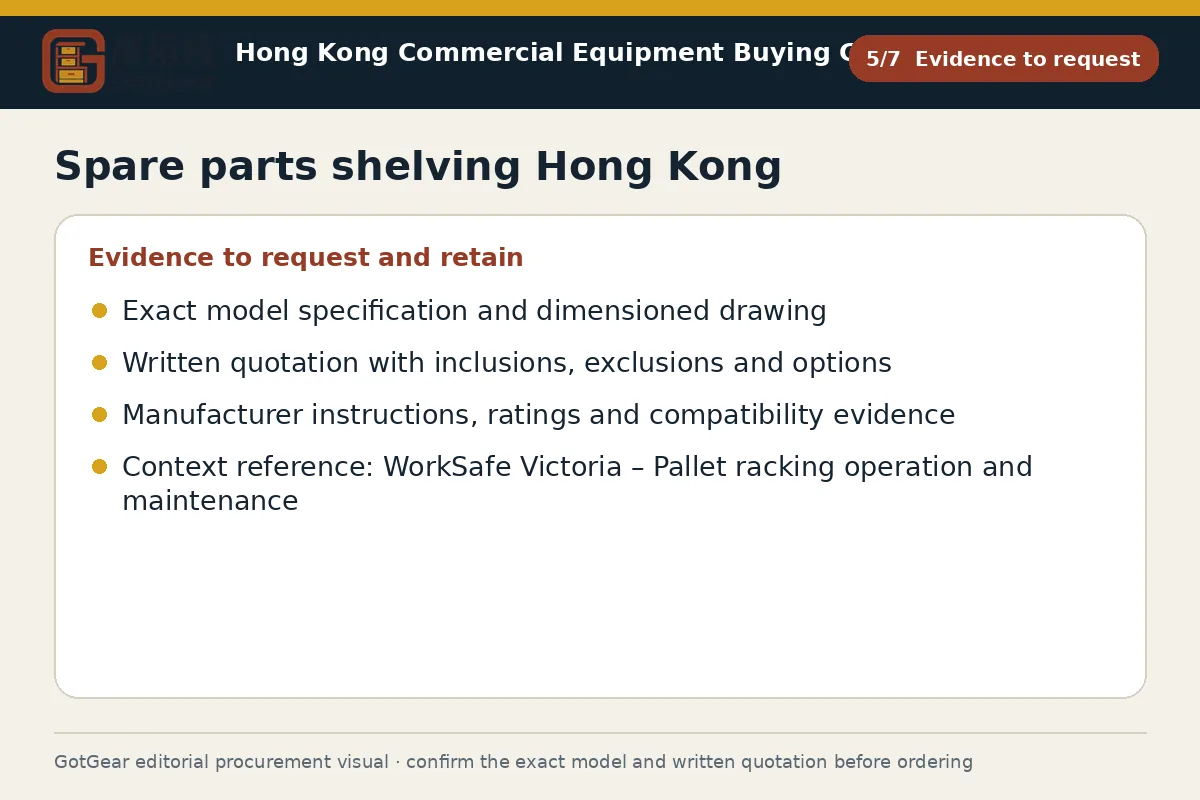
Capture representative dimensions and weights, then list the heaviest outliers and ABC pick frequencies. Sketch a to‑scale plan with proposed zones, aisle widths and kitting/returns areas, noting lift and doorway measurements. Select bin footprints and write the location‑code logic with bilingual text. Issue an enquiry that specifies clear openings, shelf pitch, load ratings, finish, dividers, label holders and any cladding or anti‑tip requirement. Request model codes, drawings and a statement of installation scope, delivery method and waste removal. On receipt, inspect finish quality, load‑rating labels, component counts, upright/shelf integrity and label‑holder fit; photograph any damage before signing. Ask for manufacturer datasheets, finish specifications and anchoring instructions where applicable; written quotations and model specifications prevail.
- Operating use, quantity and expected frequency
- Dimensions, capacity, material and accessory requirements
- Delivery address, floor, goods lift and loading window
- Required documents, acceptance checks and after-sales arrangements
Key points for spare parts shelving Hong Kong, shelving for machinery parts Hong Kong
Hong Kong MRO stores commonly occupy upper floors in industrial estates, with compact lifts, tight corridors and timed loading windows. Measure the entire delivery path—lift depth, door clear widths, turning spaces—and share photos with bidders so packaging and bay heights are planned correctly. Summer humidity accelerates corrosion and weakens some adhesives, so finishes and label media should reflect damp conditions. Management offices may require delivery bookings, worker registration and noise control. Many teams operate bilingually, so labels, plans and handover documents should include Chinese and English. Where drilling floors or fixing to walls is proposed, obtain written confirmation from the building manager and your competent adviser; site‑specific and insurer requirements may apply.
Questions about spare parts shelving Hong Kong
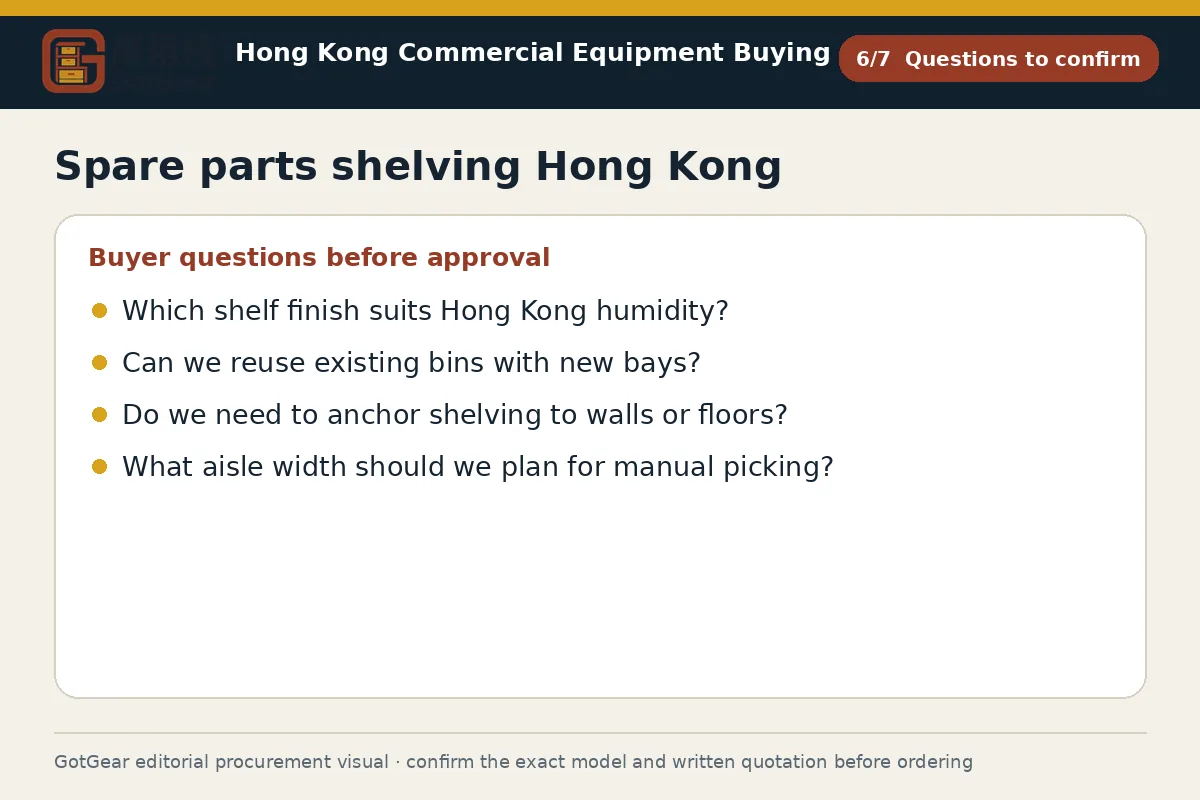
Which shelf finish suits Hong Kong humidity?
For air‑conditioned indoor stores with limited moisture, quality powder‑coat can perform well; in damp or semi‑open areas, galvanised or zinc‑rich systems with stainless fixings resist corrosion better. The best choice depends on airflow, cleaning, and exposure. Request the manufacturer’s finish specification and confirm with your building manager and insurer if conditions are demanding.
Can we reuse existing bins with new bays?
Often yes, if the clear shelf opening, lip profile and divider pattern fit your bin footprint and height. Check the bin’s external dimensions against the proposed clearances, and confirm shelf edges won’t snag. Ask for a sample shelf or a mock‑up photo from the vendor before ordering, and verify the combined load remains within the stated shelf rating.
Do we need to anchor shelving to walls or floors?
Anchoring is commonly recommended for tall, heavily loaded or uneven floors, and where anti‑tip risk exists. Whether you can drill or fix depends on your building manager’s rules and slab conditions. Ask the supplier for anchoring options and instructions, then seek written approval from the building manager or a competent adviser before installation proceeds.
What aisle width should we plan for manual picking?
Choose an aisle that suits your handling equipment and trolleys; as an example starting point to validate, many teams trial 900–1,200 mm for hand picking. Actual width should reflect parts size, passing needs and emergency egress rules for your venue. Confirm with your safety lead, building manager and insurer before you freeze the layout.
Continue with closely related procurement topics
These pages share equipment, operating or decision-stage signals with this guide.
Industrial shelving Hong Kong
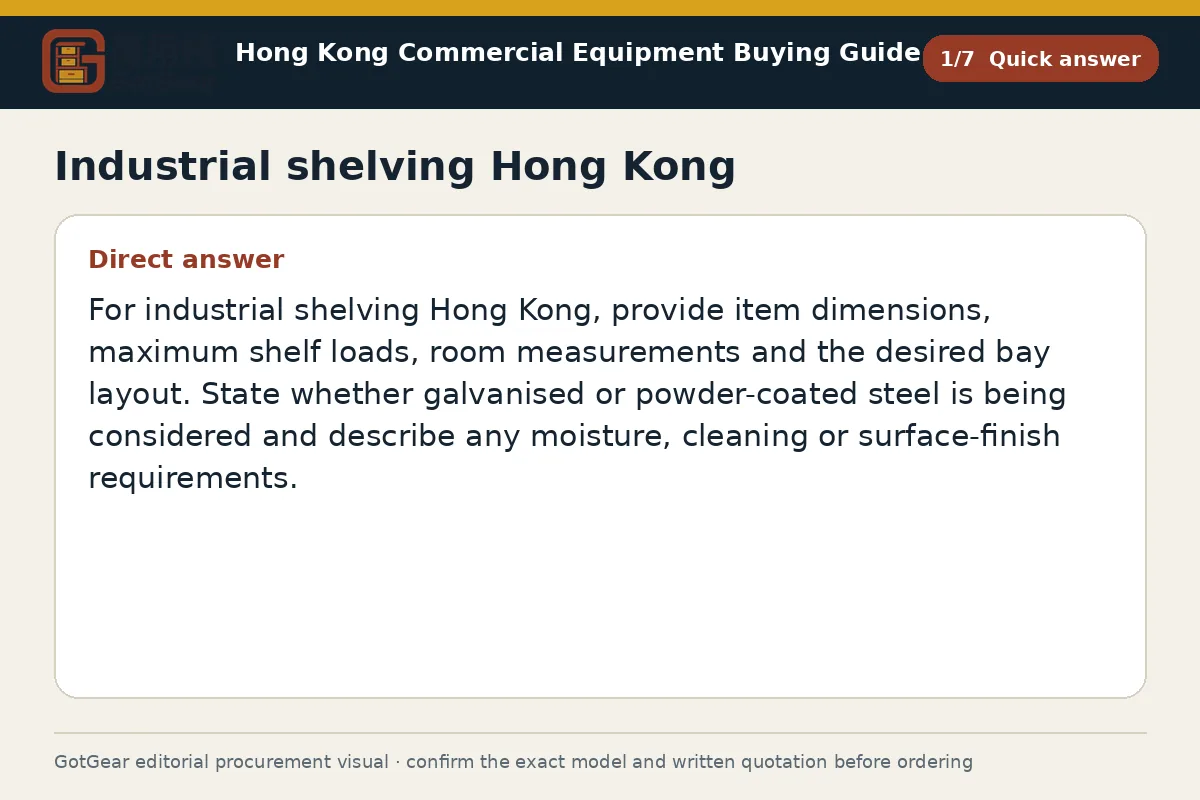
GotGear outlines loads, dimensions, layout and moisture considerations for industrial shelving Hong Kong. It compares galvanised steel shelving Hong Kong with powder-coated steel shelving Hong Kong.
Read the guide
Modular shelving Hong Kong
Compare usable height, picker travel, access and expansion when choosing between modular shelving Hong Kong and multi-tier shelving Hong Kong. Read practical layout guidance from GotGear.
Read the guide
Workshop shelving Hong Kong
If you are planning workshop shelving Hong Kong, GotGear provides a checklist covering item and bin sizes, shelf loads, access, cleaning and labelling and includes considerations for factory shelving Hong Kong.
Read the guide
Archive shelving Hong Kong
Plan archive shelving Hong Kong by box size, document format, retention period, retrieval frequency and labelling to organise office records effectively. GotGear helps office and records buyers.
Read the guideRelated topic indexOpen more English procurement pages4 topics
Browse additional equipment families, applications and procurement questions relevant to a wider buying brief.