
For warehouse rack location labels Hong Kong, provide the location-code format, quantity by label type, rack elevations, viewing or scanning distance and sample data. Include aisle-wayfinding needs, barcode symbology, substrate conditions and required dimensions so the quotation covers the complete identification scheme.
Define the address hierarchy for warehouse rack location labels Hong Kong
When defining warehouse rack location labels Hong Kong, begin by mapping the operational hierarchy to your physical layout and WMS data model. Decide the elements that will appear in every address (for example, site, zone, aisle, bay, level and position) and fix the reading direction by face and travel path. Use consistent zero‑padding and separators, and avoid characters that can be confused at distance. An example starting point could be Z1-A07-B12-L02-P03, but the exact syntax must be confirmed in the written brief and matched to your system limits.
Account for real layouts: double‑deep storage, drive‑in lanes, mezzanine tiers, cross‑dock lanes and stage buffers. Set rules for left/right counting, odd/even aisles, and whether positions number from the main travel path or the wall. State how you will handle exceptions such as blocked bays or seasonal pop‑up areas. Include bilingual zone names where needed and provide a legend so installers and auditors read addresses the same way. Align the hierarchy with your warehouse racking specification Hong Kong so structural drawings, fire plans (if applicable) and inventory addresses refer to the same aisles and elevations. Request a supplier proof layout that shows sample labels at each elevation and validates the addressing logic before production.
Set placement and data fields for warehouse rack location labels Hong Kong
Placement and data are where legibility meets workflow. Measure representative beam face heights, lip depths and upright widths, and note whether surfaces are painted, powder‑coated, galvanised or wire‑mesh. Record typical viewing and scanning distances by task (put‑away, ground picking, replenishment from a reach truck). As an example starting point, a 100×50 mm label may suit ground‑level hand scanning at about 0.8–1.2 m, while higher elevations often need larger characters; confirm exact sizes in the quotation. Specify fixings by substrate: high‑tack adhesive for smooth paint, magnets for changeable slots, or holders for wire‑deck. In humid areas, request material and adhesive datasheets and cleaning instructions.
Define data fields unambiguously: human‑readable address, barcode symbology and density, optional arrows, check digits and any colour banding by level. If bilingual lines are required, show the Chinese field content in your sample data. Smaller formats used on spare parts shelving Hong Kong and workshop shelving Hong Kong often need shortened legends or stacked text; provide mock‑ups to verify character heights. State whether bay capacity or safety notices appear on separate plates to avoid clutter and misreads.
What should buyers compare for warehouse rack location labels Hong Kong?
| Criterion | Straightforward requirement | More complex requirement | Evidence to provide |
|---|---|---|---|
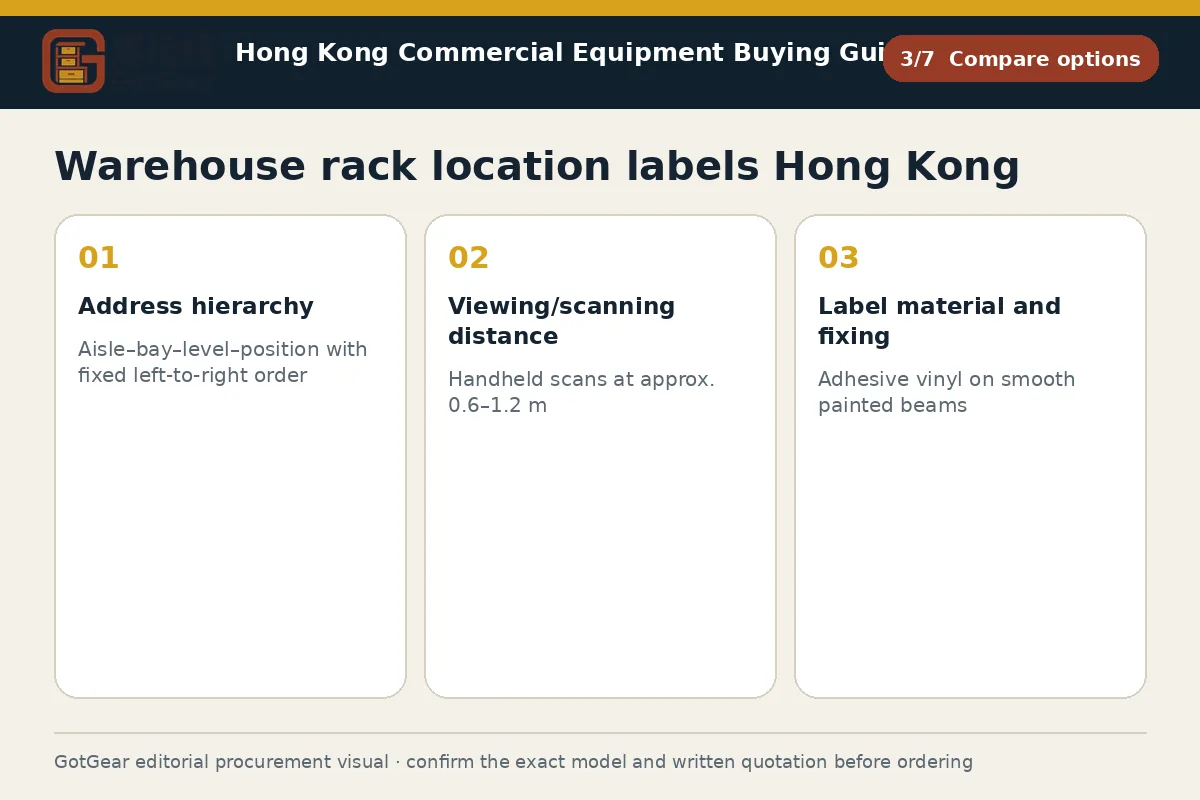
| Address hierarchy | Aisle–bay–level–position with fixed left-to-right order | Zones, mezzanines, drive-in/depth and staging lanes included | Floor plan, WMS field limits and sample codes |
| Viewing/scanning distance | Handheld scans at approx. 0.6–1.2 m | Forklift or long-range scans with larger fonts/low-density barcodes | Measured distances, beam heights, equipment list |
| Label material and fixing | Adhesive vinyl on smooth painted beams | Freezer-rated, wire-deck holders, magnetic strips for changeovers | Substrate photos, humidity/temp notes, cleaning method |
| Aisle signage build | Simple end-of-aisle plates | Suspended double-face boards, floor arrows, bilingual legends | Ceiling height, sprinkler clearance, landlord permissions |
| Data and printing | Supplier pre-prints static addresses | Variable data, check digits, colour bands, bilingual fields | CSV with field map, artwork proofs, sample scans |
This framework helps buyers create comparable written enquiries. Final model specifications, availability, delivery and commercial terms must be confirmed in a formal quotation.
Warehouse rack location labels Hong Kong: Coordinate with rack aisle signs Hong Kong
Wayfinding must make the address system instantly navigable. Coordinate end‑of‑run boards, cross‑aisle markers and floor references so they reinforce the same hierarchy and reading direction. Determine whether aisles display ascending numbers from the inbound dock or follow building gridlines; show this choice on a plan. Choose materials for visibility and durability: reflective or high‑contrast panels where lighting is uneven, and font sizes scaled to read from main travel lanes. Confirm mounting methods (rivet, clamp, suspended) and the clearance to pallets, sprinklers and lighting.
Local constraints shape final choices for rack aisle signs Hong Kong. Many industrial floors in Hong Kong have low soffits, beams and ductwork; suspended signs must clear M&E services and may need landlord approval or method statements. If large panels cannot pass through goods‑lift doors, specify multi‑section boards that assemble on site. Note delivery windows and building access rules so installation teams can schedule quiet aisles without interrupting operations. Where routes serve visitors or mixed‑use areas, consider bilingual legends and colour coding consistent with evacuation diagrams if your insurer or building manager prefers alignment; confirm any such requirement in writing before artwork approval.
Test barcode rack labels Hong Kong as part of the plan for warehouse rack location labels Hong Kong
Before committing to full production, trial the design and workflow assumptions. Select a representative pilot area with different elevations, travel paths and lighting, and install a controlled batch of barcode rack labels Hong Kong using the proposed materials and fixings. Run tasks end‑to‑end: put‑away, ground pick and replenishment from typical equipment. Capture scan performance by distance (standing, on pallet jack, from reach truck), note glare angles on glossy beams and log any misreads or near‑duplicates.
Agree acceptance criteria in advance, such as minimum character height by elevation, barcode density that your scanners decode at the intended range and tolerance to cleaning chemicals—each as an example starting point only and to be confirmed in the supplier’s quotation. Request artwork proofs, a material specification sheet and, if offered, a barcode verification summary for the pilot batch. Document the data load process so addresses import reliably to WMS. Extend the same conventions to adjacent areas like warehouse shelving for boxed goods Hong Kong so staff move between zones without relearning rules.
Warehouse rack location labels Hong Kong decision checklist
Start with a floor plan and confirm the hierarchy for zones, aisles, bays, levels and positions, including counting direction. Measure beam faces, uprights and scanning distances by task; photograph substrates and note humidity, cleaning and lighting. Provide sample data with the exact location-code format, bilingual text where needed, barcode symbology, colours and proposed character heights. Request quotations that state materials, adhesive type, fixing method, label dimensions, artwork sign-off steps, installation scope and any pilot or proofs. Compare quotes line by line against quantities by label type and elevations. On receipt, inspect print contrast, edge quality, barcode clarity and packaging integrity, and spot‑check scans at working distances. Where relevant, ask for manufacturer datasheets, installation guidance and any offered barcode verification summaries. Model specifications and the formal written quotation prevail.
- Operating use, quantity and expected frequency
- Dimensions, capacity, material and accessory requirements
- Delivery address, floor, goods lift and loading window
- Required documents, acceptance checks and after-sales arrangements
Key points for warehouse rack location labels Hong Kong, rack aisle signs Hong Kong, barcode rack labels Hong Kong
Hong Kong warehouses often operate within mixed‑use or high‑rise industrial buildings, so access and installation planning matter. Large aisle boards may not fit lifts or stairwells, and loading bay windows can be short; confirm packaging sizes and delivery timing with management offices early. Humid summers affect adhesives and ink, while cold rooms introduce condensation—specify materials accordingly. Bilingual legends are common across multi‑team sites; if both English and Chinese appear, fix the field order and font sizes in your brief. Any requirements from landlords, insurers or building managers should be confirmed in writing before production; this is operational guidance, not legal advice.
Questions about warehouse rack location labels Hong Kong
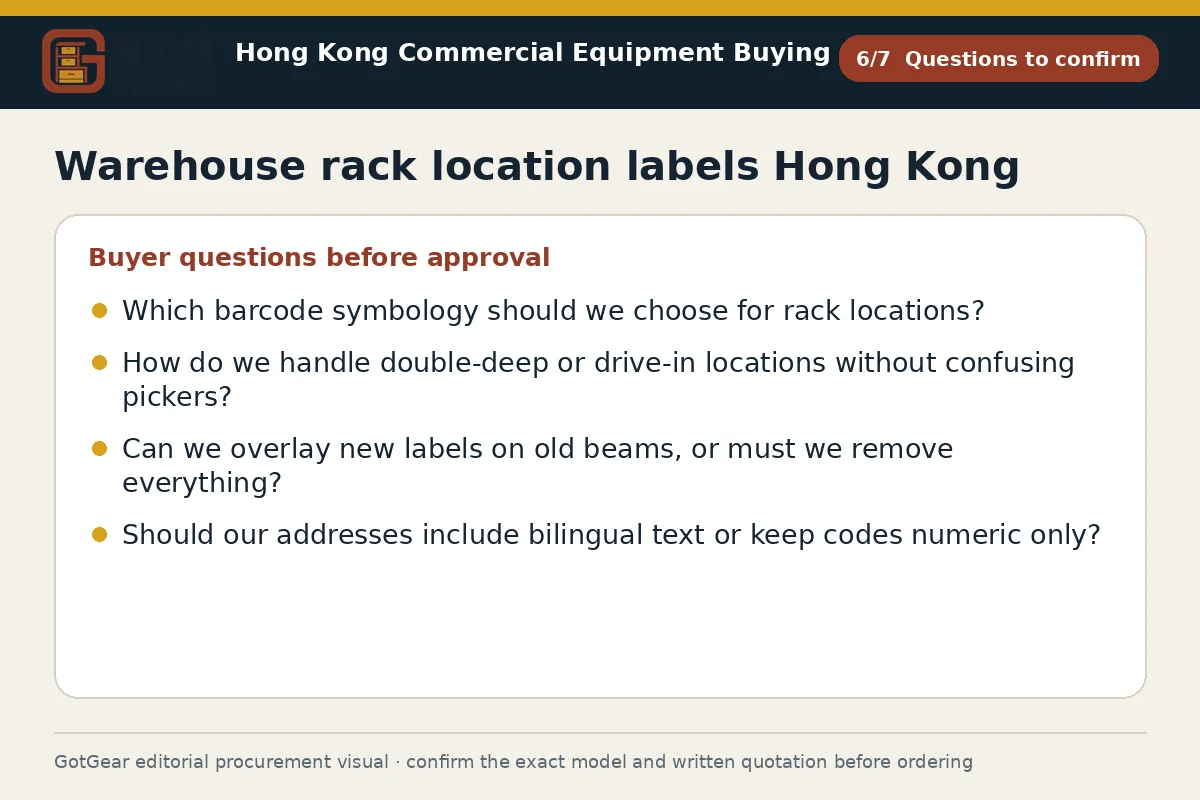
Which barcode symbology should we choose for rack locations?
Most WMS users select Code 128 for compact, high‑reliability linear scanning. If your workflows need camera scanning from very close range or to encode longer strings, consider Data Matrix or QR, subject to device capability. Confirm scanner models, target distances and any ERP import limits in the written brief, and request a supplier test print before approving artwork.
How do we handle double‑deep or drive‑in locations without confusing pickers?
Define a depth or lane element in the address and show it consistently in human‑readable text and barcode. Use colour bands or arrows only if they are documented in the legend and tested in a pilot. Validate left/right and front/back conventions on site, and ensure aisle end‑signs reinforce the same ordering to prevent mirrored mistakes.
Can we overlay new labels on old beams, or must we remove everything?
Overlays work when the new substrate is stable, flat and clean; otherwise residue can reduce adhesion and legibility. For changeable areas, holders or magnetic strips avoid build‑up. Ask the supplier to advise on surface prep and to quote any removal work separately. Testing a small area first is prudent, especially on galvanised or rough coatings.
Should our addresses include bilingual text or keep codes numeric only?
Keep the core address alphanumeric and language‑agnostic, then add bilingual zone or area names if teams benefit. Fix the field order, fonts and character heights in artwork proofs, and confirm WMS displays handle the same labels. Where signage is visible to visitors, check with your building manager whether consistent bilingual wayfinding is preferred before finalising art.
Continue with closely related procurement topics
These pages share equipment, operating or decision-stage signals with this guide.
Modular shelving Hong Kong
Compare usable height, picker travel, access and expansion when choosing between modular shelving Hong Kong and multi-tier shelving Hong Kong. Read practical layout guidance from GotGear.
Read the guide
Warehouse shelving for boxed goods Hong Kong
Use the GotGear checklist to plan warehouse shelving for boxed goods Hong Kong. Evaluate carton sizes, unit and shelf loads, stock-keeping unit counts, pick rates and access when arranging storage and picking routes.
Read the guide
Spare parts shelving Hong Kong
Use this maintenance, repair and operations checklist to compare sizes, weights, counts, pick rates and store layout for spare parts shelving Hong Kong and shelving for machinery parts Hong Kong. This checklist is from GotGear.
Read the guide
VNA racking Hong Kong
Compare VNA racking Hong Kong with double deep racking Hong Kong and push back racking Hong Kong when planning your warehouse layout. GotGear provides a checklist on selectivity, aisle geometry, stock rotation and truck type.
Read the guide