
When requesting workshop shelving Hong Kong, provide item and bin dimensions, maximum loads, access frequency, and the required number of storage locations. Also include a measured plan, cleaning conditions, labelling requirements, and any separation needed between production stock, tools, and work in progress.
Plan workshop shelving Hong Kong around tools, parts and work in progress
Start by mapping what must be stored and how it moves through the work area. Group tools by set and by task, separate consumables from fasteners, and keep work in progress apart from finished or cleaner stock. Measure the outer dimensions of bins, cases and toolkits, including handles and lids, and record the heaviest expected contents. Note replenishment methods and whether items arrive in supplier cartons, totes or returnable containers that must be shelved directly.
For workshop shelving Hong Kong, teams should prioritise fast, unobstructed access at benches and machines. Mark out where operators stand, the swing of doors, and trolley turning arcs so shelving does not block working positions. Specify adjustable shelves, dividers and container stops to keep small parts controlled. In humid spaces, request finishes and decking materials suitable for corrosion resistance and for easy wiping. Ask suppliers to propose shelf depths that match your measured containers, clear openings that admit gloved hands, and bay spans compatible with available wall or floor space, avoiding conflicts with sockets, trunking and fire equipment. Confirm that the written quotation states the number of shelves per bay, their adjustability range, and any compatible bin types so the layout you drew remains achievable on site.
Set load, access and labelling needs for workshop shelving Hong Kong
Define the real loads and how often each location is touched. Classify items by per-shelf uniform load and any concentrated point loads from vices, jigs or stacked bins. State maximum bay load, intended bracing, and whether mobile steps or trolleys will be used so safe picking heights can be set. Put heavier, less-handled stock low, high-frequency items between knee and shoulder height, and fragile pieces in protected compartments or drawers as needed.
Set a labelling scheme that operators can follow at a glance. Provide bilingual location identifiers, shelf-level labels sized to your holders, and barcode or QR requirements if stock is scanned. In your enquiry ask for: declared per-shelf and per-bay load classes, shelf pitch, decking type (solid, perforated, wire), coating specification, fasteners included, and recommended fixing methods. Request manufacturer data sheets and test declarations where available, subject to the chosen model. On receipt, inspect coating integrity, upright plumbness, beam engagement, and hardware counts against the packing list. If the site demands installation, seek assembly drawings, torque guidance, and a statement of any anchors required, to be confirmed by your building manager or competent adviser before drilling.
What should buyers compare for workshop shelving Hong Kong?
| Criterion | Straightforward requirement | More complex requirement | Evidence to provide |
|---|---|---|---|
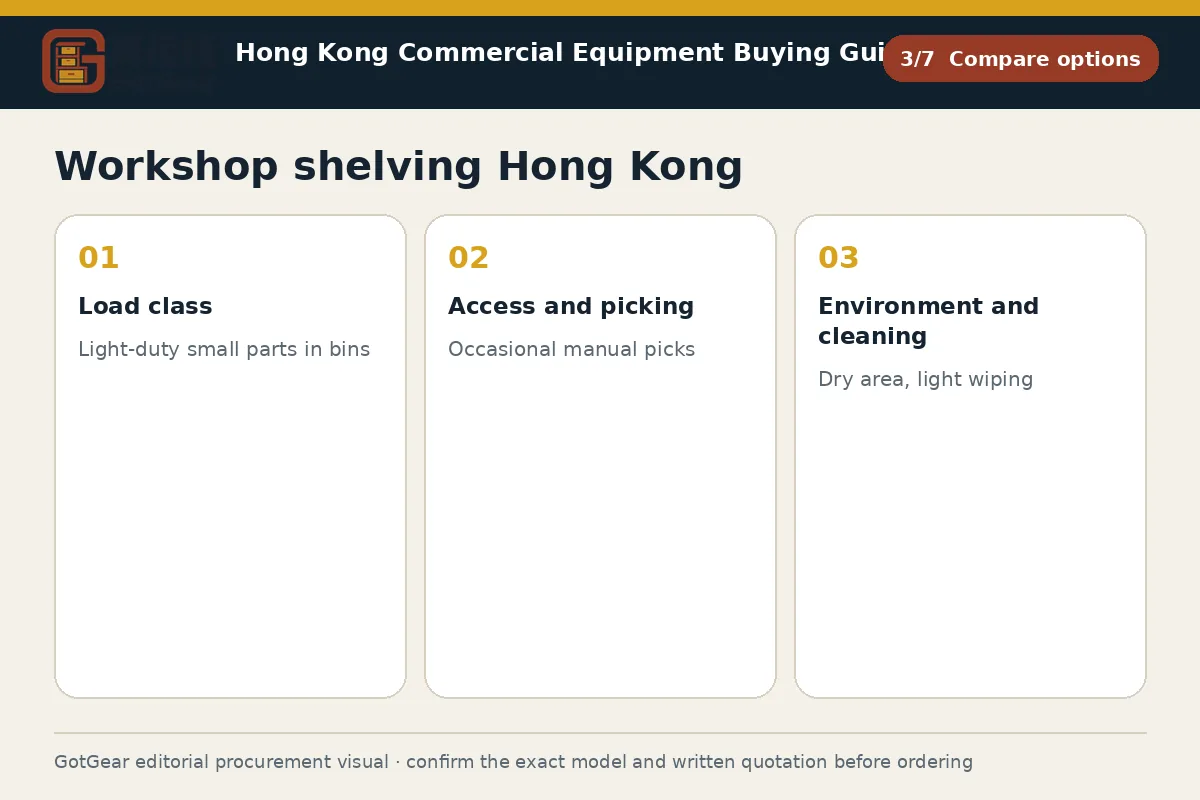
| Load class | Light-duty small parts in bins | Mixed heavy tools, fixtures and WIP totes | List per-shelf and total bay weights by location |
| Access and picking | Occasional manual picks | High-frequency line-side or kitting picks | Describe pick frequency and ergonomic reach ranges |
| Environment and cleaning | Dry area, light wiping | Humid, washdown or dust-control required | Provide cleaning methods and chemicals used |
| Space and access | Ground-floor, open access | Goods-lift only, narrow doors, restricted bay hours | Attach measured plan, lift and doorway sizes, booking rules |
| Labelling and controls | Simple shelf identifiers | Bilingual, barcode and zoned WIP separation | Share label text, languages, coding and sample data |
This framework helps buyers create comparable written enquiries. Final model specifications, availability, delivery and commercial terms must be confirmed in a formal quotation.
Workshop shelving Hong Kong: Differences from factory shelving
Compare the duty and flow of a manual bench area with a production zone so that specifications remain consistent. Workshops typically need frequent small-part picks, flexible dividers and bins adjacent to benches, while line-side or assembly areas may emphasise first-in, first-out lanes, tote compatibility and clearer pedestrian routes. State whether the same bay must accept both small parts and bulkier tools, or whether separate zones are safer and cleaner. If powered equipment operates nearby, confirm the required clearances and protections in your layout brief.
When evaluating factory shelving Hong Kong, buyers should check that quotations are aligned on bay width and height, the number of shelves supplied, load classes, finish, and accessories such as dividers, bin rails and stops. Ask for exploded drawings and a complete component list so two offers can be compared item-for-item. If your insurer, building manager or process owner requires anchoring, barrier rails or fire-fighting access clearances, request written guidance from the responsible party and circulate it with the enquiry. For incoming inspection, verify that the delivered components match the agreed drawing codes and that any documentation—finish specification, load declarations and care instructions—accompanies the shipment. The model specification and formal quotation should always prevail.
Fit workshop shelving Hong Kong to cleaning routines and usable space
Plan shelves that can be cleaned quickly without disrupting work. State whether sweeping, vacuuming or wet mopping is used, and whether dust or oil mist is a concern. Choose perforated or wire decks to reduce dust accumulation, or solid decks with raised edges where spill containment is important. If wet cleaning is routine, ask for galvanised, stainless or high-build powder-coated finishes, plastic foot caps or stand-offs to keep legs off damp floor patches, and label materials that withstand detergents.
Match the layout to the space you can truly use. Survey columns, trunking, hose reels, skirting and uneven walls, and note slab flatness so levelling feet can be specified. Measure doorways, stair turns and goods-lift cars to confirm the longest delivered component will pass; provide floor-to-ceiling heights clear of sprinklers and services as directed by your building manager. Coordinate loading-bay bookings and delivery hours with the management office, and document any lift operator or work-permit requirements. In your enquiry, request bay fixing options suited to your substrate, method statements for safe handling in confined access, and bilingual location labels to match your stock codes. After installation, check that aisles remain clear, shelves are level, and labels are readable at working distance.
Workshop shelving Hong Kong decision checklist
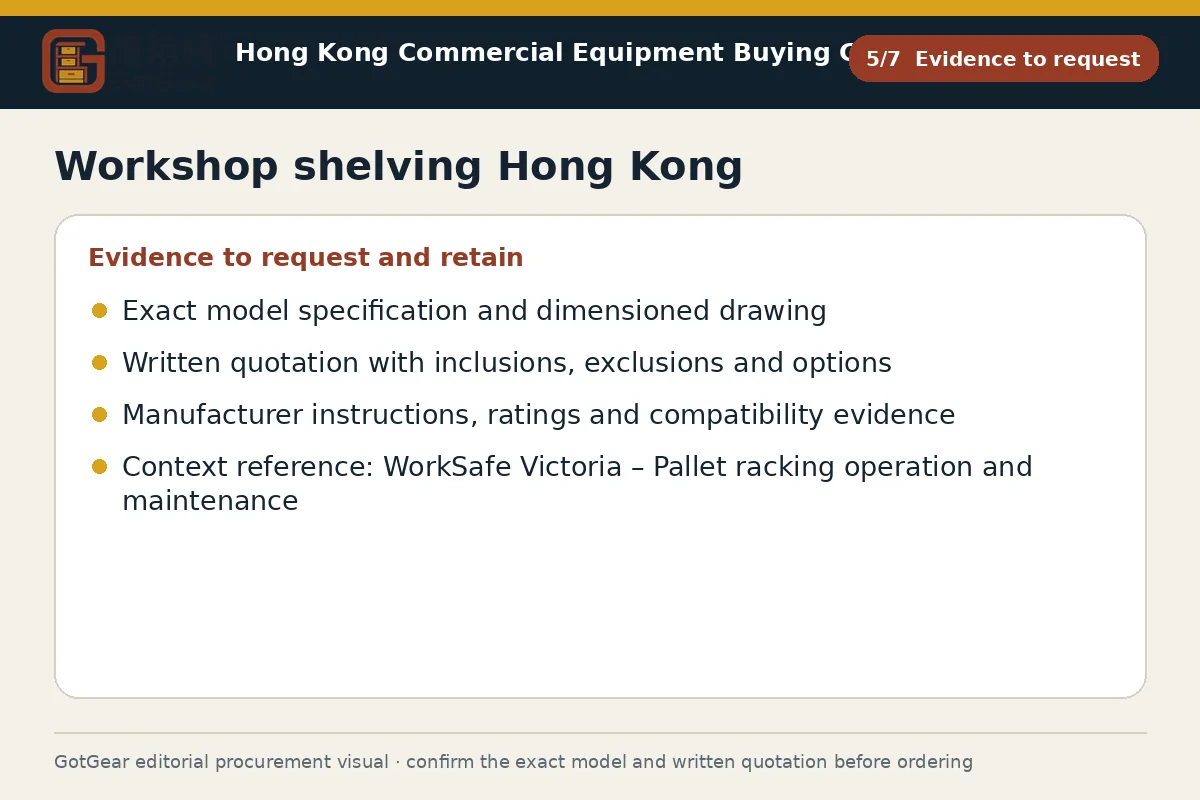
Document your items by family, container size and expected weight, then sketch a measured plan showing obstructions, services and realistic aisle widths. State per-shelf and per-bay load classes, access frequency, preferred picking heights and any separation between clean stock, tools and work in progress. Specify decking type, coating, shelf pitch, dividers, stops and bilingual labelling, and request drawings with a full component list. Record building constraints—doorways, stairs, goods-lift size, loading windows and booking rules—and ask for fixing options compatible with your substrate. Compare quotations on identical bay sizes, shelf counts, load declarations and finishes. On receipt, inspect coating condition, component codes and hardware counts against the quotation and packing list, and file any manufacturer data sheets and installation guidance.
- Operating use, quantity and expected frequency
- Dimensions, capacity, material and accessory requirements
- Delivery address, floor, goods lift and loading window
- Required documents, acceptance checks and after-sales arrangements
Key points for workshop shelving Hong Kong, factory shelving Hong Kong
Hong Kong sites often combine narrow corridors and small goods-lifts with tightly managed loading bays. Before ordering, measure lift and doorway clearances and confirm delivery timing and access rules with the management office. Coastal humidity can accelerate corrosion, so request finishes appropriate to your environment and cleaning routine. Older industrial buildings may have uneven slabs or embedded services; fixing methods and any drilling should be agreed with the building manager or other responsible party. This summary highlights typical operating constraints and is not legal advice.
Questions about workshop shelving Hong Kong
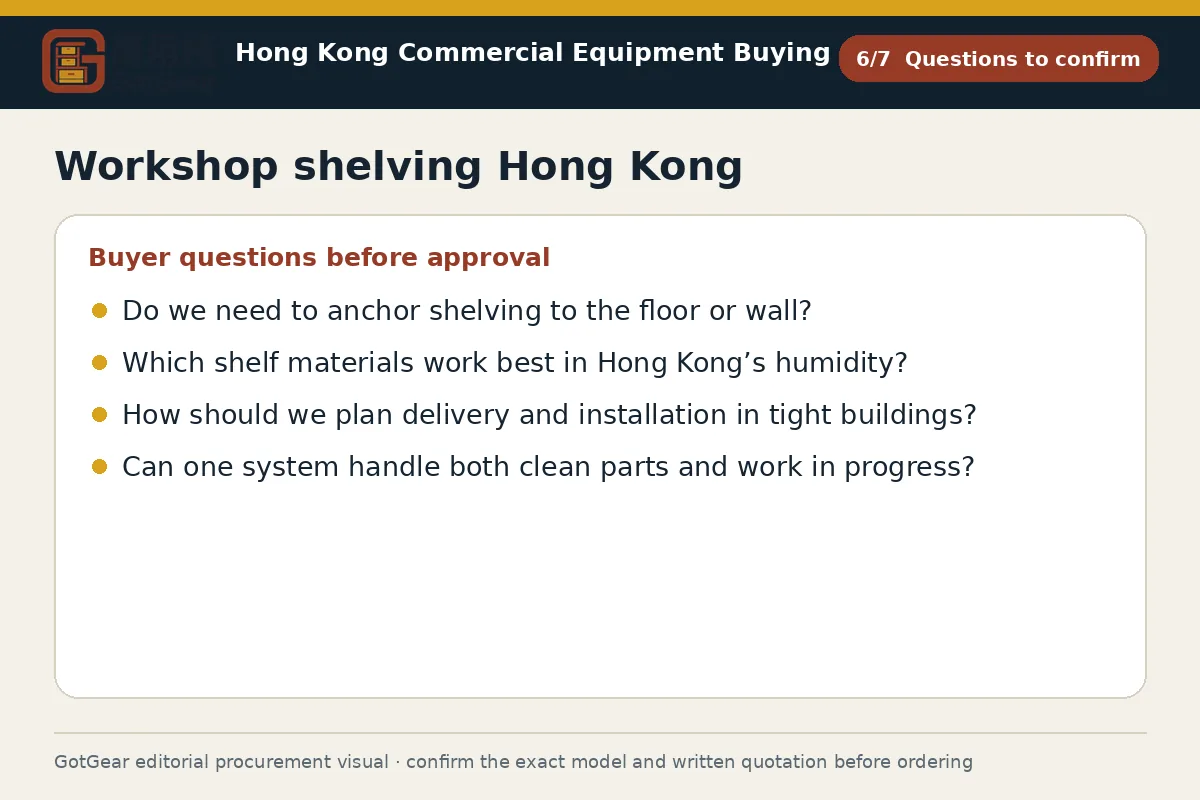
Do we need to anchor shelving to the floor or wall?
Anchoring is often recommended for taller bays or heavier loads, but it depends on the model, substrate and risk assessment. Seek written advice from the supplier and confirm with your building manager or insurer before drilling. If anchoring is required, request the fixing type, installation guidance and any drawings, and ensure they match your slab or wall construction.
Which shelf materials work best in Hong Kong’s humidity?
Powder-coated steel suits dry, general areas; galvanised or stainless components offer added corrosion resistance; wire or perforated decks help dust control. The right choice depends on load, cleaning routine and exposure. Ask the supplier for finish specifications, care instructions and compatibility with your detergents, and confirm any warranty terms applicable to the selected model.
How should we plan delivery and installation in tight buildings?
Measure doorway widths, stair turns and goods-lift car and door clearances, then share the longest component length you can accept. Coordinate loading-bay bookings and working hours with the management office. Request flat-pack or sectional delivery options, a handling method statement for confined access, and confirmation of any permits or lift operator arrangements required by the venue.
Can one system handle both clean parts and work in progress?
Yes, with clear zoning, dividers, colour or bilingual labels, and rules for where parts and WIP sit. Consider separate bays for dusty or oily tasks and use different shelf types if contamination is a risk. Document your scheme in the enquiry so suppliers can propose compatible accessories, and ensure it aligns with your internal quality or safety requirements.
Continue with closely related procurement topics
These pages share equipment, operating or decision-stage signals with this guide.
Archive shelving Hong Kong
Plan archive shelving Hong Kong by box size, document format, retention period, retrieval frequency and labelling to organise office records effectively. GotGear helps office and records buyers.
Read the guide
Industrial shelving Hong Kong
GotGear outlines loads, dimensions, layout and moisture considerations for industrial shelving Hong Kong. It compares galvanised steel shelving Hong Kong with powder-coated steel shelving Hong Kong.
Read the guide
Spare parts shelving Hong Kong
Use this maintenance, repair and operations checklist to compare sizes, weights, counts, pick rates and store layout for spare parts shelving Hong Kong and shelving for machinery parts Hong Kong. This checklist is from GotGear.
Read the guide
AS/RS racking Hong Kong
GotGear in Hong Kong assesses the feasibility of AS/RS racking Hong Kong and mini-load storage system Hong Kong for distribution centres, examining loads, dimensions, throughput and control interfaces.
Read the guideRelated topic indexOpen more English procurement pages3 topics
Browse additional equipment families, applications and procurement questions relevant to a wider buying brief.