
Specify tools, spares or components before cabinet dimensions. Tool storage may favour controlled issue and varied shapes; component storage may need many clearly coded locations.
Industrial parts cabinet Hong Kong — Define Capacity and Retrieval Needs
Start by mapping what must be stored, who retrieves it, and how often. Tally the number of SKUs, the largest and smallest item envelopes, and the heaviest single piece. Record the target pick rate per shift and any trolley or tote sizes used for kitting. Note aisle clearance, turning space, and the reach height acceptable for regular users. In catalogues listed under industrial parts cabinet Hong Kong, models vary widely in drawer geometry and structural rating, so translate your list into drawer heights, divider counts, and bin footprints before you compare vendors.
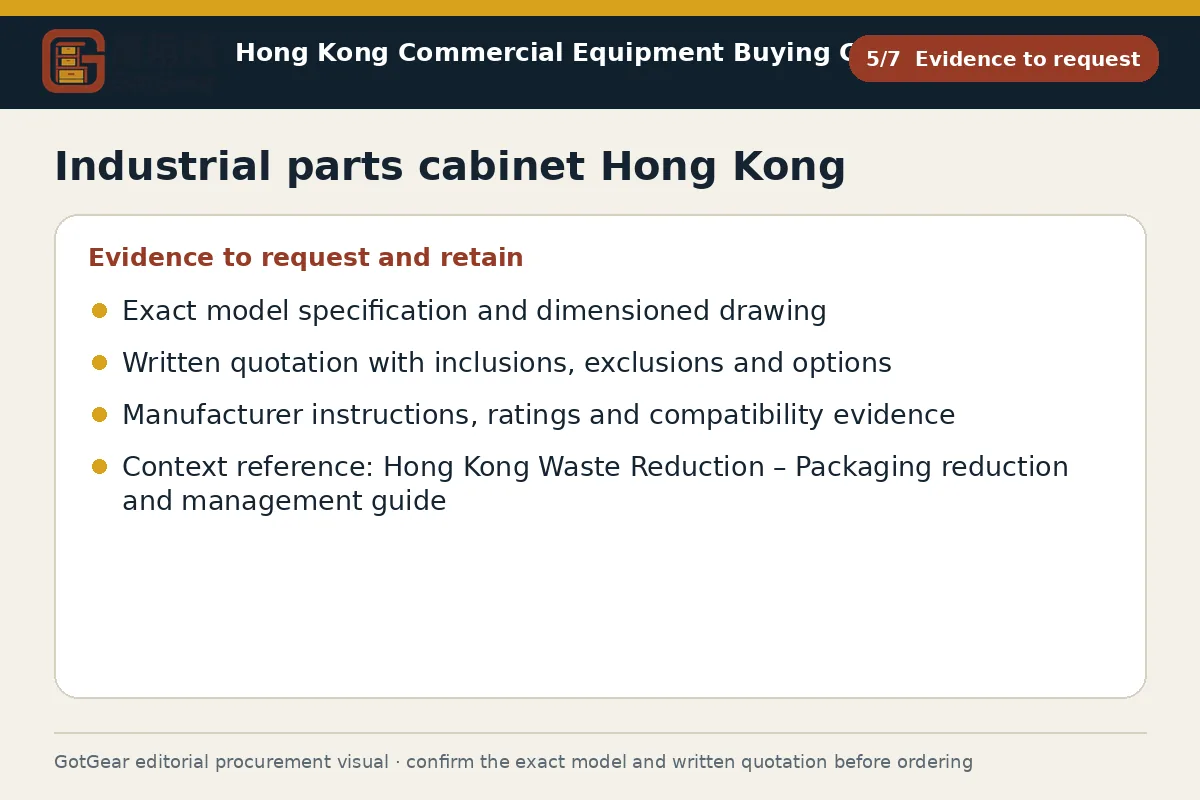
Measure the intended route from loading bay to final position, including lift car and door sizes, corridor widths, and door swings. Request a written quotation that states external W×D×H, internal drawer dimensions, per-drawer and total cabinet load rating, drawer extension percentage, anti-tilt interlock, construction gauge, surface finish, levelling feet, and anchoring options. Ask for an example starting point for drawer rating and extension that suits your heaviest item, and confirm it in writing with the manufacturer. For humid plant rooms, specify corrosion protection and sealed ball-bearing slides. When cabinets arrive, inspect for transit damage, verify drawer travel and interlocks, count dividers and labels, test locks, and list serial numbers against the packing note; the model specification and formal quotation prevail over any verbal statements.
Industrial parts cabinet Hong Kong: Plan Tool and Parts Storage for Varied Item Shapes
Irregular tool sets and issue rules drive layout. Reserve deeper drawers for power tools, tall gauges or pullers; keep high-frequency hand tools in mid-height drawers with partitions or foam inserts. Shadow-lining can speed checks at shift change, while mixed-height drawers suit calibration fixtures. Many garages evaluating a tool storage cabinet option in Hong Kong will also want audit-friendly sign-out methods and a drawer mix that mirrors their service menu.
Where drawer access must be controlled, specify lock type, master-keying, spare-key quantities and whether employee IDs, QR codes or manual logs will be used. For shape management, request drawings that show proposed divider grids, foam densities and maximum item length by orientation. If you are comparing a parts drawer cabinet configuration for Hong Kong against open bins, consider tool loss risk and dust control. Workshops maintaining vehicles can align drawer schemes with automotive parts storage bins in Hong Kong to keep common fasteners near torque tools without mixing issue policies.
What should buyers compare for industrial parts cabinet Hong Kong?
| Criterion | Straightforward requirement | More complex requirement | Evidence to provide |
|---|---|---|---|
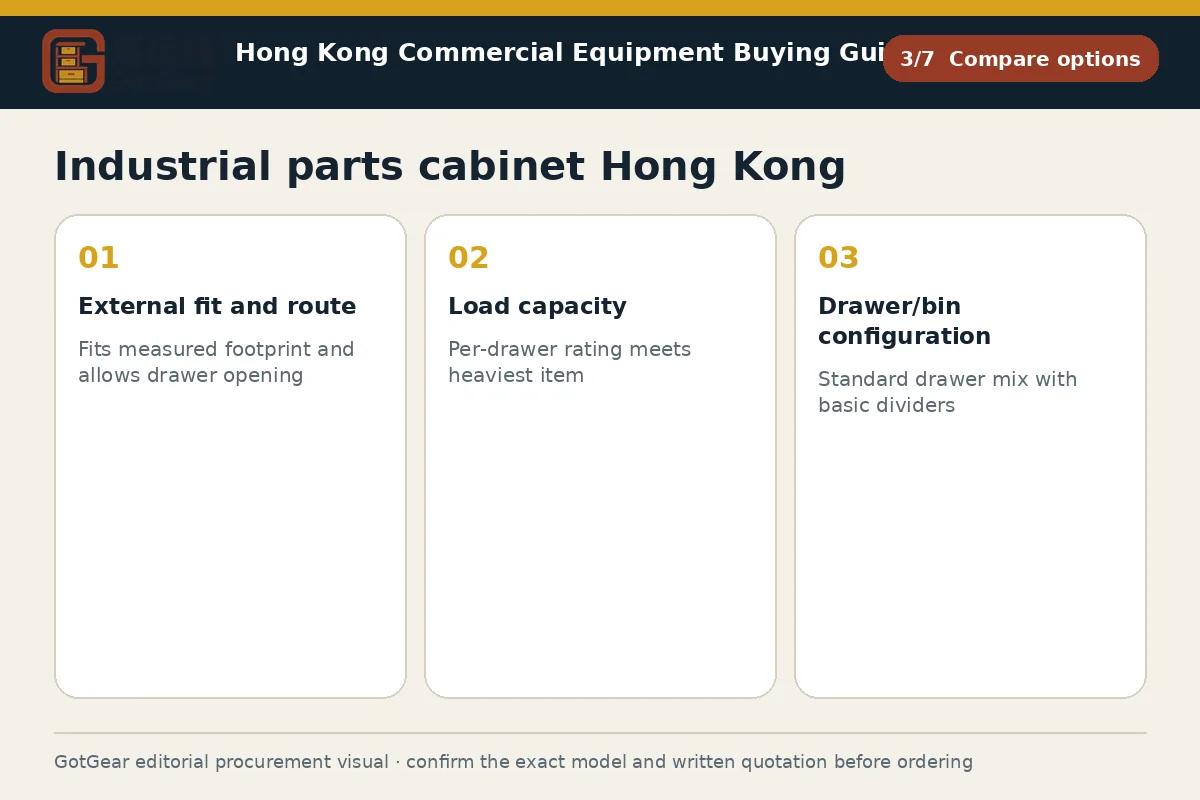
| External fit and route | Fits measured footprint and allows drawer opening | Route accommodates lift car, corridor turns and door swings | Provide site sketch with lift and doorway sizes; note obstacles and loading window |
| Load capacity | Per‑drawer rating meets heaviest item | Total cabinet rating and floor loading suit combined contents | List heaviest item weight and total estimated load; ask for example starting ratings to confirm |
| Drawer/bin configuration | Standard drawer mix with basic dividers | Custom heights, foam inserts, ESD options and clear fronts | Attach inventory summary with required locations and any ESD or foam notes |
| Security and keying | Single lock with two keys | Master‑key hierarchy, spare keys, audit trail method | State lock type, key quantities, master‑key needs and audit process |
| Labelling and codes | Basic label holders on drawers | Bilingual, barcoded scheme with location map | Supply code format, font size and a sample label template for approval |
This framework helps buyers create comparable written enquiries. Final model specifications, availability, delivery and commercial terms must be confirmed in a formal quotation.
Industrial parts cabinet Hong Kong — Set Access Control and Location Codes
Decide which users may open which cabinets, when and under what supervision. Specify locks (cam, padlock hasp, mechanical code or electronic where offered), master‑key hierarchies for supervisors, and the number of user keys to be cut. If audit needs are high, add cabinet and drawer IDs, and plan sign‑in/out sheets or barcode scans. A lockable storage cabinet Hong Kong configuration placed near a controlled workshop entrance can reduce walk time while keeping compliance staff comfortable with oversight.
Define a clear location‑coding scheme before labels are printed. Keep codes short, consecutive and bilingual where required. Plan label positions on drawer fronts and end‑panels, and request compatible label holders or clear windows. If any cabinet includes powered lighting or sensors, ask for an example starting point for electrical ratings and confirm with a competent person. In towers and schools, check with the building manager about fixings, fire egress clearances and delivery windows; document agreed placement, anchoring method and any prohibition on drilling. Ask the supplier to include a sample label template with the quotation so procurement can check readability in both languages.
Industrial parts cabinet Hong Kong: Organise Small-Parts Storage Locations
Small components require dense, unambiguous locations. Start with pick frequency: place fast-movers in the "golden zone" of waist to chest height; put seldom-used spares higher or lower. Define the smallest needed compartment size and multiply by the required counts; then group items by family so replenishment is simple. For electronics, consider ESD-safe inserts if the model supports them, and keep desiccant plans practical for Hong Kong humidity.
When comparing a warehouse bin storage system for operations in Hong Kong with drawer alternatives, weigh dust exposure, ergonomic reach and barcode visibility. For a component storage cabinet intended for use in Hong Kong, the specification should request the number, size and colour of bins or dividers per drawer, clear-front options, stop-open features, and the maximum labelled locations per cabinet. Ask suppliers for a proposed layout drawing with example starting quantities for each SKU family, to be confirmed in the purchase brief. On receipt, count all bins/dividers, check that label windows fit, verify smooth slide action at full load with sample contents, and confirm that the cabinet footprint and opening clearances match the agreed site sketch.
Industrial parts cabinet Hong Kong decision checklist
Confirm the item inventory, largest and heaviest pieces, and pick frequency, then translate these into drawer heights, bin footprints, divider counts and access zones. Measure the delivery path and final space, including lift and doorway limits, plus aisle and opening clearances. Write specifications for external and internal dimensions, per‑drawer/overall load ratings, extension, interlocks, finish and corrosion resistance. State lock type, keying plan, and bilingual label requirements with a location‑coding scheme. Request layout drawings, inclusion lists for dividers/bins/labels, and any example starting points for ratings to be confirmed in the purchase brief. Compare quotations line by line against the same fields. Before installation, obtain management‑office approval for placement and fixings. On receipt, inspect for damage, verify operation and counts, test locks, and record serials.
- Operating use, quantity and expected frequency
- Dimensions, capacity, material and accessory requirements
- Delivery address, floor, goods lift and loading window
- Required documents, acceptance checks and after-sales arrangements
Key points for industrial parts cabinet Hong Kong, tool storage cabinet Hong Kong, component storage cabinet Hong Kong
Hong Kong sites often route heavy cabinets through tight industrial lifts and narrow corridor turns, so confirm lift car depth, door widths and the delivery path before you order. Many buildings restrict loading‑bay access to pre‑booked windows, sometimes outside office hours; coordinate with management offices early. Humid plant rooms and coastal locations can accelerate corrosion, making surface finish and slide sealing important. Bilingual labelling is common in public and institutional settings; check font size and character support. Where anchoring or wall fixing is proposed, consult the building manager and, if required, a competent person. This summary is operational guidance, not legal advice.
Questions about industrial parts cabinet Hong Kong
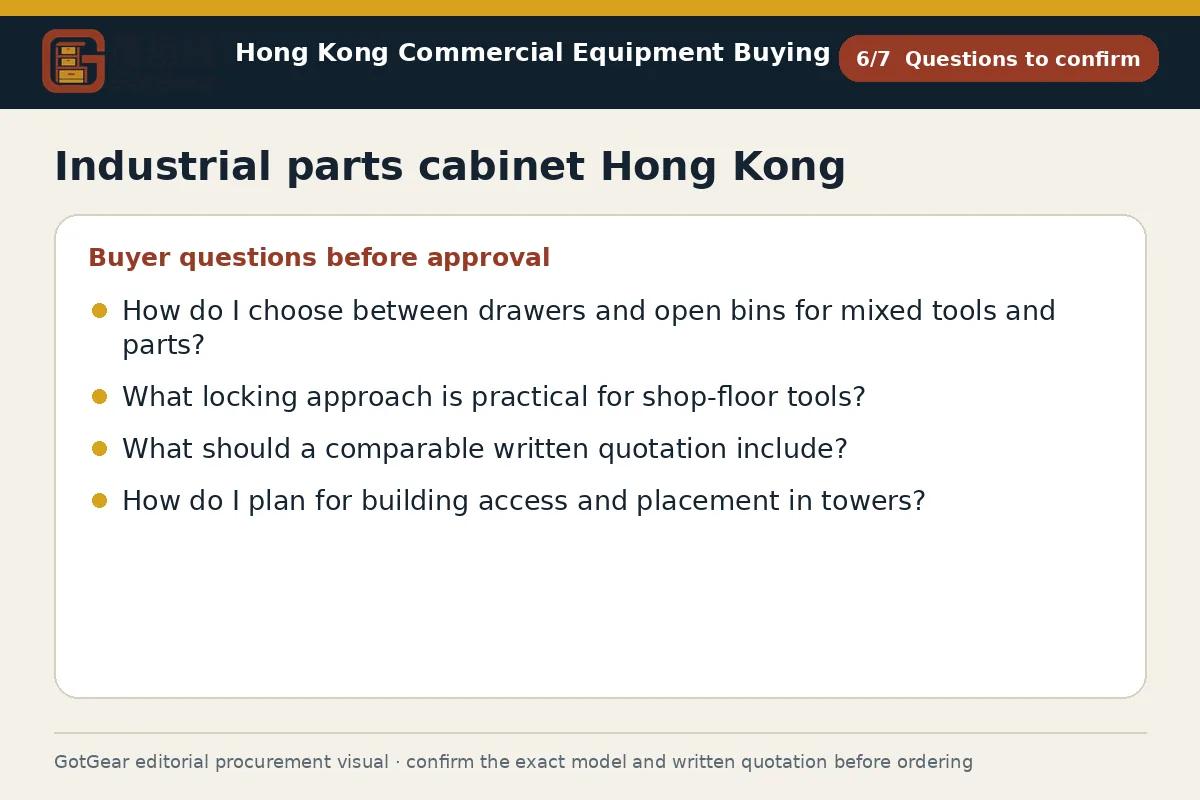
How do I choose between drawers and open bins for mixed tools and parts?
Use drawers for valuable or dust‑sensitive tools and small precision parts, and open bins for bulk fasteners and quick visual counts. Where issue control or cleanliness matters, drawers with dividers usually win. If fast replenishment and at‑a‑glance stock checks dominate, open bins can be efficient. Confirm this choice with a layout drawing and a trial bill of materials.
What locking approach is practical for shop‑floor tools?
A keyed cam lock with master‑keying is straightforward and reliable; electronic locks add audit options where offered. Decide how keys are controlled, the number of spares, and who holds the master. If an insurer, school or public venue has conditions, align with their guidance. Verify any electronic features, power supply and maintenance in writing before approval.
What should a comparable written quotation include?
Ask for external W×D×H, internal drawer sizes, per‑drawer and total load ratings, extension, anti‑tilt, finish, included dividers/bins/labels, lock type and keying plan, levelling/anchoring method, and delivery conditions. Request a proposed location map and label template. Evidence such as drawings and inclusion lists makes comparisons fair; model specifications and the formal quotation should govern the purchase.
How do I plan for building access and placement in towers?
Measure the lift car depth and height, door widths and corridor turns, and confirm booking rules for the loading bay. Prepare a route sketch and a simple placement drawing showing clearances for doors and drawers. Building managers may restrict drilling or after‑hours work; obtain written approval. If fixings are proposed, consult a competent person as appropriate.
Continue with closely related procurement topics
These pages share equipment, operating or decision-stage signals with this guide.
Drawer containers Hong Kong
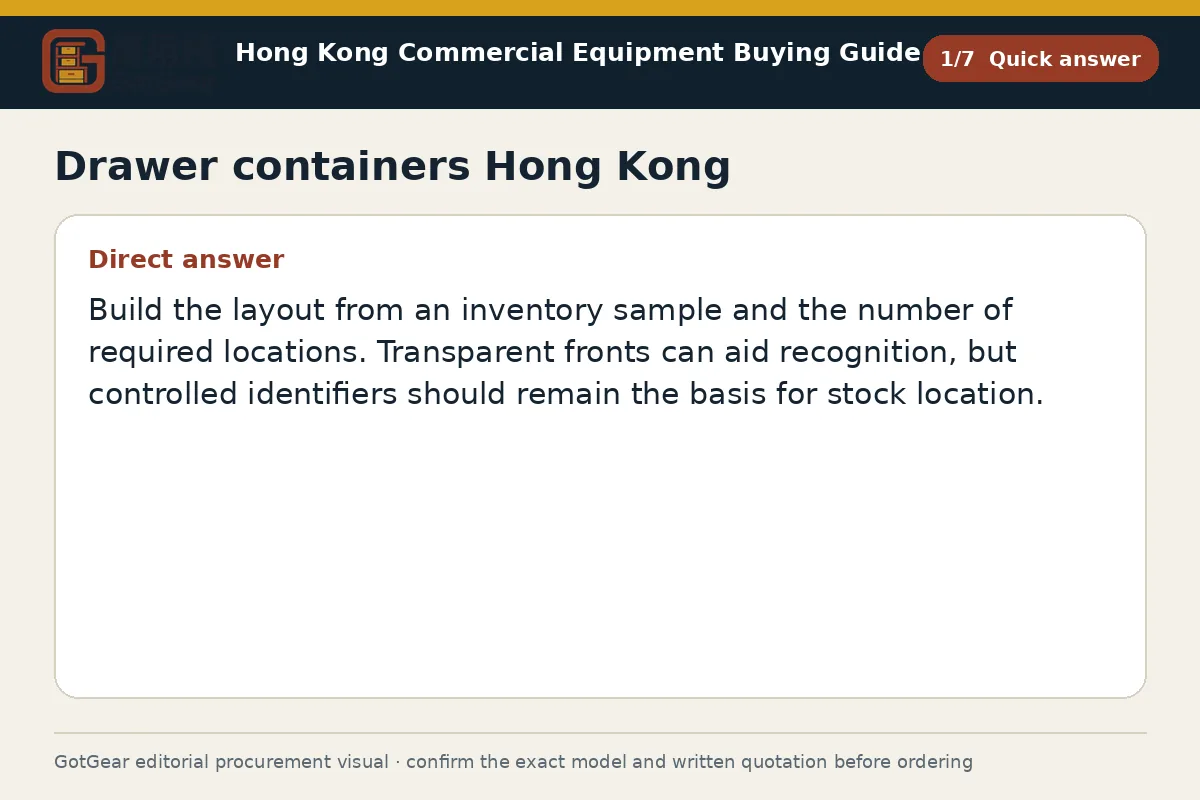
GotGear compares drawer containers Hong Kong by depth and labelling to help you choose the right parts drawer cabinet Hong Kong or transparent drawer storage cabinet Hong Kong.
Read the guide
Plastic storage cabinet Hong Kong
Choose a plastic storage cabinet Hong Kong by checking shelf and bin layout, door clearance and access to fit your space. At GotGear, explore lockable storage cabinet Hong Kong and bin storage cabinet Hong Kong.
Read the guide
Plastic storage bins with dividers Hong Kong
GotGear provides practical guidance to help teams choose plastic storage bins with dividers Hong Kong, including how compartment sizes and refill triggers support line-side movement for material flow bins Hong Kong.
Read the guide
Tipping bins Hong Kong
GotGear helps buyers compare tipping bins Hong Kong by compartment size, dispensing access, mounting position, refill method and labelling.
Read the guideRelated topic indexOpen more English procurement pages2 topics
Browse additional equipment families, applications and procurement questions relevant to a wider buying brief.