
Order training table connectors Hong Kong only after compatibility and quantity have been confirmed for each planned layout. Ask for the fitting method and manufacturer’s use instructions, and check that connected tables remain appropriate for the actual floor and operating conditions.
Match training table connectors Hong Kong to the exact table system
Start with the table brand, series and exact model code. Photograph the frame and edge detail from below and above, and record top thickness and overhang (for example, 25 mm top and 15 mm overhang, to be confirmed in writing). Note leg positions, beam or apron depth, and the distance from the table edge to the nearest rail where a clamp would seat. If you are considering training table connectors Hong Kong across mixed fleets, capture these dimensions for each table family to avoid cross‑compatibility assumptions.
Check for features that obstruct clamps or brackets. A training table with modesty panel Hong Kong may block underside mechanisms or reduce hand clearance for tool use. Flip mechanisms, cable ports, and power boxes can also collide with connector hardware. Request manufacturer drawings with fixing centres, any permitted tolerance for misalignment, recommended join locations, and whether corner protection is required to avoid top damage. Ask the supplier to confirm the connector SKU against your model list, the fastener type (metric size, head style, finish), and whether protective pads are included for fragile edges. Where possible, request one sample to trial on a single pair of tables in situ to confirm grip, stability and finger clearance before you commit. Ensure all instructions are provided in bilingual format to support mixed teams.
Ask how training table connectors Hong Kong are fitted and released
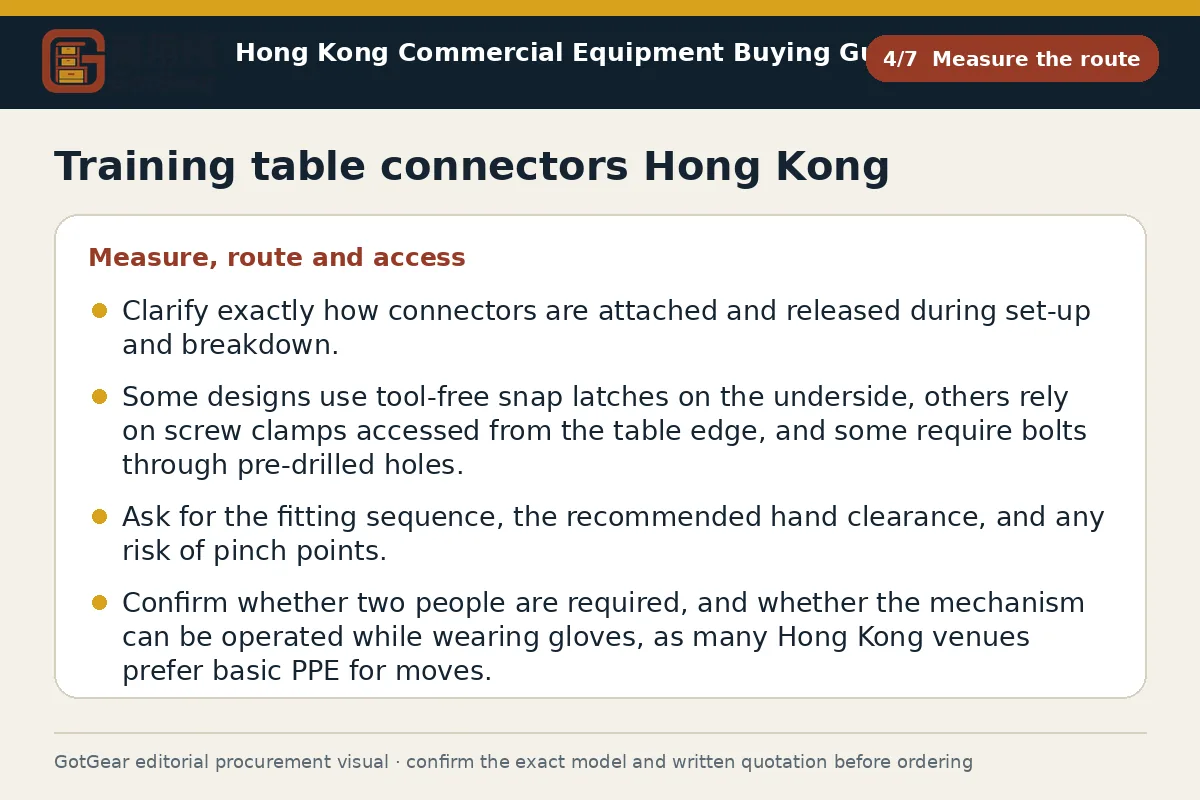
Clarify exactly how connectors are attached and released during set‑up and breakdown. Some designs use tool‑free snap latches on the underside, others rely on screw clamps accessed from the table edge, and some require bolts through pre‑drilled holes. Ask for the fitting sequence, the recommended hand clearance, and any risk of pinch points. Confirm whether two people are required, and whether the mechanism can be operated while wearing gloves, as many Hong Kong venues prefer basic PPE for moves.
If your fleet includes flip‑tops, confirm that connectors can remain fitted when tables are in the parked position and that release levers do not obstruct the flip arc. This matters when specifying a flip top training table Hong Kong for rooms that reset several times daily. Request cycle‑life guidance for the latch or screw mechanism (for example, an indicative 5,000 cycles as a starting point, to be confirmed by the manufacturer), together with maintenance advice on lubrication or periodic tightening if applicable. Ask for the official installation and operating instructions, plus any risk assessment or safe‑use note required by your venue, institution or insurer. Finally, confirm whether connectors are left in place or travel separately, and how they are labelled to prevent loss.
What should buyers compare for training table connectors Hong Kong?
| Criterion | Straightforward requirement | More complex requirement | Evidence to provide |
|---|---|---|---|
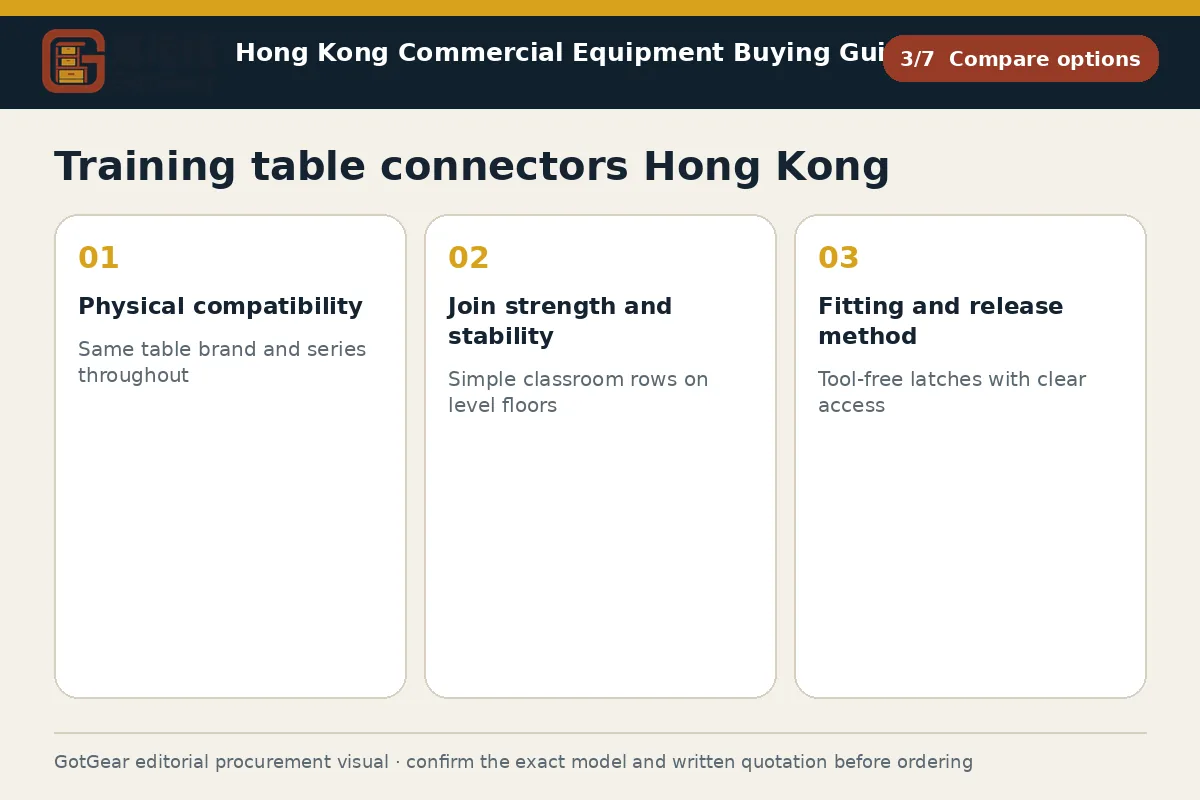
| Physical compatibility | Same table brand and series throughout | Cross‑brand joining with adapters or mixed frame geometries | Model codes, underside photos, measured top thickness and rail set‑backs |
| Join strength and stability | Simple classroom rows on level floors | Chevron/U‑shape layouts with higher lateral loads or sloping floors | Manufacturer’s layout suitability note and indicative shear resistance (to be confirmed) |
| Fitting and release method | Tool‑free latches with clear access | Underside bolts or clamps requiring tools and specific hand clearance | Installation instructions, sequence, clearance dimensions, training notes |
| Finish and durability | Dry, climate‑controlled rooms | Humid rooms near docks or coastal air; frequent daily resets | Material and finish specification, corrosion statement, care guidance |
| Logistics and spares | Single room with low turnover | Multiple rooms with tight resets and spare stock policy | Pack sizes, re‑order codes, indicative lead time (to be confirmed) and storage plan |
This framework helps buyers create comparable written enquiries. Final model specifications, availability, delivery and commercial terms must be confirmed in a formal quotation.
Define every joined layout for training table connectors Hong Kong
Translate room use into joined layouts with quantities. List each configuration you will actually run—rows, chevrons, conference blocks, U‑shapes—and count the number of joins per layout, not just the number of tables. Provide a scaled room sketch showing stage or teaching wall, columns, door swings, and minimum aisle widths mandated by your building or event plan. On sloping or irregular floors, specify the levelling range available on table feet and ask the supplier to confirm acceptable tolerance for height differences between joined tops.
For each layout, state whether tables are on glides or castors, and whether locking castors are fitted. If power and data must bridge between tops, note where grommets and cable trays sit so connectors do not clash. Request written quotations that map connectors to layouts line‑by‑line, with connector model codes, finish, fitting method, number per join, and pack sizes. Ask for an alternative option where layouts are less frequent, such as a lighter device for occasional rows, versus a heavier duty option for conference blocks. If you are planning mobile resets similar to a mobile training desk Hong Kong, confirm whether joined tables may be wheeled short distances or must be separated before movement, and under what conditions that is permitted.
Plan storage and replacement quantities for training table connectors Hong Kong
Plan how connectors are stored, tracked and replenished. Decide whether units travel attached to specific tables or are kept centrally in labelled totes. In humid plant‑adjacent rooms, choose corrosion‑resistant finishes and store connectors dry; desiccant packs may help as an example practice, but confirm suitability with the manufacturer. Create a simple check‑in/out process for event teams, with bilingual labels and re‑order codes. Consider holding a small buffer of spares (for example, 5–10% of the operational quantity as a planning start point, to be confirmed against loss rates and lead times).
On receipt, inspect each batch for finish defects, burrs on clamp faces, smooth latch action, and complete fastener kits. Match delivered SKUs to the quotation and your approved table models. Test‑fit a sample set on real tables in the intended room to confirm clearance over modesty panels, beam positions and flips. Record pack sizes, any special tools needed, and the supplier’s written guidance on cleaning and lubrication. If your building enforces tight goods‑lift windows, coordinate deliveries with management office booking so connectors and tables arrive in the correct sequence for commissioning.
Training table connectors Hong Kong decision checklist
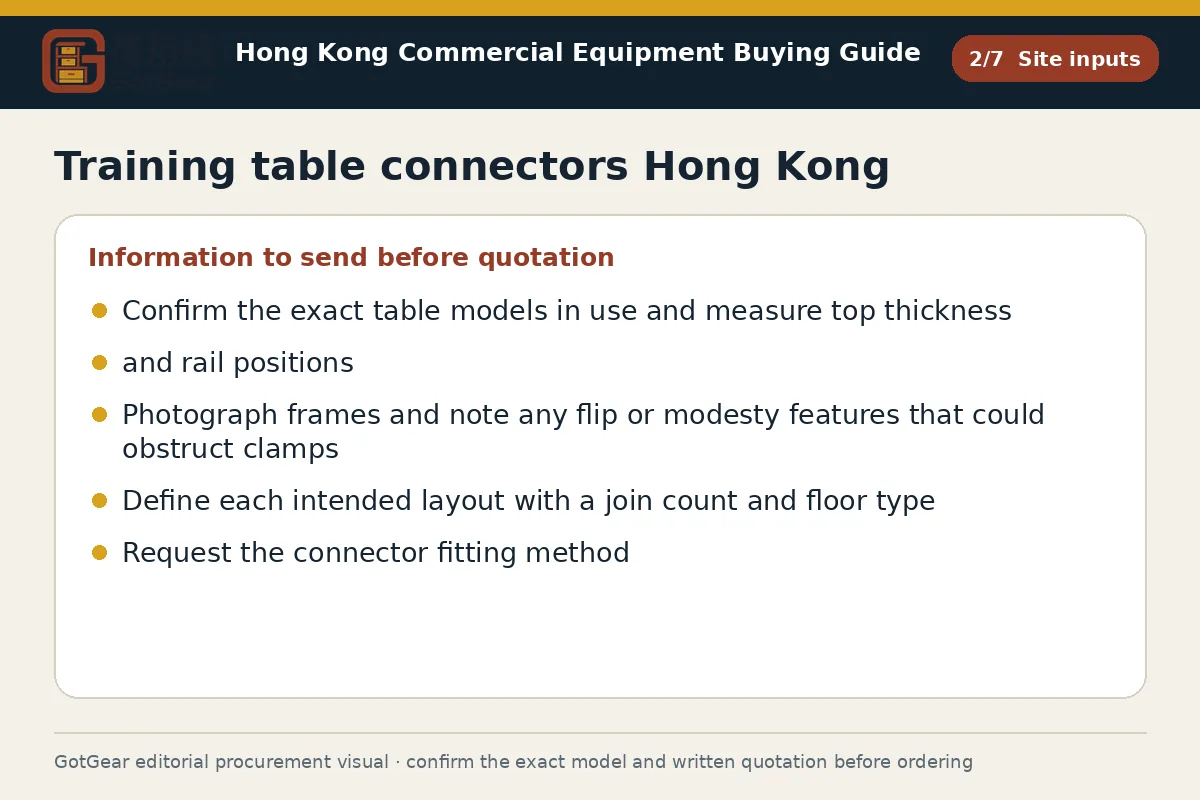
Confirm the exact table models in use and measure top thickness, overhang, and rail positions. Photograph frames and note any flip or modesty features that could obstruct clamps. Define each intended layout with a join count and floor type. Request the connector fitting method, operating sequence, and any clearance requirements. Ask for manufacturer instructions, indicative cycle‑life and maintenance notes. Compare quotations line‑by‑line for model codes, finish, number per join, pack sizes, and delivery terms suited to your building’s loading windows. Before approval, test a sample set on real tables, then on receipt, re‑check finish, hardware completeness and smooth operation, keeping bilingual records for institutional sign‑off.
- Operating use, quantity and expected frequency
- Dimensions, capacity, material and accessory requirements
- Delivery address, floor, goods lift and loading window
- Required documents, acceptance checks and after-sales arrangements
Key points for training table connectors Hong Kong
In Hong Kong, connector choices are influenced by tight resets, building‑management controls and humidity. Many industrial buildings require advance booking for dock and lift access, and deliveries may need to fit small lifts and corridors rather than a free run to the room. Confirm that connectors can be operated quickly by mixed crews, with bilingual instructions. Corrosion‑resistant finishes help where rooms are near loading bays or coastal air. For public‑event venues, check whether your operator or insurer requires written safe‑use guidance; this is not legal advice and the supplier’s formal specification prevails.
Questions about training table connectors Hong Kong
Can one connector work across different table brands?
Sometimes, if frame geometry and edge profiles are very similar, but it should never be assumed. Request written confirmation from the connector manufacturer naming your table models, and test a sample on site. Mixed fleets often need different SKUs or adapters, especially where beams, modesty panels or flip mechanisms change the available clamping area.
How many connectors are needed per join?
The quantity depends on table size, frame stiffness and the layout’s lateral forces. As a planning example only, smaller classroom rows may use two connectors per side join, but U‑shapes and conference blocks can need more. Always ask the manufacturer to confirm numbers per join for each table model and layout in your written quotation.
Do connectors keep tables level on uneven floors?
Connectors hold tops together but are not a substitute for levelling feet. Specify the levelling range on your tables and ask the supplier to state acceptable height tolerance across joined tops. In spaces with irregular slabs or old carpet tiles, test a sample layout on the actual floor and adjust feet before finalising the connector choice.
Can joined tables be moved while connected?
Many systems advise separating tables before moving, particularly on castors, to reduce stress on frames and connectors. If short moves are required, request the manufacturer’s written guidance on when rolling while joined is acceptable, locking‑castor requirements, and maximum recommended speed—treat any figures as examples until confirmed for your exact models.
Continue with closely related procurement topics
These pages share equipment, operating or decision-stage signals with this guide.
Flip top training table Hong Kong
GotGear guides buyers on comparing a flip top training table Hong Kong by folded footprint, movement routes and joining options. It also covers nesting training table Hong Kong and modular training table Hong Kong designs.
Read the guide
Training room furniture Hong Kong
Training room furniture Hong Kong helps you plan layouts for capacity, sightlines and writing space. Assess a training room table and chair set Hong Kong for circulation, reset labour and comfort with GotGear.
Read the guide
Mobile training desk Hong Kong
GotGear explains considerations for a mobile training desk Hong Kong, including mapping routes, floors and thresholds. It also helps assess a training table with lockable casters Hong Kong for movement, parking and storage.
Read the guide
Trapezoid training table Hong Kong
Compare trapezoid training table Hong Kong and semi circular training table Hong Kong to choose a layout for your training space. Consider cluster formation, seating edges, join details, leg positions and storage with GotGear.
Read the guideRelated topic indexOpen more English procurement pages2 topics
Browse additional equipment families, applications and procurement questions relevant to a wider buying brief.