
For an initial AS/RS racking Hong Kong discussion, provide load types and dimensions, weights, daily and peak transactions, order profile and operating hours. Include building geometry, process flow, control-system interfaces, resilience expectations and expansion assumptions so the concept can be tested against real demand.
Define loads and throughput for AS/RS racking Hong Kong
Begin with hard measurements and clear definitions of every handled unit. Record the external length, width and height of pallets, bins, trays and cartons in millimetres, with the permitted orientation and any overhang. State pallet construction, entry points, deck gaps and whether broken or non-standard pallets are rejected. For small formats, specify tote or tray material, ribbing and maximum stack height. Capture the gross weight of typical and heaviest loads, the centre of gravity if offset, and the fragility of packaging that may soften in humid conditions. Photograph representative loads and, where possible, provide a sample for supplier test cycles.
Define the transaction profile in terms that can be simulated. Separate putaway, replenishment, order release, returns and cycle-count volumes, and describe the busiest periods at quarter-hour resolution. Note operating hours, exceptions for building loading windows and the service levels you must protect during peaks. Indicate minimum and desirable staging buffers, plus batch sizes for induction and pick waves. When planning AS/RS racking Hong Kong solutions, request a supplier cycle-time model that shows crane utilisation, dwell, queueing and recovery from a blocked aisle. State acceptance assumptions in writing so the supplier’s model and formal quotation can be compared like for like.
Map software and process interfaces for AS/RS racking Hong Kong
Map the physical process from receipt to dispatch and the decision points that drive movements. Confirm where decanting occurs, how non-conformances are quarantined, and whether replenishment is triggered by min–max, demand forecasts or order release. Identify manual workstations that form part of the automated flow, including label print-and-apply, exception lanes and value-added services. Define barcode symbologies, label placement rules and any requirement for bilingual carton or tote labels to support Hong Kong teams and downstream customers.
Translate that flow into software and controls. Specify master-data fields (dimensions, weight, nesting, hazard notes, lot/expiry), order and container identifiers, and transaction states from allocation to confirmation. State whether integration uses real-time APIs, message queues or scheduled files, and the latency and retry expectations. Ask bidders for an interface control document, sample payloads and a controls narrative showing the WMS/WES/WCS handshakes, safety interlocks, bypass modes and manual overrides. Request indicative panel schedules, network topology, device addressing, power loads and resilience options such as controlled shutdown and restart procedures. Ensure the supplier confirms responsibilities for scanners, printers and location label standards in the written quotation and drawings.
What should buyers compare for AS/RS racking Hong Kong?
| Criterion | Straightforward requirement | More complex requirement | Evidence to provide |
|---|---|---|---|
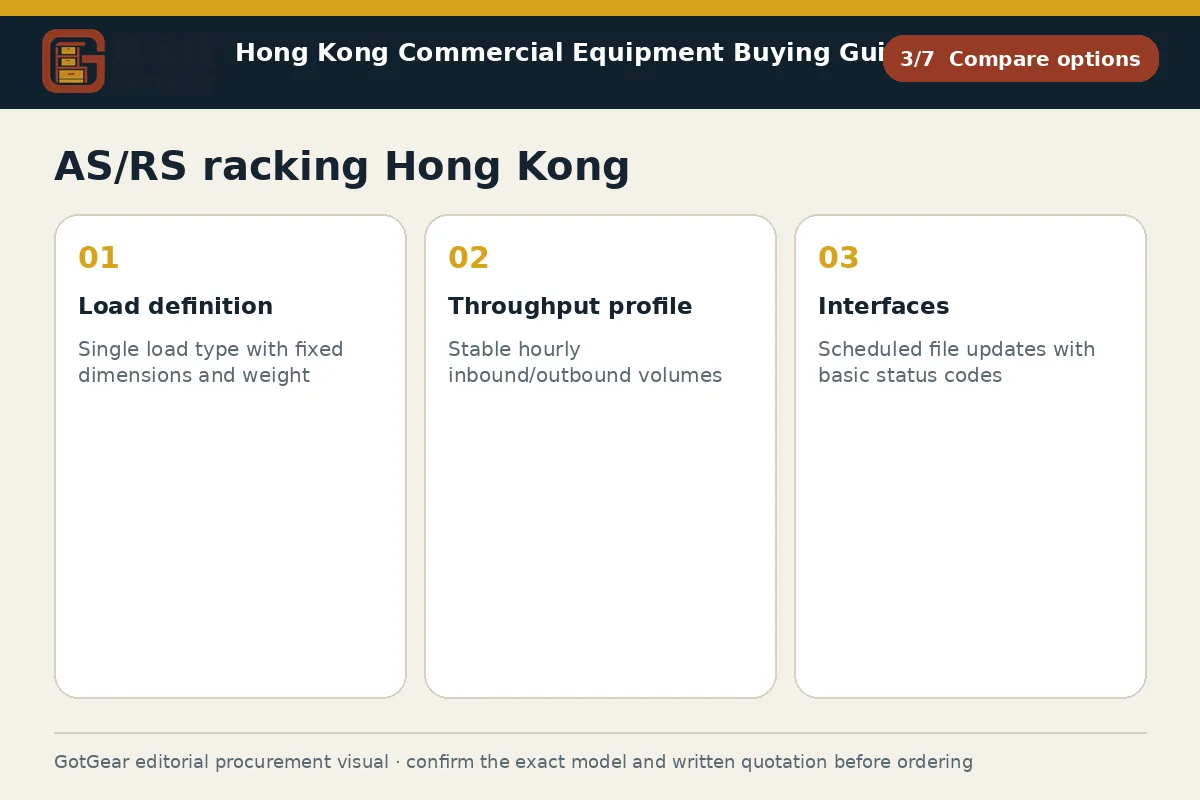
| Load definition | Single load type with fixed dimensions and weight | Mixed formats, fragile packaging or offset centres of gravity | Measured L×W×H, max mass, photos, material notes, sample units |
| Throughput profile | Stable hourly inbound/outbound volumes | Burst peaks, waves, returns and cycle counts across shifts | Quarter-hour demand histogram, operating windows, service targets |
| Interfaces | Scheduled file updates with basic status codes | Real-time APIs with exception handling and carton/tote tracking | Interface control document, message samples, latency and retry rules |
| Building and access | Single-storey hall with clear access and docks | Multi-storey site with goods-lifts and narrow doorways | Scaled plans, lift specs, route surveys, management-office constraints |
| Resilience and maintenance | Business-hours operation with manual fallback | Continuous operation with redundancy, UPS and spares strategy | Recovery objectives, maintenance windows, spares list, escalation path |
This framework helps buyers create comparable written enquiries. Final model specifications, availability, delivery and commercial terms must be confirmed in a formal quotation.
AS/RS racking Hong Kong: Comparing mini-load storage systems
Select the storage and retrieval concept by aligning unit format, access frequency and labour strategy. Pallets that feed full-case or reserve storage often suit crane-based aisles, while fast-moving cartons or totes benefit from goods-to-person workstations. A mini-load storage system can deliver dense bin storage and steady ergonomic picking, but it introduces extra decanting and container-control steps. Consider hybrid paths: pallet reserve with a downstream mini-load for split-case, or carton shuttles for fast movers. Whichever path is shortlisted, compare energy use, manning and maintenance envelopes using the same demand file.
Procurement actions should require each bidder to provide a layout drawing, storage-density calculation, throughput model and a pick-station design that includes ergonomic reach and lighting notes. Request noise and heat output at source, and ask how condensation is managed in humid seasons. Provide carton and tote samples for fit, deflection and barcode-read tests. Where automation is not justified, ask for a manual benchmark such as VNA racking to keep the business case honest. Align racking details with your warehouse racking specification so pallet, bin and location conventions remain consistent across the site.
Test building and layout constraints for AS/RS racking Hong Kong
Test building and layout constraints early so proposals reflect the real site. Confirm clear heights beneath services, column grids, slab capacities, joint locations and the position of sprinklers and in-rack drops, then mark keep-clear fire aisles and egress routes on drawings. In multi-storey buildings, document goods-lift car and door dimensions, lift capacities and the turning radii on every landing. Note dock availability, queue limits and management-office rules on delivery windows and noisy works. Record ambient conditions, condensation risk near sea air, and any requirement for corrosion-resistant finishes.
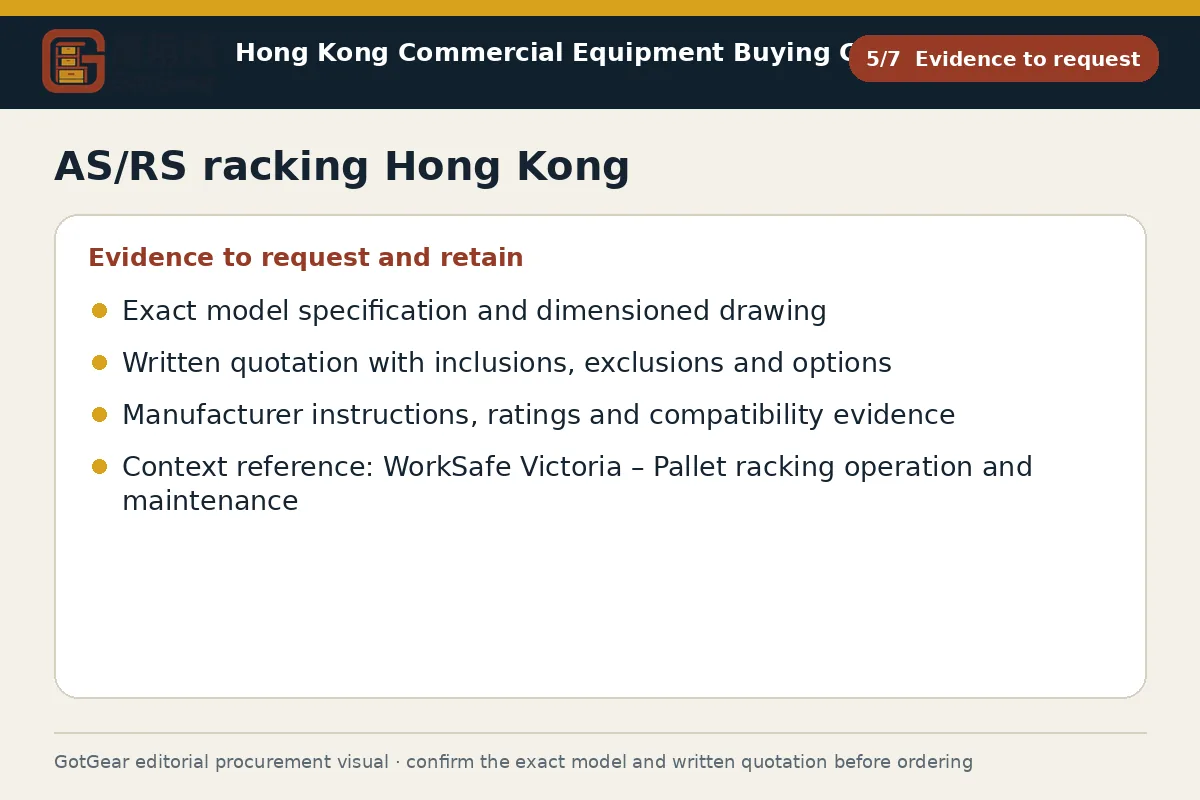
For installation feasibility, request a general arrangement with crane and maintenance envelopes, pit or rail details if applicable, and rack reactions for structural review by a competent party appointed by you. Ask for method statements, lifting plans, temporary staging areas, waste handling and dust control measures that suit shared Hong Kong industrial estates. Specify acceptance documents you expect on completion: as-built drawings, O&M manuals, spares lists, and bilingual training materials. Confirm labelling conventions to align with warehouse rack location labels Hong Kong and ask how pallet racking load distribution Hong Kong interacts with the proposed anchors, shims and baseplates. State that the model specification and the formal written quotation prevail.
AS/RS racking Hong Kong decision checklist
Before inviting quotations, finalise the unit-load catalogue with dimensions, weights, orientation and fragility notes, then confirm the demand file with peak profiles and operating windows. Map the end-to-end process, define master-data fields and agree the interface method, payloads and latency expectations. Issue scaled drawings with measured heights, column grids, lifts and access routes, and state ambient risks such as humidity. Ask bidders for throughput models, GA drawings, rack reactions, controls narratives and training outlines. Compare quotations on inclusions for commissioning, documentation, spares and support. On delivery, inspect packing integrity, finishes and nameplates against the packing list and the model specification, then use your written acceptance plan to govern site testing. The formal quotation must prevail.
- Operating use, quantity and expected frequency
- Dimensions, capacity, material and accessory requirements
- Delivery address, floor, goods lift and loading window
- Required documents, acceptance checks and after-sales arrangements
Key points for AS/RS racking Hong Kong, mini-load storage system Hong Kong
In Hong Kong, many distribution centres occupy multi-storey industrial buildings with limited loading windows governed by the management office. Plan for tight goods-lift and doorway dimensions, narrow turning spaces and shared service corridors. High summer humidity can soften corrugated packaging and affect sensors and drives unless protected; request finish and enclosure details. Access for cranes or long components may require route surveys and after-hours moves. Institutional or landlord approvals, method statements and permits to work are often required; confirm what applies to your site with the building manager and any competent advisers before scheduling installation.
Questions about AS/RS racking Hong Kong
How do I choose between pallet AS/RS and tote-based mini-load for my profile?
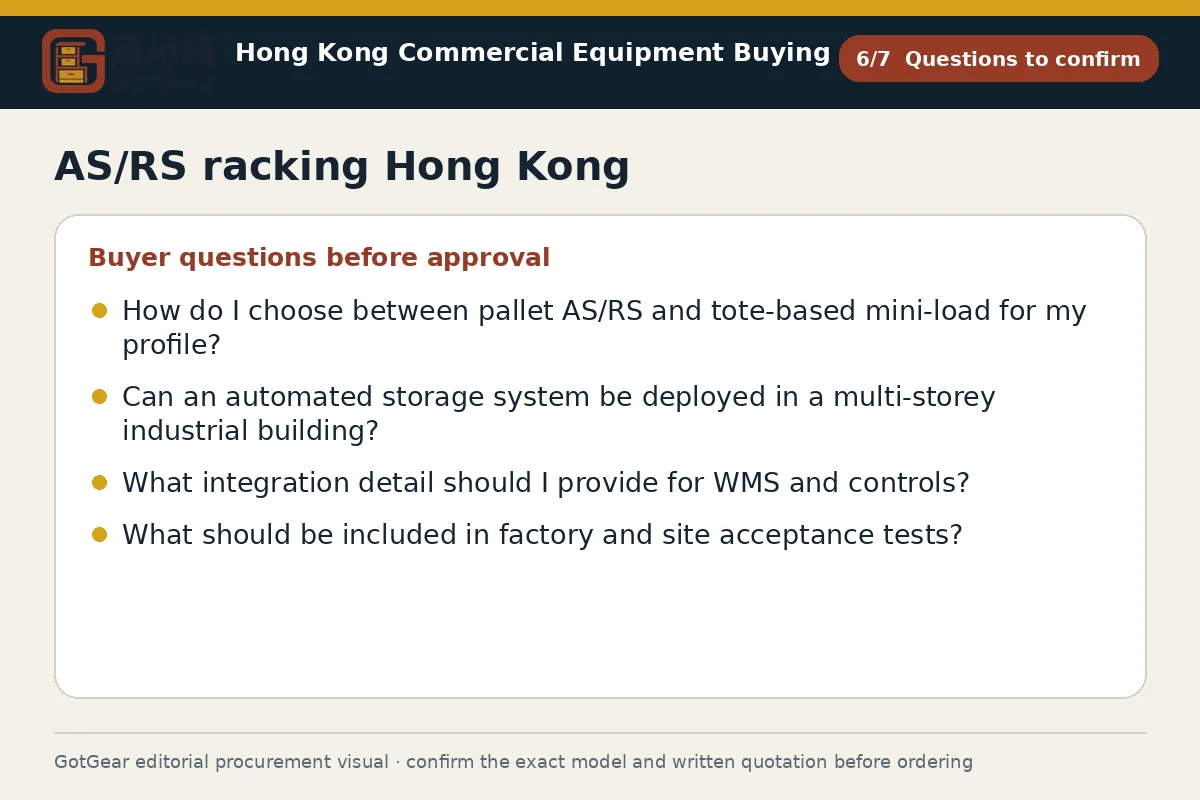
Decide by the handled unit, peak work and labour plan: reserve pallets and full cases lean toward pallet aisles, while split-case orders suit goods-to-person with totes. As an example starting point, if most lines are single or small quantities from many SKUs, mini-load often wins on accuracy and ergonomics. Always confirm with supplier simulations and a written quotation.
Can an automated storage system be deployed in a multi-storey industrial building?
Yes, if access, power and floor criteria are evidenced in writing. Document goods-lift sizes, door openings, slab capacity and turning spaces on each level, then ask bidders how modules will be broken down, routed and installed. Management-office rules, noise limits and loading windows in Hong Kong can shape the programme; confirm these before award and include them in the quotation.
What integration detail should I provide for WMS and controls?
Issue a transaction map with master-data fields, message triggers, payload samples, error handling and timing assumptions. State whether the interface is real time or scheduled, and who owns device IDs, printers and label standards. Ask for an interface control document and a controls narrative in the quotation so responsibilities for scanning, labelling and exceptions are unambiguous at acceptance.
What should be included in factory and site acceptance tests?
Set cycle-time, storage-density and accuracy criteria, plus tests for safety circuits, interlocks, exception handling, restart after stoppage and power-down recovery. Define sample sizes and data sets as example starting points and have the supplier propose instruments and methods. The acceptance plan and tolerances must be written into the formal quotation and confirmed with your competent advisers.
Continue with closely related procurement topics
These pages share equipment, operating or decision-stage signals with this guide.
Industrial shelving Hong Kong
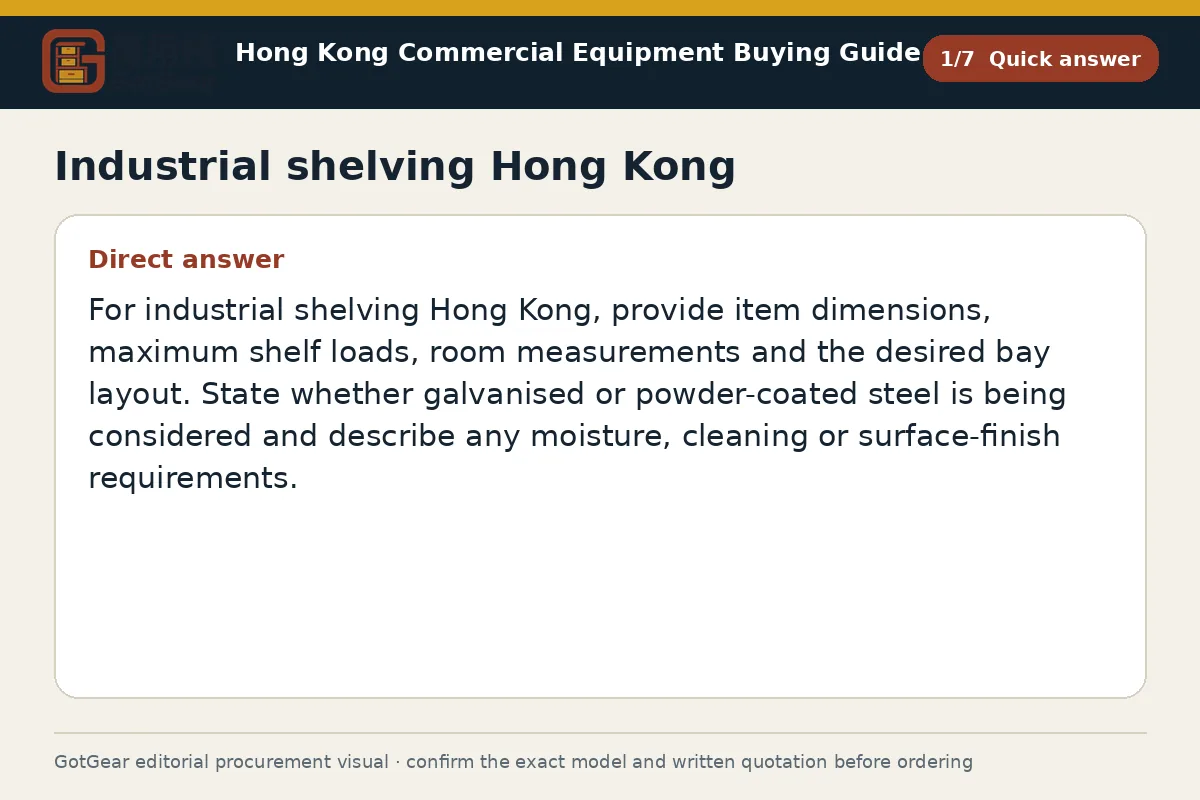
GotGear outlines loads, dimensions, layout and moisture considerations for industrial shelving Hong Kong. It compares galvanised steel shelving Hong Kong with powder-coated steel shelving Hong Kong.
Read the guide
Workshop shelving Hong Kong
If you are planning workshop shelving Hong Kong, GotGear provides a checklist covering item and bin sizes, shelf loads, access, cleaning and labelling and includes considerations for factory shelving Hong Kong.
Read the guide
Spare parts shelving Hong Kong
Use this maintenance, repair and operations checklist to compare sizes, weights, counts, pick rates and store layout for spare parts shelving Hong Kong and shelving for machinery parts Hong Kong. This checklist is from GotGear.
Read the guide
Archive shelving Hong Kong
Plan archive shelving Hong Kong by box size, document format, retention period, retrieval frequency and labelling to organise office records effectively. GotGear helps office and records buyers.
Read the guide